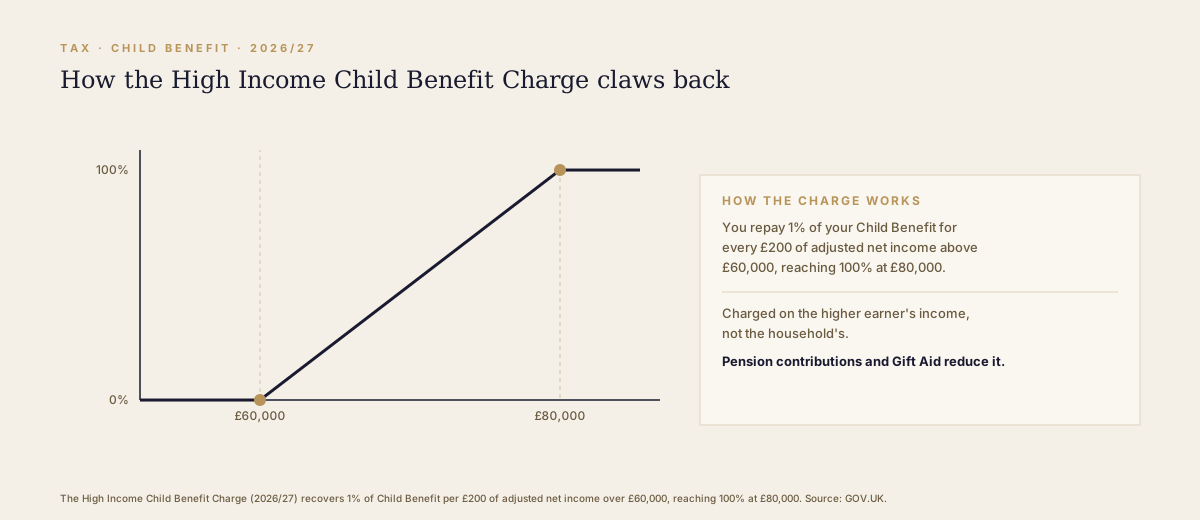
The High Income Child Benefit Charge is a tax that recovers some or all of a household's Child Benefit when one partner's adjusted net income exceeds £60,000 a year for 2026/27. You start repaying Child Benefit once the higher earner's adjusted net income passes £60,000 a year for 2026/27, losing 1% for every £200 above it, with the full amount clawed back by £80,000. The charge falls on the higher earner regardless of which partner actually receives the benefit. Pension contributions and Gift Aid reduce adjusted net income, so they can shrink the charge or remove it altogether.
The High Income Child Benefit Charge is a tax that recovers Child Benefit from higher-earning households: once one partner’s adjusted net income passes £60,000 a year for 2026/27, the family begins to lose the benefit, and by £80,000 it is clawed back in full. Crucially, the charge is based on one person’s income rather than the household’s combined total, so two partners each earning £55,000 keep everything while a single earner on £80,000 keeps nothing. The figures and thresholds throughout this article are correct for the 2026/27 tax year. Understanding how the charge is calculated, and how a pension contribution can reduce it, is the difference between losing the benefit silently and keeping more of it.
How much Child Benefit do you lose to the charge?
You lose 1% of your Child Benefit for every £200 of adjusted net income above £60,000. At £70,000 the charge equals 50% of the benefit, and at £80,000 or more it equals 100%. For 2026/27, full Child Benefit for two children is £2,337.40 a year.
Contents
- What is the High Income Child Benefit Charge?
- How is the High Income Child Benefit Charge calculated?
- Who pays the charge when both partners earn?
- What happens if you stop claiming Child Benefit?
- How can a pension contribution reduce the charge?
- Should you opt out of Child Benefit to avoid the charge?
What is the High Income Child Benefit Charge?
The High Income Child Benefit Charge is an income tax charge that recovers Child Benefit when one partner in a household has an adjusted net income above £60,000 a year for 2026/27. It is not a separate tax on the benefit itself: HMRC collects it from the higher earner through the income tax system, which is why it can apply even when the other partner is the one who actually receives the money.
Child Benefit is worth £27.05 a week for the eldest or only child and £17.90 a week for each additional child in 2026/27. For one child that is £1,406.60 over the year, and for two children it is £2,337.40. The charge can recover any proportion of that figure, up to the whole amount, depending on how far the higher earner’s income sits above the threshold.
The number that governs everything is adjusted net income, not gross salary. This is your total taxable income from all sources, less grossed-up pension contributions and Gift Aid donations. That distinction is what makes the charge manageable, because the same levers that reduce a tax bill also reduce the income the charge is measured against.
Risk warnings
The Financial Conduct Authority does not regulate Cashflow Planning.
HM Revenue and Customs practice and the law relating to taxation are complex and subject to individual circumstances and changes which cannot be foreseen.
How is the High Income Child Benefit Charge calculated?
The charge recovers 1% of the Child Benefit received for every £200 of adjusted net income above £60,000. By £80,000 a year for 2026/27 the percentage reaches 100%, so the entire benefit is recovered. The percentage is applied to the total Child Benefit paid across the tax year, then collected from the higher earner.
The chart shows the charge climbing in a straight line across the £60,000 to £80,000 band: there is no cliff edge, just a steady recovery of 1% of the benefit for every £200 of income. At £70,000, exactly halfway through the band, the charge takes back half the family’s Child Benefit, which for two children is £1,168.70 of the £2,337.40 paid for the year.
How the High Income Child Benefit Charge tapers at £70,000 of income
Daniel, 41, has an adjusted net income of £70,000. His partner Hannah claims Child Benefit for their two children.
| Input | Value |
|---|---|
| Adjusted net income | £70,000 |
| Income above the £60,000 threshold | £10,000 |
| Annual Child Benefit (two children) | £2,337.40 |
- Charge percentage: £10,000 divided by £200 = 50%.
- Apply to the annual Child Benefit: £2,337.40 × 50% = £1,168.70.
- Daniel reports the £1,168.70 through his PAYE tax code or Self Assessment and pays it for the year.
Result: Daniel keeps half the family’s Child Benefit; the other half, £1,168.70, is recovered through the charge.
Because the charge is a flat percentage of the benefit, larger families face a larger cash recovery for the same income. A household with three children loses more in pounds at £70,000 than a household with one, even though both face the same 50% rate, which is worth bearing in mind when weighing up whether to act.
Who pays the charge when both partners earn?
The charge falls on whichever partner has the higher adjusted net income, regardless of who claims or receives the Child Benefit. If both partners earn above £60,000, it is the higher earner who reports and pays it. If only one partner is over the threshold, that partner pays it even when the other person is the named claimant.
This individual basis produces outcomes that feel unfair when set side by side. Two partners each earning £55,000 have a household income of £110,000 and pay nothing, because neither crosses £60,000. A single earner on £80,000 supporting the same family loses every penny of Child Benefit. The same logic drives the 60% tax trap, where individual income above £100,000 withdraws the personal allowance, and the two charges can bite at once for a single high earner.
The High Income Child Benefit Charge is assessed on one person’s income, not the household’s. A couple can earn far more between them than a single earner and still keep the benefit the single earner loses entirely.
The government confirmed it would keep the individual basis after consulting on a move to household income, so this asymmetry is a settled feature of the system rather than a temporary quirk.
Risk warning
Your pension income could also be affected by the interest rates at the time you take your benefits. The tax implications of pension withdrawals will be based on your individual circumstances, tax legislation and regulation which are subject to change in the future.
What happens if you stop claiming Child Benefit?
You can choose not to receive Child Benefit payments to sidestep the charge, but stopping the claim entirely can cost you more than the benefit itself. The act of claiming Child Benefit gives the main carer National Insurance credits that count towards the State Pension, and it secures a National Insurance number for the child at 16.
Does claiming Child Benefit protect your State Pension?
Yes. Claiming Child Benefit gives the main carer National Insurance credits until the youngest child turns 12, which count towards the State Pension. A parent who is not working or earns little can opt out of the payments to avoid the charge but should still submit the claim to keep the credits.
The distinction that matters is between claiming and being paid. You can complete the Child Benefit claim form, which preserves the National Insurance credits and the child’s records, while electing not to receive the payments. That removes the charge without giving up the protections, and it is usually the right choice for a non-working or low-earning carer in a household caught by the charge.
If your income later falls back below £60,000, perhaps after a career break, a reduced bonus, or a larger pension contribution, you can restart the payments. Keeping the claim live makes that straightforward, whereas a fresh claim can only be backdated by three months.
How can a pension contribution reduce the charge?
A gross pension contribution reduces your adjusted net income pound for pound, and adjusted net income is the figure the charge is measured against. Bringing adjusted net income from £70,000 down to £60,000 with a £10,000 gross contribution removes the charge entirely, on top of the income tax relief the contribution already attracts.
There are two routes, and they are not identical. With salary sacrifice, you give up gross salary before it is paid, so the sacrificed amount never counts as income and your adjusted net income falls automatically. With a personal contribution paid under relief at source, you pay from net income, the provider adds basic-rate relief, and the grossed-up amount is deducted when adjusted net income is worked out.
The effect stacks with other tax savings in this income range. For someone whose income also strays above £100,000, the same contribution can restore the personal allowance and reduce the Child Benefit charge at the same time, which is why we cover the overlapping £100,000 childcare and allowance cliff separately. If the contribution needed is large, carry forward of unused allowance from the previous three tax years can make a payment above the standard annual allowance possible.
Charitable giving works on the same principle. Gift Aid donations are grossed up and deducted from adjusted net income, so they reduce the charge in the same way a pension contribution does, with the money leaving your estate rather than being saved for retirement.
Risk warnings
Pensions
Levels and bases of, and reliefs from, taxation are subject to change and their value will depend upon personal circumstances. Taxation and pension legislation may change in the future.
Salary sacrifice
It is important to note that salary sacrifice is not suitable for all employees. Employees’ pre-tax salary will be reduced. This may affect their entitlement to State Benefits.
Should you opt out of Child Benefit to avoid the charge?
For most households where the higher earner is comfortably above £80,000 and the carer is already building a full National Insurance record, opting out of the payments is the simplest choice, because the charge would recover the entire benefit anyway. There is no advantage to receiving money in one hand and repaying all of it through a tax charge with the other.
The calculation changes if income sits inside the £60,000 to £80,000 band, where only part of the benefit is recovered and keeping the payments still leaves the family ahead. It changes again if the carer is not building National Insurance credits elsewhere, in which case the claim should stay live even where the payments are declined. Weighing these threshold effects against the rest of a household’s finances is the kind of question a lifetime cashflow plan is built to answer, because the right call depends on income trajectory and pension strategy, not the charge in isolation.
What rarely makes sense is doing nothing while income hovers just above £60,000. A modest pension contribution in that range buys back the benefit and earns tax relief, so the band rewards action more than almost any other part of the income scale.
One contribution, several levers
The High Income Child Benefit Charge is best read as another reason to watch adjusted net income rather than the figure on the payslip. It shares its trigger with childcare support, the personal allowance taper, and pension tax relief, so a single contribution can move several of these levers at once. For a household with children and income near £60,000, the question is less about how much Child Benefit is at stake and more about how the same pound of income is taxed across every threshold it touches.
Frequently asked questions
What is the High Income Child Benefit Charge?
The High Income Child Benefit Charge is a tax that recovers some or all of a family's Child Benefit when one partner's adjusted net income exceeds £60,000 a year for 2026/27. The charge rises gradually and reaches 100% of Child Benefit at £80,000. It is paid by the higher earner, not necessarily the person who claims.
How is the High Income Child Benefit Charge calculated?
The charge is 1% of the Child Benefit received for every £200 of adjusted net income above £60,000 a year for 2026/27. So at £70,000 the charge is 50% of the benefit, and at £80,000 it is the full amount. The percentage is applied to the total Child Benefit paid for the tax year.
Does the charge use household income or individual income?
It uses individual income, not combined household income. The charge is based on the adjusted net income of whichever partner earns more. A couple each earning £55,000 pays nothing, while a single earner on £80,000 loses all their Child Benefit, even though the household totals are very different.
Should I stop claiming Child Benefit if I earn over £80,000?
You can opt out of receiving the payments to avoid the charge, but you should still complete the claim form. The National Insurance credits it carries go to whoever is registered for the claim, and they only add anything for a parent who is not working or earns too little to pay National Insurance, so the claim belongs in that parent's name rather than the higher earner's. Where it is already in the wrong name, the credits can be transferred between partners. The claim also secures a National Insurance number for your child.
Can a pension contribution reduce the High Income Child Benefit Charge?
Yes. A gross pension contribution reduces your adjusted net income pound for pound, the figure the charge is measured against. Bringing adjusted net income from £70,000 down to £60,000 a year for 2026/27 removes the charge entirely. Gift Aid donations work the same way.
How do I pay the High Income Child Benefit Charge?
Since 2025, employed people can pay the charge through their PAYE tax code without registering for Self Assessment. Self-employed people and those who prefer to report it themselves still pay through a Self Assessment tax return after the end of the tax year.