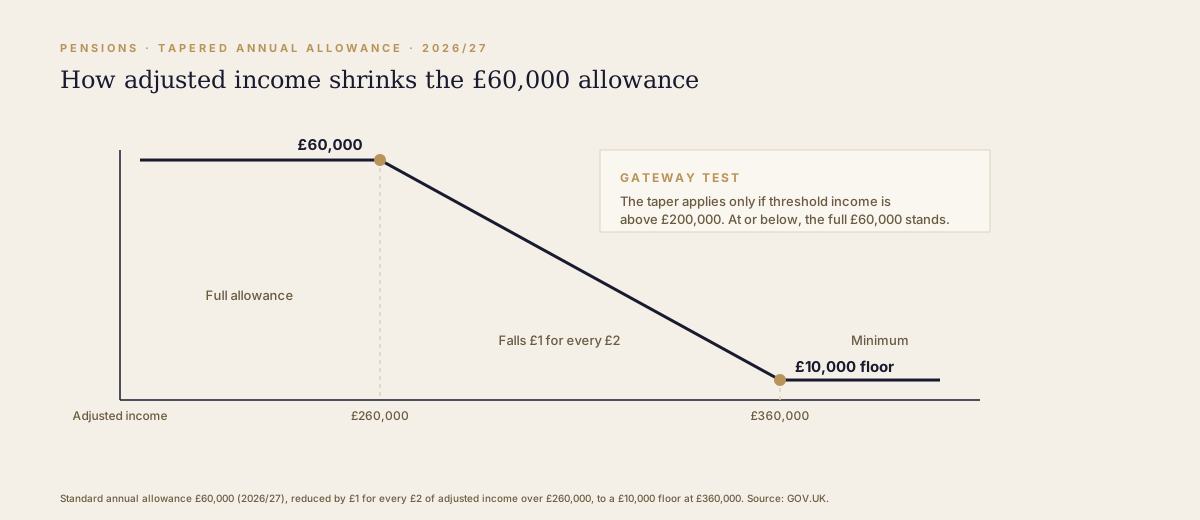
Adjusted income is net income for a tax year plus employer pension contributions and any of your own contributions paid before tax, such as through net pay or salary sacrifice. Check threshold income first: if it stays at or below £200,000 the taper never applies, whatever your adjusted income. Adjusted income only sets how far the £60,000 annual allowance falls once both thresholds are crossed, shrinking it by £1 for every £2 above £260,000 in 2026/27. That is why threshold income, not adjusted income, is the figure most worth watching.
Adjusted income and threshold income are the two figures HMRC uses to work out the tapered annual allowance, the rule that shrinks how much a high earner can pay into a pension each year. Threshold income is the gateway test that decides whether the taper applies at all; adjusted income then decides how deep the cut goes. Get either calculation wrong and you can either lose pension tax relief you were entitled to, or face an unexpected tax charge for over-contributing. The thresholds and allowances in this article are correct for the 2026/27 tax year.
Is adjusted income the same as adjusted net income?
No. Adjusted income and threshold income belong to the tapered annual allowance, which limits how much high earners can pay into a pension. Adjusted net income is a separate figure that governs the personal allowance, Child Benefit, and childcare support above £100,000. The calculations and thresholds are entirely different.
Contents
- What are adjusted income and threshold income?
- How are threshold income and adjusted income calculated?
- How is the tapered annual allowance calculated?
- Why does threshold income decide whether the taper applies?
- Is adjusted income the same as adjusted net income?
- How does salary sacrifice affect threshold income?
- How can you reduce the impact of the taper?
- Should you stop pension contributions if the taper applies?
What are adjusted income and threshold income?
Adjusted income and threshold income are two separate income measures, defined in tax law, that together determine whether and how the tapered annual allowance reduces your pension allowance. Neither appears on a payslip, and they can differ from each other by tens of thousands of pounds for the same person in the same year. The reason they exist as a pair is that each does a different job.
Threshold income is your net taxable income after taking off your own personal pension contributions. It is deliberately constructed to capture only your underlying income, so that someone whose total looks high purely because of large employer pension contributions is not caught unfairly. Adjusted income works in the opposite direction: it starts from the same net income but adds the employer’s pension contributions back in.
The standard pension annual allowance is £60,000 for most people in 2026/27. The tapered annual allowance only reduces that figure for people who breach both income tests, which is why the two measures are always assessed together rather than in isolation.
Risk warning
Levels and bases of, and reliefs from, taxation are subject to change and their value will depend upon personal circumstances. Taxation and pension legislation may change in the future.
How are threshold income and adjusted income calculated?
You start both calculations from the same place - your net income, HMRC’s term for income before income tax is applied, not take-home pay - then move in opposite directions. For threshold income, you deduct the gross value of personal pension contributions you paid yourself. For adjusted income, you instead add back the pension contributions that were not already counted, most importantly your employer’s contributions and anything paid through a net pay or salary sacrifice arrangement.
The clearest way to see the difference is to follow net income down both paths at once.
The flowchart shows the two figures starting from the same net income and moving in opposite directions: threshold income strips out your own pension contributions, while adjusted income instead adds your employer’s contributions on top. Because relief-at-source contributions already sit inside net income, only the employer’s payment is added to reach adjusted income. That is why a large employer contribution can lift adjusted income past the £260,000 test for 2026/27 while leaving threshold income, and the £200,000 test, untouched.
The salary sacrifice rule is the one that surprises people. Any salary given up for pension under an arrangement set up on or after 9 July 2015 is added back into threshold income, a deliberate anti-avoidance measure. That means newer salary sacrifice cannot be used to duck under the threshold income test, a point we return to below.
Risk warnings
Salary sacrifice
Employees earning more than £260,000 with a tapered annual allowance may incur additional annual allowance tax charges.
Tax, trusts and estate planning
HM Revenue and Customs practice and the law relating to taxation are complex and subject to individual circumstances and changes which cannot be foreseen.
How is the tapered annual allowance calculated?
The tapered annual allowance reduces your £60,000 allowance by £1 for every £2 of adjusted income above £260,000 in 2026/27, but only once threshold income has already cleared £200,000. HMRC’s guidance on working out your reduced annual allowance sets out the mechanics, and the reduction stops at a minimum allowance of £10,000, reached once adjusted income hits £360,000.
How adjusted income reduces the annual allowance for a high earner
Bridget, 52, a senior executive, earns £250,000 with a £40,000 employer pension contribution for 2026/27.
| Input | Value |
|---|---|
| Net income (salary) | £250,000 |
| Employer pension contributions | £40,000 |
| Adjusted income | £290,000 |
- Threshold income is £250,000, above the £200,000 limit, so the taper applies.
- Adjusted income: £250,000 net income plus £40,000 employer contributions = £290,000.
- Excess over £260,000 is £30,000. Reduce the allowance by £1 for every £2: £30,000 ÷ 2 = £15,000.
Result: Bridget’s tapered annual allowance is £60,000 minus £15,000 = £45,000 for 2026/27.
Bridget can still pay £45,000 into her pension with full tax relief. The taper has not removed her ability to save into a pension; it has narrowed the window, and exceeding it would trigger a tax charge that claws the relief back.
Why does threshold income decide whether the taper applies?
Threshold income matters most because it is a binary gate: if it stays at or below £200,000 for 2026/27, the taper cannot apply at all, no matter how high adjusted income climbs. The House of Commons Library figures for 2026/27 confirm both limits, and the law requires both to be breached before a single pound of allowance is lost.
This is why a director with a modest salary but very large employer contributions can have an adjusted income well over £260,000 and still keep the full £60,000 allowance, simply because their threshold income never reaches £200,000. The two figures move differently for the same person, and the smaller, easier-to-manage number is often the one that determines the outcome.
Threshold income is the switch and adjusted income is the dial. If the switch stays off below £200,000, the dial setting never matters, which is why high earners should check threshold income first.
Is adjusted income the same as adjusted net income?
No, and confusing the two is one of the most common and costly errors in pension planning. Adjusted income is part of the tapered annual allowance for high earners; adjusted net income is the measure behind the personal allowance, the High Income Child Benefit Charge, and Tax-Free Childcare. They share three words and almost nothing else.
The deductions run in opposite directions, which is what makes the confusion dangerous. Adjusted net income subtracts your pension contributions, so paying into a pension lowers it. Adjusted income adds the employer’s contributions in and never deducts your own, so the same payment can leave it unchanged or even higher. A reader trying to protect a £100,000-threshold benefit should work with adjusted net income; a reader worried about their pension contribution limit is in the right place here.
How does salary sacrifice affect threshold income?
Salary sacrifice set up on or after 9 July 2015 does not reduce your threshold income, because the salary you give up is added straight back when the figure is calculated. The date is not arbitrary: 9 July 2015 was the day the tapered annual allowance was announced, and the add-back was written into the rules from the outset to stop high earners sacrificing pay purely to slip below the threshold income test.
Take a £250,000 earner who sacrifices £20,000 of salary. The £20,000 is added back to threshold income, so it stays exactly where it started, which the flowchart traces in full. Arrangements genuinely in place before 9 July 2015 are not caught and still reduce threshold income, but after a decade these survivors are rare, and materially varying one can count as a fresh arrangement that loses the protection.
In the example, the £20,000 sacrifice cuts net income to £230,000, but threshold income adds the £20,000 straight back and adjusted income picks it up as an employer contribution, so both return to £250,000, the pre-sacrifice salary. Because salary sacrifice moves neither the £200,000 threshold income test nor the £260,000 adjusted income test for 2026/27, it cannot pull a high earner below either limit, whereas a personal contribution paid from taxed income does reduce threshold income.
Can salary sacrifice help you avoid the tapered annual allowance?
No, not for arrangements made on or after 9 July 2015. The salary you give up is added back to your threshold income, and it reappears as an employer contribution inside your adjusted income, so neither of the two taper tests is reduced. Personal contributions paid from taxed income lower threshold income instead.
A modern salary sacrifice arrangement does not lower your adjusted income either. The salary you give up reappears as an employer contribution, and adjusted income counts employer contributions, so the same money is simply captured on the other side. For the tapered annual allowance, sacrifice is therefore neutral on both measures, which is the opposite of what many people assume when they lean on it to manage high earnings.
How can you reduce the impact of the taper?
The most effective lever is threshold income, because bringing it to £200,000 or below for 2026/27 removes the taper entirely. The route that works is a personal pension contribution paid from your own income under relief at source, because that is deducted when threshold income is calculated. Reducing taxable income through a lower bonus or deferred income has the same effect, while a new salary sacrifice arrangement does not, for the reasons set out above.
For company directors, who control the balance of salary and employer pension contributions, the planning is more nuanced still, because the contributions that keep salary down can themselves drive adjusted income up. Mapping the interaction across a full year of income, contributions, and bonuses is what stops a high earner stumbling into the taper by accident.
Should you stop pension contributions if the taper applies?
Usually not. A reduced allowance, even the £10,000 minimum for 2026/27, still attracts full tax relief on every pound contributed within it, so stopping forfeits relief you are entitled to. The taper limits the size of the contribution, not its value.
The decision changes only when a planned contribution would exceed your tapered allowance, because the excess triggers an annual allowance charge at your marginal rate that effectively cancels the relief. Before assuming you have exceeded the limit, check whether carry forward of unused allowance from the previous three years gives you more room, as it often does for someone newly caught by the taper. Where the position is genuinely tight, structured pension and retirement planning weighs the charge against the relief rather than abandoning contributions on instinct.
Which figure should you check first?
Adjusted income and threshold income are best understood as a pair that pulls in opposite directions: one strips your pension contributions out, the other adds them all back in. For anyone with income approaching £200,000, the practical discipline is to check threshold income first, because that single figure decides whether the tapered annual allowance is a live concern or an irrelevance for the year. The arithmetic rewards looking at the whole year’s income, contributions, and bonuses together, rather than reacting to a payslip in isolation.
Frequently asked questions
What is the difference between adjusted income and adjusted net income?
Adjusted income belongs to the tapered annual allowance, which caps pension contributions for high earners, while adjusted net income governs the personal allowance, Child Benefit, and childcare support above £100,000. They are calculated differently and tested against different thresholds, so the two are not interchangeable.
What is threshold income?
Threshold income is your net taxable income for the tax year after deducting your own personal pension contributions. It is the gateway test for the tapered annual allowance: if threshold income is £200,000 or below in 2026/27, the taper does not apply, regardless of your adjusted income.
How is the tapered annual allowance calculated?
The tapered annual allowance reduces the standard £60,000 limit by £1 for every £2 of adjusted income above £260,000 in 2026/27. It only applies if threshold income also exceeds £200,000. The reduction stops at a minimum allowance of £10,000, reached when adjusted income hits £360,000.
Does the taper apply if my income is below £200,000?
No. The tapered annual allowance only applies if your threshold income exceeds £200,000 in 2026/27. If threshold income is £200,000 or below, you keep the full £60,000 annual allowance no matter how high your adjusted income is, because both tests must be failed.
Do employer pension contributions count towards adjusted income?
Yes. Adjusted income adds employer pension contributions back in, which is why a large employer contribution can push a director into the taper even when their salary is modest. Employer contributions are never counted in threshold income, so the two figures can diverge sharply.
Can salary sacrifice reduce your threshold income?
No, not for arrangements set up on or after 9 July 2015. Salary given up for pension under a newer sacrifice arrangement is added back when threshold income is calculated, so it cannot switch off the taper. Personal contributions paid from net income are deducted instead.
Should you stop pension contributions if the tapered annual allowance applies?
Usually not. Even a reduced allowance still receives full tax relief on every pound contributed within it, and unused allowance from the previous three years can be carried forward. Stopping only makes sense if a contribution would exceed the allowance and trigger a tax charge.