The annual allowance charge is an income tax charge that recovers tax relief on pension savings above your annual allowance in a tax year, taxed at your marginal rate. It most often catches high earners, those with large employer or defined benefit contributions, and anyone who has misjudged their carry forward. The excess is added to your taxable income for the year, so the relief is recovered at whatever rate you would otherwise have paid. Scheme Pays can move the bill from your own pocket onto your pension fund, but the mandatory route only applies if the charge exceeds £2,000 and one scheme's input tops £60,000 a year for 2026/27.
The annual allowance charge is the tax HMRC reclaims when your pension savings in a year exceed the amount you are allowed to fund with tax relief. The standard allowance is £60,000 a year for 2026/27, and anything paid in above your available limit is added to your taxable income and taxed at your marginal rate. The contribution itself stays in your pension; what you lose is the relief on the excess. Where the charge is large, Scheme Pays can shift the bill from your own bank account onto your pension fund, but only the mandatory version gives you a right to insist. All figures in this article reflect the 2026/27 tax year.
How is the annual allowance charge worked out?
The annual allowance charge takes the pension savings above your available allowance, adds them to your taxable income for the year, and taxes them at your marginal rate of 20%, 40%, or 45%. The standard allowance is £60,000 a year for 2026/27. You report the charge through Self Assessment.
Contents
- How does the annual allowance charge work?
- How is the annual allowance charge calculated?
- What is Scheme Pays?
- Mandatory and voluntary Scheme Pays: what is the difference?
- Who can use mandatory Scheme Pays?
- Why does the taper leave high earners relying on voluntary Scheme Pays?
- Is Scheme Pays worth using?
- How does the annual allowance charge fit your wider plan?
How does the annual allowance charge work?
The annual allowance charge works by removing the tax advantage on any pension savings above your allowance for the year. It is not a penalty on top of the contribution and it does not force you to take the money back out. Instead, the excess is treated as extra taxable income, which cancels out the relief you would otherwise have kept.
Your allowance for the year is the standard £60,000 for 2026/27, plus any unused allowance carried forward from the previous three years, and reduced by the taper if you are a high earner. Total pension input is measured across every scheme you hold: your own contributions, your employer’s, and, for a defined benefit pension, the capitalised growth in your promised benefits. It is the combination of these that pushes people over, often without a single large cash payment being involved, as the GOV.UK guidance on the annual allowance sets out.
You report and pay the charge through Self Assessment, normally by 31 January after the end of the tax year, so a 2026/27 charge is due by 31 January 2028. The GOV.UK guidance on who must pay the annual allowance tax charge sets out the reporting process and the Scheme Pays alternative. Before assuming a charge applies at all, it is worth checking whether pension carry forward covers the excess, because unused allowance from earlier years is used automatically and can remove the charge entirely.
Risk warning
Levels and bases of, and reliefs from, taxation are subject to change and their value will depend upon personal circumstances. Taxation and pension legislation may change in the future.
How is the annual allowance charge calculated?
The annual allowance charge is calculated by taking the amount above your allowance, adding it to your taxable income, and applying your marginal rate of tax. There is no separate rate for the charge: it simply lands in whichever income tax band the excess falls into, so a higher rate taxpayer effectively loses 40% of the excess and an additional rate taxpayer 45%.
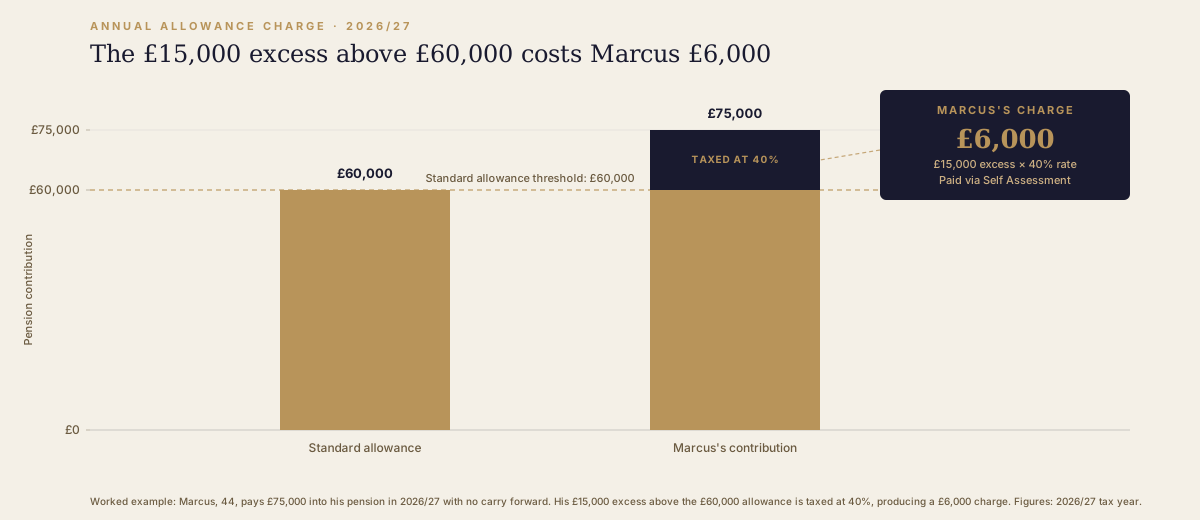
How the annual allowance charge is worked out on a contribution above the limit
Marcus, 44, a higher rate taxpayer, pays £75,000 into his pension in 2026/27 with no carry forward available.
| Input | Value |
|---|---|
| Total pension contributions | £75,000 |
| Standard annual allowance | £60,000 |
| Marginal income tax rate | 40% |
- Pension savings above the allowance: £75,000 less £60,000 = £15,000
- The excess is added to taxable income and taxed at his marginal rate: £15,000 x 40%
- Annual allowance charge: £6,000
Result: Marcus faces a £6,000 annual allowance charge for 2026/27, recovering the higher rate relief on the £15,000 paid in above his allowance.
The arithmetic is straightforward once you know your numbers. The harder part is establishing the right allowance in the first place, because carry forward and the taper both change the figure you subtract from. Where income is high, the adjusted income and threshold income tests decide how far the allowance falls, and getting those wrong is the most common reason a charge appears unexpectedly.
What is Scheme Pays?
Scheme Pays is an arrangement that lets your pension scheme pay your annual allowance charge directly to HMRC in exchange for a permanent reduction in your pension benefits. For a defined contribution pension, the charge is deducted from your fund value. For a defined benefit pension, your future pension is reduced by an actuarially equivalent amount. Either way, the money leaves your pension rather than your bank account.
It exists because the charge can be large and the contributions that triggered it are locked inside the pension until at least age 55, rising to 57 from 6 April 2028. Without Scheme Pays, a member could face a substantial bill on money they cannot touch for years or even decades. Crucially, using Scheme Pays does not remove the charge or change its amount. You still declare it on your Self Assessment return, and you note that the scheme is settling some or all of it.
Scheme Pays does not reduce the charge by a penny. It changes which pocket funds it, and on a defined contribution pension that shift can quietly work in your favour.
Risk warning
HM Revenue and Customs practice and the law relating to taxation are complex and subject to individual circumstances and changes which cannot be foreseen.
Mandatory and voluntary Scheme Pays: what is the difference?
The difference is whether the scheme is legally obliged to pay. Mandatory Scheme Pays gives you a statutory right to make the scheme settle the charge once specific conditions are met, and the scheme becomes jointly liable for it with you. Voluntary Scheme Pays is entirely at the scheme’s discretion: it may agree to help, but it does not have to, and liability for the charge stays with you alone.
The practical consequences differ in two ways. First, on certainty: a scheme can decline a voluntary request, so you cannot rely on it when planning how to fund a charge. Second, on deadlines. The mandatory route has a fixed statutory cut-off, while voluntary Scheme Pays has no statutory deadline at all, so schemes set their own, frequently earlier and often timed to the 31 January Self Assessment date. Missing a voluntary scheme’s internal deadline can leave you paying the charge from your own resources whether you wanted to or not.
Who can use mandatory Scheme Pays?
You can use mandatory Scheme Pays only if all three conditions are met for the tax year. Your total annual allowance charge for the year must be more than £2,000, your pension input to that one scheme must exceed the standard £60,000 annual allowance, and you must notify the scheme by 31 July in the year after the tax year the charge relates to. For a 2026/27 charge, that notification deadline is 31 July 2028.
When must a pension scheme pay your annual allowance charge?
A scheme must pay your charge under mandatory Scheme Pays if three conditions are met: your annual allowance charge for the year is over £2,000, your pension input to that single scheme is above the standard £60,000 allowance, and you tell the scheme by 31 July in the year after the relevant tax year.
The second condition is the one that catches people out. The £60,000 test uses the standard allowance, not your personal allowance after the taper or the money purchase annual allowance. So a member can owe a real charge, because their own allowance is far below £60,000, yet have no mandatory right to Scheme Pays because their input never crossed the standard figure. The two tests are deliberately separate, and conflating them is a frequent and expensive mistake.
Why does the taper leave high earners relying on voluntary Scheme Pays?
The taper leaves many high earners with a charge but no mandatory Scheme Pays right, because the mandatory test ignores their reduced allowance. A tapered annual allowance can fall as low as £10,000 a year for 2026/27, so a high earner can breach their own limit with an input well under £60,000. They owe the charge, but they fail the mandatory £60,000 condition and must fall back on voluntary Scheme Pays, which the scheme can refuse.
Priya and Daniel, both facing a charge for 2026/27
Priya, 49, is a tapered high earner with an annual allowance of £20,000. Her total pension input across a workplace scheme and a SIPP is £50,000, split so that neither scheme alone exceeds £60,000. Her excess is £30,000, producing a charge of £13,500 at her 45% rate.
Daniel, 52, is an additional rate taxpayer who keeps the full £60,000 allowance, but a year of promotion pushes the input on his single defined benefit scheme to £68,000. His excess is £8,000 and his charge £3,600.
Daniel has the smaller bill but the stronger position: his input to one scheme tops £60,000 and his charge beats £2,000, so his scheme must pay under mandatory Scheme Pays if he notifies it by 31 July 2028. Priya, with the far larger charge, fails the £60,000 test and can only ask for voluntary Scheme Pays, which her providers are free to decline. The deciding factor is not the size of the charge but whether one scheme’s input crosses £60,000.
This is why the taper and the charge are best understood together. The people most exposed to a charge are often the least protected when settling it, and that mismatch only becomes visible if you check the conditions before the contributions are made rather than after the bill arrives.
Is Scheme Pays worth using?
Whether Scheme Pays is worth using is genuinely case-specific, and the decision hinges on one fact that is easy to miss: the charge is the same amount whichever way you pay it. A £6,000 charge costs £6,000 today whether you settle it from your own cash or the scheme deducts it from your fund. What changes is where that money ends up. Pay from cash and the sum stays invested inside your pension; use Scheme Pays and you keep it in your own hands instead.
On a defined contribution pension there is a genuine edge to Scheme Pays, and it is a tax one. Money used through Scheme Pays leaves the fund to settle the charge and is never taxed as a withdrawal, whereas the same £6,000 left in the pension would later be drawn with 75% taxed at your marginal rate and only 25% tax-free. The surrendered slice therefore escapes the exit tax it would otherwise suffer, so it clears the bill with money worth less to you than the same sum in cash. Paying from cash uses fully taxed money, worth its full face value, to clear the same bill, and then keeps that £6,000 in the pension exposed to the later tax. The edge widens with investment growth, and further still if you shelter the freed cash in an ISA, which grows and pays out tax-free.
Strengths
- Settles a large charge without you finding the cash up front
- On a defined contribution pension, the surrendered money escapes the tax a later withdrawal would suffer
- Frees cash you could shelter in an ISA, which grows and pays out tax-free
Trade-offs
- Permanently reduces your pension fund or your defined benefit entitlement
- Poor value on many defined benefit schemes, where the actuarial reduction can be steep
- Weaker if you expect a much lower tax rate in retirement, or would simply spend the freed cash
The excess that triggered the charge received no net relief on the way in, yet it is still taxed on 75% of the way out, so leaving it in the pension locks in that double hit. For a defined contribution saver who is a higher rate taxpayer and has a tax-efficient home for the cash, Scheme Pays is therefore usually the more efficient route, not just the more convenient one. What reverses this is mainly a defined benefit pension, where the scheme cuts your guaranteed income using actuarial factors that can cost far more than the charge, or a retirement tax rate low enough that the exit tax barely bites. The right answer turns on your scheme type, your retirement tax position, and where the freed cash would go, which is exactly the kind of trade-off that lifetime cashflow modelling is built to test.
Risk warnings
ISAs
The favourable tax treatment of ISAs may be subject to changes in legislation in the future.
Pensions
A pension is a long-term investment, the value of your investment and the income from it may go down as well as up. Your eventual income may depend upon the size of the fund at retirement, future interest rates and tax legislation.
Your pension income could also be affected by the interest rates at the time you take your benefits. The tax implications of pension withdrawals will be based on your individual circumstances, tax legislation and regulation which are subject to change in the future.
How does the annual allowance charge fit your wider plan?
The annual allowance charge fits a wider plan as a signal to check before contributing, not a problem to solve afterwards. Once a charge is unavoidable, the only remaining choice is how to pay it; the more valuable decisions, around timing contributions, using carry forward, and managing income to avoid the taper, all happen earlier in the year.
For high earners especially, this is where contributions, income, and allowances need to be looked at as one. A bonus, a vesting event, or a generous employer contribution can quietly tip you over, and the interaction with the taper is rarely intuitive. Structured pension and retirement planning treats the annual allowance charge as something to anticipate and design around, so that Scheme Pays becomes a deliberate choice rather than a last resort.
Who ends up paying the charge?
The annual allowance charge is simple arithmetic built on top of a complicated allowance. Work out the allowance correctly, including carry forward and the taper, and the charge rarely surprises you. Scheme Pays then determines who funds it, but only the mandatory route is yours to insist on, and the people with the largest charges are often the ones who cannot use it. Knowing that before you contribute is worth far more than knowing it after the bill lands.
Frequently asked questions
What is the annual allowance charge?
The annual allowance charge is a tax charge that recovers the relief on pension savings above your annual allowance in a tax year. The excess is added to your taxable income and taxed at your marginal rate. The standard allowance is £60,000 a year for 2026/27, or 100% of your earnings if lower.
How does Scheme Pays work?
Scheme Pays lets your pension scheme pay your annual allowance charge to HMRC in return for a permanent reduction in your pension benefits. You still report the charge through Self Assessment. The mandatory version obliges the scheme to pay; the voluntary version is at the scheme's discretion.
What are the conditions for mandatory Scheme Pays?
Your scheme must pay the charge if your total annual allowance charge for the year is more than £2,000, your pension input to that single scheme exceeds the standard £60,000 allowance, and you notify the scheme by 31 July in the year after the tax year the charge relates to. That is roughly sixteen months after the tax year ends, and missing it costs you the statutory right for good.
Can I use Scheme Pays if my allowance is tapered?
Often only through voluntary Scheme Pays. The mandatory test uses the standard £60,000 allowance, not your reduced figure, so a tapered earner whose input is below £60,000 fails it even though they owe a charge. The scheme can still agree to pay voluntarily, but it is not obliged to and liability stays with you.
Does Scheme Pays mean I avoid the tax?
No. Scheme Pays changes who hands the money to HMRC, not whether the charge is due. The charge is still settled in full; it simply comes out of your pension fund instead of your bank account, which permanently lowers your future retirement benefits.
Is Scheme Pays worth using?
For a defined contribution pension it usually is, if you are a higher rate taxpayer with a tax-efficient home for the cash. The charge is the same either way, but money used through Scheme Pays escapes the income tax a later withdrawal would suffer, so it settles the bill with money worth less to you than cash. Paying from cash tends to win only with a defined benefit scheme, where the actuarial reduction can be steep, or where your retirement tax rate will be very low.