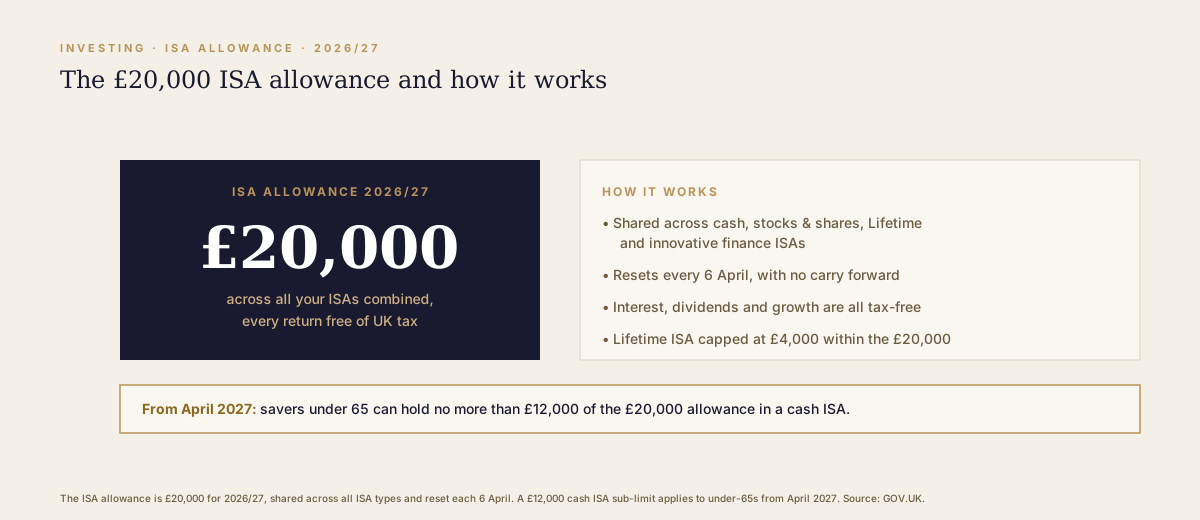
The ISA allowance is the maximum amount you can pay into Individual Savings Accounts each tax year without paying UK tax on the interest, dividends, or growth those savings produce. You can pay up to £20,000 a year for 2026/27 across all your ISAs combined, and any interest, dividends, or growth inside them is free of UK tax. The allowance resets every 6 April rather than carrying forward. From 6 April 2027, savers under 65 will be able to hold no more than £12,000 of that allowance in a cash ISA.
The ISA allowance is the total amount you can pay into Individual Savings Accounts in a single tax year while keeping every penny of interest, dividend, and growth free of UK tax. That allowance is £20,000 a year for 2026/27, and it is shared across every ISA you hold rather than applied to each account separately. The number itself is simple. What trips people up is how the allowance is split between cash and investments, what happens to the part you never use, and a change arriving in April 2027 that will reshape how much of it can sit in a cash ISA. All figures in this article reflect the 2026/27 tax year.
What counts towards your ISA allowance?
Only new money you pay in during the tax year counts towards the ISA allowance of £20,000 a year for 2026/27. Interest, dividends, and growth on existing ISA savings do not count, and neither do transfers of ISA money held from previous years.
Contents
- How does the ISA allowance work?
- What counts towards your ISA allowance?
- Can you pay into more than one ISA in the same tax year?
- How is the cash ISA allowance changing in April 2027?
- How does the Lifetime ISA fit into the £20,000 limit?
- Why does the ISA allowance matter for your wider plan?
- Is it worth using your full ISA allowance?
How does the ISA allowance work?
The ISA allowance works as a single annual pot of £20,000 a year for 2026/27 that you can spread across different ISA types however you like. It belongs to you as an individual, not to an account, so a couple have £40,000 of allowance between them. The tax year runs from 6 April to 5 April, and any money inside an ISA is sheltered from income tax on interest, dividend tax, and capital gains tax for as long as it stays there.
The allowance is also use-it-or-lose-it. Whatever part of the £20,000 you have not used by 5 April vanishes, and a fresh £20,000 begins the next day. There is no way to carry an unused allowance into a future year. Within the limit you have full freedom: you can save up to £20,000 in one account or split it across several, in any combination of cash and investments that suits you.
Risk warnings
Investments
The taxation of the investment is dependent on the individual circumstance of each investor, and may be subject to change in the future.
ISAs
The favourable tax treatment of ISAs may be subject to changes in legislation in the future.
What counts towards your ISA allowance?
Only fresh contributions count towards your ISA allowance, not the growth your investments make or the income they pay out. If you pay in £20,000 and it grows to £22,000, the £2,000 of growth does not eat into next year’s allowance, and it is not taxed. Transfers of ISA money you built up in previous years do not count either, so moving an old ISA to a new provider leaves your current allowance untouched.
There are four ISA types that draw on the same £20,000: the cash ISA, the stocks and shares ISA, the innovative finance ISA, and the Lifetime ISA. You can mix them as you choose, for example £12,000 in a cash ISA and £8,000 in a stocks and shares ISA. The same logic that governs any choice of investment wrapper applies here: the wrapper decides the tax treatment, while the investment inside decides the return. A Junior ISA is separate, with its own allowance of £9,000 a year for 2026/27 held in the child’s name.
Can you pay into more than one ISA in the same tax year?
Yes. Since 6 April 2024 you can pay into more than one ISA of the same type in a single tax year, as long as your total contributions stay within the £20,000 limit. Before that change, you could only pay new money into one ISA of each type per year, which forced savers to commit a whole year’s cash ISA allowance to a single provider and rate.
The practical effect is flexibility. You can open a second cash ISA midway through the year to chase a better rate, or spread investments across two stocks and shares providers, without breaching the rules. Partial transfers of current-year money are also allowed, so you are no longer locked in by an early decision. The one exception is the Lifetime ISA: you can still only pay into a single Lifetime ISA in any given tax year.
How is the cash ISA allowance changing in April 2027?
Savers under 65 will be able to pay into a cash ISA no more than £12,000 a year from 6 April 2027, out of an ISA allowance of £20,000 a year for 2026/27 that is itself unchanged. Savers aged 65 and over keep the full £20,000 cash ISA allowance. The reform was announced in the Autumn 2025 Budget, and HMRC has since confirmed the detail, including the lower cash limit, in the GOV.UK ISA reform anti-circumvention factsheet published in June 2026. The government’s stated aim is to nudge more long-term savings into investments, where returns have historically beaten cash.
The cash ISA cut is one of four changes landing on 6 April 2027, and it is worth seeing against the wider timetable of dated pension and tax changes, because the money you might have sheltered in cash is often the money a pension change affects too. The same factsheet closes two routes around the new cash limit. Interest on cash held inside a non-cash ISA, for example money left uninvested in a stocks and shares ISA, faces a charge of 22% from 6 April 2027, and from the same date transfers from a non-cash ISA into a cash ISA are blocked. Only the transfer block lifts at 65. The charge on in-wrapper cash interest applies at every age, as does the bar on running an ISA wholly in cash-like assets.
What the factsheet does not close off is cash-like investments. It defines these as money market funds only, and they stay eligible inside a stocks and shares ISA provided they are a partial allocation rather than 100% of the account. The charge draws a narrow line: it falls on interest and alternative finance return paid on cash, so it still catches anything left sitting uninvested in the account, including the cash buffers most platforms hold. It is not aimed at the return a money market fund itself produces. That gives an under-65 somewhere low-volatility for the £8,000 that can no longer sit in a cash ISA from 6 April 2027, though it is not cash. A money market fund’s value is not fixed and it carries no deposit protection.
How is the cash ISA allowance changing in 2027?
The cash ISA limit falls to £12,000 a year from 6 April 2027 for savers under 65, within an unchanged overall ISA allowance of £20,000 a year for 2026/27. Savers aged 65 and over keep the full £20,000 cash ISA limit. The change does not affect money already held in cash ISAs.
For an under-65 saver who wants to use the full allowance, the change means at least £8,000 a year must go into a stocks and shares or innovative finance ISA from 6 April 2027. The same saving habit can produce very different results depending on a single factor: the saver’s age.
Rachel, 52, and Brian, 67, both cash savers
Rachel and Brian each pay £20,000 a year, and both have always put the lot into a cash ISA for safety. Under the new rules their identical habit splits in two.
Rachel, being under 65, can keep in her cash ISA only £12,000 a year from 6 April 2027. To shelter the other £8,000 she must move it into a stocks and shares ISA, or leave it in ordinary savings where the interest may become taxable once her Personal Savings Allowance is used up.
Brian, at 67, keeps the full £20,000 in his cash ISA, tax-free, so nothing changes in what he can shelter in cash. The age line is narrower than it looks, though. If he also left cash sitting uninvested in a stocks and shares ISA, the charge would reach that interest exactly as it would Rachel’s. What being over 65 gives him is the higher cash ISA limit and the ability to move money from a non-cash ISA into a cash ISA, not exemption from the charge.
Risk warnings
Pensions
The value of pensions and any income from them can fall as well as rise. You may not get back the full amount invested.
Levels and bases of, and reliefs from, taxation are subject to change and their value will depend upon personal circumstances. Taxation and pension legislation may change in the future.
A pension is a long-term investment and the value is not guaranteed. Any advice or considerations are personal to each individual’s circumstances.
A pension is a long-term investment, the value of your investment and the income from it may go down as well as up. Your eventual income may depend upon the size of the fund at retirement, future interest rates and tax legislation.
Tax, trusts and estate planning
The Financial Conduct Authority does not regulate Cashflow Planning.
HM Revenue and Customs practice and the law relating to taxation are complex and subject to individual circumstances and changes which cannot be foreseen.
Cash and deposits
The Financial Services Compensation Scheme (FSCS) protects eligible deposits up to £120,000 per person, per banking licence.
Some banking brands share a single licence, so spreading funds across them may not increase protection.
If total deposits with one banking group exceed the FSCS limit, amounts above this may not be covered in the event of default.
How does the Lifetime ISA fit into the £20,000 limit?
A Lifetime ISA lets you pay in up to £4,000 each tax year, and that counts inside your overall ISA allowance of £20,000 a year for 2026/27, not on top of it. So paying the maximum into a Lifetime ISA leaves £16,000 for your other ISAs in the same year. In return the government adds £1 for every £4 you pay in, up to £1,000 a year, which makes it one of the few accounts to boost your own savings directly.
The trade-off is access. A Lifetime ISA is built for two specific goals, a first home costing £450,000 or less or retirement from age 60, and taking the money out before then for any other reason triggers a 25% charge that can return less than you paid in. The full mechanics, including who can open one and how the penalty bites, are covered in our guide to how the Lifetime ISA works. For most savers the Lifetime ISA is a slice of the allowance reserved for a defined purpose, with the cash or stocks and shares ISA doing the general-purpose work.
Why does the ISA allowance matter for your wider plan?
The ISA allowance matters because it is one of the few tax breaks that genuinely expires: unused allowance does not roll into next year, so each tax year is a separate opportunity that closes on 5 April. Money sheltered early compounds tax-free for decades, and that head start can never be recovered once an allowance year has passed. A saver who fills the allowance steadily for twenty years ends up with a far larger tax-free pot than one who starts late, even at the same contribution rate.
Where you direct the allowance matters as much as using it. For cash, the Personal Savings Allowance already lets many basic-rate taxpayers earn up to £1,000 of interest tax-free outside an ISA, so a cash ISA earns its keep mainly for larger balances or higher earners. For investments, the case is stronger: an ISA removes any capital gains tax on shares and any tax on dividends, shelter that becomes more valuable as a portfolio grows. Matching the right money to the right wrapper is exactly what investment advice is for.
The ISA allowance is shelter with a deadline. Each 5 April that passes with it unused is tax-free growth you can never reclaim, and across a saving lifetime that lost ground quietly compounds into a meaningful gap.
Risk warning
The value of investments and any income from them can fall as well as rise. You may not get back the full amount invested.
Is it worth using your full ISA allowance?
Using your full ISA allowance is worth it if you have money to save beyond your emergency fund and want returns sheltered from tax for good, but it is not automatically the right first call for everyone. The clearest benefit is permanence: once money is inside an ISA, its growth and income stay tax-free for life, and unlike a pension you can take it out at any time without a tax charge. For anyone investing for the long term outside a pension, the allowance is the most efficient home available.
The trade-offs are about priority rather than the ISA itself. If your employer matches pension contributions, or you are a higher-rate taxpayer, a pension can beat an ISA for retirement money because of the relief and employer top-ups involved, a balance we weigh in Stocks and Shares ISA versus pension. And if your savings are modest and sit in cash, the Personal Savings Allowance may already cover any tax due, lowering the urgency. The allowance is worth filling once those higher-priority calls are made, and the right order between ISA and pension depends on your tax position and goals.
Use it by 5 April, and watch April 2027
The ISA allowance gives you £20,000 a year for 2026/27 of tax-free saving, shared across every ISA you hold and gone for good if it is not used by 5 April. The headline number is stable, frozen into the next decade, but the rules underneath it are not: from 6 April 2027 under-65s will be steered out of cash and towards investments, with the cash ISA share of the allowance capped at £12,000 a year from 6 April 2027. The allowance rewards savers who use it early, direct it deliberately, and let the wider plan, rather than the wrapper alone, decide where each pound goes.
Frequently asked questions
What is the ISA allowance for 2026/27?
The ISA allowance is £20,000 a year for 2026/27. That is the most you can pay into Individual Savings Accounts in the tax year, shared across cash, stocks and shares, innovative finance, and Lifetime ISAs combined. Any returns inside the wrapper are free of UK tax.
Can you carry forward unused ISA allowance?
No. The ISA allowance does not carry forward. Any part of the £20,000 you do not use by 5 April is lost, and a fresh £20,000 allowance begins on 6 April. This is why ISA saving is often described as use-it-or-lose-it.
Can you pay into two cash ISAs in the same year?
Yes. Since 6 April 2024 you can pay into more than one ISA of the same type in a single tax year, including two cash ISAs, as long as your combined contributions stay within the £20,000 limit. The exception is the Lifetime ISA, where you can only pay into one per year.
Is the cash ISA allowance being cut?
Yes, for younger savers. The amount under-65s can pay into a cash ISA falls to £12,000 a year from 6 April 2027, within an unchanged overall allowance of £20,000 a year for 2026/27. Savers aged 65 and over keep the full £20,000 cash ISA limit.
Is it worth using your full ISA allowance every year?
It is worth using your full ISA allowance if you have money to save beyond an emergency fund and want returns sheltered from tax permanently. If your savings are modest, the Personal Savings Allowance may already cover any tax, so the urgency is lower for cash held outside an ISA.
Does the Lifetime ISA count towards the £20,000 limit?
Yes. The £4,000 you can pay into a Lifetime ISA each year sits inside your £20,000 overall ISA allowance, not on top of it. Paying the full £4,000 into a Lifetime ISA leaves the rest of the allowance for your other ISAs in the same tax year.
Do you pay tax when you take money out of an ISA?
No. Withdrawals from a cash or stocks and shares ISA are completely free of UK tax, and you do not declare them on a tax return. The Lifetime ISA is the exception, as withdrawals before age 60 for anything other than a first home carry a 25% charge.