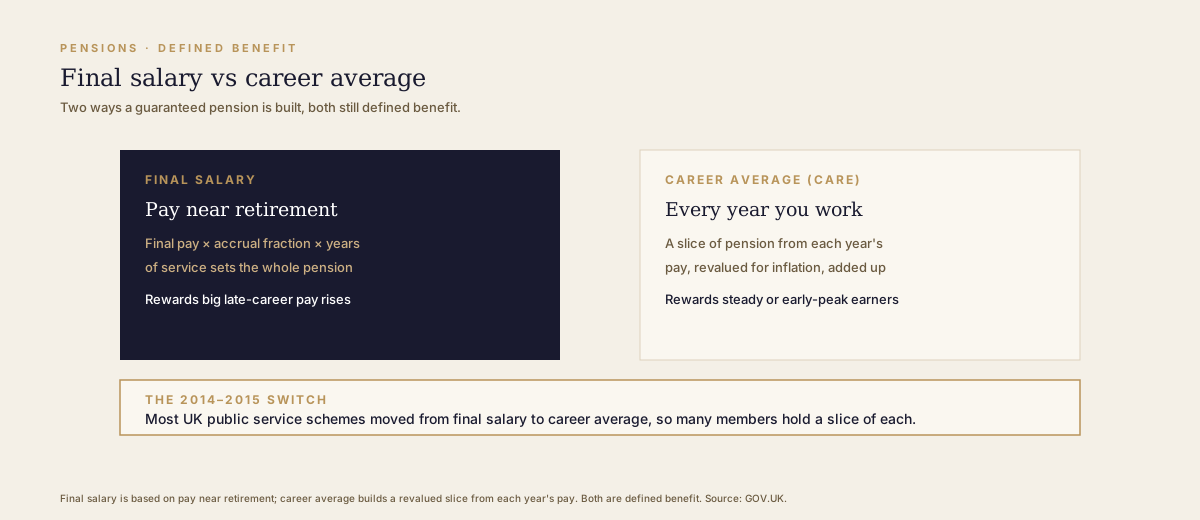
Final salary and career average are the two forms of defined benefit pension: one bases the income on pay near retirement, the other on revalued pay across every year of membership. Neither is automatically better: final salary rewards big late-career pay rises, while career average can pay more for steady or early-peak earners. The distinction matters because most UK public service schemes switched from final salary to career average in 2014 and 2015, so many people now hold a slice of each. Both remain defined benefit, so the employer carries the investment risk and the income is guaranteed for life.
Final salary and career average pensions are the two ways a defined benefit scheme turns your salary and service into a guaranteed retirement income. A final salary pension is worked out from your pay at or near retirement; a career average pension instead values every year you work, revaluing each year’s slice for inflation along the way. The difference looks technical, but it changes who gains and who loses by thousands of pounds a year, and most public sector workers now hold a portion of each. All figures in this article reflect the 2026/27 tax year.
How is a final salary pension calculated?
A final salary pension multiplies your final pensionable pay by an accrual fraction, often 1/60 or 1/80, and then by your years of membership. On a 1/60 scheme, 30 years of service ending on a £48,000 salary produces 30/60 of £48,000, which is £24,000 a year for life.
Contents
- What is the difference?
- How does a final salary pension work?
- How does a career average pension work?
- How do they compare?
- Why did schemes switch?
- What happens when you leave or retire?
- Which is better?
What is the difference between a final salary and career average pension?
The difference between a final salary and career average pension is which pay it uses: a final salary pension looks only at your pay near retirement, while a career average pension averages your revalued pay across the whole of your membership. Both are defined benefit schemes, so the employer guarantees the income rather than handing you an invested pot to manage.
That single design choice decides the winners and losers. A final salary pension applies your highest, latest salary to every year of service, so a promotion shortly before you retire lifts the pension you earned decades earlier too. A career average pension locks in the pay you actually received in each year, then protects it with annual revaluation, so an early career on modest pay stays modest no matter how senior you become.
Whichever of the two you hold, the guarantee behind it is the same: an income built from salary and service, funded by the employer rather than by the invested pot of a defined contribution scheme. That promise is now largely confined to public service schemes and a shrinking number of older private ones, because almost every workplace pension opened since automatic enrolment began in 2012 has been defined contribution. Final salary and career average describe two ways of measuring the salary inside the formula, not two different kinds of guarantee.
Risk warning
Advice on auto enrolment pensions is not regulated by the financial conduct authority.
How does a final salary pension work?
A final salary pension multiplies your final pensionable pay by an accrual rate and your years of service. The accrual rate is the slice of pay you earn as pension for each year in the scheme, commonly 1/60, or 1/80 with an automatic tax-free lump sum of three times the pension in older schemes.
Take a 1/80 scheme with 40 years of service and a final salary of £40,000. The pension is 40/80 of £40,000, which is £20,000 a year, plus a lump sum of £60,000. The arithmetic is simple precisely because only one salary figure matters: whatever you are earning when you stop, or in your best year of the final few, sets the value of your entire career.
This is why final salary schemes were so generous to people who climbed the ladder. Two members with identical service can retire on very different pensions if one finished on a far higher grade. It is also why these schemes became expensive for employers to fund, because a single late promotion retrospectively increased decades of accrued liability. Most private sector final salary schemes are now closed, and where one remains, giving it up for a transfer value is tightly regulated.
Risk warnings
Pensions
Levels and bases of, and reliefs from, taxation are subject to change and their value will depend upon personal circumstances. Taxation and pension legislation may change in the future.
Your pension income could also be affected by the interest rates at the time you take your benefits. The tax implications of pension withdrawals will be based on your individual circumstances, tax legislation and regulation which are subject to change in the future.
Defined benefit transfers
We do not currently provide advice on transferring out of defined benefit (final salary) pension schemes. If you require this advice, we will provide details of a suitably qualified adviser at a firm with the necessary regulatory permissions who can assist you.
How does a career average pension work?
A career average pension builds up a slice of pension from each year’s pensionable pay, revalues each slice for inflation, and adds them together at retirement. Instead of one final figure, the scheme keeps a running pension account that grows every year you contribute.
The accrual rates are typically more generous than final salary to compensate for losing the final-pay link. The NHS Pension Scheme builds up 1/54 of each year’s pay in its 2015 section and revalues active members by the Consumer Prices Index (CPI) plus 1.5% each year. The Teachers’ Pension Scheme uses 1/57 revalued by CPI plus 1.6%, the Local Government Pension Scheme uses 1/49 revalued by CPI, and the Civil Service alpha scheme builds up 2.32% of each year’s earnings.
How is a career average pension revalued each year?
Pension already built up in a public service career average scheme is revalued annually while you remain an active member, often by CPI plus a set margin: CPI plus 1.5% in the NHS 2015 scheme and CPI plus 1.6% for teachers in 2026/27. The Local Government and Civil Service schemes revalue by CPI alone. Members who leave usually get CPI only.
The revaluation margin is what keeps a career average pension competitive. Without it, pay earned 30 years ago would be frozen at its original cash value and eroded by inflation. With CPI plus a margin applied every year, an early slice of pension can grow substantially before you ever draw it.
Risk warning
A pension is a long-term investment, the value of your investment and the income from it may go down as well as up. Your eventual income may depend upon the size of the fund at retirement, future interest rates and tax legislation.
Final salary vs career average pension: how do they compare?
Final salary and career average pensions compare best across the few features that actually move the number: which pay counts, who the design favours, and how inflation is handled before retirement. The table sets out the practical contrast.
Final salary vs career average pensions at a glance
| Feature | Final salary | Career average |
|---|---|---|
| Income based on | Pay at or near retirement | Revalued pay from every year |
| Favours | Large late-career pay rises | Steady or early-peak earners |
| Typical accrual rate | 1/60 or 1/80 of final pay | 1/54 to 1/57 of each year’s pay |
| Inflation cover before retirement | Tracks final pay growth | Revalued yearly, often CPI plus a margin |
| Mostly found in | Older and closed schemes | Public service schemes since 2014 to 2015 |
| Investment risk | Employer | Employer |
Aisha and Marcus, both 60, retiring on £48,000
Aisha and Marcus are colleagues retiring together with 30 years of service and the same final pensionable salary of £48,000. Aisha was promoted to that salary only in her last three years, having spent most of her career around £30,000. Marcus reached roughly £45,000 early and stayed close to it.
On a 1/60 final salary basis, both receive 30/60 of £48,000, which is £24,000 a year. Their different career shapes are invisible, because only the final salary counts.
On a 1/57 career average basis, the picture splits. Aisha’s pension reflects her lower revalued mid-career pay and works out at around £19,000 a year, while Marcus’s, built on consistently higher earnings, comes out at around £23,000. Same final salary, same service, but a late promotion is worth far more under final salary than career average. Figures are illustrative.
Why did public sector schemes switch to career average?
Public sector schemes switched to career average to control cost and to share value more evenly between members. Under the Public Service Pensions Act 2013, the Local Government Pension Scheme moved to career average on 1 April 2014, and the NHS, Teachers’, Civil Service and uniformed services schemes followed in April 2015.
Final salary schemes quietly transferred most of their value to high earners and late climbers, because the final-pay link rewarded the steepest salary curves. A long-serving administrator on flat pay subsidised a colleague who was promoted into management near the end. Career average breaks that link: each year stands on its own revalued pay, so the pension tracks what you genuinely earned across a career rather than its peak.
The switch to career average was a benefit cut for high-flyers and a fairer deal for everyone whose pay never spiked: the same scheme can produce opposite outcomes, decided almost entirely by the shape of a career.
The change was politically contentious, and the way it was phased in turned out to be unlawful. The 2018 McCloud judgment held that letting members closest to retirement stay in the final salary schemes discriminated on grounds of age. The remedy rolled affected members’ service between 1 April 2015 and 31 March 2022 back into their old scheme and gave them a choice, exercised when they take their benefits, over which basis applies to those years. The direction of travel is settled, though. The legacy final salary sections closed to new accrual on 31 March 2022, so every member of those schemes, including the protected ones who had been left on a final salary basis, has built up career average since then. The remedy looked backwards at the transition years only; it did not reopen final salary accrual for anyone.
What happens to each pension when you leave or retire?
When you leave a scheme before retirement, both pension types are preserved, but they are protected differently. A final salary pension you have already built up usually keeps its link to your salary at the point you left, then increases each year as a deferred pension, typically in line with CPI. A career average pension stops earning the active revaluation margin and is normally revalued by CPI alone once you are no longer contributing.
In retirement, both pay a guaranteed income for life that increases broadly with inflation, and both let you exchange part of the pension for tax-free cash at a scheme commutation rate. The headline difference between final salary and career average disappears once the pension is in payment: from that point, what matters is the indexation cap and what passes to a survivor.
Death benefits also work similarly across both. A defined benefit scheme typically pays a reduced pension to a surviving spouse or partner, and the way these pensions are taxed on death follows the same rules whether the income was calculated on a final salary or career average basis. Coordinating that guaranteed income with your State Pension forecast is usually a bigger planning question than which DB formula produced it.
Is a final salary or career average pension better?
Neither is universally better: a final salary pension is more valuable if your pay rises sharply late in your career, and a career average pension is more valuable if your earnings are steady or peak early. The accrual rate matters too. A career average scheme with a generous fraction such as 1/49 can out-pay a 1/80 final salary scheme even for a modest climber, because more pension builds up each year.
For most people the choice is not theirs to make. The scheme decides the basis, and the only real decision is how much to value the guarantee you already hold. Where members do face a choice, such as the McCloud remedy years or whether to buy added pension, the answer turns on the shape of your expected pay, not on a general view that one design beats the other. Mapping that against your wider retirement income plan is what turns the comparison into a decision, and it is the kind of question a realistic retirement number depends on.
What both designs share is the part that matters most. As GOV.UK confirms, a defined benefit pension, in either form, is a promise from the employer to pay a set income, not a pot exposed to markets. That guarantee is rare and hard to replace, which is why giving one up is so heavily regulated regardless of whether it was built on a final salary or career average basis.
The label tells you who carries the risk
Final salary and career average pensions answer the same question, how much guaranteed income your service has earned, in two different ways. Final salary stakes everything on your closing pay; career average values each year you worked and protects it with revaluation. The label tells you who the design favours, but it does not change the underlying promise: a defined benefit income for life, funded and guaranteed by the employer. For most members today, the practical task is not choosing between them but understanding which slice you hold, and what each is worth inside the wider plan.
Frequently asked questions
What is the difference between a final salary and career average pension?
A final salary pension works out your income from your pay at or near retirement, multiplied by an accrual fraction and your years of service. A career average pension instead builds up a slice of pension from each year's pay, revalues each slice for inflation, and adds them together. Both are defined benefit schemes funded by the employer.
Is a career average pension worse than a final salary pension?
Not for everyone. A career average pension usually pays less than final salary for people who win large promotions late in their career, because only the revalued earnings count rather than a high final salary. For steady earners, or those whose pay peaks early, a career average pension can be worth as much or more.
How do I know if I have a final salary or career average pension?
Check your annual benefit statement or scheme name. Final salary benefits are quoted against your current or final pensionable pay; career average benefits show a pension account that grows each year and is revalued. Many public sector workers have both: final salary for service before 2014 or 2015, and career average after.
What happens to my final salary benefits when my scheme moves to career average?
Final salary benefits you have already built up are protected and stay linked to your final pay, even after the scheme closes that section to new accrual. From the switch date, new pension builds up on a career average basis instead. The 2018 McCloud judgment then required schemes to give members with service between 1 April 2015 and 31 March 2022 a choice over which basis applies to those years, made when they take their benefits.
Are career average pensions still defined benefit?
Yes. A career average pension is a form of defined benefit pension: the income is set by a formula and guaranteed by the employer, not by investment performance. The guarantee is the same in kind, but the terms are not identical to the schemes they replaced. The 2015 schemes generally pay an unreduced pension at State Pension age rather than 60 or 65, and where an older section paid an automatic lump sum on top of the pension, tax-free cash now has to be created by giving up pension at the scheme's commutation factor.
Which public sector schemes are career average?
Most large public service schemes are now career average. The Local Government Pension Scheme moved across on 1 April 2014, and the NHS, Teachers', Civil Service, police, firefighters and armed forces schemes followed in April 2015. Older service in those schemes may still be on a final salary basis.
Risk warning
Past performance is used as a guide only; it is no guarantee of future performance.