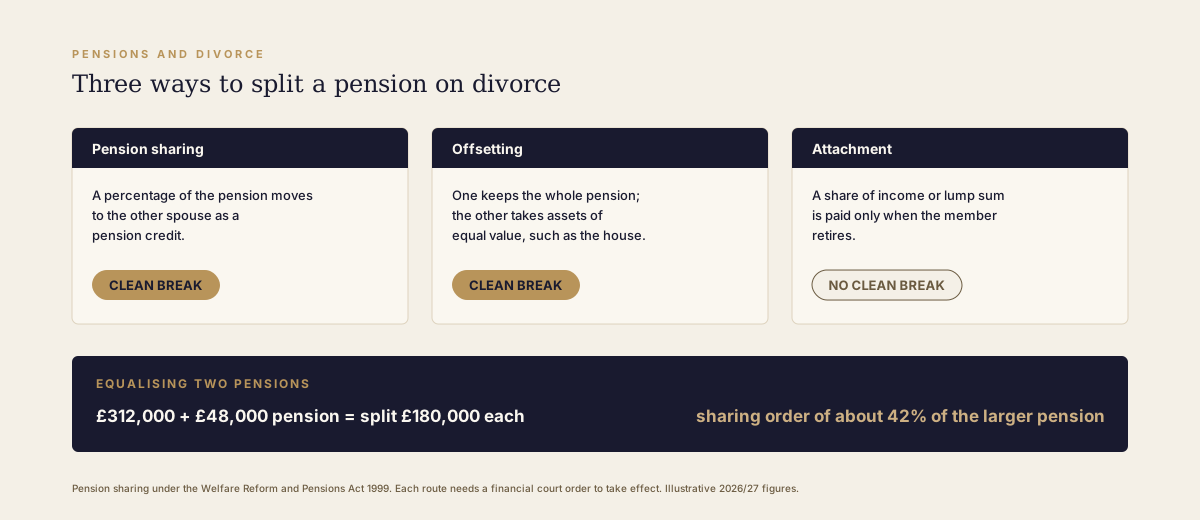
Pension sharing on divorce is the division of one or both spouses' pension rights as part of a financial settlement, using a pension sharing order, offsetting against other assets, or an attachment order. Most divorcing couples split a pension with a pension sharing order, moving a percentage of the fund to the other spouse for a clean break. It matters because a pension is frequently worth more than the family home, yet it is the asset most often overlooked in a settlement. Whichever route you use, a pension is only divided once a court seals a financial order: divorce alone splits nothing.
Pension sharing on divorce is how a couple divides retirement savings when a marriage or civil partnership ends, and for many people it decides more of their future than the house does. A pension can quietly become the largest asset either person owns, worth more than the property once a mortgage is stripped out, yet it is the asset most often ignored or waved through in a hurry to reach a settlement. The rules and figures in this article are current for the 2026/27 tax year.
There are three ways to deal with a pension, and they produce completely different outcomes. Getting the choice wrong, or skipping pensions altogether, can leave one person comfortable and the other short by the time they stop working.
How are pensions split in a divorce?
Pensions are split one of three ways: a pension sharing order that moves a percentage of the fund to the other spouse as a pension credit, offsetting where one keeps the pension and the other takes assets of equal value, or an attachment order that pays a share when the member retires. Each needs a financial court order to take legal effect.
Contents
- What is pension sharing on divorce?
- How are pensions valued in a divorce?
- What are the three ways to split a pension?
- How does a pension sharing order work?
- What happens to the State Pension?
- How is it different in Scotland?
- Should you share, offset or attach?
What is pension sharing on divorce?
Pension sharing on divorce is the legal division of one or both spouses’ pension rights as part of the financial settlement, set out in a court order rather than agreed on a handshake. The power to do it comes from the Welfare Reform and Pensions Act 1999, and it applies to divorce and dissolution proceedings started on or after 1 December 2000.
The single most important point is that divorce and money are two separate processes. Ending the marriage does not touch either person’s pension. Financial claims stay open until a court seals a financial order, which is why a clean-break order matters even where there is little to divide: without one, an ex-spouse can return years later to claim against a pension that has since grown. The Divorce, Dissolution and Separation Act 2020 introduced no-fault divorce in England and Wales from 6 April 2022, but it changed only how the marriage is ended, not how the finances are resolved.
Pensions are easy to undervalue because you cannot see or spend them today. A £400,000 defined benefit pension does not feel like £400,000 the way a house does, so the spouse without the pension frequently trades it away for something tangible. Treating pensions properly as matrimonial assets is the difference between a settlement that looks fair on paper and one that is fair across two full retirements.
How are pensions valued in a divorce?
Every pension has a capital value put on it before it can be divided, and for most schemes that figure is the cash equivalent, often called the cash equivalent transfer value or CETV. It is the lump sum the scheme would pay to move your benefits elsewhere, and it becomes the starting number for any split.
How reliable that number is depends entirely on the type of pension. For a defined contribution pension, the cash equivalent is simply the fund value, so it is accurate. For a defined benefit pension, the cash equivalent transfer value is an actuary’s estimate of what the guaranteed income is worth as a single sum, and it routinely understates the real value. A CETV of £250,000 can represent a pension that would cost far more than £250,000 to buy on the open market, because it does not fully price in the inflation protection, the spouse’s pension, and the certainty a final salary scheme provides.
Do pensions have to be valued by an actuary in a divorce?
Not always. A defined contribution pension is valued at its fund value, which needs no actuary. A defined benefit pension is valued by its cash equivalent transfer value, which the scheme provides, but because that figure can understate the real worth of a guaranteed income, courts often appoint a pensions actuary to value larger defined benefit pensions and advise on a fair share.
This matters because a naive split treats one pound of defined benefit CETV as equal to one pound of a defined contribution fund, when the guaranteed income behind the defined benefit figure is usually the more valuable asset. Where a settlement involves a substantial defined benefit pension, it is common for the court to appoint a pensions actuary to value the benefits properly and recommend the percentage share that genuinely equalises the two retirements.
Important information
We do not currently provide advice on transferring out of defined benefit (final salary) pension schemes. If you require this advice, we will provide details of a suitably qualified adviser at a firm with the necessary regulatory permissions who can assist you.
What are the three ways to split a pension?
There are three routes, and they are not variations on a theme: they hand the parties different things, at different times, with different risks. A settlement can use one route for one pension and a different route for another.
The three ways to divide a pension on divorce
| Route | What happens | Clean break? | Who it tends to suit |
|---|---|---|---|
| Pension sharing | A percentage of the pension moves to the other spouse as a pension credit | Yes | Most cases, especially where the pension is large or the couple want independence |
| Offsetting | One keeps the whole pension; the other takes assets of equal value | Yes | Where one spouse needs the house now and has their own pension |
| Attachment (earmarking) | A share of the income or lump sum is paid when the member retires | No | Rare, occasionally used alongside sharing for a specific benefit |
Pension sharing is now the default in most settlements because it delivers a genuine clean break and gives the receiving spouse a pension in their own name. Offsetting keeps the pension intact but forces a comparison between a retirement income and, say, house equity, two things that are hard to weigh against each other honestly. Attachment, once known as earmarking, has largely fallen out of use because it ties one person’s retirement to the other’s decisions and leaves them exposed if the member dies or delays taking the pension.
Risk warning
A pension is a long-term investment, the value of your investment and the income from it may go down as well as up. Your eventual income may depend upon the size of the fund at retirement, future interest rates and tax legislation.
How does a pension sharing order work?
A pension sharing order works by expressing the split as a percentage of the pension’s cash equivalent, not a fixed sum, so both parties share any growth or fall in value up to the point it is implemented. The receiving spouse gets a pension credit, and the member’s pension is reduced by a matching pension debit.
The percentage is usually chosen to equalise the outcome rather than simply cut each pension in half. If one spouse has a large pension and the other has almost none, an even split of the couple’s total pension wealth needs a larger percentage of the bigger pot, as the calculation below shows.
Working out the pension sharing percentage that equalises two pensions
Nadia and Tom are divorcing at 49. Nadia has a pension with a cash equivalent of £312,000; Tom's is worth £48,000. They want to leave with equal pension wealth.
| Input | Value |
|---|---|
| Nadia's pension (cash equivalent) | £312,000 |
| Tom's pension (cash equivalent) | £48,000 |
| Combined pension wealth | £360,000 |
| Equal share each | £180,000 |
- Tom already holds £48,000, so he needs a further £132,000 to reach the equal share of £180,000.
- That £132,000 credit is expressed as a percentage of Nadia's pension: £132,000 divided by £312,000 is 42.3%.
Result: A pension sharing order of 42.3% of Nadia's pension, not a flat 50%, is what actually leaves both with £180,000 of pension wealth.
Once the court makes the order and the divorce is final, the scheme has a set period, normally 4 months, to put the split into effect. What the receiving spouse can then do with the credit depends on the scheme. Many workplace and personal pensions let the credit transfer out to a pension of the recipient’s choosing. Some, particularly public sector schemes, keep the credit inside the scheme, so the ex-spouse becomes a pension credit member with benefits paid at the scheme’s retirement age. Either way, that credit is theirs, and once it is held in their own pension it is unaffected by anything the other person does afterwards.
A pension sharing order does not hand over cash. It hands over a pension, which means the receiving spouse still faces every retirement question the money raises: when to take it, how to invest it, and how long it has to last.
Schemes are allowed to charge for implementing a pension sharing order, and those charges vary widely, so the cost of splitting a pension is itself worth checking before the route is agreed.
What happens to the State Pension on divorce?
The State Pension is treated differently from private pensions, and for most people reaching pension age today it cannot be shared at all. The new State Pension is based on your own National Insurance record, and that record cannot be transferred to an ex-spouse.
There is one exception worth knowing. If either person built up Additional State Pension under the old system before April 2016, or holds a protected payment, a court can share that element. Where it is shared, the member’s own State Pension is reduced and the ex-partner receives an extra amount on top of their own. For younger divorcing couples, whose entire entitlement sits under the new State Pension, there is nothing to share, so the focus falls entirely on private and workplace pensions.
Even where the State Pension itself cannot be divided, it belongs in the arithmetic. A spouse who took years out to raise children may have a thinner National Insurance record and a lower State Pension for life, and checking a State Pension forecast for both people shows the true gap the private pension split has to help close.
How is pension sharing different in Scotland?
Pension sharing in Scotland works on a narrower base: only the pension built up during the marriage or civil partnership counts as matrimonial property, under the Family Law (Scotland) Act 1985. Pension earned before the wedding or after the date of separation is normally left out entirely.
That single difference changes settlements sharply. In England and Wales the whole of a pension is in principle available to divide, even the part built up long before the couple met, though a court may choose to ring-fence pre-marital pension after a short marriage. In Scotland that ring-fencing is built into the law rather than left to the court’s discretion, so someone with a long pre-marriage career keeps far more of their pension out of the divorce. Scotland also fixes the valuation at the date of separation rather than the date of the hearing, which can matter a great deal when markets or transfer values have moved in between.
The practical result is that the same couple with the same pensions can reach materially different splits depending on which side of the border they divorce. Anyone with a pension that pre-dates the marriage should establish early which jurisdiction applies.
Should you share, offset or attach a pension?
For most couples, pension sharing is the better route, because it gives both people a clean break and a pension in their own name rather than tying one retirement to the other’s choices. Offsetting is the right call in narrower circumstances, and attachment almost never is. The honest answer turns on what each person needs and when, not on a general preference for one mechanism.
Offsetting earns its place where one spouse genuinely needs the house now, to keep children in a home or because their own pension is already adequate, and both sides go in clear-eyed about what is being traded. The danger is the mismatch the numbers hide: the spouse who keeps the house gets an asset that produces no income and costs money to maintain, while the one who keeps the pension holds a rising, tax-advantaged income for life. Comparing them fairly means valuing the pension as the retirement income it will actually produce, not accepting its transfer value at face value, and being especially careful with defined benefit pensions whose cash equivalent understates their worth.
Rekha and Daniel: the same £180,000, two different retirements
Rekha and Daniel are both 52 and divorcing. Their main assets are Daniel’s defined benefit pension, with a cash equivalent of £360,000, and £180,000 of equity in the family home. Rekha proposes she keeps the house and Daniel keeps his whole pension, a clean and tempting split of £180,000 each on paper.
An actuary values Daniel’s pension differently. The guaranteed, inflation-linked income it will pay would cost around £520,000 to replicate through an annuity, so the £360,000 transfer value understates it by a wide margin. Measured as retirement income, Daniel is walking away with far more than Rekha.
A pension sharing order of roughly 35% of Daniel’s pension would instead give Rekha a pension credit worth about £126,000 of transfer value, alongside a larger share of the housing equity. She ends up with both a home and an income in retirement, rather than a home and nothing to live on once she stops working. The headline figures looked equal; the retirements were not.
Attachment is worth ruling in only for a specific reason, such as capturing a share of a tax-free lump sum, and never as the main way to divide a pension. It leaves the receiving spouse waiting on the member to retire, exposed if they die first, and still financially entangled with a former partner for decades. When you weigh the three routes inside a full picture of both people’s income needs across retirement, pension sharing is usually what a fair, durable settlement looks like.
Risk warning
Levels and bases of, and reliefs from, taxation are subject to change and their value will depend upon personal circumstances. Taxation and pension legislation may change in the future.
The mistake is treating the pension as an afterthought
The mistake to avoid is not choosing the wrong route, it is treating the pension as an afterthought behind the house. A pension is frequently the biggest thing a couple divides, its value is easy to understate, and the way it is split is locked in by a court order that is hard to unwind. Pension sharing, offsetting and attachment each hand the parties something different, at a different time, with different risks, and the right one depends on what each person needs their money to do once the settlement is signed. Value the pensions as the retirement income they will produce rather than as a transfer value, and get a financial order sealed even where the split looks simple. A sealed order is very hard to reopen, which is precisely why the valuation has to be right before anyone signs it.
Frequently asked questions
How are pensions split in a divorce?
Pensions are split in one of three ways: a pension sharing order that transfers a percentage of the fund to the other spouse as a pension credit, offsetting where one spouse keeps the pension and the other keeps assets of equal value, or an attachment order that pays a share of the pension income or lump sum when the member retires. All three need a financial court order to take effect.
What is a pension sharing order?
A pension sharing order is a court order that moves a set percentage of one spouse's pension to the other as a pension credit. The receiving spouse holds the credit in their own name, either inside the same scheme or transferred to their own pension. It gives a clean break, so neither person keeps a financial claim on the other's retirement income.
Is it better to share a pension or keep the house?
Neither is automatically better. Offsetting a pension against the house suits someone who needs a home now and has their own retirement provision, but it swaps a guaranteed future income for property that produces none. Comparing the two fairly means valuing the pension as retirement income, not as a headline transfer value, because a defined benefit pension often replaces at far higher cost than its cash equivalent suggests.
Does the State Pension get shared on divorce?
The new State Pension based on your own National Insurance record cannot be shared. However, a court can share Additional State Pension or a protected payment built up under the old system. If ordered to share it, your own State Pension is reduced and your ex-partner receives an extra amount on top of theirs.
Can a pension be shared if you were only married a short time?
Yes, a pension can be shared after a short marriage, but the length of the marriage affects how much. In England and Wales the whole pension is in principle available to divide, though courts often ring-fence pension built up before the marriage after a short one. In Scotland only the pension built up during the marriage counts, so a short marriage sharply limits the shareable amount.
What happens to a pension sharing order if your ex dies before retiring?
A pension credit is yours once the order is implemented, so it is unaffected if your ex-partner dies afterwards. This is a key advantage of sharing over attachment. Under an attachment order, the payments depend on the member drawing the pension, so an ex-partner's death before retirement can leave the other spouse with nothing.