A State Pension forecast is the official gov.uk estimate of how much new State Pension a person has built up from their National Insurance record and how much they could receive at State Pension age. It matters because gaps in your National Insurance record can leave you short of the 35 years of qualifying National Insurance needed for the full rate, which voluntary contributions can sometimes fill. The forecast shows both what you have built up so far and what you could reach by State Pension age. Topping up only helps in certain cases, so checking the forecast before paying anything is the order that protects your money.
Your State Pension forecast is the most useful retirement number that most people never check. It tells you how much new State Pension your National Insurance record has earned so far, and how much it could reach by the time you retire. Where there are gaps, paying voluntary National Insurance can fill them, often for a fraction of what the extra pension is worth over a full retirement. The catch is that topping up does not always increase your pension, so the forecast comes first and the payment second. All figures in this article reflect the 2026/27 tax year.
How do you check your State Pension forecast?
Check your State Pension forecast online at gov.uk/check-state-pension or in the HMRC app, signing in with a Government Gateway account or GOV.UK One Login. The forecast shows what you have built up so far, what you could get at State Pension age if you keep contributing, and the gaps in your National Insurance record.
Contents
- How do you check your State Pension forecast?
- What does your State Pension forecast show?
- How does topping up National Insurance work?
- When is topping up National Insurance worth it?
- Why might topping up not help if you were contracted out?
- What is the deadline for filling NI gaps?
- How does this fit into your wider retirement plan?
- Should you top up your State Pension?
How do you check your State Pension forecast?
You check your State Pension forecast online at gov.uk/check-state-pension or through the HMRC app, signing in with a Government Gateway account or GOV.UK One Login. The forecast is free, takes a few minutes, and is the official figure from the Department for Work and Pensions rather than an estimate from a third party. If you have already started claiming or deferred your pension, the online service is not available and you contact the Future Pension Centre instead.
The number you see is rarely the full rate, and that is the point of checking early. Career breaks, time abroad, low-earning self-employment, and years spent contracted out all leave gaps or reduce what you have built up. Knowing the figure in your fifties, rather than discovering it the year before you retire, is what gives you the time to act. Building that figure into a realistic view of your retirement income is a core part of pension and retirement planning, because the State Pension is usually the foundation everything else is layered on top of.
Risk warnings
Pensions
A pension is a long-term investment, the value of your investment and the income from it may go down as well as up. Your eventual income may depend upon the size of the fund at retirement, future interest rates and tax legislation.
Tax, trusts and estate planning
HM Revenue and Customs practice and the law relating to taxation are complex and subject to individual circumstances and changes which cannot be foreseen.
What does your State Pension forecast show?
Your forecast shows three figures: the amount you have built up to date, the amount you could reach if you keep contributing until State Pension age, and the most you can possibly get. The full new State Pension is £241.30 a week, around £12,548 a year, as set out by GOV.UK. It also lists the tax years in your record that are complete and the ones that are not.
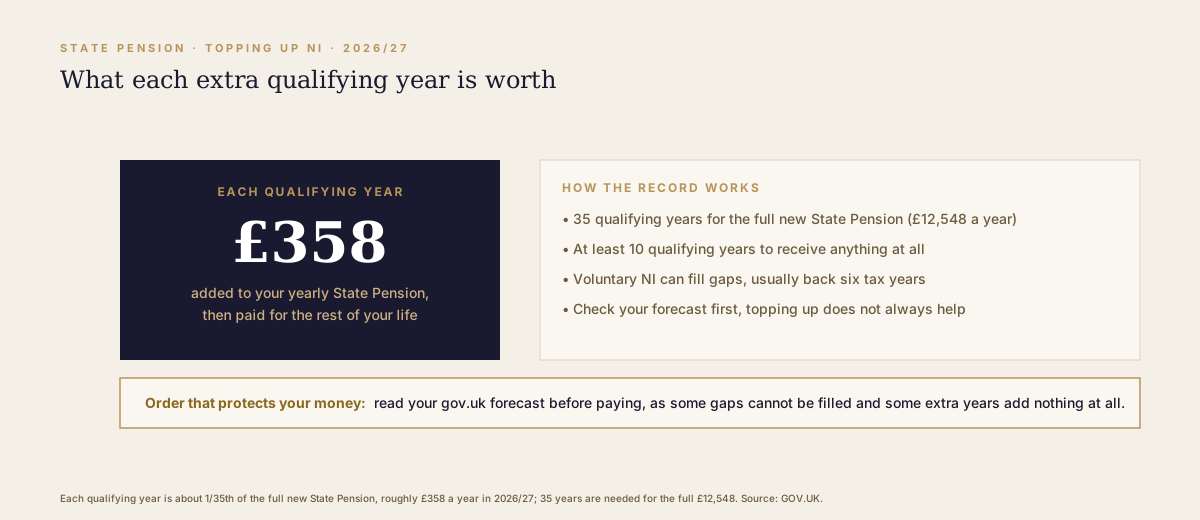
The figures rest on qualifying years. A qualifying year is a tax year in which you paid or were credited with enough National Insurance to count. You need 35 years of qualifying National Insurance for the full new State Pension, and at least 10 years to receive anything at all. Each qualifying year is worth roughly 1/35th of the full rate, around £358 a year in 2026/27. That arithmetic is what makes the forecast actionable: if you are sitting on 30 qualifying years, you can see at a glance that five more would lift you to the full amount. The State Pension is a far larger asset than most people picture, a point that shapes any honest view of what makes a good pension to retire on.
Risk warning
Levels and bases of, and reliefs from, taxation are subject to change and their value will depend upon personal circumstances. Taxation and pension legislation may change in the future.
How does topping up National Insurance work?
Topping up means paying voluntary National Insurance to turn an incomplete year into a qualifying one. Most people pay at the Class 3 rate, which is £18.40 a week, or £956.80 for a full year in 2026/27, according to GOV.UK. Some self-employed people can pay the much cheaper Class 2 rate of £3.65 a week instead, which makes filling a gap far better value. You can also fill gaps for free in some cases, because National Insurance credits from Child Benefit, carer’s responsibilities, or certain benefits may cover a year without any payment.
The economics are usually compelling because the pension uplift is fixed while the cost is one-off.
How quickly a single topped-up year repays its cost
Marcus, 63, fills one gap year with voluntary Class 3 National Insurance in 2026/27.
| Input | Value |
|---|---|
| Cost of one full Class 3 year | £956.80 |
| Extra pension per qualifying year | £358 a year |
| Years to recover the cost | About 2.7 years |
- One qualifying year adds about 1/35th of the full rate: £241.30 ÷ 35 = £6.89 a week, around £358 a year
- A full year of Class 3 voluntary National Insurance costs £18.40 a week, or £956.80 for the year
- £956.80 ÷ £358 = about 2.7 years of retirement to recover the cost
Result: After about three years the top-up has paid for itself; across a 20-year retirement it adds roughly £7,000 of gross State Pension.
How much does it cost to top up a year of National Insurance?
A full year of Class 3 voluntary National Insurance costs £18.40 a week, or £956.80 for the 2026/27 tax year. Some self-employed people pay the cheaper Class 2 rate of £3.65 a week. Each full year filled adds around £358 a year to your State Pension.
When is topping up National Insurance worth it?
Topping up is worth it when filling a gap actually raises your forecast, and not before you have confirmed that it will. The most expensive mistake is paying for a year that adds nothing, which happens more often than people expect. If you are already projected to reach the full rate by State Pension age through future working years, buying an old gap year changes nothing. A past period of contracting out can have the same effect, for a reason that catches a lot of people out.
This is why two people with identical-looking gaps can reach opposite decisions.
Two gaps, two very different answers
Priya, 66, has stopped work with 32 qualifying years and no further contributions coming. Her forecast is stuck at around £11,470 a year. Filling three gap years at the Class 3 rate costs about £2,870 and lifts her to the full £12,548, adding roughly £1,074 a year for life.
Daniel, 52, also shows three gap years, but he plans to work another 13 years to State Pension age. His forecast already reaches the full rate through those future years alone.
If Daniel paid £2,870 to fill the old gaps, his pension would not rise by a penny, because he will hit the 35-year ceiling regardless. The same gap is worth over a thousand pounds a year to Priya and nothing to Daniel, purely because of how many contributing years each has left.
Because the State Pension is guaranteed and rises each year under the triple lock, replacing that income any other way is costly. Buying a comparable inflation-linked income on the open market would take a substantial pension pot, a point explored in our guide to whether annuities are worth it. Against that benchmark, a top-up that genuinely counts is one of the best-value uses of capital available to someone approaching retirement.
Risk warning
Your pension income could also be affected by the interest rates at the time you take your benefits. The tax implications of pension withdrawals will be based on your individual circumstances, tax legislation and regulation which are subject to change in the future.
Why might topping up not help if you were contracted out?
If you were contracted out, your new State Pension was reduced to reflect it, so filling old gaps can leave your entitlement unchanged. Contracting out, which ended on 5 April 2016, let employees and salary-related workplace schemes pay lower National Insurance in exchange for giving up the Additional State Pension and building a separate workplace or private pension instead. You took the benefit elsewhere, so the State Pension system does not pay for those years twice.
When the new State Pension began in April 2016, anyone with a record before that date was given a starting amount: the higher of what they had built under the old rules and what they would have under the new rules, minus a deduction called the Contracted Out Pension Equivalent, or COPE. For people with long contracted-out periods, that deduction often left the starting amount below the full flat rate of about £12,548 a year for 2026/27, even with decades of contributions, as the GOV.UK calculation guidance explains.
The practical effect is twofold. You can usually only rebuild the figure by adding qualifying years from 2016/17 onwards, each worth about 1/35th of the full rate up to the cap. And paying for gaps before April 2016 frequently adds nothing, because your pre-2016 position is already fixed in the starting amount, and the basic element may already be complete at 30 qualifying years. This is precisely why a contracted-out record makes checking with the Future Pension Centre essential before paying: only they can tell you which specific years would actually lift your figure.
What is the deadline for filling NI gaps?
Under the standard rules you can pay voluntary contributions for the last six tax years only, as GOV.UK confirms. The annual cut-off is 5 April, so for example you have until 5 April 2032 to fill a gap for the 2025/26 tax year. The temporary extension that let people fill gaps all the way back to April 2006 closed on 5 April 2025, and that window will not reopen.
That change matters because it shortens the runway. Anyone who put off checking their record during the extended window has lost access to the oldest years for good, and is now limited to the rolling six-year window. The practical consequence is simple: a gap you can fill cheaply today may become unfillable in a few years, so the forecast is worth checking sooner rather than later.
A State Pension top-up is rarely urgent until it is impossible. The six-year window means the cheapest, highest-value years are the ones quietly ageing out of reach while a forecast sits unchecked.
How does this fit into your wider retirement plan?
The forecast is an input, not the whole answer. Knowing your State Pension figure tells you how much guaranteed, inflation-linked income sits underneath everything else, which then determines how hard your private pensions and other savings have to work. A larger State Pension reduces the amount you need to draw from invested assets, which in turn eases the pressure of a sustainable withdrawal rate in the early years of retirement.
It also interacts with how a couple plans together, since the new State Pension cannot be inherited and the survivor keeps only their own, an issue covered in our guide to the State Pension and a surviving spouse. Testing how these pieces combine, before and after each partner retires, is exactly what lifetime cashflow modelling is built for. Modelling the numbers shows whether topping up closes a real gap or simply buys income you did not need, which is the difference between a sensible top-up and an avoidable cost.
Should you top up your State Pension?
You should top up if your forecast confirms that filling a gap raises your pension and you have fewer contributing years left than you need, and you should leave it alone if you are already on course for the full rate. The decision turns entirely on the forecast, not on a general rule of thumb. A year of Class 3 contributions costing £956.80 in 2026/27 that genuinely counts will usually repay itself within three years of reaching State Pension age, then pay out for the rest of your life, which is hard to beat.
The trade-offs are real. The money is gone once paid, the pension you buy is taxable income, and a year that does not increase your forecast is simply lost. There is also no value in paying years you would have earned anyway through future work or credits. The honest position is that topping up is excellent value when the forecast says a year will count, and a waste when it will not, so the order matters: check first, confirm with the Future Pension Centre, then pay.
Only pay for the years that actually count
The State Pension forecast quietly answers the most important question in retirement planning: how much secure income you can count on for life. For many people the figure is below the full rate, and the gap can often be closed cheaply, but only where an extra year actually counts. The discipline that protects your money is the sequence. Check the forecast, confirm a top-up will increase it, watch the six-year deadline, and only then decide whether to pay. Done in that order, topping up is one of the surest returns in personal finance. Done in reverse, it is one of the easiest ways to waste a four-figure sum.
Frequently asked questions
What is a State Pension forecast?
A State Pension forecast is the official gov.uk estimate of how much new State Pension you have built up from your National Insurance record and how much you could receive at State Pension age. It shows your figure to date, your projected figure if you keep contributing, and any gaps in your record. It is free to check online or in the HMRC app.
How many qualifying years do you need for the full State Pension?
You need 35 years of qualifying National Insurance for the full new State Pension, and at least 10 years to receive anything at all. Each qualifying year is worth roughly 1/35th of the full rate, around £358 a year in 2026/27. People who were contracted out before April 2016 may need more than 35 years because of how their starting amount was calculated.
How does topping up National Insurance work?
You pay voluntary National Insurance to fill gaps in your record, usually at the Class 3 rate of £18.40 a week for 2026/27, or the cheaper Class 2 rate of £3.65 a week if you are self-employed and eligible. Each full year filled adds around £358 a year to your State Pension. You should confirm with the Future Pension Centre that a payment will increase your pension before you make it.
Is topping up your State Pension worth it?
Topping up is usually worth it when filling a gap raises your State Pension, because a year of Class 3 contributions costing £956.80 in 2026/27 typically pays for itself within three years of retirement. It is not worth it if you are already on track for the full rate or the extra year would not count. Always check your forecast first.
Can topping up National Insurance ever fail to increase your pension?
Yes. Paying for some years adds nothing to your pension, which is the most common and costly mistake. This happens if you are already forecast to reach the full rate, if you were contracted out, or if filling a pre-2016 year does not lift your starting amount. This is why you check the forecast and call the Future Pension Centre before paying.
What is the deadline to fill gaps in your National Insurance?
You can normally pay voluntary contributions for the last six tax years only. The temporary extension that allowed gaps to be filled back to April 2006 ended on 5 April 2025. Under the standard rules, for example, you have until 5 April 2032 to fill a gap for the 2025/26 tax year.