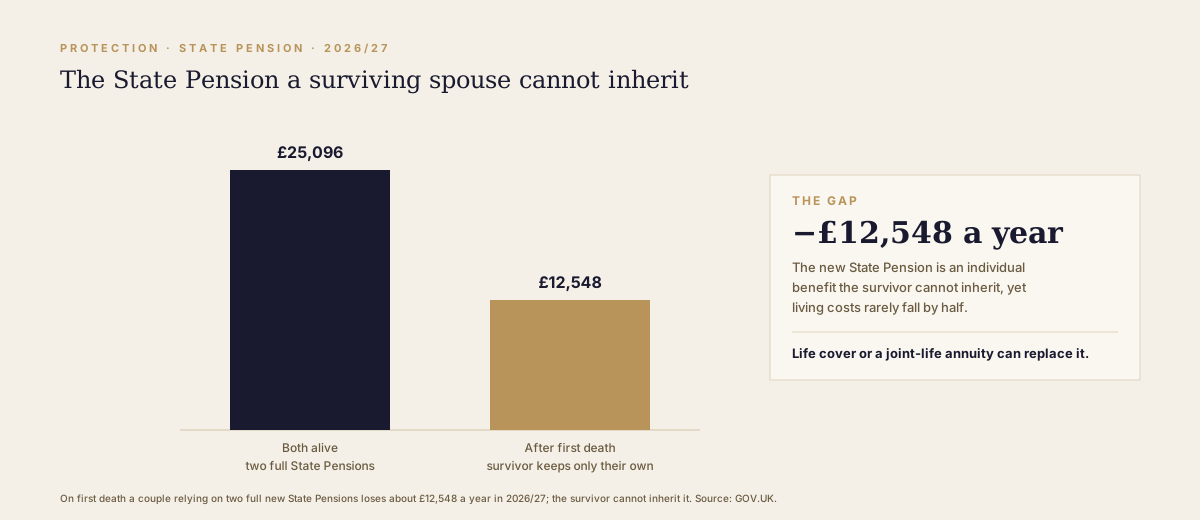
The new State Pension is an individual benefit that generally cannot be inherited, so when one partner dies the surviving spouse keeps only their own and the household loses the other in full. On first death a household can lose around £12,548 of guaranteed annual income in 2026/27, even though the survivor's living costs rarely fall by half. Life cover or a joint-life annuity can replace that income, and the only part of the State Pension a spouse may inherit is half of any protected payment.
When one partner in a couple dies, the household usually loses an entire State Pension. The new State Pension is an individual benefit, and a surviving spouse cannot inherit it: they keep only their own. For a couple who both built up the full new State Pension, that is around £12,548 a year of guaranteed income gone in 2026/27, while most of the survivor’s bills carry on much as before. Insuring your state pension means planning, often through life cover or a joint-life annuity, to replace the income a surviving spouse loses on first death. All figures in this article reflect the 2026/27 tax year.
What happens to your state pension when your spouse dies?
When your spouse or civil partner dies, your own State Pension carries on unchanged, but their new State Pension stops and cannot be inherited. A surviving spouse keeps only their own pension. The single exception is that you can inherit half of any protected payment your partner had built up.
Contents
- What happens to your state pension when a partner dies?
- Can a surviving spouse inherit the state pension?
- How big is the income gap for a surviving spouse?
- What does it mean to insure your state pension?
- How does this fit into your wider retirement plan?
- Should you insure your state pension for a surviving spouse?
What happens to your state pension when a partner dies?
When one partner in a couple dies, the survivor keeps their own State Pension in full and, in most cases, receives nothing from their late partner’s. The new State Pension is built on each person’s own National Insurance record and paid to them as an individual. There is no household pension and no automatic widow’s or widower’s portion, which is a sharp break from how many couples assume the system works.
This catches people out because the old State Pension, paid to those who reached State Pension age before 6 April 2016, did pass on far more to survivors. Under the new system, the default position is that a couple’s combined state pension income roughly halves on first death, while the survivor still faces council tax, energy bills, insurance, and most fixed running costs that do not fall in step with the loss of one person. Working out how much income a survivor would actually keep is a core part of pensions and retirement planning.
Risk warning
Levels and bases of, and reliefs from, taxation are subject to change and their value will depend upon personal circumstances. Taxation and pension legislation may change in the future.
Can a surviving spouse inherit the state pension?
Generally, no. A surviving spouse cannot inherit their late partner’s new State Pension; the entitlement stops on death. The only part that can pass on is half of any protected payment, and even that comes with conditions, as set out in the GOV.UK guidance on inheriting State Pension from a spouse or civil partner.
A protected payment is the slice of a new State Pension that sits above the full flat rate. It exists where someone had built up substantial Additional State Pension, sometimes called the State Second Pension or SERPS, under the old rules before April 2016. Where a marriage or civil partnership began before 6 April 2016, the survivor inherits half of that protected payment on top of their own pension. Two further conditions apply across the board: you inherit nothing if you remarry or form a new civil partnership before your own State Pension age, and a deferred pension your partner had not yet claimed follows separate inheritance rules.
How much state pension does a widow or widower lose?
A widow or widower loses their late partner’s entire new State Pension, which is up to £12,548 a year in 2026/27, because it cannot be inherited. They keep only their own State Pension. Household state pension income for a couple who both received the full amount therefore roughly halves on first death.
How big is the income gap for a surviving spouse?
The gap is the whole of the lost State Pension, which for someone on the full new rate is £241.30 a week, or around £12,548 a year for 2026/27, as confirmed by GOV.UK. For a couple who both qualify for the full amount, combined state pension income falls from about £25,096 to £12,548 when the first of them dies. The survivor does not get a top-up to cushion that fall.
How much guaranteed income a surviving spouse loses on first death
David and Susan, both 68, each receiving the full new State Pension in 2026/27.
| Input | Value |
|---|---|
| David’s full new State Pension | £12,548 |
| Susan’s full new State Pension | £12,548 |
| Combined household state pension | £25,096 |
- Household state pension income while both are alive: £12,548 x 2 = £25,096 a year
- On David’s death, his new State Pension stops and cannot be inherited: minus £12,548
- Susan’s remaining state pension income: £12,548 a year
Result: Susan’s guaranteed state pension income halves, from £25,096 to £12,548 a year, while most of her household bills do not halve.
To put that loss in context, replacing £12,548 a year of secure, inflation-linked income for life is not cheap. A guaranteed income of that size is roughly what a healthy 65-year-old might buy with a pension pot of well over £150,000 at current annuity rates, and more still if the income is to rise each year. The State Pension is a far larger asset than most people picture, which is exactly why losing one matters. This is also why it features so heavily in any realistic view of what makes a good pension to retire on.
The loss is not always identical, because what each partner had built up differs.
Two widows, very different outcomes
Jean, 72, lost her husband Brian, who had the full new State Pension of £12,548 a year and no protected payment. Jean inherits none of it. Her household state pension income falls from £25,096 to her own £12,548.
Across the road, Maureen, 70, has a husband, Tom, who reached State Pension age with a protected payment of £45 a week, carried over from Additional State Pension he had built under the old rules, on top of the flat rate.
When Tom dies, Maureen inherits half of that protected payment, around £1,170 a year, on top of her own pension. Nothing about Jean’s and Maureen’s circumstances looked different on the surface, yet Maureen keeps over a thousand pounds a year of guaranteed income that Jean does not, purely because of how each husband’s pension was made up.
Risk warning
Your pension income could also be affected by the interest rates at the time you take your benefits. The tax implications of pension withdrawals will be based on your individual circumstances, tax legislation and regulation which are subject to change in the future.
What does it mean to insure your state pension?
Insuring your state pension means putting something in place to replace the income a surviving spouse loses, since the pension itself cannot be passed on. You are not insuring the State Pension as a thing; you are covering the hole it leaves. There are three main routes, and they are not mutually exclusive.
The first is life insurance, and the type of policy matters as much as the amount. Cover comes in two broad shapes: policies that pay a lump sum, and policies that pay a regular income. For replacing a lost State Pension, an income-paying policy often fits the need most closely.
- Whole of life cover pays a lump sum whenever you die, which suits a lifelong need but carries the highest premiums.
- Family income benefit pays a regular, usually monthly, income to the survivor for the rest of a set term rather than a lump sum, which mirrors a lost State Pension closely and is typically cheaper than equivalent lump-sum cover.
- Level term assurance pays a fixed lump sum if you die within a chosen term, with premiums and cover held constant throughout.
- Decreasing term assurance is the cheapest, but the cover falls year by year, so it suits a shrinking debt such as a repayment mortgage rather than an income the survivor needs to last.
Life cover is sized against the income and liabilities it needs to replace. One caveat matters in retirement: term-based policies, including family income benefit and decreasing term assurance, run only to a chosen end age, whereas a survivor’s need can last for the rest of their life. Premiums also rise with age and depend on health, so arranging cover in your late sixties is very different from your forties, and is part of broader protection planning.
The second route is a joint-life annuity. If you are converting a pension pot into a guaranteed income, choosing a joint-life basis means the income continues, often at 50% or 100%, to your spouse after you die, rather than stopping with you. It does not replace the State Pension directly, but it shores up the household’s total guaranteed income so the survivor is less exposed to the loss. The trade-off is a lower starting income than a single-life version, a point covered in our guide to whether annuities are worth it.
The third route is simply to make sure the survivor inherits enough other income or capital. Private pensions left to a spouse, ISAs, and other savings can all backfill the gap. How a defined contribution pension passes on, and the tax treatment that applies, is set out in our guide to how pensions are taxed on death.
Risk warnings
ISAs
The favourable tax treatment of ISAs may be subject to changes in legislation in the future.
Mortgages
Your home may be repossessed if you do not keep up repayments on your mortgage. Think carefully before securing debts against your home.
Not all mortgage contracts are regulated by the Financial Conduct Authority.
How does this fit into your wider retirement plan?
The State Pension gap only matters in the context of everything else the survivor would have. The right question is not whether one State Pension disappears, but whether the survivor’s remaining income still covers their essential spending. For some couples the answer is comfortably yes, because a generous private pension or a joint-life annuity already does the work. For others, particularly where both partners lean heavily on the State Pension, the shortfall is real and needs a plan.
The State Pension gap is rarely a standalone problem. It is one input into a single question: would the survivor still be able to pay their bills, and if not, where does the missing income come from?
This is where lifetime cashflow modelling earns its place. Modelling the household’s income both before and after a first death shows the size of any shortfall in today’s money, and lets you test whether life cover, a joint-life annuity, or simply the assets the survivor would inherit are enough to close it. Decisions about pension death benefits also sit alongside the April 2027 changes that bring most unused pension funds into the estate, so the way you leave a pension to a survivor now carries an inheritance tax dimension as well.
Should you insure your state pension for a surviving spouse?
You should consider it if losing one State Pension would leave the survivor unable to meet their core costs, and you can probably leave it alone if their other income already covers the gap. The decision turns on the shortfall, not on the State Pension in isolation. A couple who both rely on the full new State Pension face a drop of around £12,548 a year in 2026/27 on first death, and if most of their retirement income is the two State Pensions, that loss is hard to absorb.
There are real trade-offs. Life cover taken out in retirement can be expensive, and whole of life premiums can run for many years, so the total paid may be substantial relative to the sum assured. A joint-life annuity gives up income today to protect the survivor tomorrow. Against that, doing nothing leaves the survivor exposed at the worst possible time, often in their late seventies or eighties when options narrow. The honest answer is that insuring the gap is worthwhile when the survivor would genuinely struggle without it, and unnecessary cost when they would not. Working out which applies to you is the whole point of looking at it properly before, rather than after, the event.
The income that can vanish on first death
The new State Pension was designed around the individual, and the cost of that design lands on the surviving spouse. Half of a couple’s most secure, inflation-proof income can vanish on first death, and there is no automatic safety net to replace it. That does not mean every couple needs to act, but it does mean the gap deserves to be measured rather than assumed away. Once you know how large the shortfall would be and what the survivor would still have, the question of whether to insure it tends to answer itself.
Frequently asked questions
Can a surviving spouse inherit the new State Pension?
No. A surviving spouse cannot inherit the new State Pension; they keep only their own, and the household loses the other in full. The single exception is that you can inherit half of any protected payment your late partner built up. You also cannot inherit anything if you remarry or form a new civil partnership before reaching State Pension age.
What is a protected payment, and can it be inherited?
A protected payment is the part of a new State Pension above the full flat rate, created when someone had built up substantial Additional State Pension under the old system before 6 April 2016. A surviving spouse can inherit half of a protected payment, provided the marriage or civil partnership began before 6 April 2016.
How do you insure your state pension for a surviving spouse?
You replace the income the survivor loses, rather than the State Pension itself. The main routes are life insurance, either a lump sum or a family income benefit that pays a regular income for a set term, a joint-life annuity that keeps paying a spouse after the first death, or leaving pensions and other assets to the survivor. Which fits depends on your age, health, and existing income.
Should you insure your state pension in retirement?
Consider it if losing one State Pension would leave the survivor unable to meet their core costs. A couple who both rely on the full new State Pension face a drop of around £12,548 a year in 2026/27 on first death. If the survivor has a generous private pension or large savings, the gap may already be covered.
Does the old basic State Pension pass to a widow or widower?
The old system is more generous to survivors than the new one. A widow or widower who reached State Pension age before 6 April 2016 can often inherit some of a late partner's Additional State Pension, and in some cases use their partner's National Insurance record to boost a basic State Pension. The new State Pension removed most of these survivor benefits.