State Pension deferral is choosing not to claim your State Pension at State Pension age, so it builds up at a set rate and pays a higher amount for life once you claim. Deferring adds just under 5.8% to the new State Pension for each full year you wait, about £727 a year on the full rate. You give up the pension entirely in the meantime, so it suits someone still working or with other income who expects a long retirement. The catch is the break-even: on the current rules it takes roughly 17 years of higher payments to recover the year you gave up.
State Pension deferral is one of the few decisions in retirement where doing nothing is itself the choice: if you reach State Pension age and simply do not claim, your pension defers automatically and grows by 1% for every nine weeks you wait. The reward is a permanently larger, inflation-linked income for the rest of your life. The cost is every pound of pension you go without in the meantime, which you never get back. Whether that trade favours you comes down to two things the headline rate hides: how long you expect to draw the pension, and what income you have to live on while you wait. All figures reflect the 2026/27 tax year.
How much extra State Pension do you get for deferring?
Deferring the new State Pension adds just under 5.8% for every full year you delay claiming. On the full rate of £241.30 a week for 2026/27, one year of deferral adds about £13.99 a week, or £727 a year, for life. The increase is permanent and is uprated each year alongside the rest of your pension.
Contents
- How does deferring the State Pension work?
- How much extra do you get for deferring?
- How long does it take deferral to pay off?
- When does deferring the State Pension not build up extra?
- How is deferred State Pension taxed?
- How does deferring fit into your wider retirement plan?
- Should you defer your State Pension?
How does deferring the State Pension work?
Deferring works by leaving your State Pension unclaimed past State Pension age, so it builds up and pays a higher weekly amount once you start taking it. You do not have to fill in a form or notify anyone to defer, as GOV.UK sets out. If you do nothing when you reach State Pension age, the pension defers by default, and it keeps deferring until you make a claim.
The mechanism only rewards a minimum wait. On the new State Pension, you must defer for at least nine weeks before any increase applies, and the extra is then added at a fixed rate for the rest of your life. That is the important feature: deferral does not give you your missed payments back with a bit of interest. It converts the income you skip into a slightly higher income later, and only later. If you have deferred and then claim, you can ask for up to twelve months of pension to be backdated as a one-off arrears payment instead, but that is only the pension you had already gone without, with nothing added, and those weeks then stop counting towards the increase.
Because the benefit is a higher income for life rather than a lump of capital, deferral suits people whose plan can absorb the gap. Knowing your starting figure is the first step, which is why it is worth reading your State Pension forecast before you decide anything: the forecast tells you what you would be giving up each week you wait.
How much extra do you get for deferring?
You get 1% added to your State Pension for every nine weeks you defer under the new rules, which works out at just under 5.8% for a full 52 weeks, according to GOV.UK. On the full rate of £241.30 a week for 2026/27, confirmed by GOV.UK, that is an extra £13.99 a week, around £727 a year, for the rest of your life. Defer for two years and the uplift roughly doubles to 11.6%, and so on in proportion.
The rate matters far more than it first appears, because it is roughly half what the old system paid. Anyone who reached State Pension age before 6 April 2016 defers their basic State Pension at 1% for every five weeks, just under 10.4% a year, as GOV.UK sets out, and they can also take the build-up as a lump sum with interest at 2% above the Bank of England base rate. The 2016 reform kept deferral but halved its value, and it removed the lump-sum route entirely for everyone on the new pension.
| Feature | New State Pension (State Pension age from 6 April 2016) | Basic State Pension (State Pension age before 6 April 2016) |
|---|---|---|
| Increase rate | 1% per 9 weeks, just under 5.8% a year | 1% per 5 weeks, just under 10.4% a year |
| Minimum deferral | 9 weeks | 5 weeks |
| Lump-sum option | None | Yes, after deferring at least 12 months, with interest at 2% above base rate |
| Extra on one year deferred | About £13.99 a week | Higher, reflecting the 10.4% rate |
Almost everyone reaching State Pension age today is on the new rules, so the 5.8% figure is the one that counts. The 10.4% rate is now only relevant to a shrinking group who reached State Pension age before the reform.
Risk warning
Your pension income could also be affected by the interest rates at the time you take your benefits. The tax implications of pension withdrawals will be based on your individual circumstances, tax legislation and regulation which are subject to change in the future.
How long does it take deferral to pay off?
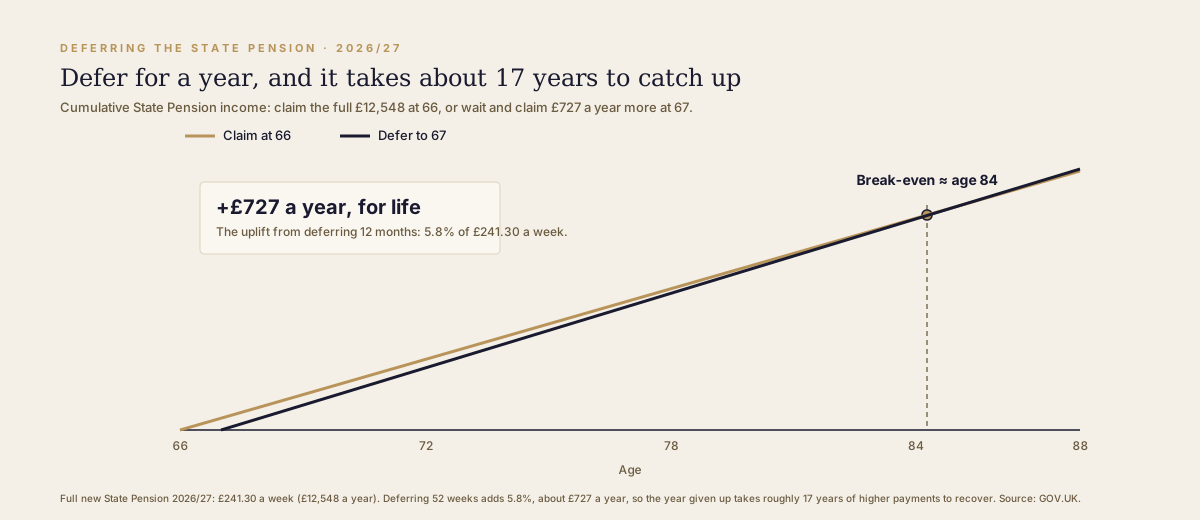
On the new State Pension it takes about 17 years of higher payments to recover the pension you gave up, so deferral only pays if you live well beyond that. The maths is unforgiving because you are spending a whole year’s pension to buy an extra 5.8% of it.
How long deferring one year takes to pay back
Colin defers the full new State Pension for one year in 2026/27, from age 66 to age 67.
| Input | Value |
|---|---|
| Pension given up (one year) | £12,548 |
| Extra pension bought | £727 a year, for life |
| Years of higher payments to recover it | About 17 years |
- Deferring 52 weeks adds 5.8% to the full rate: 5.8% of £241.30 = £13.99 a week
- £13.99 a week is about £727 a year, paid for the rest of Colin's life
- He gave up one year of pension worth £12,548, so £12,548 ÷ £727 = about 17 years to break even
Result: Colin has to reach roughly 84, some seventeen years after the higher pension starts, before deferral leaves him better off overall.
That 17-year break-even is the single most important number in the decision, and it explains why deferral is really a bet on your own longevity. Someone in strong health with a family history of long life is buying a genuinely good deal; someone whose health is already poor is very likely to lose. The State Pension carries no death benefit to soften that, unlike a private pot, so a deferred pension that never pays out long enough is simply gone.
How long does it take to break even on a deferred State Pension?
On the new State Pension it takes about 17 years of higher payments to break even, because deferring one year gives up around £12,548 of pension to buy roughly £727 a year extra. Someone who defers from 66 to 67 needs to reach their mid-80s before the higher income repays the year they went without.
When does deferring the State Pension not build up extra?
Deferring builds up nothing for any period when you, or in some cases your partner, are claiming certain benefits. The list includes Pension Credit, Universal Credit, Carer’s Allowance, Employment and Support Allowance and a few others, as GOV.UK confirms. During those periods the pension is treated as if you were receiving it, whether or not you actually are, so the clock on your 5.8% simply stops.
This turns a common assumption on its head. Someone on a low income who defers in the hope of a bigger pension later can end up with the worst of both worlds: no income now, and no uplift either, because they are on means-tested support that both cancels the increment and would often have been reduced by the deferred pension anyway. Deferral is a strategy for people who do not need the income, not for those who cannot afford to take it.
There is also the question of what you live on in the gap. Deferring the State Pension usually means drawing more from a private pension or from savings to cover the shortfall, which has its own tax and longevity consequences. Anyone bridging the gap from invested assets should weigh it against their sustainable withdrawal rate, because spending down a pot faster in your late sixties to defer a guaranteed income is a real trade, not a free one.
How is deferred State Pension taxed?
The extra State Pension from deferral is taxable as income in exactly the same way as the rest of your pension. There is no special relief and no tax-free element: once you claim, the higher weekly amount is added to your other taxable income for the year. Because the State Pension is always paid without tax deducted, any tax due is collected through your other income or a self-assessment adjustment.
Tax is where deferral quietly earns or loses its keep, and it is the reason two people facing the same 5.8% can reach opposite answers.
Same 5.8%, opposite decisions
Dev, 66, still runs a consultancy earning about £58,000 a year and is a higher-rate taxpayer. If he claimed his State Pension now, the £12,548 would stack on top of his earnings and be taxed at 40%, leaving him roughly £7,529 of it. Deferring until he winds the business down at 68 skips two years of pension he would largely have lost to tax, and the enlarged pension then starts once he is a basic-rate taxpayer.
That is not his only way out of the 40%. Because Dev still has relevant UK earnings, he can claim the pension and pay it straight into his own pension instead. The £7,529 he is left with after tax funds a gross contribution of the whole £12,548, once basic-rate relief is added at the provider and the higher-rate relief is reclaimed through self-assessment. The full State Pension ends up in his pot with the tax handed back, and drawn later as a basic-rate taxpayer, a quarter of it tax free, it is worth about £10,666 before any growth.
So Dev has three options rather than two: defer, and buy £727 a year of guaranteed income for life; claim and contribute, and recover the tax now with the money still his; or claim and spend it. On the tax argument alone the middle option beats deferral, because it recovers the same 40% without a year of no income and without waiting seventeen years to break even. Deferring is the better answer for Dev only if what he actually wants is more guaranteed, inflation-linked income in his eighties, which is a different objective from saving tax this year.
Yvonne, also 66, has no other income; the State Pension is all she has to live on. For her, deferring even a few months means going without her only income, and the tax angle is irrelevant because she is nowhere near the higher-rate band.
The deferral rate is identical for both. Dev has a real decision to make between three routes; Yvonne has none, because the decision was never really about the 5.8%. It was about the rest of the plan.
Two limits gate the contribution route, and both need checking before anyone counts on it. Personal contributions only attract relief up to 100% of your relevant UK earnings, which leaves someone who has stopped working with £3,600 gross a year and no more, and dividends do not count towards the limit at all. If you have already taken taxable income from a defined contribution pension, the money purchase annual allowance caps tax-relieved contributions at £10,000 a year for 2026/27. The higher-rate slice of the relief also has to be claimed through self-assessment rather than arriving on its own.
This is the heart of it. Deferral is not a product with a return you can quote in isolation; it only makes sense inside the tax and income picture of the specific person deferring.
Risk warning
Levels and bases of, and reliefs from, taxation are subject to change and their value will depend upon personal circumstances. Taxation and pension legislation may change in the future.
How does deferring fit into your wider retirement plan?
Deferring is a decision about income sequencing, so it belongs inside a plan rather than being judged on its headline rate alone. The State Pension is the inflation-linked foundation most retirement income sits on, and deferring reshapes that foundation: a smaller number of years at a higher, guaranteed rate. Whether that helps depends on what else is happening around it, which is precisely the kind of question lifetime cashflow modelling is built to answer.
Deferring the State Pension is really buying an inflation-linked income at a fixed price. On the post-2016 rules that price is far steeper than it looks, which is why so few people who defer actually come out ahead.
The comparison worth making is with buying secure income another way. Deferring one year buys roughly £727 a year of index-linked income for £12,548, which is a purchase price of around 17 times the annual income before tax. That is a useful yardstick to hold against whether an annuity is worth it at current rates, because both are ways of converting capital into guaranteed lifetime income and can be compared directly. Deferral also interacts with how a couple plans, since the new State Pension is largely personal and a survivor keeps only limited rights to a deceased partner’s deferred amount, a point covered in the guide to the State Pension and a surviving spouse. It is worth remembering, too, that deferral is a separate lever from when you can take your private pensions, which run on their own pension access age.
The 5.8% tells you the price. It cannot tell you whether what that price buys is what your plan needs, and that is the question which actually decides it.
Risk warning
A pension is a long-term investment, the value of your investment and the income from it may go down as well as up. Your eventual income may depend upon the size of the fund at retirement, future interest rates and tax legislation.
Should you defer your State Pension?
You should consider deferring only if you expect a long retirement, have enough other income to live on comfortably in the meantime, and are not relying on means-tested benefits. Where all three hold, deferral can be a sound way to secure more guaranteed, inflation-proofed income for later life, and it is one of the cleaner ways to buy longevity insurance, because the income is government-backed and rises each year. A high tax band this year is a weaker reason than it first appears: if you still have relevant UK earnings, claiming the pension and paying it into your own pension recovers the tax without giving up a year of income, so the tax point on its own rarely settles the question.
For most people, though, claiming on time is the stronger choice. The 17-year break-even is a high bar, the money given up is gone if you die early, and the benefits interaction can wipe out the uplift for exactly the people who can least afford to gamble. Deferring in the vague hope of a bigger pension is where most people go wrong. Escaping tax in a single high-income year is at least a concrete reason, though for anyone still earning it is usually the second-best way of doing it. The honest test is not whether 5.8% sounds attractive, but whether your health, your other income and your tax position all point the same way. When they do, deferral is worth a proper look. When they do not, the guaranteed income in your hand is worth more than the larger one you might not live to enjoy. That decision sits at the centre of pension and retirement planning, where the State Pension is only ever one moving part.
Frequently asked questions
What is State Pension deferral?
State Pension deferral is choosing not to claim your State Pension when you reach State Pension age, so it builds up and pays a higher amount for life once you do claim. On the new State Pension it grows by 1% for every nine weeks you wait, just under 5.8% for a full year. You do not need to do anything to defer; the pension defers automatically until you claim it.
How much does deferring the State Pension add?
Deferring the new State Pension for a full year adds just under 5.8% to it, which is about £13.99 a week or £727 a year on the full rate of £241.30 a week for 2026/27. The increase is permanent and is then uprated each year like the rest of your pension. Deferring two years adds roughly 11.6%, and so on in proportion.
Can you take deferred State Pension as a lump sum?
Not in the form the old rules allowed. Anyone who reached State Pension age on or after 6 April 2016 can only take the extra built up by deferring as higher weekly payments for life. You can backdate a claim by up to twelve months and receive that year's pension as a one-off arrears payment, but that is only the pension you had already gone without, with nothing added, and those weeks then stop counting towards the increase. The lump sum paid with interest at 2% above the Bank of England base rate applies only to people who reached State Pension age before 6 April 2016 under the old basic State Pension.
Does deferring the State Pension affect your benefits?
Yes, in both directions, and rarely in your favour. While you defer, means-tested support such as Pension Credit and Housing Benefit still counts the State Pension you could have claimed as income, so going without it does not increase what you receive. Once you claim, the higher pension counts as income too and can reduce those same benefits. Separately, you build up no extra pension at all for any period when you, or in some cases your partner, are receiving certain benefits, including Pension Credit, Universal Credit and Carer's Allowance.
What happens to a deferred State Pension when you die?
The new State Pension generally cannot be passed on, but a surviving husband, wife or civil partner may be able to inherit some of the extra amount built up through deferral. An unmarried partner cannot inherit any of it. The rules are narrow, so deferring purely to leave more behind is an unreliable strategy compared with other ways of providing for a partner.
Is it worth deferring the State Pension?
Deferring is usually worth it only if you expect a long retirement and can comfortably live without the pension in the meantime, because it takes about 17 years of higher payments to break even on the new rules. A high tax band this year is a weaker reason than it looks, because anyone with relevant UK earnings can claim the pension and pay it into their own pension to recover the tax instead. For most people who need the income at State Pension age, claiming on time is the stronger choice.