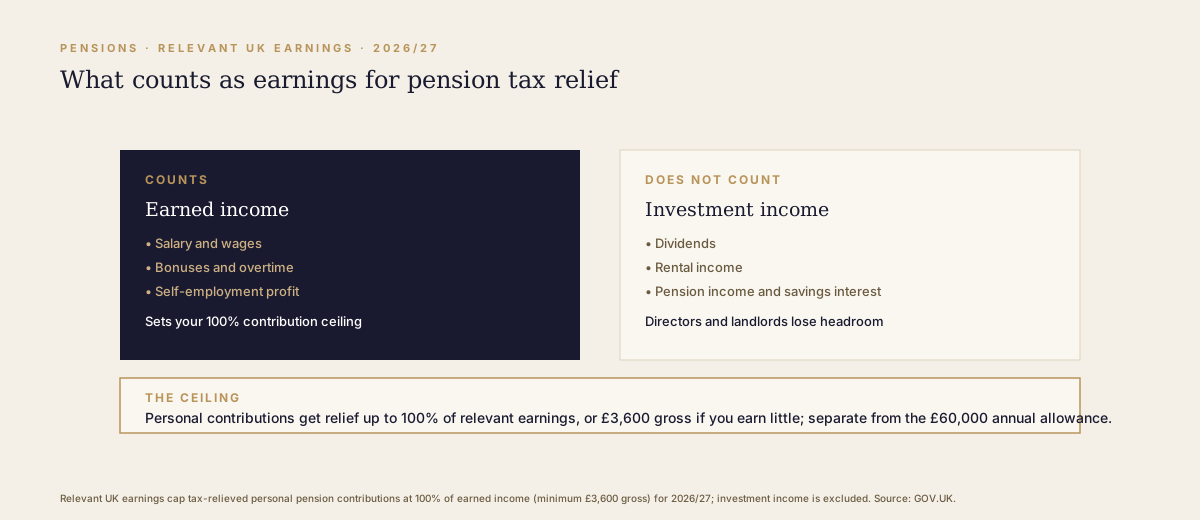
Relevant UK earnings are the categories of taxable UK income, principally employment earnings and self-employment profits, that HMRC uses to measure the maximum tax-relieved personal pension contribution someone can make. The catch is what does not count: dividends, rental income and pension income are all excluded, so company directors and landlords often have far less pension headroom than their total income suggests. Only earned income, such as salary, bonuses, overtime and self-employment profit, sets the ceiling. That ceiling is 100% of those earnings, or £3,600 gross if you earn little or nothing, and it is separate from the annual allowance, £60,000 a year for 2026/27.
Relevant UK earnings are the income HMRC counts when deciding how much you can personally pay into a pension and still receive tax relief. For most people they mean salary, bonuses, overtime and self-employment profits. The phrase matters because it sets a firm ceiling: you can contribute up to 100% of your relevant UK earnings in a tax year and claim relief, and not a pound more on a personal basis. Income that feels like earnings to you, such as dividends from your own company or rent from a property, does not count. All figures and thresholds in this article reflect the 2026/27 tax year.
How much can you contribute to a pension based on relevant UK earnings?
For 2026/27, you can pay up to 100% of your relevant UK earnings into pensions and receive tax relief, capped in practice by the £60,000 annual allowance. With no relevant UK earnings, you can still contribute £3,600 gross, which is £2,880 of your own money, each tax year.
Contents
- What are relevant UK earnings?
- What counts as relevant UK earnings?
- What does not count as relevant UK earnings?
- How do relevant UK earnings limit pension tax relief?
- How do relevant UK earnings differ from the annual allowance?
- Why are employer contributions more tax-efficient for a business owner?
- What changed for furnished holiday lettings in 2025?
- Should you worry about your relevant UK earnings?
What are relevant UK earnings?
Relevant UK earnings are the types of taxable income that HMRC allows you to count when working out the maximum personal pension contribution you can make with tax relief. The concept exists for one reason: the rules let you get tax relief on contributions worth up to 100% of these earnings, so HMRC has to define precisely which income qualifies. It is the measuring stick for personal contributions, nothing more.
The important word is earned. Relevant UK earnings are built around money you work for, whether as an employee or as someone running their own business. Income that arrives because you own an asset, rather than because you worked, generally sits outside the definition. That distinction is the single most useful thing to understand about the term, because it is where most of the surprises come from.
This only constrains contributions you make yourself. Contributions an employer makes on your behalf are governed by a different limit, which is why the earned-income test matters far more to the self-employed and to company directors than to a typical salaried employee.
Risk warnings
Pensions
Levels and bases of, and reliefs from, taxation are subject to change and their value will depend upon personal circumstances. Taxation and pension legislation may change in the future.
Tax, trusts and estate planning
HM Revenue and Customs practice and the law relating to taxation are complex and subject to individual circumstances and changes which cannot be foreseen.
What counts as relevant UK earnings?
Relevant UK earnings cover the income you receive from working, and HMRC sets out the full list in its Pensions Tax Manual. The main categories are straightforward, and for most employees the first one is the whole story.
- Employment income such as salary, wages, bonuses, overtime, commission and most taxable benefits in kind.
- Profits from a trade, profession or vocation, the income of the self-employed and partners.
- Patent income where you devised the invention yourself.
- Certain payments linked to employment, including some redundancy pay above the £30,000 tax-free limit and statutory payments such as Statutory Maternity Pay.
For an employed person, relevant UK earnings are usually just their gross pay and any bonus. For a sole trader, they are the taxable profits of the business, not the money drawn from it. The figure is your earnings chargeable to UK income tax for the tax year, so it is the gross amount before pension contributions are deducted.
What does not count as relevant UK earnings?
Income from owning assets, rather than working, does not count as relevant UK earnings, even when it is substantial and even when it is taxed. The exclusions catch more people than the inclusions. The most common excluded sources are:
- Dividends, including dividends from your own limited company.
- Rental income from buy-to-let or other property letting.
- Savings interest and most other investment income.
- Pension income, including the state pension and income drawn from your own pensions.
Dividends are the exclusion that surprises company owners most. Because a tax-efficient salary and dividend split usually keeps the salary low, the relievable contribution a director can make from their own pocket is small. The interaction with how dividends are taxed for company directors is why so many business owners route pension funding through the company instead. Pension income being excluded also matters for anyone phasing into retirement: drawing from one pension does not create earnings to justify paying into another.
Risk warnings
Pensions
A pension is a long-term investment, the value of your investment and the income from it may go down as well as up. Your eventual income may depend upon the size of the fund at retirement, future interest rates and tax legislation.
Mortgages
If property prices fall and your capital value falls below your outstanding interest-only mortgage, you’ll need to make up for any shortfall if the property sells for less.
How do relevant UK earnings limit pension tax relief?
Your relevant UK earnings cap the personal pension contribution you can make with tax relief at 100% of those earnings in the tax year. That 100%-of-earnings ceiling on tax-relievable personal contributions is set out in GOV.UK’s guidance on pension tax relief. Contribute within that limit and you receive relief at your marginal rate; contribute above it and the excess gets no relief and may have to be unwound.
There is a floor as well as a ceiling. For 2026/27, anyone under 75, including non-earners and children, can contribute £3,600 gross a year and still get basic-rate relief, which means paying in £2,880 and HMRC adding £720. This basic amount runs through relief at source, so it works even when you have no relevant UK earnings at all. It is how a non-working spouse or a parent funding a child’s pension still benefits from tax relief.
Marcus, 45, company director on a low salary
Marcus runs his own company and pays himself a salary set at the personal allowance, £12,570 a year for 2026/27, topped up with £50,000 in dividends. His total income is around £62,570, comfortably into the higher-rate band.
Only the £12,570 salary is relevant UK earnings. The £50,000 of dividends counts for nothing here, so the most Marcus can pay into a pension personally with tax relief is £12,570 in the year, despite his income.
Had the company paid £40,000 directly as an employer contribution instead, none of it would be tested against his relevant UK earnings. The same person, the same money, but the route changes the relievable amount from £12,570 to as much as the £60,000 annual allowance allows.
For employees who pay higher-rate tax, the relevant earnings limit is rarely the binding constraint, but the relief itself still needs claiming. The mechanics of claiming higher-rate pension tax relief through Self Assessment, or by contacting HMRC, apply once a contribution sits within the earnings limit.
How do relevant UK earnings differ from the annual allowance?
Relevant UK earnings limit your own contributions, while the pension annual allowance limits the total going in from every source. They are two separate tests, and a contribution has to pass both. The annual allowance is £60,000 a year for 2026/27 and covers your contributions, any employer contributions and the basic-rate tax relief added on top.
The order they apply in is what trips people up. First, your personal contribution cannot exceed 100% of your relevant UK earnings. Second, the combined total of personal and employer contributions cannot exceed the annual allowance. A director on a £12,570 salary is held to £12,570 personally by the earnings test, even though the £60,000 annual allowance sits far above it, because the earnings test bites first on the money they pay in themselves. The gap between the two limits is filled by employer contributions, which are not tested against earnings at all.
Are relevant UK earnings the same as the annual allowance?
No. Relevant UK earnings cap the contribution you make personally at 100% of your earnings. The annual allowance, £60,000 a year for 2026/27, caps the total from all sources, including employer contributions. A contribution must satisfy both limits, and the earnings test applies only to your own money.
This ordering also explains why carry forward helps some people but not others. Pension carry forward lets you draw on unused annual allowance from the previous three tax years, but it only ever relaxes the annual allowance, never the relevant UK earnings limit. Someone on a low salary cannot use it for a personal contribution, because their own payments are still capped at this year’s earnings, and carrying forward more allowance does not change that. They can use it through an employer contribution instead, which faces no earnings test, so the company can pay in well above £60,000 in a year when enough allowance has built up.
Why are employer contributions more tax-efficient for a business owner?
Employer contributions are more tax-efficient because the money moves from company profit straight into the pension, without passing through income tax, National Insurance or dividend tax first. A personal contribution is made from income you have already drawn as salary or dividends, after those taxes have been paid, so more is lost on the way. For a business owner deciding how to fund a pension, the route can matter as much as the amount.
Take £10,000 of company profit earmarked for the pension. Paid as an employer pension contribution, it is a deductible business expense, so the full £10,000 reaches the pension and the company saves corporation tax as well. Extract the same £10,000 as salary or dividends first, and a large slice goes in tax and National Insurance before anything is contributed.
The table assumes a higher-rate taxpayer in the 2026/27 tax year, paying themselves £12,570 as salary and the rest as dividends, with corporation tax at the 25% main rate.
The order income is taxed in does most of the work here. Dividends are treated as the top slice, so salary is taxed first and the dividends stack on whatever is left. Extra salary therefore goes in underneath them rather than on top: it fills the basic-rate band at 20%, and it carries employee National Insurance at the 8% main rate, because this director’s salary, even after the top-up, is nowhere near the £50,270 upper earnings limit where that rate drops to 2%.
What the extra salary does instead is push the dividends up. Every pound added below them displaces a pound of dividend income out of the basic rate at 10.75% and into the higher rate at 35.75%, so the real cost of taking salary includes 25% on the slice that moves. Extra dividends behave differently. They arrive at the top of the stack already, are taxed at 35.75% from the first pound, and displace nothing.
A personal contribution then earns higher-rate relief, paid back to the contributor as cash through Self Assessment rather than landing in the pension. The table keeps that cash on its own line, takes off the displaced dividend tax on another, and adds up to the total benefit of each route, so nothing is double-counted.
How £10,000 of company profit reaches a pension, by route (2026/27)
| Step | Employer contribution | Extra salary, then pension | Dividend, then pension |
|---|---|---|---|
| Company profit used | £10,000 | £10,000 | £10,000 |
| Corporation tax | £0 (deductible) | £0 (deductible) | £2,500 |
| Employer NI at 15% | £0 | £1,304 | £0 |
| Income tax or dividend tax | £0 | £1,739 | £2,681 |
| Employee NI at 8% | £0 | £696 | £0 |
| Basic-rate relief added | not applicable | £1,565 | £1,205 |
| Lands in pension | £10,000 | £7,826 | £6,023 |
| Higher-rate relief reclaimed as cash | £0 | £1,957 | £1,506 |
| Less extra tax on displaced dividends | £0 | £2,174 | £0 |
| Total benefit | £10,000 | £7,609 | £7,529 |
The employer contribution puts the entire £10,000 into the pension, because the money never becomes the director’s income. There is no personal tax to pay, nothing to reclaim, and no dividend pushed anywhere. The two extraction routes leave between £6,000 and £7,800 in the pension once basic-rate relief has been added back, so between £2,200 and £4,000 of every £10,000 goes in National Insurance and tax on the way through.
The higher-rate relief comes back separately, as cash rather than pension, and on both routes it works the same way. The gross contribution extends the basic-rate band, moving that slice of dividend income from the 35.75% higher rate back down to the 10.75% basic rate, a 25% saving on top of the 20% basic-rate relief already added at source. Because more reaches the pension on the salary route, more band is extended there, so the cash is larger: about £1,960 against about £1,510.
Set against that is the tax on the dividends the salary route displaced, which the dividend route never triggers. Take the cash relief and the displacement together and the total benefit is roughly £7,500 to £7,600 whichever way the money comes out, still well short of the £10,000 the employer contribution delivers, and the cash sits outside the pension rather than compounding inside it. Companies whose profits fall in the £50,000 to £250,000 band pay an effective 26.5% corporation tax rate for 2026/27, which widens the gap further.
The employer route is not free of conditions. To be deductible, the contribution must pass HMRC’s wholly and exclusively test, which means a cost qualifies for corporation tax relief only when it is incurred purely for the purposes of the business. The money is also locked away until at least age 55, rising to 57 from 6 April 2028. Where a business owner genuinely wants to commit profit to retirement, funding the pension from the company rather than from extracted income is usually the more efficient choice, and it removes the relevant UK earnings ceiling from the decision entirely.
What changed for furnished holiday lettings in 2025?
Furnished holiday letting profits stopped counting as relevant UK earnings from 6 April 2025. Until then, a furnished holiday let was treated more like a trade than ordinary property letting, and its profits qualified as earnings for pension purposes. The abolition of the furnished holiday lettings tax regime removed that treatment along with several other reliefs.
The practical effect is a narrower base for affected owners. Someone whose income came largely from a holiday let could previously make sizeable personal pension contributions against those profits. From the 2025/26 tax year onward, that income is ordinary property income, which has never been relevant UK earnings, so their relievable contribution falls back to £3,600 gross unless they have other earnings. For a hands-on holiday let owner who treated the business as their livelihood, that is a meaningful reduction in pension capacity rather than a technicality.
Should you worry about your relevant UK earnings?
You should check your relevant UK earnings if you intend to make a large personal pension contribution and a meaningful part of your income comes from dividends, property or investments. For a salaried employee paying into a workplace scheme, the figure rarely binds and needs no thought. The risk concentrates among directors, landlords and the semi-retired, where total income and relevant UK earnings can diverge sharply.
The trade-off is worth being honest about. Routing pension funding through a company as an employer contribution sidesteps the earnings limit, but it is not free of constraints: the contribution must be commercially justifiable, and it still counts against the annual allowance. For most business owners, weighing the personal route against the employer route is the central question, and it sits naturally within wider pensions and retirement planning rather than being settled in isolation.
The single insight to carry away is that a pension is funded out of earned income, not total income. Two people with identical lifestyles can have very different pension capacity depending on how their money arrives, and the relevant UK earnings test is what draws that line.
Frequently asked questions
What are relevant UK earnings?
Relevant UK earnings are the income HMRC counts when deciding how much you can personally pay into a pension with tax relief. They mainly cover employment earnings such as salary, bonuses and overtime, plus profits from self-employment. Investment income does not qualify.
How do relevant UK earnings affect pension tax relief?
They cap the personal contribution you can make with tax relief at 100% of your relevant UK earnings each tax year. Pay in more than that, and the excess does not attract relief and may have to be reclaimed from the scheme or HMRC.
Do dividends count as relevant UK earnings?
No. Dividends are not relevant UK earnings, even when they come from your own company. A director paying themselves mostly in dividends has very limited scope to make personal pension contributions, which is why employer contributions are often used instead.
Does rental income count as relevant UK earnings?
No. Ordinary property rental income is not relevant UK earnings. Furnished holiday letting profits used to count, but they stopped qualifying from 6 April 2025 when the furnished holiday lettings regime was abolished.
Are employer pension contributions limited by relevant UK earnings?
No. Employer contributions are not restricted by your relevant UK earnings at all. They are limited only by the annual allowance, £60,000 a year for 2026/27, plus any carry forward, which is why company contributions suit directors with low salaries.
Are employer pension contributions more tax-efficient than salary or dividends?
Usually, yes. An employer contribution moves company profit straight into the pension with no National Insurance and full corporation tax relief, so £10,000 of profit can fund £10,000 of pension. Taking the same profit as salary or dividends first leaves roughly £6,000 to £7,800 in the pension, and the salary route costs more again in tax on the dividends it pushes into the higher rate.
Is it worth checking your relevant UK earnings before making a large pension contribution?
Yes, if you plan to contribute personally. Tax relief only applies to contributions up to 100% of your relevant UK earnings, so a contribution that looks affordable from your total income can exceed the relievable limit if much of that income is dividends or rent.