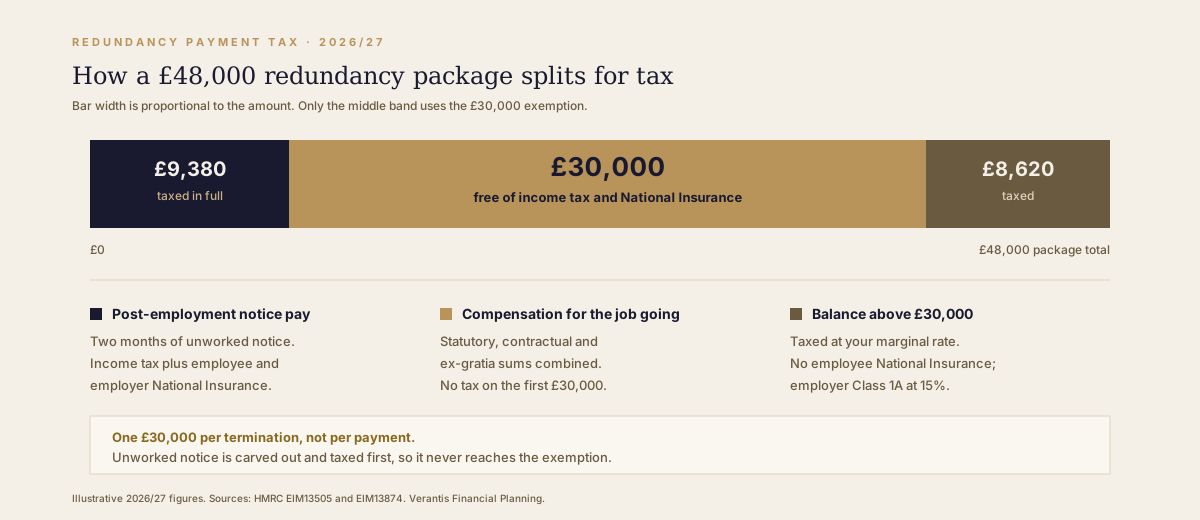
A redundancy payment is compensation an employer pays an employee whose job is removed, made up of a statutory minimum set by service and age plus any additional contractual or ex-gratia sum. The first £30,000 of a genuine redundancy package is free of income tax and National Insurance, and the balance is taxed at your marginal rate. The exemption covers only compensation for losing the job, so notice pay, holiday pay and unpaid bonus are taxed in full before the £30,000 is even reached. Where an employer pays part of the package straight into your pension, that part sits outside the £30,000 altogether.
Redundancy payment tax comes down to one number and one distinction. The number is £30,000 for 2026/27, the amount of a genuine redundancy package that arrives free of income tax and National Insurance. The distinction is between money paid because the job has gone, which can use that exemption, and money you would have earned by working, which cannot. Miss the second half and a package that read as tax free on the offer letter lands several thousand pounds lighter. All figures reflect the 2026/27 tax year.
The exemption gets the attention because it is the friendly number. The carve-outs decide what you actually receive.
What counts towards the £30,000 redundancy exemption?
Only payments made because the employment is ending: statutory redundancy pay, contractual redundancy pay, and discretionary ex-gratia sums. Salary, bonus, accrued holiday pay and notice pay are payments for work, so they are taxed in full and sit outside the exemption entirely. All qualifying payments from one job share a single £30,000, however many separate sums the package contains.
Contents
- How much of a redundancy payment is tax free?
- How is statutory redundancy pay calculated?
- Which parts of a redundancy payment are taxed?
- What is post-employment notice pay?
- Does National Insurance apply to redundancy pay?
- Can you pay a redundancy payment into a pension?
- Should you put your redundancy payment into a pension?
- Where redundancy fits the rest of your plan
How much of a redundancy payment is tax free?
£30,000 of it, provided the money is genuinely compensation for the loss of the job. HMRC’s guidance at EIM13505 sets out the mechanism: qualifying termination payments count as employment income only to the extent that they exceed £30,000. Below that line there is no income tax and no National Insurance of any kind.
The word that does the work in that rule is aggregate. The £30,000 belongs to the termination, not to any individual payment within it. An employee who receives statutory redundancy pay of £13,518, a contractual top-up of £20,000 and a £4,000 discretionary goodwill sum has received £37,518 of qualifying compensation, not three separate payments each testing themselves against the threshold. £30,000 is exempt and £7,518 is taxed.
The amount above £30,000 is taxed at your marginal rate, and marginal rate here means marginal after everything else you have earned in that tax year. Made redundant in March, with eleven months of salary already banked, the excess stacks on top of that income and is often taxed entirely at the higher rate. Made redundant in April, the same excess can fall largely into the basic-rate band because the rest of the year is still empty. The package has not changed. The date has.
Risk warnings
The Financial Conduct Authority does not regulate Cashflow Planning.
HM Revenue and Customs practice and the law relating to taxation are complex and subject to individual circumstances and changes which cannot be foreseen.
How is statutory redundancy pay calculated?
Statutory redundancy pay is worked out from three things: your age across each year of service, your complete years with the employer up to a maximum of twenty, and your weekly pay subject to a cap. GOV.UK’s employer guidance sets the rates at half a week’s pay for each year worked below age 22, one week’s pay for each year from 22 to 40, and one and a half weeks’ pay for each year from 41 onwards.
Two limits then bite. Pay is capped at £751 a week for 2026/27 regardless of what you actually earn, and service beyond twenty years is ignored. Together those caps put a hard ceiling on any statutory redundancy payment: £22,530 for 2026/27. That is why the statutory element on its own almost never reaches the £30,000 exemption. Both limits are England, Wales and Scotland only; Northern Ireland legislates separately and its own are higher.
Statutory redundancy pay for a 49-year-old with 14 years' service
Marcus is 49 and has worked for the same employer for 14 complete years. His gross pay is £44,850 a year, or about £862 a week.
| Input | Value |
|---|---|
| Age at redundancy | 49 |
| Complete years of service | 14 |
| Actual weekly pay | £862 |
| Capped weekly pay | £751 |
- Eight of his 14 years were worked after his 41st birthday, so they count at 1.5 weeks each: 12 weeks.
- The other six years were worked between 22 and 40, counting at one week each: 6 weeks.
- That gives 18 weeks in total, valued at the capped £751 rather than his actual £862.
Result: Marcus receives £13,518 of statutory redundancy pay, comfortably inside the £30,000 exemption and therefore free of income tax and National Insurance. The £111 a week the cap removes costs him £1,998 against an uncapped calculation.
Anything the employer pays above this is contractual or discretionary. Enhanced schemes are common in larger organisations and in the public sector, and it is the enhancement, not the statutory floor, that usually pushes a package past £30,000.
Which parts of a redundancy payment are taxed?
Everything you were owed for working is taxed in full; only the compensation for the job ending can shelter behind the £30,000. Payroll makes this split before you see the money, so the number on the offer letter and the number in your account can differ substantially.
| Element of the package | Income tax | National Insurance | Uses the exemption? |
|---|---|---|---|
| Statutory redundancy pay | Exempt within £30,000 | None | Yes |
| Contractual or ex-gratia redundancy pay | Exempt within £30,000 | Employer only, above £30,000 | Yes |
| Post-employment notice pay | Taxed in full | Employee and employer | No |
| Contractual payment in lieu of notice | Taxed in full | Employee and employer | No |
| Unpaid salary and bonus | Taxed in full | Employee and employer | No |
| Accrued but untaken holiday pay | Taxed in full | Employee and employer | No |
| Employer contribution to your pension | None when paid, taxed when drawn | None | No |
The £30,000 exemption is not a discount on your whole severance cheque. It applies only to the part that compensates you for losing the job, and payroll decides which part that is before you see a penny.
The row that surprises people most is holiday pay. It feels like part of the settlement because it arrives in the same payment on the same day, but untaken leave is money earned by working, and it is taxed exactly as a normal month’s salary would be.
What is post-employment notice pay?
Post-employment notice pay, usually shortened to PENP, is the basic pay you would have received for any part of your notice period that you do not actually work. It is calculated by a statutory formula in section 402D of the Income Tax (Earnings and Pensions) Act 2003, and HMRC’s guidance at EIM13874 is explicit that it is chargeable as general earnings and does not benefit from the £30,000 threshold.
This rule arrived on 6 April 2018 and closed a route that had been widely used. Before it, an employer with no contractual right to pay in lieu of notice could dismiss someone immediately and treat the whole notice value as compensation, sheltering it inside the exemption. Now the notice value is stripped out first whatever the contract says, and only what remains is tested against the £30,000.
The practical effect is that two people can be handed identical headline figures and receive materially different amounts. The variable is how much of the package is notice you did not work.
Naomi and Ade, both offered £48,000 to leave
Naomi and Ade work for the same employer on the same basic salary of £56,280, or £4,690 a month. Both are made redundant in March with almost a full year of that salary behind them, so everything that follows sits above the higher rate threshold of £50,270. Both are asked to leave immediately, and both are offered £48,000. What differs is the contract: Naomi’s carries two months’ notice and Ade’s carries six.
Naomi’s unworked notice comes to £9,380. That is taxed in full as earnings, which leaves £38,620 as a termination award, of which £30,000 is exempt and £8,620 is taxed. £18,000 of her £48,000 is taxable in total and she pays £7,200 of income tax.
Ade’s unworked notice comes to £28,140. Only £19,860 of his package survives as a termination award, and because that sits below £30,000 it is exempt in full. That sounds like the better result and is the worse one: he uses £19,860 of the exemption and the other £10,140 of it goes nowhere. £28,140 is taxable and he pays £11,256.
Same employer, same offer, and £4,056 more income tax, plus employee National Insurance on three times as much notice pay.
Once your unworked notice passes the amount by which the package exceeds £30,000, every further pound of notice costs a pound of exemption you cannot get back. The longer your notice period, the less the same headline number is actually worth to you, which is a fair thing to have in mind while the figure is still being discussed.
Does National Insurance apply to redundancy pay?
Not for the employee, at any level. A qualifying termination award carries no employee National Insurance even where it runs well past £30,000, which is unusual: almost every other form of employment income does. The exemption on the first £30,000 covers both taxes, and above it the income tax applies but employee National Insurance still does not.
Do you pay National Insurance on a redundancy payment?
Employees pay none on a qualifying redundancy payment, however large. Employers pay Class 1A National Insurance at 15% for 2026/27 on the part of a termination award above £30,000. Notice pay, holiday pay and unpaid salary are different: those attract both employee and employer National Insurance in the normal way, because they are earnings rather than compensation.
The employer is not so lucky. Class 1A National Insurance, charged at 15% for 2026/27, applies to the amount of the award above £30,000. On a £48,000 termination award that comes to £2,700, which is a real cost to the business and one reason employers are sometimes receptive to structuring part of a package differently.
Can you pay a redundancy payment into a pension?
You can, and the route matters more than the amount. Where the employer pays part of the package directly into a registered pension scheme, HMRC’s guidance at EIM13735 confirms that the contribution does not use up any of the £30,000 threshold available for that termination. The employer avoids the Class 1A charge on that slice, no income tax or National Insurance is charged on it when it is paid, and the exemption remains fully available for the cash element.
What that buys is a deferral, not an exemption, and the distinction matters when you are comparing the two routes. Money in a pension is taxed when it comes out: normally a quarter of it free of tax, capped by the lump sum allowance of £268,275 for 2026/27, and the remaining three-quarters charged at whatever your marginal rate is in the year you draw it. The gain is the difference between the rate avoided now and the rate paid later, which is why this route does most of its work for someone whose package is being taxed at 40% or more and who expects to draw the money as a basic-rate taxpayer.
Paying it yourself from the cash you receive is a different transaction with a different limit, and this is where packages most often go wrong. A personal contribution attracts tax relief only up to 100% of your relevant UK earnings for the year. The taxable excess above £30,000 does count towards those earnings, but the exempt £30,000 does not, because it was never charged to income tax in the first place. Someone made redundant in April with a £45,000 package and almost no salary yet that year has £15,000 of relevant earnings from it, not £45,000.
The other ceiling is the annual allowance, which for most people is £60,000 a year for 2026/27, and it counts employer contributions as well as your own. A large one-off contribution from a package can exceed it, though unused allowance from the previous three tax years is often available through carry forward, and redundancy is one of the few moments in a career when a person genuinely has the cash to use it.
Risk warning
Levels and bases of, and reliefs from, taxation are subject to change and their value will depend upon personal circumstances. Taxation and pension legislation may change in the future.
Should you put your redundancy payment into a pension?
Only after the cash you need to live on is secured, and then it depends on where the taxable slice of the package lands. The pension route is at its most valuable when the excess above £30,000 would otherwise be taxed at 40% or 45%, or when it drags your adjusted net income above the point at which the personal allowance starts to taper, £100,000 a year for 2026/27. In that band the effective rate on the excess reaches 60%, and diverting the same money into a pension keeps the whole slice out of it rather than merely reducing what lands there. The tax is not cancelled, it is moved: three-quarters of it will be charged when you draw the pension, at the rate that applies then rather than the one applying now.
The argument weakens sharply in three situations. If you are under 55 and the redundancy is unexpected, pension money is inaccessible for years and you may need it long before then. If the whole package sits inside the £30,000, there is no tax to save, and a pension contribution simply converts accessible money into locked money for nothing. And if you have no other income for the tax year, the excess may fall within the personal allowance and basic-rate band anyway, so the relief you gain on the way in is barely more than the tax you will pay on the way out.
The mistake I see most often is deciding this in the first week. A redundancy package is usually the largest single sum a person has ever received, and the pull to do something decisive with it is strong at exactly the moment the rest of the picture is least clear. The tax treatment of the money does not change while it sits in a savings account, and the £30,000 exemption is applied by payroll regardless. What does change is how much you know about how long the job search will take.
Risk warning
While cash provides security of capital, it may not keep pace with inflation. Over time, the real value of your savings could fall.
Where redundancy fits the rest of your plan
Redundancy tends to arrive with several decisions attached, and the tax on the payment is only the first of them. The workplace pension you were paying into stops receiving contributions the day the employment ends, which raises the question of whether to leave it, keep contributing personally, or fold it into an existing pot, and there are good reasons on both sides of consolidating older pensions that have nothing to do with redundancy.
Cash needs a home too. Money set aside to cover several months without earnings is doing a defensive job, so it belongs somewhere accessible rather than invested, and using the ISA allowance to shelter the interest costs nothing and preserves access. The mistake in the other direction is treating the whole package as an emergency fund and leaving a large sum earning very little for years after the emergency has passed.
The question underneath all of it is how long the money has to last, and that is a question about the whole plan rather than the payment. Modelling the next few years properly, with a realistic gap in earnings and a realistic restart, tends to make the pension decision obvious in a way that staring at the tax alone never does. That is the work our lifetime cashflow modelling service exists to do, and redundancy is one of the moments it earns its keep.
If you take one thing from the arithmetic above, make it the split. Two people handed the same £48,000 kept different amounts because one of them had a longer notice period than the other. Reading the offer as two separate pots, earnings and compensation, is what turns a headline number into a figure you can actually plan around.
Risk warnings
ISAs
The favourable tax treatment of ISAs may be subject to changes in legislation in the future.
Pensions
A pension is a long-term investment, the value of your investment and the income from it may go down as well as up. Your eventual income may depend upon the size of the fund at retirement, future interest rates and tax legislation.
Defined benefit transfers
We do not currently provide advice on transferring out of defined benefit (final salary) pension schemes. If you require this advice, we will provide details of a suitably qualified adviser at a firm with the necessary regulatory permissions who can assist you.
Frequently asked questions
What is a redundancy payment?
A redundancy payment is compensation for the loss of your job when the role itself is removed. It has two parts: a statutory minimum set by law according to your age, length of service and weekly pay, and any extra contractual or discretionary sum the employer chooses to add on top.
How does the £30,000 redundancy exemption work?
All the qualifying termination payments from one job are added together first, and only the total above £30,000 is taxed. The exemption is per termination, not per payment, so a statutory sum and an ex-gratia top-up share the same £30,000 rather than each getting their own.
Is statutory redundancy pay ever taxable?
Rarely, because the statutory maximum is £22,530 for 2026/27, which sits below the £30,000 exemption. It becomes taxable only when an employer adds enough on top that the combined qualifying total passes £30,000, and then it is the excess that is taxed, not the statutory element specifically.
Do you pay tax on notice pay and holiday pay when you are made redundant?
Yes, both in full. Notice pay and accrued holiday pay are money you would have earned by working, not compensation for losing the job, so they are taxed as ordinary earnings with employee and employer National Insurance and never touch the £30,000 exemption.
Does a long notice period increase the tax on a redundancy payment?
It can, and the effect is largest on packages near or below £30,000. Unworked notice is taxed as earnings before the exemption is applied, so a long notice period can leave too little termination award behind to use the £30,000 in full. On a £25,000 package with two months of unworked notice at £4,690 a month, £9,380 is taxed as earnings and only £15,620 remains as a termination award, so nearly half the exemption goes unused on a package that looked entirely tax free.
Is it worth paying a redundancy payment into a pension?
It can be, where the package pushes you into a higher tax band or the money is not needed for living costs while you look for work. An employer contribution made from the package carries no income tax or National Insurance when it is paid and does not use up the £30,000, though it is taxed when you eventually draw it: normally a quarter tax free and the rest at your marginal rate. The trade-off is that pension money is locked away until at least age 55, rising to 57 from 6 April 2028.
Does a redundancy payment affect child benefit or your personal allowance?
The taxable part can, because it is added to your income for the year. If it pushes your adjusted net income above £100,000 a year for 2026/27 the personal allowance starts to taper, and above £60,000 the high income child benefit charge applies for that year. A large package received in a year you also worked most of is the usual trigger.
Do you pay National Insurance on a redundancy payment above £30,000?
You do not, but your employer does. Employee National Insurance is not charged on a qualifying termination award at all, however large. The employer pays Class 1A National Insurance at 15% for 2026/27 on the amount above £30,000, which is one reason packages are sometimes structured through a pension instead.