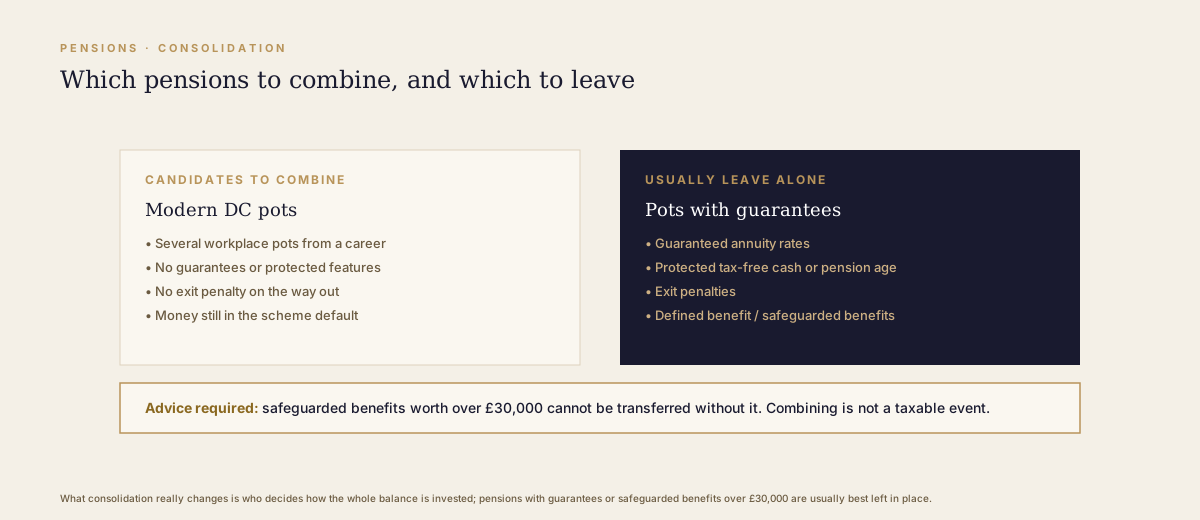
Pension consolidation is the process of transferring two or more separate pensions into a single plan, so that one provider holds and invests the combined fund under one set of charges. Consolidating pensions puts the whole balance under one investment decision and one statement, rather than leaving each pot in whatever fund its scheme defaulted to years ago. It matters most for people who have gathered multiple workplace pots over a career and lost track of both where the money sits and what it is invested in. The pensions needing most care are the oldest, which can carry guarantees or protections a transfer ends permanently.
Pension consolidation is the act of bringing several pensions together into a single plan, and for many people it is the most useful tidy-up they will do before retirement. A typical career now leaves behind a trail of workplace pots, each with its own login and its own fund quietly investing the money on assumptions nobody has revisited since you left. Merging them puts the whole balance under one investment decision and makes a retirement income far easier to manage. The figures in this article reflect the 2026/27 tax year. The decision is rarely as simple as it looks, though, because the oldest pensions are often the ones carrying guarantees worth far more than the convenience of combining them. What follows is how consolidation works, what it does and does not change, and the features that should stop you in your tracks.
What is pension consolidation, and how does it work?
Pension consolidation is moving two or more pensions into a single plan, so one provider holds and invests the combined fund. You request a transfer from the new provider, who collects the money from each old scheme. Most defined contribution transfers complete in weeks, but where safeguarded benefits are worth more than £30,000, regulated advice is a legal requirement first.
Contents
- What is pension consolidation?
- Why do people consolidate their pensions?
- When is consolidating pensions a mistake?
- How do you consolidate your pensions?
- What does the small pots rule mean for consolidation?
- How does consolidation fit your wider retirement plan?
- Should you consolidate your pensions?
What is pension consolidation?
Pension consolidation is the process of transferring two or more separate pensions into one plan, so a single provider holds and invests the combined fund under one set of charges. It does not add a penny to your savings: the same money simply moves from several places into one. The appeal is partly administrative, replacing a scatter of statements with one view, and partly that a single pot can be invested as one thing rather than as six unrelated decisions taken by six different schemes.
The pensions being merged are almost always defined contribution pots, the kind where you build up a fund that rises and falls with its investments. These differ fundamentally from a defined benefit pension, which promises a set income for life. Understanding the difference between defined benefit and defined contribution pensions is the foundation of any consolidation decision, because the two are treated very differently and only one is usually a sensible candidate for merging.
Consolidation is not all-or-nothing. You might combine three modern workplace pots while deliberately leaving a fourth, older pension untouched because it carries something the others do not. The aim is a simpler structure, not a single pension at any cost.
Important information
We do not currently provide advice on transferring out of defined benefit (final salary) pension schemes. If you require this advice, we will provide details of a suitably qualified adviser at a firm with the necessary regulatory permissions who can assist you.
Why do people consolidate their pensions?
People consolidate their pensions mainly to get the money invested the way their plan actually needs, and to see the whole of it in one place. Cost comes into it too, but it is the smallest of the three reasons and the least dependable.
What the money is invested in is the part that changes most. A workplace scheme offers a short menu picked by whoever set it up, and a pot left behind at an old employer is almost always still sitting in that scheme’s default fund. A default is a reasonable average answer to a question nobody asked you: how long the money has to run, what else you hold alongside it, and what you intend to do with it at the end.
That last part is where a lifestyled default can do real harm. Lifestyling moves you automatically out of shares and into bonds and cash as a target retirement date approaches, so it has a destination as well as a date, and plenty of these glide paths were designed before the 2015 pension freedoms, when almost everyone finished by buying an annuity. For that purpose the bonds are doing a real job: annuity rates move with gilt yields, so a bond-heavy pot tends to rise in value at roughly the moment annuities become more expensive to buy. Aim the same path at someone going into drawdown and it works against them. That money has to keep growing through a retirement which might run thirty years, and arriving de-risked for a purchase you are never going to make leaves it in the wrong shape for the job it now has. Some schemes have since moved their defaults onto a drawdown or blended path and some have not. Ask which one your money is on, and what that path is aiming to buy.
The date is often wrong too. It is normally the retirement age recorded when you joined that employer, not the one you now have in mind, and nothing in the scheme prompts you to revisit it.
Six pots means six of those decisions, each taken in ignorance of the other five. You cannot set one asset allocation across them, you cannot rebalance between them when markets move one further out of line than another, and the risk you are actually running is whatever six schemes happened to land on. A single plan with a proper fund range replaces that with one deliberate choice, which is also what makes choosing between an annuity and drawdown a single decision rather than several.
The caution is a narrower one than it looks: a wider fund range is not itself the prize. What matters is that the money is invested for the plan you actually have, and a workplace scheme’s own menu sometimes already holds something that will do it, including a drawdown-targeted path or a straightforward global fund you can hold without any glide at all. Switching inside the scheme takes a form and a few days where a transfer takes weeks, so ask what the existing scheme offers before assuming the fix is to move. Reaching five thousand funds you will never open buys nothing on its own.
Visibility comes along with the same move. One statement rather than six makes it far easier to see your total savings and judge whether you are on track, and that matters most as retirement approaches, when guesswork becomes expensive.
Cost deserves a look and less weight than it usually gets. What you pay is two numbers, the plan charge and the ongoing charge on the funds inside it, and a transfer changes both, so a plan advertising a lower annual charge can still cost more once your money is in it. Compare the two sides on the same basis, all in, and treat a saving as a bonus rather than the reason for moving.
Risk warnings
Investments
Investing in shares should be regarded as a long-term investment and should fit in with your overall attitude to risk and financial circumstances.
Pensions
A pension is a long-term investment, the value of your investment and the income from it may go down as well as up. Your eventual income may depend upon the size of the fund at retirement, future interest rates and tax legislation.
Your pension income could also be affected by the interest rates at the time you take your benefits. The tax implications of pension withdrawals will be based on your individual circumstances, tax legislation and regulation which are subject to change in the future.
Pension drawdown
Drawdown pension plans (unsecured income) are complex and are not suitable for everyone. Pension decisions can affect your income for the rest of your life (and that of any partner and other dependants). Where benefits are accessed on a flexible basis, these are not fixed or safeguarded for life. If security of income is important to you then you should consider purchasing an annuity or taking a scheme pension to provide a secured level of income.
When is consolidating pensions a mistake?
Consolidating pensions is a mistake when you transfer away a guarantee or protection worth more than the simplicity you are trying to gain. Some older pensions, typically those set up in the 1980s and 1990s, contain features that a transfer destroys permanently, and these are exactly the pots people are tempted to sweep up without checking.
The features worth pausing for include a guaranteed annuity rate, which can promise an income far above today’s open-market rates; protected tax-free cash above the usual 25%; a protected pension age that lets you draw benefits before 57; and exit penalties that take a slice of the fund on the way out. A with-profits pension may also carry a terminal or final bonus that is lost if you leave at the wrong moment.
The flowchart applies one test to each pension in turn: if it carries a guarantee, protected tax-free cash, or an exit penalty, it usually stays put, and where those safeguarded benefits exceed £30,000 a transfer cannot legally proceed without regulated advice. Only a pension with none of those features is a candidate for consolidation, and even then it is worth moving only where the receiving plan gets the money invested better than it is now.
How do you consolidate your pensions?
You consolidate pensions by choosing the plan you want to keep, then asking that provider to transfer your other pots into it. The receiving scheme does most of the legwork, contacting each old provider and pulling the money across, but the groundwork beforehand is where good decisions are made or lost.
The process runs in four steps. First, list every pension you hold, using the free Pension Tracing Service on GOV.UK to recover any scheme you have lost contact with. Second, ask each provider in writing whether the pension carries guarantees, protected features, or exit charges. Third, find out what each pot is invested in, what date and what outcome any lifestyling is aiming at, and what the receiving plan would let you hold instead, comparing the all-in cost of both while you are asking. Fourth, apply for the transfer, taking regulated advice where the rules demand it.
That fourth point is a legal line, not a suggestion. Where safeguarded benefits are worth more than £30,000, the law requires you to take regulated financial advice before transferring them, and the advice must come from a firm authorised to handle pension transfers. The rule exists because so many people have historically given up valuable guarantees they did not fully understand.
Two savers, the same instinct to tidy up
Marcus, 58, holds four defined contribution workplace pensions from past jobs, worth £213,400 in total, and none carries a guarantee or exit penalty. Three are still in their scheme default, and two of those are lifestyle funds already shifting into bonds and cash on a glide path to 65, the retirement age recorded when he joined those employers, and both were built to hand over a pot ready to buy an annuity. He now intends to draw an income gradually to 72 and stay invested throughout. Roughly a third of his money is therefore being de-risked for a decision he is not going to make, and no one is watching it happen. Consolidating gives him one balance, one allocation set for the retirement he is actually planning, and a fund range wide enough to hold it.
Elena, 61, is about to sweep three pensions together too. Two are modern and unremarkable, but the third, a personal pension opened in 1990 and worth £48,000, carries a guaranteed annuity rate that would pay around 9% income for life, against roughly 6% on the open market. Folding it into the others would quietly forfeit that guarantee. Because it is a safeguarded benefit worth more than £30,000, she cannot transfer it without taking regulated advice first, and that advice, rather than the appeal of a single statement, is what decides whether it moves.
Marcus and Elena start from the same impulse, but the older pension changes everything: the same tidy-up that finally gets Marcus invested for the right date would cost Elena a third of her guaranteed income on that pot. The difference is invisible until someone checks the small print of each scheme.
What does the small pots rule mean for consolidation?
The small pots rule lets you cash in a defined contribution pension worth £10,000 or less as a one-off lump sum, with 25% tax-free and the remaining 75% taxed as income. It offers a route to clear away tiny pots without a formal transfer, and from age 55 (rising to 57 from 6 April 2028) it is available regardless of the size of your other pensions.
The rule has a useful quirk. You can take up to three personal pension pots this way in your lifetime, but there is no limit on the number of workplace scheme pots you can cash under it. Crucially, taking a small pot lump sum does not trigger the money purchase annual allowance, so unlike flexibly accessing a larger pension, it does not cut how much you can keep contributing.
Can you cash in small pensions instead of transferring them?
Yes. The small pots rule lets you take a defined contribution pension of £10,000 or less as a lump sum, 25% tax-free and 75% taxed as income, from age 55 (57 from 6 April 2028). You can use it on up to three personal pensions and any number of workplace pots, and it does not trigger the money purchase annual allowance.
For someone with one or two genuinely small, stranded pots, cashing them can be simpler than merging them, though the taxable 75% should be weighed against your income in the year you take it.
Risk warning
Levels and bases of, and reliefs from, taxation are subject to change and their value will depend upon personal circumstances. Taxation and pension legislation may change in the future.
How does consolidation fit your wider retirement plan?
Consolidation is a means to an end, and the end is a retirement plan you can actually run. A single, well-structured pot makes it far easier to set an investment strategy, decide a withdrawal strategy, and adjust course as markets move, which is the heart of pensions and retirement planning. It is much harder to manage a sustainable withdrawal rate across six scattered pensions than across one consolidated fund.
Timing matters too. Once you start drawing an income, the structure of your pot shapes how exposed you are to a poor run of early returns, so getting the arrangement right before you retire is worth more than tidying up afterwards. Consolidation can also interact with how and when you start drawing benefits from a pension, a step known as crystallising the pension, since combining plans changes which provider administers your benefits and reports them to HMRC.
The largest change on the horizon is fiscal. From 6 April 2027, most unused pension funds will count towards your estate for inheritance tax, a shift covered in detail in our guide to pensions and inheritance tax from April 2027. That reform changes the calculus of how much to hold in pensions at all, and a consolidated view makes it far easier to see your total exposure. Pulling these threads together is the work of lifetime cashflow modelling, which tests how today’s structure plays out across a full retirement.
Risk warning
HM Revenue and Customs practice and the law relating to taxation are complex and subject to individual circumstances and changes which cannot be foreseen.
Should you consolidate your pensions?
Whether you should consolidate is a question about each pension rather than about you, which is why no article can settle it for your particular set. Several modern defined contribution pots with no protected features and no exit penalty are the ones normally worth looking at, and the case for moving them turns on whether the receiving plan gets the money invested the way your plan needs, with the all-in cost as a second check rather than the first. The trade-off is that consolidation is irreversible in one important sense: any guarantee, protected tax-free cash, or protected pension age you transfer away is gone for good, and no later decision can recreate it.
The honest answer is that most people have a mix. A few pots are straightforward candidates to combine, and one or two older ones may well deserve to be left alone. The mistake is treating consolidation as a single yes-or-no choice rather than a pension-by-pension judgement. Check each scheme for guarantees and penalties before anything else, because a guaranteed annuity rate or a protected early retirement age can be worth far more across a retirement than the convenience of a single statement, and neither can be bought back once it has been transferred away.
Consolidation is a tidy-up, not an upgrade. It adds nothing to the pot. What it changes is who decides how the money is invested, and the pensions most worth keeping separate are often the oldest ones in the drawer.
Where the pensions are simple and the money is sitting in a fund nobody chose, consolidation is one of the most effective housekeeping moves before retirement. Where guarantees are involved, the right move is to slow down and take advice, because the cost of getting it wrong is permanent.
The discipline is in the checking
Pension consolidation simplifies a working life’s worth of scattered pots, and more usefully it lets you invest the whole balance on purpose rather than leaving each piece of it in whatever fund its scheme selected years ago. Whether it also costs less depends on the plan you move into and the funds inside it, which is worth checking before you commit but is rarely the thing that decides it. The discipline is in the checking: a guaranteed annuity rate, protected tax-free cash, a protected pension age, or an exit penalty can each be worth far more than the convenience of one plan, and safeguarded benefits over £30,000 demand regulated advice before any transfer. Take it pension by pension, and let the wider plan, rather than the appeal of tidiness, decide which of them move.
Frequently asked questions
What is pension consolidation?
Pension consolidation is the process of transferring two or more separate pensions into one plan, so a single provider holds and invests the combined fund. It is used to bring the whole balance under one investment decision, to simplify management, and sometimes to reduce what the pensions cost to hold. It does not add money to your pensions, only changes where they sit.
Is pension consolidation worth it?
That is a question about each pension rather than a single yes or no. Several modern defined contribution pots with no protected features and no exit penalty are the usual candidates, and the gain is normally being able to invest the combined balance deliberately rather than leaving each pot in its scheme default. A pension carrying a guaranteed annuity rate, protected tax-free cash or an exit penalty is a different matter, because the value of what you would give up usually outweighs the convenience.
Can you consolidate a defined benefit pension?
You can transfer a defined benefit pension into a defined contribution plan, but you give up a guaranteed income for life, and it is rarely in your interest. If the transfer value of safeguarded benefits exceeds £30,000, you must take regulated financial advice before the transfer can proceed.
Do you pay tax when you combine pensions?
No. A transfer between registered pension schemes is not a taxable event, so combining pensions does not trigger an income tax charge. Tax only arises when you take money out of a pension, not when you move it from one provider to another.
Will consolidating pensions change my retirement age or tax-free cash?
It can. Some older pensions carry a protected pension age below 57 or a right to more than 25% tax-free cash, and transferring usually destroys those protections. Always check each scheme for protected features before moving it, because they cannot be recovered once lost.
How do I find old pensions to combine?
Use the government's free Pension Tracing Service to find contact details for schemes you have lost touch with, then ask each provider for a current value and a list of any guarantees or exit charges. Gathering this information is the essential first step before deciding whether to consolidate anything.