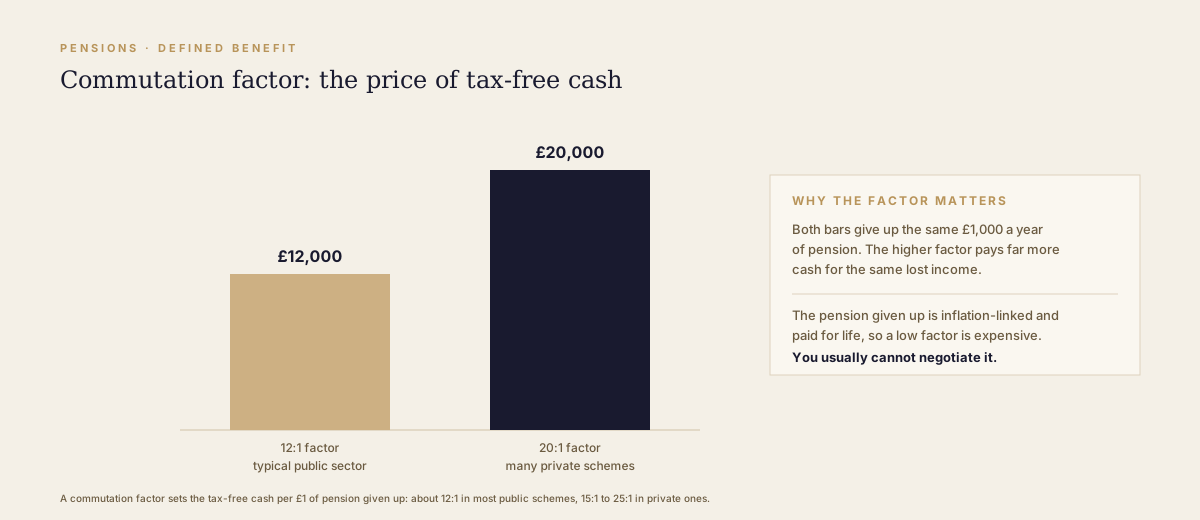
A commutation factor is the rate at which a defined benefit pension scheme converts part of your annual pension into a one-off tax-free lump sum at retirement. Give up £1 of annual pension for every £12 of cash on a 12:1 factor; the lower the factor, the more income each pound costs. Most public sector schemes use a relatively ungenerous factor of around 12:1, while many private schemes offer 20:1 or more, and you usually cannot negotiate it. The pension you surrender is normally inflation-linked and paid for life, so commuting too much can quietly cost far more than the cash appears to be worth.
A commutation factor is the rate at which a defined benefit pension scheme turns part of your annual pension into a one-off tax-free lump sum when you retire. A factor of 12:1 pays £12 of cash for every £1 of yearly pension you give up, so a £1,000 reduction in pension would raise £12,000 of tax-free cash. The figure decides how expensive that cash really is: a low factor means you surrender a large slice of guaranteed, inflation-linked income for relatively little, while a high factor lets the same lump sum cost far less pension. All figures and thresholds in this article reflect the 2026/27 tax year.
What is a good commutation factor?
A higher commutation factor is better value, because you give up less pension for the same cash. Many public sector schemes, including the NHS, use a factor of around 12:1, meaning £12 of lump sum for every £1 of annual pension surrendered. Private defined benefit schemes often offer 20:1 or more, so each pound of tax-free cash costs far less pension.
Contents
- What is a pension commutation factor?
- How does commutation work in a defined benefit pension?
- How is the maximum tax-free lump sum calculated when none of it is automatic?
- How does an automatic lump sum change the maximum?
- Why does a low commutation factor mean poor value?
- How does commutation fit into your wider retirement plan?
- Should you commute pension for a tax-free lump sum?
What is a pension commutation factor?
A commutation factor is the conversion rate your scheme applies when you swap guaranteed annual pension for a tax-free lump sum. It is written as a ratio, such as 12:1 or 20:1, and it answers one question: how many pounds of cash do you receive for each pound of yearly pension you give up? Only defined benefit, or final salary, pensions use a commutation factor, because only they promise a set income that has to be converted into capital.
The factor is set by the scheme’s actuary, not by you, and it reflects how much the scheme thinks the income you are giving up is worth. A 12:1 factor implies the scheme values £1 of your pension at £12 of cash, even though replacing that same inflation-linked income on the open market would usually cost much more. That gap is the heart of the issue.
The crucial point is that the commutation factor, not the size of your pension, decides how good a deal the cash is. Two people with identical pensions can give up very different amounts of income to raise the same lump sum, purely because their schemes use different factors.
Risk warnings
Levels and bases of, and reliefs from, taxation are subject to change and their value will depend upon personal circumstances. Taxation and pension legislation may change in the future.
Your pension income could also be affected by the interest rates at the time you take your benefits. The tax implications of pension withdrawals will be based on your individual circumstances, tax legislation and regulation which are subject to change in the future.
How does commutation work in a defined benefit pension?
Commutation lets you trade part of your guaranteed annual income for a larger tax-free lump sum at the moment you start drawing benefits. You tell the scheme how much pension you want to give up, within the scheme and HMRC limits, and the commutation factor converts that sacrifice into cash. The remaining pension is then paid at the reduced level for the rest of your life, with the scheme’s usual annual increases applied to the lower figure.
Whether you have any choice at all depends on the scheme design. Some older schemes, such as the NHS 1995 section, paid an automatic tax-free lump sum on top of the pension, so commutation was only needed to take more than that. Many career average schemes provide no automatic lump sum at all, which means the only way to take any tax-free cash is to commute pension at the scheme’s factor.
That tax-free cash has a formal name, the pension commencement lump sum, and the same 25% tax-free rules apply whether the cash comes from a defined benefit or a defined contribution pension. The difference is that in a defined contribution pension you simply withdraw 25% of the pot, whereas in a defined benefit scheme the lump sum is manufactured by giving up income at the commutation factor.
Risk warning
HM Revenue and Customs practice and the law relating to taxation are complex and subject to individual circumstances and changes which cannot be foreseen.
How is the maximum tax-free lump sum calculated when none of it is automatic?
The maximum tax-free lump sum is the lower of two limits: 25% of the value of your benefits, and the lump sum allowance of £268,275 for 2026/27. HMRC sets the first limit in its pension commencement lump sum rules, where a defined benefit pension is valued at roughly 20 times the pension left after commutation, plus the lump sum itself. That total is the value of the whole pension rather than the cash you can take, and the cash is 25% of it: on the £20,000 pension used below the value comes to about £342,900, which caps the tax-free cash at about £85,700. The two depend on each other, because the value moves with the lump sum while the lump sum is 25% of the value, so a scheme solves them together rather than reading either off directly.
How much tax-free cash can you take from a defined benefit pension?
Up to 25% of the value of your benefits, capped by the lump sum allowance of £268,275. On a £20,000 pension with a 12:1 commutation factor, the maximum is about £85,700 of tax-free cash, taken by giving up around £7,140 a year of pension. A higher factor raises the cash for the same reduction.
The second limit, the lump sum allowance, is a lifetime cap across all your pensions of £268,275 for 2026/27, unless you hold a protected higher allowance. Most people never reach it, but members of generous schemes or those with several pensions can.
The 25% value test resolves into a formula you can run on your own numbers, which is what matters here, because your pension and your scheme’s factor are both particular to you. Where your scheme pays no automatic lump sum:
Maximum tax-free cash = (20 × annual pension before commutation) / (3 + (20 / commutation factor))
On a £20,000 pension at a factor of 12, the denominator comes to 3 + (20 / 12), or 4.667, so the maximum is £400,000 divided by 4.667, about £85,700. That 4.667 belongs to a factor of 12 and nothing else. On a 20:1 factor the denominator is 4, and on 25:1 it is 3.8, which is why the same pension raises more cash in a more generous scheme.
The income you are left with comes from the same two numbers:
Pension after commutation = annual pension before commutation − (cash you commute / commutation factor)
Where the scheme pays no automatic lump sum, the cash you commute is the whole tax-free lump sum, so £85,700 at a factor of 12 costs about £7,140 a year of pension and leaves roughly £12,860. The two formulas check each other: whatever your factor, the maximum tax-free cash always works out at 20/3 of the pension left after commutation, roughly 6.67 times it. That check holds in every scheme. The formula above does not, and the next section covers the ones it misses.
The calculation below works the standard case through in full.
Maximum tax-free lump sum on a 12:1 commutation factor
Sandra retires from a public sector scheme paying £20,000 a year with a 12:1 commutation factor.
| Input | Value |
|---|---|
| Starting annual pension | £20,000 |
| Commutation factor | 12:1 |
| Tax-free cap | 25% of value |
- HMRC caps the tax-free lump sum at 25% of the value of the benefits. That value is roughly 20 times the pension left after commutation plus the lump sum itself, so it is the value of the whole pension, not the cash.
- Solving that cap for the lump sum gives the maximum tax-free cash as (20 × annual pension before commutation) / (3 + (20 / commutation factor)).
- On £20,000 at a factor of 12 the denominator is 3 + (20 / 12), or 4.667, so the maximum is £400,000 divided by 4.667, about £85,700.
- The pension left is the pension before commutation minus the cash commuted divided by the factor. £85,700 divided by 12 is around £7,140 a year given up, leaving roughly £12,860 a year for life.
Result: Sandra can take about £85,700 tax-free, but only by surrendering around £7,140 a year of inflation-linked pension for the rest of her life.
How does an automatic lump sum change the maximum?
An automatic lump sum counts towards the same 25%, so it uses up part of the tax-free cash you would otherwise have commuted. Schemes that pay one, the NHS 1995 section being the best known at three times the pension, hand you that cash whether you commute or not, and the formula above gets them wrong in both directions: it understates the total tax-free cash available and overstates how much pension you have to surrender to reach it.
What you can commute on top of the automatic lump sum is:
Cash you can commute = ((20 × annual pension before commutation) − (3 × automatic lump sum)) / (3 + (20 / commutation factor))
Add the automatic lump sum back to that figure and you have your total tax-free cash. The 20/3 check survives intact, because it never depended on where the cash came from: whatever the scheme, the maximum still comes to roughly 6.67 times the pension you are left with.
Marcus, with an automatic lump sum of three times his pension
Marcus retires on a pension of £18,600 a year from a scheme that pays an automatic lump sum of £55,800, three times the pension, with a commutation factor of 12.
His commutable element is (20 × £18,600) − (3 × £55,800), which is £372,000 − £167,400, equating to £204,600, divided by a denominator of 4.667. That comes to about £43,800. Adding the automatic £55,800 gives total tax-free cash of roughly £99,600.
Reaching it costs him £43,800 divided by 12, about £3,650 a year, leaving roughly £14,950 of pension. Had the same £18,600 carried no automatic lump sum, his maximum would have been about £79,700, every pound of it commuted, costing £6,640 a year and leaving £11,960. The automatic lump sum is worth around £19,900 more in cash for £2,990 a year less pension surrendered.
That gap is why the commutation decision is a different question in a scheme with an automatic lump sum. Marcus reaches the HMRC ceiling having surrendered under a fifth of his pension, where a member with no automatic lump sum would have to give up more than a third of the same pension to reach a smaller total, so the factor of 12 costs Marcus far less. Members of schemes with no automatic lump sum face the factor at its full weight, because commuting is the only route to any tax-free cash at all.
Why does a low commutation factor mean poor value?
A low commutation factor is poor value because it pays you far less than the income you give up is actually worth. Replacing £1,000 a year of inflation-linked, spouse-protected income by buying an annuity on the open market could easily cost £25,000 or more, yet a 12:1 factor hands you just £12,000 of cash for surrendering it. You are, in effect, selling a valuable guarantee back to the scheme at a discount.
The discount is easy to miss because the lump sum looks large in isolation. What it hides is the lifetime cost: the pension you give up keeps rising with inflation and continues, in many schemes, to pay a survivor’s pension after you die. Commuting trades that long, growing stream for a fixed sum today.
A 12:1 commutation factor sells a pound of inflation-linked income for life at the price of a fixed twelve, which is why the lump sum so often flatters a decision the underlying maths does not support.
This is where a difference that looks minor on the surface changes the outcome materially. The worked example below shows two retirees raising exactly the same tax-free cash, where only the commutation factor differs.
Raymond and Bridget, both taking £60,000 of tax-free cash
Raymond is in a private defined benefit scheme with a 20:1 commutation factor. To raise £60,000 of tax-free cash, he gives up £60,000 divided by 20, which is £3,000 a year of pension.
Bridget is in a public sector scheme with a 12:1 commutation factor. To raise the same £60,000, she gives up £60,000 divided by 12, which is £5,000 a year of pension.
They walk away with identical cash, yet Bridget surrenders £2,000 a year more income than Raymond, every year, rising with inflation and reducing the base on which her future increases are paid. Over a 25-year retirement that gap runs to roughly £50,000 of pension before any inflation uplift. The commutation factor, not the cash, decided the price each paid.
How does commutation fit into your wider retirement plan?
Commutation should be judged against what the cash is for, not taken automatically because it is offered. A lump sum that clears a mortgage, funds the early, more active years of retirement, or bridges the gap before the State Pension starts can be worth giving up some income for. Taking the maximum simply because it is tax-free, with no plan for the money, is how members on a 12:1 factor quietly erode a guaranteed income they cannot rebuild.
The decision also interacts with tax and inheritance rules. Tax-free cash that is taken and then paid back into a pension can fall foul of the tax-free cash recycling rules, which carry an unauthorised payment charge. Commuting also changes what is left in your estate. A scheme pension is not an asset anyone can inherit: it stops when you die, or continues at a reduced rate as a survivor’s pension, and neither counts in your estate. The lump sum is different. Once paid it is your capital, and whatever remains of it when you die sits in your estate, where anything above the available nil-rate bands is taxed at 40%. Commuting heavily and then not spending the cash converts income that would never have been taxed on death into capital that can be.
Commutation is one of the few defined benefit decisions that is genuinely irreversible. Once the pension is given up it cannot be reinstated, so the choice deserves the same care as any other permanent change to guaranteed income. Weighing it properly is part of pension and retirement planning.
Risk warnings
Your home may be repossessed if you do not keep up repayments on your mortgage. Think carefully before securing debts against your home.
Not all mortgage contracts are regulated by the Financial Conduct Authority.
Should you commute pension for a tax-free lump sum?
Whether you should commute depends on the factor on offer and what the cash will do, and on a low factor the bar is high. Giving up inflation-linked income for life at 12:1 means selling a valuable guarantee cheaply, so it is hardest to justify when you have no specific use for the money and ample income without it. The lump sum is tax-free and flexible, but flexibility is not free when the price is a permanent income cut.
There are sound reasons to commute. A clear purpose for the cash, such as clearing debt or front-loading spending into healthier early-retirement years, can outweigh the income given up, particularly on a more generous factor of 20:1 or higher. Someone in poor health, who may not draw the pension for long, may also rationally prefer cash now. The tax treatment is the other real argument. Under HMRC’s rules on tax-free pension cash, the lump sum is paid free of income tax while the pension you keep is taxed at your marginal rate, so a basic-rate taxpayer surrendering £1,000 of pension loses £800 a year after tax, and a higher-rate taxpayer £600, for the same £12,000. That tilts the arithmetic toward the cash, and it is the best case for commuting on a poor factor. It is still usually not enough at 12:1, because the income you surrender is guaranteed, rises with inflation, and lasts as long as you do.
What tips the balance is rarely the headline lump sum and almost always the commutation factor behind it. A high factor can make taking cash sensible; a low one means even a large lump sum is being bought with an outsized slice of secure income. Knowing your scheme’s factor, and what the surrendered pension would cost to replace, is the difference between an informed choice and an expensive default.
Is your scheme’s factor a fair trade?
A commutation factor turns a slice of guaranteed pension into tax-free cash, and the number itself decides whether that is a fair trade. On a 12:1 factor common in the public sector, each pound of lump sum costs more pension than the same cash would on a private scheme’s 20:1, and the income you give up is inflation-linked and paid for life. Read the lump sum not as a windfall but as the price of the pension you are selling back, check your scheme’s factor before you commit, and make sure the cash has a job worth that price.
Frequently asked questions
What is a commutation factor?
A commutation factor is the rate at which a defined benefit pension scheme converts part of your annual pension into a one-off tax-free lump sum. A factor of 12:1 pays £12 of cash for every £1 of yearly pension given up. The higher the factor, the more cash you receive for the same reduction in pension.
How does pension commutation work?
Commutation lets you swap some of your guaranteed annual pension for a larger tax-free lump sum when you retire. You choose how much pension to give up, up to the scheme and HMRC limits, and the commutation factor converts it into cash. The remaining pension is paid at the reduced level for the rest of your life.
What is a typical commutation factor in the UK?
Most large public sector schemes, including the NHS Pension Scheme, Teachers' and Civil Service schemes, use a commutation factor of around 12:1. Private sector defined benefit schemes vary more widely, commonly between 15:1 and 25:1. The factor is set by the scheme actuary and members generally cannot negotiate it.
Should you commute your pension for a tax-free lump sum?
It depends on what the cash is for and how generous the factor is. Commuting is harder to justify on a low factor such as 12:1, because you surrender a large slice of inflation-linked income for relatively little cash. It can make sense if you have a clear use for the lump sum and value flexibility over guaranteed income.
Does commuting your pension reduce your spouse's pension?
Usually not. In most defined benefit schemes the survivor's pension is calculated on your pension before commutation, so taking a lump sum reduces your own income but not the amount your spouse receives after your death. Always check your scheme rules, as a minority calculate it differently.
Can you take tax-free cash from a defined benefit pension without commuting?
Only if your scheme provides a separate lump sum on top of the pension, as the older NHS 1995 section did. Many career average schemes provide no automatic lump sum, so the only way to take tax-free cash is to commute pension at the scheme's factor. In that case the factor determines your entire lump sum.