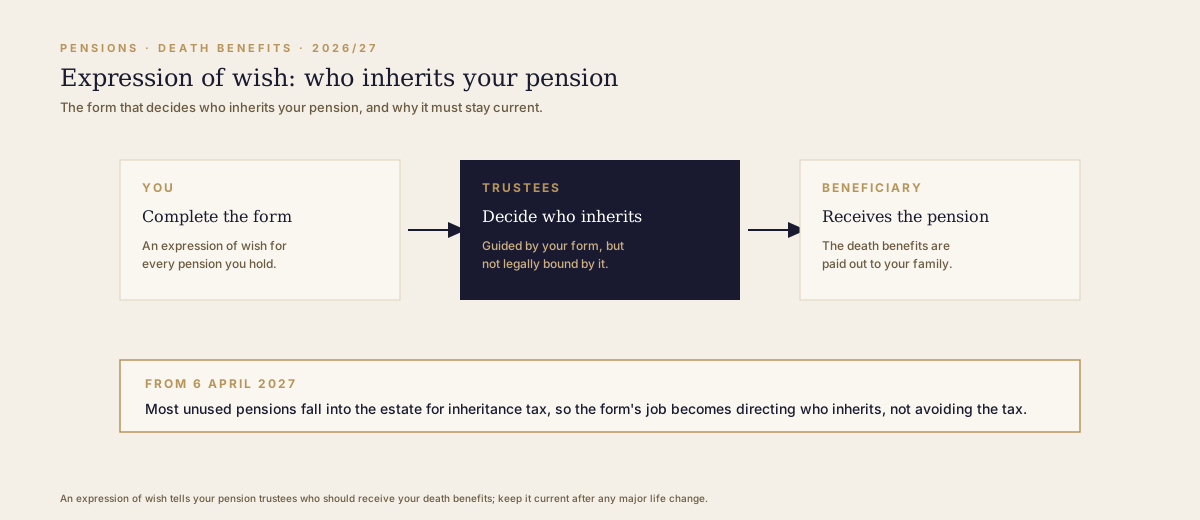
An expression of wish is a form telling your pension scheme's trustees who you would like to receive your death benefits, which they take into account but are not legally bound to follow. Complete one for every pension and update it after any major life change; otherwise your scheme's trustees alone decide who inherits your death benefits. The form is not legally binding, yet that very discretion is what has historically kept pension death benefits outside your estate for inheritance tax. From 6 April 2027 most unused pensions fall into the estate regardless, so the nomination's main job becomes directing who inherits and how, rather than avoiding the tax.
An expression of wish is the form your pension provider keeps nudging you to complete, and it is the only instruction your scheme holds about who should receive your retirement savings when you die. It is not part of your will and it is not legally binding, yet it shapes where a fund that may be worth more than your house actually goes. All figures in this article reflect the 2026/27 tax year. Most of what follows describes defined contribution pensions, the pots built up in a personal pension, a SIPP or a workplace scheme; a defined benefit pension nomination reaches less far, and has its own section below. What follows is how the form works, why its quiet legal status matters so much for inheritance tax, and how the rules change from April 2027.
Is an expression of wish legally binding?
No. An expression of wish guides your pension scheme’s trustees but does not bind them, so they keep the final say over who receives your death benefits. That discretion is deliberate: it is what has historically kept pension death benefits outside your estate for inheritance tax. Trustees almost always follow a clear, current form.
Contents
- What is an expression of wish?
- How does an expression of wish work?
- Why does trustee discretion keep a pension out of your estate?
- How does the April 2027 change affect your nomination?
- Who can you nominate, and how is the pension taxed?
- What if you have a defined benefit pension?
- How do I update an expression of wish?
- How does your nomination fit into your wider plan?
- Should you fill in an expression of wish?
What is an expression of wish?
An expression of wish is a form, sometimes called a nomination of beneficiaries, that tells your pension scheme’s trustees who you would like to receive your death benefits. You name the people or organisations you want to benefit, and the proportion each should receive, and the scheme keeps the form on record. It is the pension equivalent of leaving instructions, not a legal gift, and it sits entirely separate from your will.
The defining feature is that the form does not bind anyone. The trustees retain discretion over who actually receives the money, and they consider your nomination alongside your circumstances at the date of death. In practice a clear, current form is followed almost every time, but the discretion is real, and it exists for a reason that runs through the rest of this article. A binding nomination, which the scheme must follow exactly, is a different and less common arrangement that removes that discretion.
How does an expression of wish work?
An expression of wish works by giving the trustees a documented starting point for a decision that is legally theirs to make. When you die, the scheme administrator gathers the relevant facts, including your nomination, your marital status, your dependants, and anything else known about your situation, and then decides who should receive the death benefits. Because the decision is the trustees’ rather than a fixed entitlement written into your estate, the money can be paid quickly and without waiting for probate.
That speed is one of the practical advantages. The trustees can usually pay a nominated beneficiary within weeks of receiving a death certificate and claim form, where the rest of an estate may take months to administer. The recipient can often choose how to take the money, as a lump sum or as beneficiary drawdown, which keeps the fund invested and draws an income from it. A nomination that names the right people, in the right shares, is what makes those options available cleanly.
Risk warnings
Pensions
A pension is a long-term investment, the value of your investment and the income from it may go down as well as up. Your eventual income may depend upon the size of the fund at retirement, future interest rates and tax legislation.
Your pension income could also be affected by the interest rates at the time you take your benefits. The tax implications of pension withdrawals will be based on your individual circumstances, tax legislation and regulation which are subject to change in the future.
Pension drawdown
Drawdown pension plans (unsecured income) are complex and are not suitable for everyone. Pension decisions can affect your income for the rest of your life (and that of any partner and other dependants). Where benefits are accessed on a flexible basis, these are not fixed or safeguarded for life. If security of income is important to you then you should consider purchasing an annuity or taking a scheme pension to provide a secured level of income.
Why does trustee discretion keep a pension out of your estate?
Trustee discretion keeps a pension out of your estate because, in law, you never had a fixed right to give the money away. Since the death benefit is paid at the trustees’ discretion rather than as something you owned and directed, it does not form part of the estate that inheritance tax is charged on. GOV.UK confirms that a pension lump sum is not usually subject to inheritance tax precisely because the payment is discretionary. This is why a binding nomination, which hands the asset to a fixed person by right, can lose the very advantage that discretion provides.
Trustee discretion is the quiet engine of pension estate planning: because the trustees, not you, decide where the death benefit goes, the money has sat outside your estate, and a clear expression of wish is how you steer a decision you do not legally own.
This is a structural feature, not a loophole, and for years it has made pensions an unusually efficient way to pass on wealth. It is also why the form matters more than its informal name suggests. The discretion that delivers the tax treatment is the same discretion that means a careless or outdated nomination can be honoured to the letter, or set aside, with consequences you are no longer around to correct.
Risk warnings
Pensions
Levels and bases of, and reliefs from, taxation are subject to change and their value will depend upon personal circumstances. Taxation and pension legislation may change in the future.
Tax, trusts and estate planning
The Financial Conduct Authority does not regulate some aspects of Trust, Tax and Estate Planning.
How does the April 2027 change affect your nomination?
From 6 April 2027 most unused pension funds and pension death benefits will be counted as part of your estate for inheritance tax, regardless of trustee discretion. The change was given statutory effect by the Finance Act 2026, and HMRC’s technical note on Inheritance Tax on pensions sets out how the value will be brought into the estate. Inheritance tax is charged at 40% on the value of an estate above the nil-rate band, which is £325,000 for 2026/27 and frozen until April 2031, as GOV.UK explains. The full implications are covered in our guide to pensions and inheritance tax from April 2027.
What happens to your pension if you have not made an expression of wish?
The trustees still decide, but with no guidance from you. They pay according to scheme rules and what they can establish about your dependants, which may not match your wishes and often takes longer. From 6 April 2027 the death benefit also counts towards your estate for inheritance tax, whether or not a form was completed.
The change shifts what your nomination is for, but not whether it matters. The form will no longer be the lever that keeps a pension out of the inheritance tax net, because that net widens to include it. Its job becomes directing who inherits and how, and that is where two exemptions become important: a death benefit paid to a spouse, civil partner, or registered charity remains exempt from the charge, and death in service benefits from a registered scheme are excluded entirely, a point explained in our guide to death in service benefit. Who you name can therefore still change the tax outcome, even after 2027.
Risk warning
HM Revenue and Customs practice and the law relating to taxation are complex and subject to individual circumstances and changes which cannot be foreseen.
Who can you nominate, and how is the pension taxed?
With a defined contribution pension you can nominate almost anyone to receive your death benefits: a spouse or civil partner, an unmarried partner, your children, a more distant relative, a friend, a trust, or a charity. Since the pension freedoms of 2015, a non-dependant can take the inheritance as a lump sum or as drawdown, rather than only a dependant’s pension, which is what makes a nomination such a flexible planning tool. Splitting the fund between several beneficiaries by percentage is usually straightforward. A defined benefit scheme is more restrictive, as the next section explains.
How the inheritance is taxed for income tax turns on your age at death. If you die before 75, death benefits are generally paid free of income tax to the recipient, within the lump sum and death benefit allowance, which is £1,073,100 for 2026/27. If you die at 75 or older, the recipient pays income tax at their own marginal rate as they draw the money, so a beneficiary already on a high income may prefer drawdown to spread the tax. The mechanics of this age 75 rule, and how it sits alongside the 2027 inheritance tax change, are set out in how pensions are taxed on death.
Mark, 64, and a form he never updated
Mark divorced in 2019 and married Helena in 2021, but the expression of wish on his £480,000 SIPP still named his first wife, Sandra, from when he opened it a decade earlier. He never thought about the form again.
When Mark dies, the trustees hold a nomination pointing to an ex-spouse. They have discretion to look past it, but it is the clearest written evidence of his intentions, so Helena faces delay and a difficult claim to show what Mark actually wanted, with no guarantee of the outcome.
Had Mark spent ten minutes redirecting the form to Helena and his two children, the trustees would have paid them within weeks, each able to choose a lump sum or beneficiary drawdown. The fund, the rules, and the trustees were identical. A single unsigned update was the difference between a clean inheritance and a contested one.
What if you have a defined benefit pension?
If your pension is a defined benefit or final salary scheme, the expression of wish reaches only part of what is paid on your death. The survivor’s pension, usually around half of your own and payable for life, follows the scheme’s rules rather than your form: it goes to a legal spouse or civil partner, in some schemes to a qualifying cohabiting partner, and to dependent children up to the scheme’s age limit. You cannot redirect it to an adult child, a friend or a trust, however clearly the form is written, and because there is no fund to inherit there is no beneficiary drawdown option either.
What the form does direct is any lump sum: a death in service payment, usually a multiple of salary, if you die still working, or the balance of your contributions or the remainder of a guarantee period if you die soon after retiring. Who is eligible to receive it is set by the scheme’s own rules rather than by the general pension rules, and it varies: some schemes will pay a lump sum to anyone named, others confine it to relatives, dependants or your estate, and the trustees still choose within whichever class applies. So ask your administrator for the nomination criteria in writing, benefit by benefit. That lump sum is the part of a defined benefit scheme your form actually reaches, which is why it is worth completing.
The trap for unmarried members is a separate form. Several schemes, public sector ones in particular, run their own cohabiting partner nomination alongside the expression of wish, with its own tests on how long you have lived together and whether you are financially interdependent. Completing one and not the other is the costliest version of the out-of-date form problem, because naming your partner for the lump sum does nothing to make them eligible for the pension. Check whether your scheme runs one, and whether it holds a current one from you.
The restriction is not, on its own, a reason to transfer out. Giving up a guaranteed income for life to gain a fund you can nominate freely is a decision that runs one way only, and the inheritance case for it has narrowed since the April 2027 rules were announced. If passing money on is the motive, scheme income you do not need to spend can, where the gifts qualify, be given away under the normal expenditure out of income exemption without surrendering the pension at all.
On inheritance tax, defined benefit members are largely left alone by the April 2027 change. Dependants’ scheme pensions and registered death in service lump sums are both excluded from the new charge, as our guide to pensions and inheritance tax from April 2027 sets out. A discretionary lump sum or a guarantee period payment can still fall into the estate.
Important information
We do not currently provide advice on transferring out of defined benefit (final salary) pension schemes. If you require this advice, we will provide details of a suitably qualified adviser at a firm with the necessary regulatory permissions who can assist you.
How do I update an expression of wish?
You update an expression of wish by completing a fresh nomination form for each pension scheme and submitting it to that provider, which replaces whatever was on file before. Most schemes let you do this online in minutes, and there is no charge. Because a nomination applies only to the scheme that holds it, the single most common mistake is updating one pension and forgetting the others.
There are four practical steps. First, list every pension you hold, including old workplace schemes, personal pensions, and any SIPP, since each carries its own separate form. Second, name your beneficiaries and the share each should receive, adding a short note where your situation is unusual. Third, submit the form to each provider and confirm it has been received and logged, because the nomination only takes effect once the scheme has it on record. Fourth, review every form after any major life change, such as a marriage, divorce, birth, or death, and at least every few years in any case. Consolidating old pensions can make this easier, though it is a decision with its own trade-offs worth weighing separately.
How does your nomination fit into your wider plan?
Your nomination fits into a wider plan as the instruction that connects your pension to everyone else’s inheritance, and it needs to agree with the rest of your estate planning rather than contradict it. A common and avoidable error is to leave your pension to someone in your will, which has no effect, because the pension passes through the trustees and not the estate. Your will and your expression of wish are separate documents covering separate assets, a distinction that becomes painfully clear when someone dies without aligning them, as our guide to dying without a will illustrates.
After April 2027, the pension also has to be planned alongside the assets it will be taxed with. A nomination to a spouse can defer the inheritance tax charge, while cover written in trust, as explained in putting life insurance in trust, can supply the liquidity to pay a bill that the pension itself now helps create. Seeing how a death benefit would land alongside the estate, the survivor’s income, and the eventual tax is exactly what inheritance tax planning and lifetime cashflow modelling are designed to map, and it is a natural part of any pensions and retirement planning review.
Risk warnings
Tax, trusts and estate planning
The Financial Conduct Authority (FCA) does not regulate Inheritance Tax Planning or Trust Advice.
Protection
Benefits of insurance products will be put at risk or cease altogether if premium payments are not maintained.
The definitions vary between product providers and will be described in the key features and policy document, if you go ahead with the plan.
Should you fill in an expression of wish?
Yes, you should fill in an expression of wish for every pension you hold, because it is free, takes minutes, and is the only guidance your scheme has about who should inherit savings that are often a household’s largest asset. Without one, the trustees decide in the dark, working only from scheme rules and what they can piece together about your dependants, which risks both delay and an outcome you would never have chosen. The cost of completing it is trivial against what it directs.
The one real trade-off is that the form does nothing if it is left to drift out of date, and that is where its value most often leaks away. A nomination made before a divorce, a remarriage, or the birth of a child can quietly point your pension at the wrong person, and the trustees’ discretion is no substitute for a clear, current instruction. So the honest answer is to complete the form and then treat it as a living document, revisiting it whenever your family changes. For a piece of estate planning that costs nothing, it carries more weight than almost anything else you will sign.
The smallest form with the largest consequence
An expression of wish is the smallest piece of paperwork in your financial life and one of the most consequential, because it tells the people holding your pension where it should go. Its informal, non-binding status is not a weakness but the source of its long-standing tax efficiency, and even as the April 2027 change brings most pensions into the inheritance tax net, the form still decides who inherits and how the money is taken. Complete one for every pension, keep it current, and make sure it agrees with the rest of your plan. The ten minutes it takes is rarely a close call against what it controls.
Frequently asked questions
What is an expression of wish on a pension?
An expression of wish is a form that tells your pension scheme's trustees who you would like to receive your death benefits. The trustees take it into account but keep the final decision, which is why pension death benefits have usually fallen outside your estate for inheritance tax. You complete one separately for each pension you hold.
How does an expression of wish work?
When you die, your pension scheme's administrator gathers the relevant facts, including your nomination, and the trustees then decide who receives the death benefits. Because the payment is at their discretion rather than a fixed entitlement, it can usually be made within weeks without waiting for probate. A clear, current form is almost always followed.
Does an expression of wish override your will?
Neither overrides the other, because they cover different assets. Your will deals with your estate, while an expression of wish deals only with your pension death benefits, which normally sit outside your estate and pass through the scheme's trustees instead. Leaving your pension to someone in your will has no effect; only the nomination form reaches the trustees.
What happens if your expression of wish is out of date?
The trustees still have discretion, but an out-of-date form is the strongest evidence of your intentions they hold, so a stale nomination can send your pension to an ex-spouse or omit a new family. It can also cause delay and dispute while trustees investigate. Reviewing the form after any major life change avoids this.
Can you nominate someone who is not a dependant?
Yes, if the pension is a defined contribution pot. Since 2015 you can nominate anyone, including adult children, an unmarried partner, or a trust, and a non-dependant can take the money as a lump sum or as beneficiary drawdown. A defined benefit scheme is different: your form directs any lump sum but only within the class the scheme rules allow, and the survivor's pension follows those rules alone, so where nobody meets them it is simply not paid.
How is an inherited pension taxed?
It depends on the age at death. If you die before 75, death benefits are usually free of income tax for the recipient, within the lump sum and death benefit allowance. If you die at 75 or older, the recipient pays income tax at their marginal rate. From 6 April 2027 most unused pensions also count towards your estate for inheritance tax.
Should you fill in an expression of wish?
Yes. It is free, takes minutes, and is the only instruction your pension scheme has about who should inherit your savings. Without one, trustees decide with no guidance, which risks delay and an outcome you would not have chosen. Keeping it current matters as much as completing it in the first place.