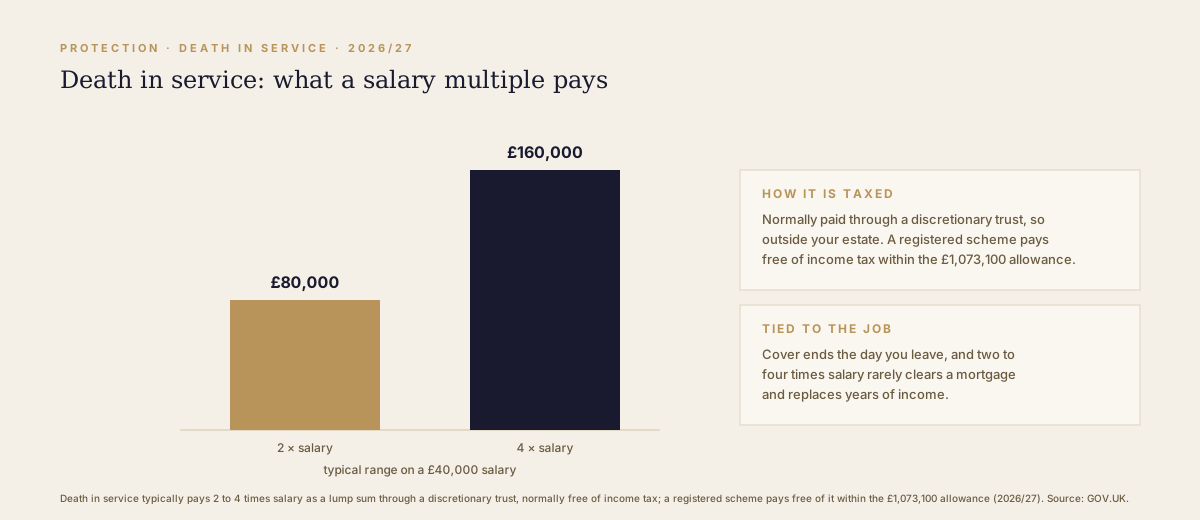
Death in service benefit is life cover provided by an employer that pays a lump sum, usually a multiple of salary, to an employee's beneficiaries if they die while still employed by the company. Treat death in service as a workplace perk rather than a substitute for personal life cover, because it ends the day you leave your employer. Most schemes pay a tax-free lump sum of two to four times salary through a discretionary trust, keeping it outside your estate for inheritance tax. It rarely matches a family's full needs, and changing jobs can leave a gap that your own policy would close.
Death in service is life cover that comes with your job: if you die while employed, the scheme pays a tax-free lump sum to your family, usually worth two to four times your salary. Your employer arranges the cover and pays for it, and you do not have to die at work for it to pay out. It is one of the most valuable workplace benefits people own without ever thinking about it, yet it has two features that catch families out: the cover stops the day you leave, and the payout is often smaller than a household actually needs. The figures and thresholds in this article reflect the 2026/27 tax year.
How much does death in service pay out?
Death in service typically pays a tax-free lump sum worth two to four times your annual salary if you die while employed. Some public sector and senior packages pay more. The multiple is set by the employer’s scheme, not by you, and is paid on top of any separate pension death benefits.
Contents
- What is death in service benefit?
- How does death in service benefit work?
- Is death in service benefit taxed?
- Does the April 2027 inheritance tax change affect death in service?
- What happens to death in service when you leave your job?
- Is death in service benefit enough on its own?
- How does death in service fit into a wider plan?
What is death in service benefit?
Death in service benefit is life cover provided by an employer that pays a lump sum to your beneficiaries if you die while employed by the company. The name is slightly misleading: you do not have to die in the workplace or because of your work. You simply have to be on the payroll when you die. The benefit is most often a fixed multiple of your salary, commonly two, three, or four times, and it is paid in addition to any pension your employer runs.
It is also known as group life assurance, because the employer insures all eligible employees together under a single scheme. That group basis is what makes it cheap to provide and is why it is offered as a standard benefit rather than something you apply for individually. There is usually no medical underwriting for ordinary levels of cover, so an employee who would struggle to buy personal life insurance on health grounds is still covered.
Two points define how useful the benefit really is. The cover belongs to the employer’s scheme, not to you, so it is only ever in force while you work there. And the sum assured is set by the scheme’s salary multiple, not by your family’s needs, so it may be generous, adequate, or well short depending on your circumstances.
How does death in service benefit work?
Death in service works by your employer taking out a group life policy that covers its workforce and pays the premiums on everyone’s behalf. If a covered employee dies, the scheme pays the agreed multiple of salary as a lump sum. In the great majority of schemes that lump sum is paid through a discretionary trust, which is what allows the money to reach the family quickly, without waiting for probate, and outside the deceased’s estate for inheritance tax. The reasons a trust changes the tax treatment of a lump sum so completely are the same ones that apply to writing a personal life insurance policy in trust.
Because the trustees hold legal discretion over who receives the money, you cannot direct the payment in your will. Instead you complete an expression of wish form, naming who you would like to benefit. An expression of wish is a non-binding nomination that tells the scheme trustees who you intend the lump sum to go to, while leaving the final decision with them. The trustees almost always follow it, but the discretion is deliberate: it is what keeps the payout out of your estate.
An expression of wish is the one part of death in service you control, and the one people most often forget. A nomination written before a divorce or a second family can send a six-figure sum to entirely the wrong person.
That makes keeping the nomination current the single most important action attached to the benefit. A marriage, a divorce, a new child, or simply changing employer all warrant revisiting the form.
Is death in service benefit taxed?
The answer depends on which of two structures your employer uses, and the difference is invisible from a payslip. Under a registered group life scheme, which is the common arrangement, death in service pays a tax-free lump sum where the employee dies before age 75 and the payment falls within their available lump sum and death benefit allowance. The standard lump sum and death benefit allowance is £1,073,100 for 2026/27, and a registered group life scheme’s payout is tested against it. Any part of the lump sum above the available allowance is taxed at the recipient’s marginal rate of income tax. The same age 75 threshold that governs how pensions are taxed on death applies here: lump sums paid where death occurs at 75 or over are taxed as income in the hands of the person who receives them.
For most employees the allowance is comfortably more than four times salary, so the benefit is paid in full and tax-free. The exception is higher earners, whose death in service cover can combine with pension lump sums to breach the allowance.
Adaeze, 54, earning £180,000 with 4x cover
Adaeze has death in service worth four times salary under her employer’s registered group life scheme, a lump sum of £720,000. She has also built a defined contribution pension of £600,000, which her scheme would pay as a lump sum on death before 75.
Both lump sums are tested against the same lump sum and death benefit allowance of £1,073,100 for 2026/27. Together they come to £1,320,000, which is £246,900 over the allowance.
The first £1,073,100 passes tax-free. The £246,900 excess is taxed as income of whoever receives it rather than of Adaeze, so her own £180,000 salary plays no part in the calculation.
Say the beneficiary is her husband Tomas, who earns £62,400. Adding £246,900 to his income for the year carries almost all of it past £125,140 into the 45% additional rate, and strips out his personal allowance on the way, so the tax comes to roughly £113,000 rather than the £99,000 a flat 40% would imply. The size of her salary multiple, not any choice she made, is what tips the total over the line.
The word trust does two jobs in that example, and they are not the same arrangement. Paying through the scheme’s own trust is what was described earlier, and it is the ordinary route: the scheme’s trustees hold the policy, exercise their discretion, and the money arrives with Tomas in his own right, taxed as his income.
Paying to a separate trust is a different act. If your expression of wish names a family trust or a spousal bypass trust instead of a person, the money is going to what HMRC calls a non-qualifying person, because the recipients are receiving it as trustees rather than in their own right. Any taxable part of the lump sum then carries a flat 45% charge in place of the recipient’s marginal rate. Below the allowance nothing is taxable, so nothing is charged; above it, the 45% lands instead of Tomas’s 45.8%, which is close enough that the tax is rarely the reason to choose either way. Naming a trust is sometimes the right answer, usually to keep the money out of a surviving spouse’s own estate, but it is a decision to take deliberately with advice rather than one to make by accident on a nomination form.
This is where the second structure matters. Some employers, particularly those covering high earners, use an excepted group life policy rather than a registered scheme, and it is taxed on an entirely different footing. An excepted policy is not a registered pension scheme, so its payout is not tested against the lump sum and death benefit allowance at all and there is no marginal-rate charge however large the sum. Adaeze’s £113,000 problem simply does not arise. The trade-off sits with the trust rather than the beneficiary: an excepted policy is held in a relevant property trust, which brings ten-yearly and exit charges of its own, though in practice these are usually small because the policy carries almost no value between claims and payouts are distributed promptly.
Which structure your cover uses is set by your employer, not by you, and it is the reason two people on identical salaries can face very different tax outcomes. If your pension and your death in service together approach £1,073,100, it is worth asking your HR or benefits team which one you are in. The same excepted structure sits behind a relevant life policy, which is how a company buys single-life cover for a director or a handful of staff when it is too small to run a group scheme.
Risk warnings
Pensions
Levels and bases of, and reliefs from, taxation are subject to change and their value will depend upon personal circumstances. Taxation and pension legislation may change in the future.
Tax, trusts and estate planning
HM Revenue and Customs practice and the law relating to taxation are complex and subject to individual circumstances and changes which cannot be foreseen.
Does the April 2027 inheritance tax change affect death in service?
No. Death in service benefits paid from a registered pension scheme are specifically excluded from the rules that bring unused pension funds into inheritance tax from 6 April 2027. The reform is aimed at unused pension pots, the savings someone dies without spending, rather than at employer life cover. HMRC has confirmed that death in service benefits payable from a registered pension scheme are out of scope of the new inheritance tax treatment, whether the scheme pays on a discretionary or non-discretionary basis.
This matters because the headlines around the pension changes coming in April 2027 have left many employees assuming their death in service lump sum will suddenly become taxable. It will not. The benefit continues to be paid free of inheritance tax, normally through the same discretionary trust that has always sat behind it. What changes from April 2027 is the treatment of the pension pot you have saved into, not the salary-multiple cover your employer provides.
What happens to death in service if you leave your employer?
Death in service cover ends on the day you leave the employer. There is no payout, no transfer value, and nothing to take with you. If your new employer offers no scheme, or you move to self-employment, a career break, or retirement, you have no death in service cover at all unless you have your own life insurance in place.
What happens to death in service when you leave your job?
Death in service cover ends the moment you stop being an employee of that company. It is not a policy you own, so there is no surrender value, no transfer, and no continuation. If you change jobs, you rely entirely on whether your new employer offers a scheme, and on any waiting period before you join it. If you move into self-employment, take a career break, or retire, the cover simply disappears.
This is the gap that catches families out, because it tends to coincide with the moments life cover matters most.
Daniel and Priya, both 42, changing jobs
Daniel and Priya each earn £60,000 and each have death in service worth four times salary, £240,000, at their current employer. Both resign to join the same early-stage company, which offers no death in service cover.
Years ago Daniel also took out a £300,000 personal term policy. Priya relied solely on her workplace benefit, reasoning that £240,000 was plenty.
On the day they both resign, Priya’s £240,000 of cover vanishes and she has nothing in place. Daniel’s family stays protected by his own policy throughout. A routine job move, not their health or their age, is what leaves one household fully exposed and the other untouched.
The practical lesson is that death in service should never be the only life cover a person with dependants holds. A modest personal policy, owned by you rather than your employer, bridges every gap between jobs and survives every career change.
Is death in service benefit enough on its own?
For most people with a mortgage or dependants, death in service is not enough on its own. A payout of two to four times salary sounds substantial, but set against a mortgage, the cost of raising children to adulthood, and years of lost income, it often falls short. A family earning £50,000 with a £300,000 mortgage and young children could easily need cover well beyond a £150,000 death in service sum. And because the cover ends when employment does, even an adequate benefit is only ever temporary.
The benefit is best understood as a foundation rather than a complete solution. The table below sets out why it does not replace a policy of your own.
| Feature | Death in service | Personal life insurance |
|---|---|---|
| Who pays | Your employer | You |
| Sum assured | Salary multiple, often 2 to 4x | Amount you choose |
| Lasts | Only while employed there | For the full term you set |
| If you change jobs | Cover ends | Cover continues |
| Control over who benefits | Expression of wish only | Named beneficiaries or trust |
Used together, the two work well. Death in service provides a layer of cover at no cost to you, while a personal policy fixes the amount, the term, and the certainty that it stays with you. For households weighing how much and what type of cover to hold, the choice between term and whole of life insurance is usually the next question, and one a protection planning review is built to answer.
Risk warnings
Your home may be repossessed if you do not keep up repayments on your mortgage. Think carefully before securing debts against your home.
Not all mortgage contracts are regulated by the Financial Conduct Authority.
How does death in service fit into a wider plan?
Death in service is one layer in a household’s protection, not the whole of it. It covers the risk of dying while employed, but says nothing about the larger risk most working people face, which is being unable to work through illness or injury. That gap is the job of income protection insurance, which replaces earnings month after month rather than paying a single lump sum on death. A plan that leans only on death in service has covered the less likely event and left the more likely one open.
It also interacts with retirement. Death in service stops when you stop working, so the cover falls away exactly as you move into retirement, when a different set of risks takes over, such as protecting a surviving partner’s income. For couples who depend on two pensions, insuring against the loss of a State Pension for a surviving spouse often matters more in later life than any salary-linked benefit ever did. Good planning treats death in service as a useful but temporary component, and builds the permanent cover around it.
Risk warning
The definitions vary between product providers and will be described in the key features and policy document, if you go ahead with the plan.
Valuable cover that leaves when you do
Death in service is a genuinely valuable benefit: tax-free cover worth several times your salary, paid for by your employer, usually outside your estate, and untouched by the April 2027 pension inheritance tax change. Its weaknesses are structural rather than incidental. The cover ends the day you leave, the salary multiple may not match what your family needs, and very high earners can find the lump sum tipping over the lump sum and death benefit allowance. The sensible response is to value it for what it is, keep the expression of wish current, and hold a personal policy of your own so that no job move or career break ever leaves your family without protection.
Frequently asked questions
What is death in service benefit?
Death in service benefit is life cover provided by an employer that pays a lump sum to your beneficiaries if you die while employed by the company. The payout is usually a multiple of your salary, commonly two to four times, and you do not have to die at work for it to be paid. The employer pays for the cover, not you.
How does death in service benefit work?
Your employer sets up a group life scheme covering its employees and pays the premiums. If you die while employed, the scheme pays a lump sum based on a multiple of your salary, usually through a discretionary trust so it reaches your family quickly and free of inheritance tax. You complete an expression of wish form to tell the trustees who you would like to receive it.
Is death in service benefit taxed?
For almost everyone, no, but which of two structures your employer uses decides what happens when the sum is large. A registered group life scheme pays a tax-free lump sum if you die before age 75, provided it is within the lump sum and death benefit allowance of £1,073,100 for 2026/27, with anything above the allowance added to the recipient's income and taxed at their marginal rate. An excepted group life policy is not tested against that allowance at all, so the payout is free of income tax however large, but the trust behind it falls under the relevant property regime. Either way the benefit is written under trust, so it sits outside your estate for inheritance tax.
Is death in service benefit enough on its own?
Usually not. A payout of two to four times salary often falls short of clearing a mortgage and supporting a family for years, and the cover disappears the moment you leave the employer. It is a valuable foundation, but most people with dependants or a mortgage still need their own life insurance alongside it.
Does death in service count towards the April 2027 inheritance tax change?
No. Death in service benefits paid from a registered pension scheme are specifically excluded from the rules bringing unused pension funds into inheritance tax from 6 April 2027. The change targets unused pension pots, not employer death in service lump sums, which continue to be paid free of inheritance tax through trust.
Can you choose who receives your death in service payout?
You cannot legally direct it, but you complete an expression of wish form nominating who you would like to benefit. The scheme trustees make the final decision, which keeps the payment outside your estate. Keeping the nomination up to date after a marriage, divorce, or new child is the single most important thing you can do.