Term and whole of life insurance are the two main forms of life cover: term insurance runs for a fixed period, while whole of life insurance covers you for life. Choose term insurance for temporary needs like a mortgage or young family; choose whole of life only when a payout must be certain to arrive. Term cover is far cheaper because most policies expire without paying out, whereas whole of life is guaranteed to pay and is priced accordingly. Whole of life premiums are often reviewable and can rise sharply with age, and any payout falls into your estate for inheritance tax unless the policy is written in trust.
The choice between term and whole of life insurance comes down to one question: do you need cover for a set period, or for certain? Term life insurance runs for a fixed number of years and pays out only if you die within that window, which keeps the premiums low. Whole of life insurance has no end date and pays out whenever you die, so it costs far more. For most families protecting a mortgage or replacing income, term is the right tool; whole of life earns its place mainly where a payout has to be guaranteed, such as covering an inheritance tax bill. All figures in this article reflect the 2026/27 tax year.
What is the difference between term and whole of life insurance?
Term life insurance runs for a fixed period, commonly 5 to 40 years, and pays out only if you die within that term, which makes it cheap. Whole of life insurance has no end date and pays out whenever you die, provided premiums are maintained, so it costs far more. Most term policies expire without ever paying a claim.
Contents
- The core difference
- How term insurance works
- How whole of life works
- How they compare
- How they are taxed
- Whole of life and inheritance tax
- Which should you choose?
What is the difference between term and whole of life insurance?
The difference is duration, and everything else follows from it. Term insurance covers you for a chosen number of years and lapses with no value if you survive the term. Whole of life insurance has no expiry, so as long as you keep paying, a claim is eventually certain. That certainty is the whole story behind the price gap: an insurer pricing a 25-year term policy is betting that, statistically, you will still be alive at the end of it and it will pay nothing, whereas an insurer pricing whole of life knows it is funding a payout that will arrive sooner or later.
Both products do the same basic job, paying a tax-free lump sum to the people you name. They sit alongside other protection such as critical illness cover, which pays out on diagnosis of a serious illness rather than on death.
Whole of life insurance is the more expensive product for a simple reason: the insurer knows it will pay out one day. Term insurance is cheaper because, most of the time, it never has to.
Risk warning
The definitions vary between product providers and will be described in the key features and policy document, if you go ahead with the plan.
How does term life insurance work?
Term life insurance pays a lump sum if you die within a fixed term you set at the outset, and nothing if you outlive it. Terms typically run from 5 to 40 years, chosen to match the period you have a financial responsibility: until the mortgage is repaid, or until the children are financially independent. You decide the sum assured and the length of cover, and the premium is usually fixed for the whole term on a guaranteed basis.
There are two common shapes. Level term keeps the sum assured flat throughout, which suits replacing income or covering an interest-only mortgage. Decreasing term reduces the payout each year to track the falling balance of a repayment mortgage, and is cheaper because the average cover over the term is lower. Many policies also offer optional extras such as adding critical illness cover, or a conversion option that lets you extend or switch the policy later without new medical questions.
The defining feature of term cover is that most policies never pay out, which is exactly why it is cheap. That is not a flaw. You are buying protection against dying too soon while others depend on you, not a savings plan, and the low cost is what makes a large sum assured affordable for a young family.
How does whole of life insurance work?
Whole of life insurance pays out whenever you die, with no end date, as long as the premiums are maintained. Because a claim is certain rather than possible, premiums are far higher than term cover for the same sum assured, and they buy permanence rather than a fixed window of protection.
The catch sits in how the premiums are structured. Many whole of life policies are reviewable: the insurer sets the premium for an initial period, often the first five or ten years, then reassesses it. At each review the cost can rise, sometimes steeply, as you age and the prospect of a claim draws nearer. A premium that looked affordable at 60 can become a strain at 80, and if you stop paying, the cover can fall away with little or nothing returned. Guaranteed-premium whole of life policies avoid this by fixing the cost for life, but charge more at the start to do so.
Do you pay tax on a life insurance payout in the UK?
A UK life insurance payout is free of income tax and capital gains tax. However, if the policy is not written in trust, the payout forms part of your estate and can be taxed at 40% inheritance tax above the £325,000 nil-rate band in 2026/27. Writing the policy in trust keeps the payout outside your estate.
This is why whole of life is rarely the right answer to a temporary need. Paying lifelong premiums to cover a mortgage that disappears in 20 years means buying decades of cover you no longer need, often at several times the cost of term.
Term vs whole of life insurance: how do they compare?
On a like-for-like basis, term and whole of life insurance differ across four things that matter: how long the cover lasts, whether a payout is certain, what it costs, and what it is for. The table sets them side by side.
| Feature | Term life insurance | Whole of life insurance |
|---|---|---|
| Length of cover | Fixed term, usually 5 to 40 years | No end date, covers your whole life |
| Pays out if you die | Only within the term | Whenever you die |
| Likelihood of a claim | Low; most policies expire unused | Certain, if premiums are maintained |
| Relative cost | Low | High, often several times more |
| Premium stability | Usually guaranteed for the term | Often reviewable and rises with age |
| Cash-in value | None | Limited or none on protection policies |
| Typical purpose | Mortgage, family income, fixed-period debt | Inheritance tax bill, guaranteed legacy, funeral costs |
The honest summary is that they are not really competitors. They answer different questions. Term cover is the efficient way to protect against a financial gap that has an end date, while whole of life is the tool for a need that never expires. Choosing whole of life for a temporary need, or term for a permanent one, is where the expensive mistakes happen.
How are term and whole of life insurance taxed?
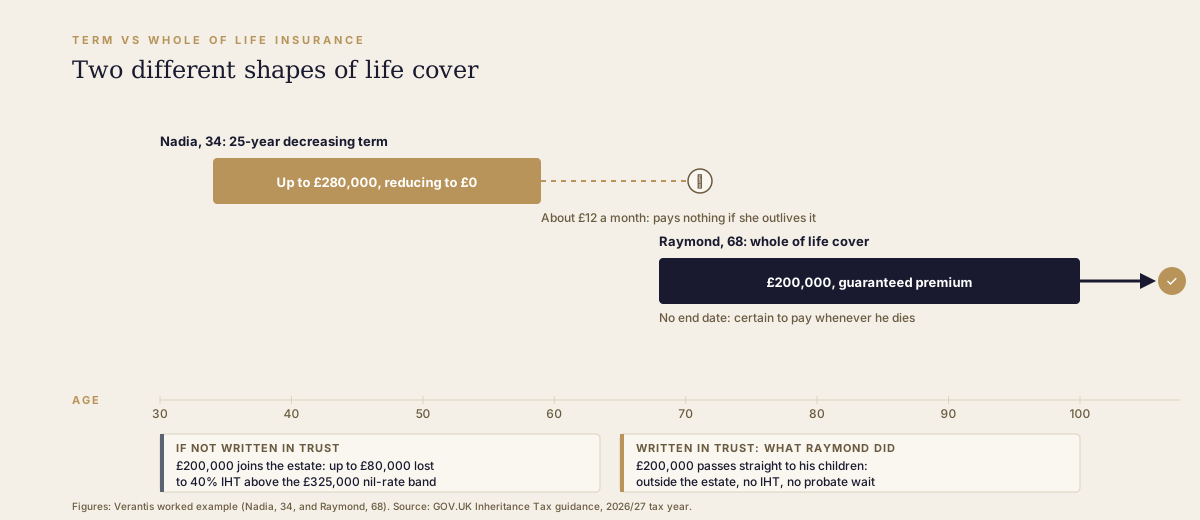
A life insurance payout is free of income tax and capital gains tax for both types of policy, but it can still be caught by inheritance tax. If a policy is owned by you and not written in trust, the proceeds are paid into your estate on death. Where your estate then exceeds the £325,000 nil-rate band, the excess is taxed at 40% in 2026/27, so a £200,000 payout sitting in a taxable estate could lose £80,000 to inheritance tax. The nil-rate band is frozen until April 2031, which steadily pulls more estates into the net. HMRC applies the 40% charge to the estate that holds the proceeds, and the mechanics are set out in GOV.UK’s inheritance tax guidance.
The fix is the same for either policy type: write it in trust. A policy held in trust pays the beneficiaries directly, outside your estate, so there is no inheritance tax on the proceeds and no wait for probate. GOV.UK explains how policies and trusts interact with tax, and the practical steps are covered in our guide to writing life insurance in trust. Premiums themselves attract no tax relief, so the only tax decision that really moves the numbers is whether the payout lands inside or outside your estate.
Risk warnings
HM Revenue and Customs practice and the law relating to taxation are complex and subject to individual circumstances and changes which cannot be foreseen.
The Financial Conduct Authority (FCA) does not regulate Inheritance Tax Planning or Trust Advice.
Why does whole of life cover suit an inheritance tax bill?
Whole of life cover suits an inheritance tax bill because the bill is certain and so is the payout. Inheritance tax falls due on death whenever that happens, which could be decades after a term policy would have expired. A term policy bought to cover an estate liability risks lapsing years before it is needed, leaving nothing to meet the charge. Whole of life, written in trust, provides a sum that arrives exactly when the tax does and sits outside the estate, so it does not inflate the very liability it is meant to settle.
Two people, two very different needs
Nadia, 34, has a £280,000 repayment mortgage and two young children. She buys 25-year decreasing term cover for around £12 a month, enough to clear the mortgage if she dies while the children are dependent. By her late 50s the mortgage is gone, the children have left home, and the policy quietly expires having cost her a few thousand pounds in total and paid nothing. That is the policy working exactly as intended.
Raymond, 68, has an estate of about £900,000 that will face an inheritance tax bill of roughly £200,000 whenever he dies. Term cover is no use to him, because the bill could arrive at 95. He takes out guaranteed-premium whole of life cover for £200,000, written in trust, at a far higher monthly cost. Whenever he dies, the trust pays his children £200,000 outside his estate, and they use it to settle the tax without selling the family home.
Nadia and Raymond could each have bought the other’s policy. Nadia would have paid many times more for lifelong cover she does not need, and Raymond would have been left with a policy almost certain to expire before it was ever needed.
This is also where insuring against the loss of a partner’s state pension and other long-term protection needs overlap, and where the type of cover, not just the amount, decides whether the plan actually holds together.
Risk warnings
The value of pensions and any income from them can fall as well as rise. You may not get back the full amount invested.
Levels and bases of, and reliefs from, taxation are subject to change and their value will depend upon personal circumstances. Taxation and pension legislation may change in the future.
A pension is a long-term investment and the value is not guaranteed. Any advice or considerations are personal to each individual’s circumstances.
Should you choose term or whole of life insurance?
Choose term insurance if your need has an end date, and whole of life only if it does not. For the overwhelming majority of people, the need is temporary: a mortgage to clear, children to raise, an income to replace until retirement. Term cover meets all of these for a low premium, which is why it is the default recommendation for family protection and why pairing it with income protection insurance often covers more ground than spending the same money on whole of life.
Whole of life makes sense in a narrower set of cases: a known inheritance tax liability, a wish to leave a guaranteed legacy regardless of how long you live, or covering funeral costs with certainty. The trade-offs are real. Guaranteed premiums cost more from the start, and reviewable premiums can climb to the point where you are tempted to cancel late in life, exactly when replacing the cover is hardest. Because the right answer depends on how long the need lasts and how your estate is shaped, this is a decision that sits within wider protection planning rather than a standalone purchase. The expensive errors are almost always a mismatch: buying permanent cover for a temporary need, or temporary cover for a permanent one.
Can you have both term and whole of life insurance?
Yes, and combining them is common. A typical arrangement is a large block of term cover to protect the mortgage and family income during your working years, plus a smaller whole of life policy in trust to cover a permanent need such as an inheritance tax bill or funeral costs. Layering policies this way means you pay the high whole of life premium only on the sum that genuinely needs to last forever, while the bulk of your cover stays on cheap term rates and falls away once the temporary need has passed. Each policy can be written in trust independently, so the structure works for both protecting dependants and managing your estate.
The price gap is not a value gap
Term and whole of life insurance are built for different jobs, and the price gap between them is not a sign that one is better value than the other; it reflects the difference between a payout that is merely possible and one that is certain. Term cover is the efficient way to protect a need with an end date, and most term policies are designed never to pay out. Whole of life is the tool for a need that never expires, and is worth its higher cost only when that permanence is genuinely required. Whichever you choose, the decision that most affects what your beneficiaries actually receive is whether the policy is written in trust, keeping the payout outside your estate and out of reach of a 40% inheritance tax charge.
Frequently asked questions
What is whole of life insurance?
Whole of life insurance is a policy with no fixed end date that pays a lump sum whenever you die, as long as you keep paying the premiums. Because the insurer knows it will eventually pay a claim, it is significantly more expensive than term cover. It is most often used to cover a known liability, such as an inheritance tax bill, or to leave a guaranteed legacy.
How does term life insurance work?
Term life insurance covers you for a set number of years, such as 25 years to match a mortgage. If you die during the term, it pays a tax-free lump sum to your beneficiaries. If you outlive the term, the policy ends and pays nothing. Level term keeps the payout fixed, while decreasing term reduces it over time to track a repayment mortgage.
Which is cheaper, term or whole of life insurance?
Term insurance is far cheaper, often by several times, because most term policies expire without ever paying out. Whole of life insurance is guaranteed to pay a claim one day, so the insurer prices in that certainty. A healthy person buying cover young will pay much less for term than for the same sum assured on a whole of life basis.
Is whole of life insurance worth it?
Whole of life insurance is worth it when you have a need that does not go away, such as an inheritance tax liability or a wish to leave a fixed sum whatever your age at death. It is rarely worth it for temporary needs like a mortgage, where term cover does the same job for a fraction of the cost. The main risk is reviewable premiums rising beyond what you can afford.
Can you convert a term policy to whole of life cover?
Some term policies include a conversion or guaranteed insurability option that lets you switch to whole of life, or extend cover, without fresh medical underwriting. Whether this is available depends entirely on the policy wording set at outset. If your needs may become permanent, it is worth checking for a conversion option before you buy, because adding one later is not possible.
Should you write a life insurance policy in trust?
Writing a policy in trust is usually sensible, because it keeps the payout outside your estate for inheritance tax and lets your beneficiaries receive it quickly, without waiting for probate. It costs nothing to set up with most insurers at the application stage. The main consideration is choosing the right type of trust and beneficiaries, which is worth taking advice on.