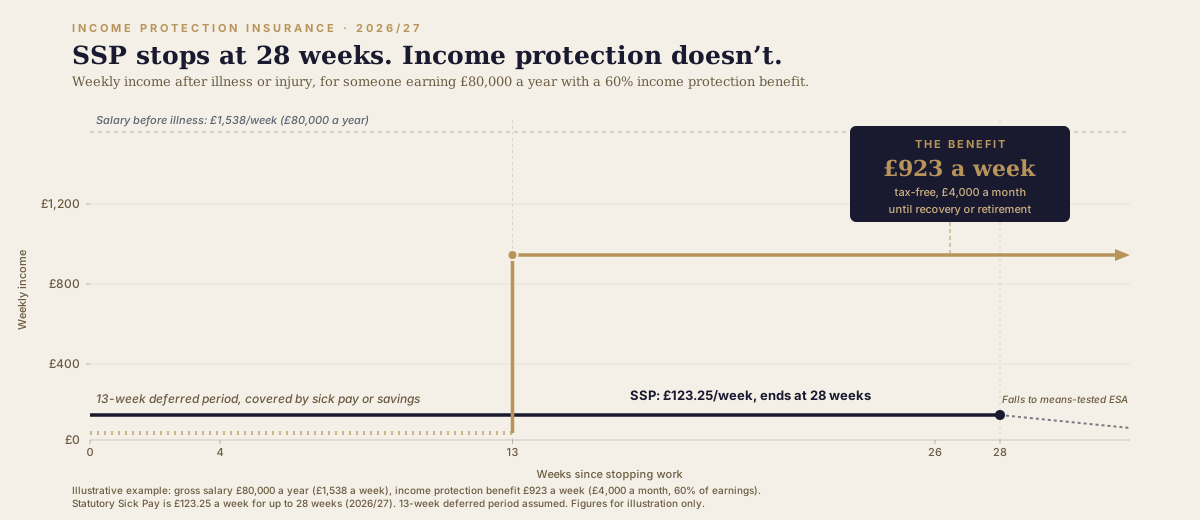
Income protection insurance is a long-term insurance policy that pays a regular replacement income to someone who cannot work because of illness or injury. Income protection pays a tax-free income worth roughly 50% to 65% of your earnings if illness or injury stops you working, starting after a waiting period you choose. Unlike critical illness cover, it keeps paying for as long as you remain unable to work rather than only on diagnosis, which is why advisers often treat it as the foundation of a protection plan. The longer the deferred period you accept before payments begin, the lower the premium.
Income protection insurance pays you a regular, tax-free income when illness or injury stops you working. It is the policy that answers a question most household budgets cannot: what happens to the bills if your salary disappears for a year, or five years, because of your health. Statutory Sick Pay is £123.25 a week and runs out after 28 weeks, and the state safety net beyond that is modest, so for most working people their earnings are the single largest asset they own and the least insured. The figures in this article reflect the 2026/27 tax year. What follows is what income protection covers, what it pays, how the deferred period shapes the cost, and how to judge whether it earns its place in your plan.
What does income protection insurance cover?
Income protection covers loss of earnings caused by almost any illness or injury serious enough to stop you working, from a back problem to cancer to a mental health condition. It pays a regular monthly benefit after a chosen waiting period and keeps paying until you can work again, or the policy term ends, whichever comes first.
Contents
- What is income protection insurance?
- How does income protection insurance work?
- How much does income protection pay, and is it taxed?
- What types of income protection are there?
- Income protection vs critical illness cover and life insurance
- Is income protection insurance worth it?
- How does income protection fit into a wider plan?
What is income protection insurance?
Income protection insurance is a long-term policy that pays a regular replacement income if illness or injury stops you working. Unlike most insurance, it does not pay out on a single event such as a death or a named diagnosis. It pays because you cannot earn, and it keeps paying for as long as that remains true, up to the end of the policy, or the point you recover.
That breadth is the point. Income protection pays a regular income to replace part of your earnings when illness or injury keeps you from working, and the cause barely matters: musculoskeletal problems, cancer, heart conditions, and mental health all sit within a typical policy. The benefit is a monthly amount, not a lump sum, because it is designed to stand in for the salary that has stopped.
Two features distinguish it from the state safety net. First, the amount is meaningful, set as a percentage of your earnings rather than a flat statutory figure. Second, it is long term: a full-term policy can pay year after year, where Statutory Sick Pay lasts a maximum of 28 weeks.
Risk warning
The definitions vary between product providers and will be described in the key features and policy document, if you go ahead with the plan.
How does income protection insurance work?
You choose three things when you set up a policy: the benefit amount, the deferred period, and the term. The benefit is the monthly income paid while you are unable to work. The deferred period is how long you wait after stopping work before payments begin. The term is how long the cover lasts, often to your expected retirement age.
When illness or injury stops you working, you make a claim. After the deferred period passes, the insurer starts paying the monthly benefit, and it continues until you can return to work, or the policy term ends. If you recover and later fall ill again during the policy term, you can usually claim again. Premiums are paid monthly, and most modern policies offer guaranteed premiums, fixed for the life of the policy, rather than reviewable ones that can rise.
The deferred period is the main lever on cost. Common choices are 4, 13, 26, or 52 weeks. The longer you are willing to wait, the cheaper the premium, because you are agreeing to cover the early months yourself, whether from employer sick pay or savings. Matching the deferred period to the support you already have is where most of the value, and most of the saving, sits.
Tom and Hannah, both 34, choosing a deferred period
Tom and Hannah are the same age, both non-smokers in good health, and both want a £2,000 a month benefit. Tom is employed and gets six months of full sick pay from his employer. Hannah is a self-employed designer with no sick pay and about two months of essential costs in savings.
Tom sets a 26-week deferred period, because his employer covers the first six months. His policy only ever pays after that gap, so the premium is low, perhaps around £20 to £25 a month.
Hannah cannot afford to wait six months with nothing coming in, so she chooses a 4-week deferred period. Her policy does far more work and starts paying almost immediately, so her premium for the same £2,000 benefit is roughly double Tom’s, in the region of £45 a month.
Same age, same health, same benefit. The deferred period, driven by sick pay and savings rather than by anything about their health, is what sets both the price and how much of the early risk each carries personally. Premiums are illustrative and vary by insurer, occupation, and health.
How much does income protection pay, and is it taxed?
A personal income protection policy pays its benefit tax-free, and most insurers cap the benefit at around 50% to 65% of your gross earnings. The cap exists deliberately: a tax-free 60% of gross salary is often close to your previous take-home pay, and insurers want you better off working than claiming. So although the headline percentage looks like a cut, the after-tax reality is usually nearer your normal net income than the gross figure suggests.
Do you pay tax on an income protection payout?
For a personal policy you pay the premiums from taxed income, so the benefit is paid tax-free. Employer-paid group or executive income protection works differently: the benefit is paid through payroll and taxed as employment income, because the premiums were never paid from your own taxed earnings.
The tax treatment turns on who pays the premium. Because a personal policy is funded from income you have already paid tax on, the benefit comes to you tax-free. Group income protection arranged by an employer is treated as a benefit paid through payroll and taxed as earnings, the same way HMRC treats your salary, so the gross benefit needs to be higher to deliver the same net result. For the self-employed, insurers usually base the benefit on recent taxable profits, which is one reason clean, consistent accounts make a claim smoother.
Risk warnings
The Financial Conduct Authority does not regulate Cashflow Planning.
HM Revenue and Customs practice and the law relating to taxation are complex and subject to individual circumstances and changes which cannot be foreseen.
What types of income protection are there?
Income protection varies along four main lines: the claims definition, how long each claim pays, whether the benefit keeps pace with inflation, and whether premiums are fixed. The most important of these after the deferred period is the claims definition, which decides how easily you can claim at all. “Own occupation” cover pays if you cannot do your own specific job, and it is the standard worth holding out for. Weaker definitions pay only if you cannot do any suited occupation, or cannot perform a set of basic daily activities, which is a far harder test to meet and the reason some cheaper policies rarely pay out as people expect.
Beyond the definition, the main choices are:
- Full-term vs short-term (budget) cover. Full-term pays until the end of the policy. Short-term or budget policies cap each claim at one or two years, which cuts the premium but leaves a long illness underinsured.
- Level vs index-linked benefit. A level benefit stays fixed; an index-linked benefit rises with inflation, protecting the real value of a claim that runs for years.
- Guaranteed vs reviewable premiums. Guaranteed premiums are fixed for the term. Reviewable premiums start lower but can be increased by the insurer.
Premiums are priced on age, health, smoking status, and occupation. A manual or higher-risk job costs more to insure than a desk role, and cover is always cheapest bought young and in good health, before any medical history accumulates to raise the price or restrict the terms.
Income protection vs critical illness cover and life insurance
Income protection, critical illness cover, and life insurance solve different problems and are easy to confuse. Income protection replaces income while you cannot work. Critical illness cover pays a lump sum on diagnosis of a specific named condition. Life insurance pays out when you die. The most common protection mistake is buying a lump-sum critical illness policy while leaving the regular-income risk, the far more likely one, uninsured.
| Feature | Income protection | Critical illness cover | Life insurance |
|---|---|---|---|
| Pays out when | Illness or injury stops you working | You are diagnosed with a named condition | You die or are diagnosed terminally ill |
| Form of payout | Regular monthly income | One-off lump sum | One-off lump sum |
| Covers | Long-term loss of earnings | A defined list of conditions | Dependants or debts after death |
| Typical use | Replacing income while off work | Clearing a mortgage or one-off costs | Protecting a family or mortgage |
Income protection is the only one of the three that keeps paying month after month for as long as you cannot earn. The other two settle a single event and stop, which is why income protection is so often the foundation a protection plan is built on, not an afterthought.
The three are complementary rather than competing. A lump sum can clear a mortgage; a regular income keeps the rest of life running. Where a lump sum is involved, writing the policy in trust can keep the payout outside the estate and speed it to the people who need it, a point that applies to life cover and critical illness more than to income protection’s monthly benefit.
Risk warnings
Tax, trusts and estate planning
The Financial Conduct Authority does not regulate some aspects of Trust, Tax and Estate Planning.
Mortgages
Your home may be repossessed if you do not keep up repayments on your mortgage. Think carefully before securing debts against your home.
Not all mortgage contracts are regulated by the Financial Conduct Authority.
Is income protection insurance worth it?
Income protection is worth it for most people who depend on their earnings and could not absorb a long gap in income, and it is hard to justify for those who could. The deciding question is simple: if your pay stopped for two years, what would cover the mortgage, food, and bills? If the honest answer is Statutory Sick Pay of £123.25 a week followed by Employment and Support Allowance and a thin savings buffer, the policy is doing real work.
The trade-off is cost against likelihood. Premiums are a permanent monthly outgoing for a risk that may never crystallise, and a policy with a weak claims definition can disappoint at the worst moment. But the probability of a working-age person being signed off for six months or more is materially higher than the probability of dying young, which is the risk most people insure first. The self-employed and single-income households tend to gain most, because they have the least to fall back on. Those with substantial savings, a partner’s income that covers the essentials, or generous employer cover may reasonably decide the gap is already filled, or simply choose a long deferred period to insure only the part they cannot self-fund.
How does income protection fit into a wider plan?
Income protection underpins everything else in a financial plan, because every other goal assumes the income keeps arriving. Pension contributions, mortgage payments, and saving towards the kind of pension you want to retire on all stop the moment a salary does, and a long illness can quietly undo years of progress. Protecting the income protects the plan.
It also sits alongside, not instead of, an emergency fund. The cash buffer behind the 20% savings habit in the 50/30/20 approach is what carries you through the deferred period before the policy starts paying, which is exactly why the size of that buffer and the length of the deferred period should be set together. In retirement the risk changes shape: once you stop working there is no earned income to insure, but a partner’s death can still cut household income sharply, which is the separate question of insuring a State Pension for a surviving spouse.
Deciding how much cover you need, and how it interacts with pensions, savings, and a partner’s position, is the work that turns a policy into a plan. That is the role of protection planning within a broader financial strategy, rather than buying cover in isolation.
Risk warnings
The value of pensions and any income from them can fall as well as rise. You may not get back the full amount invested.
A pension is a long-term investment and the value is not guaranteed. Any advice or considerations are personal to each individual’s circumstances.
The policy that insures every other plan
Income protection is the least glamorous and most quietly important protection policy most working people can hold, because it insures the asset every other plan depends on: the ability to earn. Statutory Sick Pay and the state safety net stop well short of replacing a real income, and a serious illness is more likely during a working life than an early death. The policy is not free, and a weak claims definition or the wrong deferred period can blunt its value, so the cover is only as good as how well it is matched to your sick pay, your savings, and the income you actually need to protect.
Frequently asked questions
What is income protection insurance?
Income protection insurance is a long-term policy that pays a regular replacement income if illness or injury stops you working. It typically replaces 50% to 65% of your gross earnings, paid tax-free for a personal policy, and continues until you recover or the policy term ends.
How does income protection insurance work?
You choose a benefit amount, a deferred period before payments start, and a term. If illness or injury stops you working, you claim, and after the deferred period the insurer pays a monthly benefit. Payments continue until you can work again or reach the end of the policy term.
Is income protection insurance worth it?
It is usually worth it if you rely on your earnings and could not cover essential costs for long on Statutory Sick Pay of £123.25 a week for 2026/27. The self-employed and those with little sick pay or savings benefit most. It matters less if you have substantial savings or generous employer cover.
Do you pay tax on an income protection payout?
For a personal policy you pay the premiums from taxed income, so the benefit is paid tax-free. Employer-paid group or executive income protection is different: the benefit is paid through payroll and taxed as employment income, because the premiums were not paid from your taxed earnings.
What is the difference between income protection and critical illness cover?
Income protection pays a regular income for as long as illness or injury stops you working, covering almost any condition. Critical illness cover pays a one-off lump sum on diagnosis of a specific named condition, such as cancer or a heart attack, whether or not you can still work.
Can the self-employed get income protection?
Yes, and the self-employed often need it most, because they have no employer sick pay and cannot claim Statutory Sick Pay. Insurers usually base the benefit on recent taxable profits, so keeping clear accounts helps. A short deferred period suits those with little financial cushion.