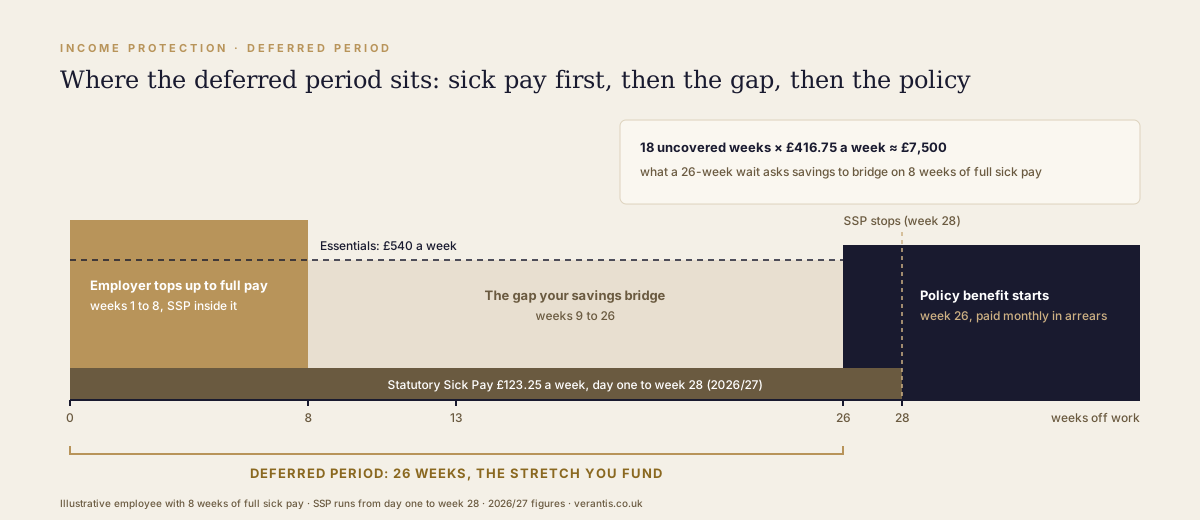
The deferred period is the waiting time on an income protection policy between becoming unable to work through illness or injury and the monthly benefit starting to be paid. Set the deferred period to end the week your sick pay and savings run out: standard options are 4, 13, 26 or 52 weeks. After the benefit amount, nothing moves the premium more, because a longer wait shifts the early months of any claim onto your own resources. Since 6 April 2026 Statutory Sick Pay starts on day one, but at £123.25 a week for 2026/27 it barely narrows the gap a long wait leaves.
Every income protection policy asks you to choose how long you will wait between illness stopping you working and the benefit starting to be paid. That wait is the deferred period: the single choice that sets when the money arrives and most of what the policy costs. It is also the feature you can only set well by looking away from the policy, at the sick pay and savings you already have, because the deferred period on an income protection policy is really a decision about which weeks you insure and which weeks you fund yourself. All figures in this article reflect the 2026/27 tax year.
How does an income protection deferred period work?
The deferred period starts on the first day illness or injury stops you working and runs for a set number of weeks, commonly 4, 13, 26 or 52. The benefit accrues only once the wait ends, and because it is paid monthly in arrears, the first payment usually arrives about a month after that.
Contents
- What is a deferred period on income protection?
- What deferred period options can you choose?
- How does the deferred period change income protection premiums?
- How does the deferred period work with sick pay?
- Which deferred period should you choose?
- What is a split deferred period?
- Who needs a short deferred period?
- How does the deferred period fit into a wider plan?
What is a deferred period on income protection?
A deferred period is the built-in wait between a claim starting and the money flowing: you become too ill to work, the clock starts, and the insurer begins paying only once the chosen number of weeks has passed. Insurers sometimes call it the waiting period. You choose it once, when the policy is set up, and it then applies to each new claim you make.
The wait exists because income protection is designed for the absence that lasts months or years, not the fortnight of flu. Short absences are common, so insuring them is expensive; long absences are rarer and far more damaging, so insuring them is cheap relative to the harm they do. The deferred period is the dial that removes the common, survivable weeks from the cover and leaves the serious risk insured. How the benefit, term and claims definition fit around that dial is covered in the wider guide to how income protection insurance works.
Seen that way, the deferred period is not a delay imposed on you. It is the part of the risk you have agreed to keep, priced accordingly.
Risk warning
The definitions vary between product providers and will be described in the key features and policy document, if you go ahead with the plan.
When does the money actually arrive?
Later than most people expect: the deferred period runs first, and the benefit is then paid monthly in arrears, so the first payment typically lands around a month after the wait ends. On a 13-week deferred period, the benefit starts accruing at week 13 and the first payment arrives around week 17. On a 26-week wait, real money appears roughly seven months after your last day at work.
That timing has a practical consequence: tell the insurer early. A claim should be registered within weeks of stopping work, not when the deferred period is about to end, because the insurer needs medical evidence from the start of the absence and may offer rehabilitation support long before any money is due. Waiting until month five to mention a month-six claim is a common and avoidable mistake.
What deferred period options can you choose?
Most insurers offer deferred periods of 4, 13, 26 or 52 weeks, and some add 8-week, 1-week or even day-one options for occupations that need them. The longer options pair with employer sick pay schemes; the shortest exist mainly for people with no sick pay at all.
Standard deferred period options and who each suits
| Deferred period | Typically suits | Premium |
|---|---|---|
| Day one to 2 weeks | Self-employed trades with no fallback | Highest |
| 4 to 8 weeks | Self-employed and statutory-only employees | High |
| 13 weeks | Employers paying around 3 months full pay | Mid |
| 26 weeks | Employers paying around 6 months full pay | Low |
| 52 weeks | 12-month sick pay schemes or large buffers | Lowest |
The table is a starting grid, not a menu to pick from on price: each row only makes sense next to the sick pay and savings that would carry you through it.
How does the deferred period change income protection premiums?
Lengthening the deferred period is the biggest premium cut available on income protection that does not shrink the benefit itself. The reason is claims frequency: absences of a few weeks happen constantly, absences beyond six months are much rarer. Each step from 4 to 13 to 26 weeks strips the most commonly claimed weeks out of the policy, so the price falls steeply at first and then more gently.
How much does a longer deferred period reduce the premium?
Moving from a 4-week to a 26-week deferred period can roughly halve the premium for the same benefit, though pricing varies by age, health and occupation. The saving comes from claims frequency: short absences are common and long ones are rare, so the early weeks of any claim are the most expensive to insure.
The saving is real, but it is conditional on your side of the bargain. A 26-week wait at a lower premium is a good trade only if you could genuinely fund 26 weeks; if you could not, the policy is cheap because it does not cover the risk you actually face. When cost needs trimming, a longer wait is usually still the right lever to reach for first, because the alternative, weakening the own occupation claims definition, removes the part of the policy that decides whether a claim pays at all.
A deferred period is a decision about whose money covers the first months of an illness. The premium follows that decision; it should never lead it.
How does the deferred period work with sick pay?
The deferred period is designed to end where your sick pay ends: the policy takes over from your employer rather than overlapping with it. What you would actually be paid, and for how long, lives in your contract or staff handbook, not in any insurance document, and it is the first fact to establish.
The statutory floor is modest. Statutory Sick Pay is worth up to £123.25 a week for 2026/27 and is paid by your employer for up to 28 weeks. Occupational schemes build on top of it: some employers pay six months at full salary, others pay full salary for a few weeks then step down to half, and many smaller employers pay the statutory amount only.
The rules changed at the start of this tax year. Since 6 April 2026, HMRC’s rates and thresholds for 2026 to 2027 set Statutory Sick Pay at £123.25 a week or 80% of average weekly earnings, whichever is lower, paid from the first day of illness rather than after three waiting days. Day-one sick pay softens the first week of an absence, but it does not change the planning picture: £123.25 a week is a fraction of most working incomes, and it still stops at 28 weeks.
After that, the main state benefit is Employment and Support Allowance, which is assessed on your capability for work in general and pays nowhere near a full salary. The state, in other words, provides a floor from day one and an assessment-based benefit after month seven, with nothing resembling your income in between.
Workplace cover changes the picture where it exists. Group income protection schemes usually set their own deferred period to dovetail with the employer’s sick pay, often 26 weeks, which is worth knowing before you buy a personal policy that duplicates the same months.
Risk warning
HM Revenue and Customs practice and the law relating to taxation are complex and subject to individual circumstances and changes which cannot be foreseen.
Which deferred period should you choose?
The one that starts paying the week your own resources stop. Work through it in order:
- Find out exactly what sick pay you would get. Not roughly: the number of weeks at full pay, the number at half, and the date the schedule was last changed.
- Count the weeks your savings could cover. Use your real monthly essentials, the spending that cannot stop, rather than your salary.
- Work out where the gap opens and what it costs. Weekly essentials minus sick pay, multiplied by the uncovered weeks.
- Choose the deferred period that ends there. Pick the standard option closest to the point your support runs out, and look at a split deferred period if your sick pay steps down in stages.
What a 26-week deferred period asks savings to bridge on 8 weeks of sick pay
Fiona, 41, gets eight weeks of full sick pay; her essentials come to £2,340 a month.
| Input | Value |
|---|---|
| Employer sick pay | 8 weeks at full pay |
| Monthly essentials | £2,340 (£540 a week) |
| Statutory Sick Pay (2026/27) | £123.25 a week to week 28 |
| Deferred period on the quote | 26 weeks |
- Weeks 1 to 8: full pay continues, so the gap is £0
- Weeks 9 to 26: income falls to Statutory Sick Pay of £123.25 a week, which is £416.75 a week short of essentials
- 18 uncovered weeks × £416.75 = £7,501.50, call it £7,500, before the policy pays at week 26
Result: A 26-week deferred period asks Fiona’s savings to bridge roughly £7,500; a 13-week wait shrinks that to about £2,100.
The arithmetic is the point, not the precision. Fiona’s quote defaulted to 26 weeks because it produced the lowest premium, but her sick pay supports a 13-week wait, and the difference between the two is £5,400 of exposure she would carry without noticing. Run the same three lines for your own numbers before accepting any quote’s default.
What is a split deferred period?
A split deferred period pays part of the benefit after a shorter wait and the rest after a longer one, so the policy steps in as your sick pay steps down. It exists because employer sick pay rarely stops in one move. A scheme that pays 13 weeks at full salary and then 13 weeks at half leaves you with two different gaps: no shortfall at all, then half your income missing, then all of it.
A single deferred period cannot follow that shape; a split one can. Half the benefit starts at week 13, replacing the half of your pay that has just stopped, and the full benefit starts at week 26 when sick pay ends altogether. Not every insurer offers the option, and the available split points are usually the standard steps rather than any week you like, but where the sick pay schedule steps down it is the precise tool for the job.
Who needs a short deferred period?
Anyone whose income would stop almost immediately: the self-employed above all, plus contractors between contracts and employees on statutory-only sick pay. Statutory Sick Pay is an employee payment, so a sole trader who cannot work has no employer to claim it from and the state safety net starts at Employment and Support Allowance rather than sick pay.
For that group the short options exist: 4-week and 8-week waits are widely available, and a few insurers, often friendly societies, will cover the first day of an absence at the highest premiums on the market. The honest way to choose between them is the size of the cash buffer. Someone holding three months of essentials can afford a 13-week wait and a markedly lower premium; someone holding three weeks of essentials cannot, and for them the expensive short wait is not an indulgence but the actual product they need.
How does the deferred period fit into a wider plan?
The deferred period and the emergency fund are the same decision seen from two sides: every week of wait is a week your savings are the insurer. That is why the two should be sized together, and why the buffer built by the savings habit in the 50/30/20 approach is not a separate project from protection but the first half of it. A bigger buffer buys a longer wait and a cheaper policy; a thin buffer makes the shorter, dearer wait the rational choice.
Osman and Margaret, both 47, three years after changing jobs
Osman and Margaret each took out income protection while working for a large firm that paid six months of full sick pay, and each sensibly chose a 26-week deferred period. Three years ago both moved to smaller companies that pay statutory sick pay only.
Margaret reviewed her policy after the move and shortened the wait to 8 weeks, which raised her premium by around £12 a month. Osman changed nothing, and his policy stayed exactly as cheap and exactly as mismatched as the day he switched jobs.
When a spinal operation kept Osman off work for nine months, he spent weeks 1 to 26 on Statutory Sick Pay of £123.25 a week (2026/27), funding the shortfall from his ISA and a credit card before the benefit began. Margaret, off work with the same operation, was receiving her benefit from week 8. Same policy, same premium history, same illness: the difference was a review neither policy document ever prompted. Premiums are illustrative and vary by insurer, occupation and health.
The example is the general rule: the deferred period is set against a sick pay schedule you might not have in five years, so a job change is the moment to re-read it. A lump sum from critical illness cover can bridge a long wait for the conditions it lists, but it is a complement rather than a substitute, and the comparison between the two policies is worth understanding before relying on it.
Matching the deferred period, the benefit and the claims definition to your actual sick pay and savings is the core of protection planning: the policy is only as good as the accuracy of the picture it was built around.
Insure the weeks you could not fund
The deferred period is where an income protection policy is tailored to you, and the tailoring is arithmetic rather than judgement: what you would be paid, for how long, what your essentials cost, and where the gap opens. Insure the weeks you could not fund and keep the weeks you could, because paying to insure income your employer already protects wastes premium, while defaulting to a long wait you cannot bridge leaves the exact risk you bought the policy for sitting on your own shoulders. The default on the quote is a price. The right deferred period is a plan, and it changes when your job does.
Frequently asked questions
What is the deferred period on income protection?
The deferred period is the waiting time between becoming too ill to work and an income protection policy starting to pay its monthly benefit. It is chosen when the policy is set up, is sometimes called the waiting period, and applies to each new claim rather than once per policy.
How does the income protection deferred period work with Statutory Sick Pay?
The two run in parallel: the deferred period is measured from your first day off work, not from the day sick pay ends. Since 6 April 2026 Statutory Sick Pay is paid from the first day of illness, at £123.25 a week (2026/27) or 80% of average weekly earnings if lower, for up to 28 weeks. A 26-week deferred period therefore ends two weeks before SSP itself runs out.
Is a 52-week deferred period worth it?
Only if you could genuinely fund a full year, from 12 months of employer sick pay or around a year of essentials in accessible savings. The saving over a 26-week wait is real but modest, because long claims are rarer than short ones, so each extra step of waiting removes less risk from the insurer. If a year without income would mean debt, the cheaper premium is a false economy.
Can you change the deferred period on an existing policy?
Often yes: many insurers treat it as a policy alteration, though shortening the wait usually needs fresh underwriting and a higher premium. The time to ask is when your sick pay changes, typically after moving jobs or going self-employed, not when your health does. Once a condition exists, altering cover on better terms becomes harder.
Does the deferred period apply every time you claim?
Each new claim normally starts its own deferred period, but a recurrence of the same condition is often treated differently. Many policies include a linked claims term: if the same illness returns within a set window of going back to work, commonly 12 months, the benefit restarts without a fresh wait. Check the policy wording, because the window and conditions vary by insurer.
What deferred period should the self-employed choose?
The one your cash buffer can bridge: with no employer sick pay to wait out, savings are the only thing funding the wait. Someone holding six months of essentials can take a 26-week wait and the lower premium that comes with it; someone holding a few weeks cannot, and needs the shorter, more expensive options between one and eight weeks. Statutory Sick Pay is an employee payment, so the buffer, not a sick pay schedule, sets the number.