Income protection insurance is a long-term policy that replaces part of your income when illness or injury stops you working, paying a monthly benefit after a chosen waiting period. Own occupation cover pays if you cannot do your own job; any occupation cover pays only if you cannot do any suitable work. The definition matters more than the benefit figure, because it decides whether the insurer accepts the claim at all. Cheaper policies often use the stricter any occupation or activities of daily living tests, which is why some cover rarely pays out as the policyholder expected.
The choice between own occupation vs any occupation income protection is the single most important detail on an income protection policy, and it turns on one word on the schedule. Own occupation cover pays out whenever illness or injury stops you doing your own job. Any occupation cover pays only if you cannot do any job you are reasonably suited to, which is a far harder test to meet. Two policies can carry the same benefit, the same premium ballpark, and the same insurer, yet settle the same claim completely differently. The figures here reflect the 2026/27 tax year.
How does the occupation definition affect an income protection claim?
The occupation definition sets the test the insurer applies to your claim. Own occupation asks only whether you can do your own job. Any occupation asks whether you can do any work you are medically and reasonably suited to, so the same illness can pay a full benefit under one definition and nothing under another. It decides whether a claim succeeds before the benefit amount matters at all.
Contents
- What do own occupation and any occupation mean?
- Own occupation vs any occupation: how do they compare?
- Why does the occupation definition decide whether a claim pays?
- What are activities of daily living and work tasks cover?
- Does group income protection use own or any occupation?
- Should you pay more for own occupation cover?
- How does the occupation definition fit into a wider plan?
What do own occupation and any occupation mean?
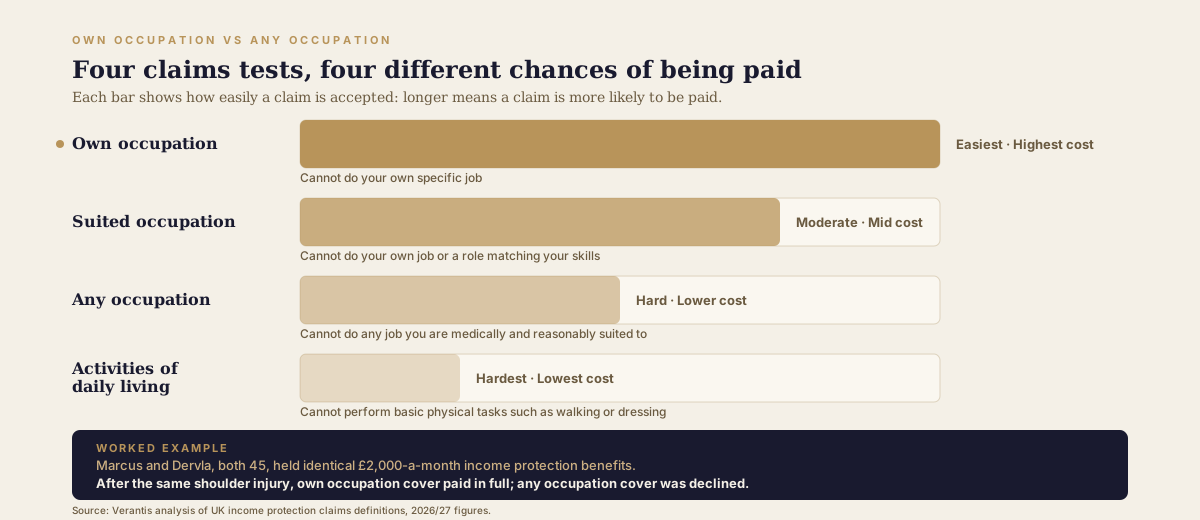
Own occupation and any occupation are two ends of a spectrum of claims definitions, the rule that decides when an income protection insurer will accept that you are unable to work. Own occupation measures incapacity against your actual job. Any occupation measures it against work in general. Between them sit two more definitions, so the full ladder runs from the most generous to the strictest: own occupation, suited occupation, any occupation, and activities of daily living.
The definition is fixed when you take out the policy and it is not the same thing as the benefit, the deferred period, or the term. Those decide how much you get and when. The definition decides whether you get anything. The occupation wording is rarely front and centre in a quote, which is exactly why it is so often overlooked.
A simple way to read the ladder: each rung asks you to be more incapacitated before a claim succeeds. Own occupation asks only that you cannot do your job. Activities of daily living asks that you cannot do basic physical tasks at all. The premium falls as you move down the rungs, because each step makes the insurer less likely to pay.
Risk warning
The definitions vary between product providers and will be described in the key features and policy document, if you go ahead with the plan.
Own occupation vs any occupation: how do they compare?
Own occupation is the most claimable definition and activities of daily living the least, with suited occupation and any occupation in between. The table sets out what each one asks of you before a claim is accepted, and roughly how the cost moves as the test gets stricter.
| Definition | You can claim if you cannot… | Ease of claim | Relative cost |
|---|---|---|---|
| Own occupation | do your own specific job | Easiest | Highest |
| Suited occupation | do your own job or one matching your skills and experience | Moderate | Mid |
| Any occupation | do any job you are medically and reasonably suited to | Hard | Lower |
| Activities of daily living | perform a set of basic physical tasks such as walking or dressing | Hardest | Lowest |
The gap between the top and bottom of the ladder is wide. Under own occupation, a surgeon who develops a tremor and can no longer operate has a clear claim. Under any occupation, the same surgeon might be told they could lecture, consult, or do administrative work, and the claim could fail. The illness is identical. Only the wording has changed.
This is why a like-for-like comparison of income protection on price alone is misleading. A cheaper premium often buys a stricter definition, and the saving comes directly out of the likelihood that the policy ever pays. The benefit headline can be identical while the real cover is not.
Why does the occupation definition decide whether a claim pays?
The occupation definition decides claims because it sets the question the insurer has to answer before releasing any money. Every income protection claim is assessed against the definition on the schedule, not against how unwell you feel or how much your income has dropped. If the definition is own occupation, the only question is whether you can do your job. If it is any occupation, the insurer can point to other work you are capable of and decline.
The occupation definition is the clause that decides whether income protection pays, yet it is the one most buyers never check. A policy can look identical on price and benefit and still fail at the only moment that counts.
That distinction is sharpest for people whose skills are specific. A self-employed tradesperson, a dentist, a professional driver, or a musician all earn from a particular physical or technical capability. Lose it and own occupation cover responds, because your own job has become impossible. Any occupation cover may not, because you could still do something. The narrower and more specialised the work, the more the definition matters.
Marcus and Dervla, both 45, same job, same injury
Marcus and Dervla are both self-employed plasterers, both 45, both non-smokers in good health. Each holds an income protection policy with a £2,000 a month benefit and a 13-week deferred period. The only difference is the occupation definition. Marcus has own occupation cover. Dervla chose any occupation cover, which saved her around £15 a month on the premium.
Both develop the same chronic shoulder injury. It ends manual work but leaves them able to sit at a desk. Marcus claims: he cannot plaster, so under own occupation his benefit is paid in full and continues while he remains unable to do his trade.
Dervla claims on the same facts. Her insurer assesses her against any occupation and concludes she is capable of sedentary work she is reasonably suited to, such as estimating or supervising. Her claim is declined. She has paid premiums for years and receives nothing at the moment she needs it.
Same job, same injury, same benefit. The £15 a month Dervla saved removed the part of the cover that pays out for someone who can no longer do their own trade. Premiums are illustrative and vary by insurer, occupation, and health.
What are activities of daily living and work tasks cover?
Activities of daily living cover is the weakest income protection definition, paying out only if you cannot perform a set number of basic physical tasks. These tasks typically include things like walking, climbing stairs, bending, lifting, and dressing, and a policy usually pays only when you cannot manage three or more of them without help or risk to your health. Some policies use a similar list called work tasks.
What are activities of daily living in income protection?
Activities of daily living are basic physical functions such as walking, bending, lifting, climbing stairs, and dressing. A policy that uses this definition pays only when you cannot perform several of these tasks, usually three or more, without help. It is the strictest income protection definition and the least likely to pay out for a claim that still leaves you mobile.
The catch is that someone can be entirely unable to earn yet still able to walk, dress, and lift a kettle. A serious mental health condition, chronic fatigue, or a stress-related illness can stop you working completely while leaving every activity of daily living intact. An activities of daily living policy would not pay, because the test has nothing to do with your job. This definition usually appears on the cheapest budget cover and on some policies sold without advice, which is part of why those policies decline more claims than buyers expect.
Does group income protection use own or any occupation?
Group income protection arranged by an employer commonly starts on an own occupation basis and can switch to a stricter test later in a long claim. Many schemes pay against your own job for an initial period, often two years, then reassess against a suited or any occupation definition. A claim that was paying happily can stop at that point if you are judged able to do other work, even though you still cannot do the role you were employed in.
This matters when you rely on workplace cover instead of a personal policy. Group income protection is valuable and usually cheaper per pound of benefit, but the definition can tighten over time in a way a good personal policy with a fixed own occupation definition does not. It is also tied to the job: leave the employer and the cover generally ends. The same is true of death in service benefit, which protects your family rather than your income but disappears the day you change jobs.
Should you pay more for own occupation cover?
For most people in skilled, physical, or specialised work, own occupation cover is worth the higher premium, because it is the only definition that reliably pays when their specific job becomes impossible. The extra cost is usually modest relative to the benefit, and it buys the part of the policy that actually responds to the most likely real-world claim. Paying for income protection and then holding a definition that rarely pays is the worst of both worlds: a permanent premium for cover that disappoints at the point of claim.
The honest trade-off is cost against certainty. Any occupation and activities of daily living cover are cheaper, and for someone whose only alternative is no cover at all, weak cover can still be better than none. But the saving is small and the loss of value is large, so the cheaper definition rarely makes sense as a deliberate choice. Where budget is tight, lengthening the deferred period or trimming the benefit usually protects more value than dropping to a weaker definition, because both of those leave intact the one feature that decides whether a claim pays at all. The same priority applies a level up, when choosing between policies rather than features within one: protect the more likely risk before the less likely one. Buying critical illness cover for a one-off diagnosis while leaving loss of earnings, the far more likely risk, on a definition that may not pay gets that priority backwards.
How does the occupation definition fit into a wider plan?
The occupation definition determines whether income protection does the job the rest of your plan assumes it will. Every other goal, the mortgage, pension contributions, and the household budget, rests on the income continuing, and a declined claim leaves that assumption exposed at the worst possible time. Getting the definition right is what turns the policy from a comforting line item into cover that actually holds.
It works alongside the support you already have rather than replacing it. Beyond Statutory Sick Pay of £123.25 a week for up to 28 weeks in 2026/27, the main state support is Employment and Support Allowance, which is itself assessed on whether you can do any work at all, much like an any occupation test, and pays far less than most working incomes. A personal own occupation policy fills the gap those leave. The cash buffer behind the 20% savings habit in the 50/30/20 approach carries you through the deferred period before the benefit starts.
Reviewing the definition is also the first thing to check on any policy you already hold. If you took out cover years ago, or it came bundled with a mortgage, read the schedule for the occupation wording before assuming you are protected. Matching the definition, the deferred period, and the benefit to your actual situation is the work of protection planning, and it is where a policy stops being a guess and starts being a plan. For the full picture of how the benefit, term, and tax treatment fit together, see the guide to income protection insurance.
Risk warnings
Pensions
The value of pensions and any income from them can fall as well as rise. You may not get back the full amount invested.
Levels and bases of, and reliefs from, taxation are subject to change and their value will depend upon personal circumstances. Taxation and pension legislation may change in the future.
A pension is a long-term investment and the value is not guaranteed. Any advice or considerations are personal to each individual’s circumstances.
Mortgages
Your home may be repossessed if you do not keep up repayments on your mortgage. Think carefully before securing debts against your home.
Not all mortgage contracts are regulated by the Financial Conduct Authority.
The definition that decides whether you get paid
Own occupation versus any occupation is the detail that decides whether income protection pays, and it is far more important than the small difference in premium between them. Own occupation responds when your own job becomes impossible; any occupation and activities of daily living demand that you cannot do other work, or basic physical tasks, before they pay. The cheaper definitions save a little each month and can quietly remove most of the cover’s value, so the single most useful thing you can do is read your schedule, find the occupation wording, and make sure it matches the work you actually do.
Frequently asked questions
What is the difference between own occupation and any occupation income protection?
Own occupation cover pays out if you cannot do your own specific job. Any occupation cover pays out only if you cannot do any job you are medically and reasonably suited to. The same illness can produce a successful claim under own occupation and a declined claim under any occupation, even with an identical benefit and insurer.
What does own occupation mean on an income protection policy?
Own occupation means the insurer assesses your claim against your actual job, not work in general. If illness or injury stops you doing that job, the benefit is payable even if you could in theory do something else. It is the most generous and most claimable definition, and usually the most expensive.
Is any occupation income protection worth it?
Any occupation cover can be worth it if the alternative is no cover at all, but it is far harder to claim on, because the insurer only pays if you cannot do any suitable work. For most people in skilled or physical jobs, own occupation cover is worth the higher premium, because it is the definition that actually pays when their specific work becomes impossible.
What is suited occupation income protection?
Suited occupation sits between own and any occupation. It pays if you cannot do your own job or another role that matches your education, training, or experience. It stops an insurer arguing you could take any unrelated job, but it is still weaker than own occupation, which ignores other work entirely.
Does group income protection use own or any occupation?
Group income protection arranged by an employer often uses own occupation in the early years of a claim, then can switch to a suited or any occupation test after a set period, such as two years. Always check the scheme rules, because a definition that tightens over time changes how long a long claim keeps paying.
How do I check which occupation definition my policy uses?
Read the policy schedule and key features document for the words own occupation, suited occupation, any occupation, or activities of daily living. If it is not clear, ask the insurer or adviser to confirm in writing. The definition is usually fixed at the start, so checking before you buy matters more than checking later.