Group income protection is an employer-arranged insurance scheme that pays a continuing percentage of an employee's salary, after a deferred period, if illness or injury stops them working long term. Most schemes replace 50% to 75% of salary, but the benefit is paid through payroll and taxed as income, unlike a tax-free personal policy. The employer arranges and pays for the cover, the employee is rarely underwritten individually, and payments usually start after a deferred period of three to six months. The cover ends the day the employment does, so it cannot follow you through a job change or into retirement.
Group income protection is income protection that an employer buys for its staff: if an employee is too ill or injured to work for an extended period, the scheme pays a continuing slice of their salary, typically 50% to 75%, rather than leaving them on Statutory Sick Pay alone. The employer arranges the cover and pays the premiums, the employee usually pays nothing and is rarely assessed on their own health, and the benefit only starts after a deferred period, often three to six months. It is one of the most useful benefits an employer can provide, and one of the most misunderstood, because the way it is taxed and the way it ends differ sharply from a policy you buy yourself. All figures in this article reflect the 2026/27 tax year.
How does group income protection work?
An employer takes out a group policy covering its employees and pays the premiums. If an employee cannot work long term through illness or injury, the insurer pays a percentage of their salary, usually 50% to 75%, after a deferred period of 13 to 52 weeks. The benefit reaches the employee through payroll.
Contents
- What is group income protection?
- How does group income protection work?
- How is group income protection taxed?
- Does salary sacrifice affect group income protection tax?
- How does group income protection compare with an individual policy?
- Is group income protection worth it?
- How does group income protection fit into a wider plan?
What is group income protection?
Group income protection is an insurance scheme an employer takes out to cover its workforce, paying a continuing percentage of an employee’s salary if illness or injury stops them working long term. It is the employer-arranged, collective version of an income protection policy, and HMRC and insurers also call it group permanent health insurance. The cover is held by the employer, not the individual, and every eligible employee is included under one policy.
Because the whole workforce is insured together, group income protection is only partially underwritten. The insurer prices the scheme on pooled risk, spreading the cost of likely claims across the whole group rather than assessing each employee individually, so most schemes provide automatic cover up to a free cover limit with no health questions asked. An employee who would struggle to buy personal cover on medical grounds is still protected up to that limit. Cover above the free cover limit, and cover for anyone who joins outside the scheme’s normal enrolment window, typically still needs individual medical underwriting in the same way as a personal policy. The benefit itself is defined by the scheme rules, usually a fixed percentage of salary, rather than by what any one person decides they need.
The benefit is designed to replace income for a sustained absence, not a short one. It sits behind Statutory Sick Pay and any company sick pay, and only begins once those have been exhausted and the deferred period has passed. That makes it a long-term safety net rather than cover for the first few weeks off work.
Risk warnings
Tax, trusts and estate planning
HM Revenue and Customs practice and the law relating to taxation are complex and subject to individual circumstances and changes which cannot be foreseen.
Protection
The definitions vary between product providers and will be described in the key features and policy document, if you go ahead with the plan.
How does group income protection work?
Group income protection works by the employer paying regular premiums on a policy that covers its employees, with the insurer paying out when a covered employee is signed off for an extended period. The payment is a set percentage of salary, commonly between 50% and 75%, and many schemes can also cover the employer’s pension contributions and National Insurance so that those continue during the absence.
The benefit does not start straight away. Statutory Sick Pay is £123.25 a week, or 80% of average weekly earnings if lower, for up to 28 weeks in 2026/27, and group income protection is built to take over once a long absence runs past that. The gap before payments begin is the deferred period, typically 13, 26, or 52 weeks, chosen by the employer to align with how long company sick pay lasts. A longer deferred period lowers the premium, which is the same trade-off that drives the cost of an individual income protection policy.
Once in payment, the benefit continues either until the employee recovers and returns to work, reaches the scheme’s ceiling age, or hits a limited payment term. Many modern schemes cap each claim at two or five years to keep premiums affordable, rather than paying right through to retirement.
Priya and Tom, both 45, both earning £80,000
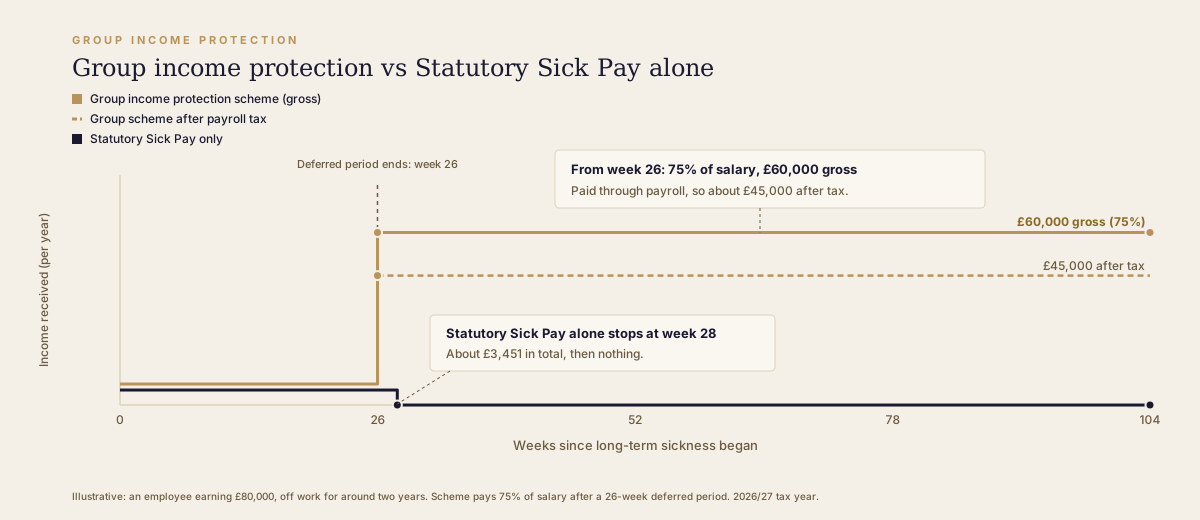
Priya and Tom each earn £80,000 and are each signed off work for around two years after a serious illness. Priya’s employer runs a group income protection scheme paying 75% of salary, the maximum most insurers will offer, after a 26-week deferred period. Tom’s employer offers only Statutory Sick Pay.
Tom receives £123.25 a week for up to 28 weeks, roughly £3,451 in total, and then nothing. Priya receives Statutory Sick Pay for the deferred period, then her scheme pays £60,000 a year through payroll.
After income tax and National Insurance, Priya nets around £45,000 a year for as long as the claim runs, while Tom’s household income from work has effectively stopped. The difference is a single decision by the employer to hold the cover, not any choice Priya or Tom made themselves.
Risk warnings
The value of pensions and any income from them can fall as well as rise. You may not get back the full amount invested.
Levels and bases of, and reliefs from, taxation are subject to change and their value will depend upon personal circumstances. Taxation and pension legislation may change in the future.
A pension is a long-term investment and the value is not guaranteed. Any advice or considerations are personal to each individual’s circumstances.
How is group income protection taxed?
Group income protection has a distinctive tax pattern: the employer gets relief on the premiums, the employee is not normally taxed on having the cover, but the benefit is taxed when it is paid. Each part matters, and the combination is what makes group cover behave so differently from a personal policy.
For the employer, the premiums are usually an allowable business expense, deductible against profit where the cover is provided wholly and exclusively for the trade. HMRC’s guidance on insurance premiums for employees and key persons sets out the conditions, and ordinary staff income protection generally meets them. For the employee, the cover is not normally treated as a P11D benefit in kind, so simply being insured does not create a tax charge.
Is group income protection a taxable benefit in kind?
No. In most cases group income protection is not a P11D benefit in kind, so an employee is not taxed simply for being covered. The tax falls instead on the benefit when a claim is paid: the insurer pays the employer, who passes it through payroll, so income tax and National Insurance are deducted as if it were salary.
The catch arrives at claim time. When the insurer pays out, it generally pays the employer, who passes the money to the employee through payroll. HMRC treats those payments as earnings taxable in the same way as salary, so income tax and National Insurance are deducted. That is why a headline 75% of salary delivers less in the hand than the same percentage from a personal policy, where the benefit is tax-free because the premiums were paid from already-taxed income. One wrinkle is worth flagging: where cover is funded through salary sacrifice under the Optional Remuneration Arrangements rules, the normal tax exclusion can be switched off entirely, a mechanism explained in detail below.
Risk warnings
It is important to note that salary sacrifice is not suitable for all employees. Employees’ pre-tax salary will be reduced. This may affect their entitlement to State Benefits.
Life cover or income protection policies may pay out on a multiple of salary. This may be less if salary is sacrificed.
Does salary sacrifice affect group income protection tax?
Yes. When an employee gives up salary to fund or top up their own cover, a set of HMRC rules introduced from 6 April 2017, known as the Optional Remuneration Arrangements provisions, remove a tax advantage that would otherwise apply. Under a normal employer-funded scheme, HMRC does not create any extra income tax charge simply because an employee has the cover: it is not treated as a taxable perk in the way a company car or private medical insurance is. That favourable position only holds when the employer bears the full cost.
When an employee gives up part of their salary through a flexible benefits platform to fund or extend their own cover, these rules change the calculation. HMRC looks at two figures: the amount of salary the employee gave up, and what it costs the employer to provide the extra cover. The employee then faces income tax and National Insurance on whichever of the two is higher. Since the salary sacrificed is usually the larger figure, the employee ends up paying tax and NI as though they had simply kept that money as salary, which removes the saving the sacrifice was intended to create.
Marcus, 38, topping up his income protection through a flex scheme
Marcus earns £55,000 a year and his employer runs a flexible benefits platform. The group scheme covers 60% of his salary as standard, but Marcus can extend that to 75% by giving up some salary each month through the platform.
He agrees to sacrifice £35 a month. The insurer charges his employer £24 a month for the extra layer of cover.
HMRC compares the two amounts and taxes Marcus on the higher one: the £35 of salary he gave up, not the £24 the cover costs. He also pays National Insurance on that same £35. The result is that the sacrifice gives Marcus no income tax or National Insurance saving. He loses £35 of gross pay each month and receives cover that costs the employer £24 to provide, leaving him paying more for the cover than it actually costs, which is the opposite of what most people expect from a salary sacrifice arrangement.
This only applies where an employee actively gives up salary to fund or top up their own cover, typically through a flexible benefits platform. Standard group income protection, where the employer pays all premiums from company funds with nothing sacrificed by the employee, is not affected at all. HMRC’s guidance on how salary sacrifice changes the tax treatment of income protection cover sets out the full detail of how the calculation works.
The practical check is simple: confirm whether any cover you hold, or are considering adding, is funded by your employer directly or through salary sacrifice. If the employer pays in full, the tax position described earlier applies. If salary sacrifice is involved, it is worth calculating the actual net cost before assuming there is a saving.
How does group income protection compare with an individual policy?
The core difference is ownership and tax: group income protection is owned and funded by your employer and the benefit is taxed, while an individual policy is owned and funded by you and pays out tax-free. Neither is simply better. They solve the same problem from opposite directions, and the right answer often involves both.
Group income protection versus an individual policy
| Feature | Group income protection | Individual income protection |
|---|---|---|
| Who arranges and pays | Employer | You |
| Is the benefit taxed? | Yes, through payroll | No, paid tax-free |
| Medical underwriting | Partially underwritten: pooled risk, then individual above the limit | Full individual underwriting |
| If you change jobs | Cover ends | Cover continues |
| Typical replacement level | 50% to 75% of salary | 50% to 65% of earnings |
| Who sets the terms | The employer’s scheme rules | You choose amount and term |
The standout weakness of group cover is that it belongs to the job. Leave the employer, and the cover stops with no transfer value and nothing to take with you. An individual policy you own moves with you across every job change, career break, or move into self-employment. The standout strength of group cover is access: because cover up to the free cover limit relies on pooled risk rather than individual underwriting, people who could not buy or afford personal cover are protected anyway, often at no cost to them. That access is not unconditional, though. Cover above the free cover limit is medically underwritten in the usual way, so a serious health condition can still limit what a higher earner gets without evidence of insurability.
Group income protection answers the question of who pays, but not the question of who is protected for life. The cover is generous while it lasts and worth nothing the day you leave, which is exactly why it works best layered with cover you own outright.
Is group income protection worth it?
For an employer, group income protection is usually worth it, because it covers the real and recurring cost of long-term sickness at a deductible, predictable premium, and the rehabilitation support that comes with most schemes actively helps employees return to work sooner. For the employee, it is a valuable benefit to have, but not a complete protection plan, because the payout is taxed and the cover disappears the moment the job does.
The honest trade-off is this. Group cover gives you protection you might never qualify for individually, at no premium cost to you, but on terms you do not control and that you lose when you leave. A personal policy costs you money and requires underwriting, but it is tax-free, portable, and set to your own needs. Relying only on group cover leaves two gaps: the tax taken off the benefit, and the cliff edge when employment ends. Many people use group cover as the base layer and a different personal policy to close those gaps. For a tailored view, a protection planning review can weigh the two against your wider position.
How does group income protection fit into a wider plan?
Group income protection covers one specific risk, being unable to work through long-term illness, and is one layer in a household’s protection rather than the whole of it. It pairs naturally with death in service benefit, which covers the risk of dying while employed, so the two together handle both long-term incapacity and death in service. Neither pays a lump sum on diagnosis of a serious condition, which is the job of critical illness cover, so a plan leaning only on group income protection has left that gap open.
Some employers run a critical illness scheme alongside the income protection, which does pay that lump sum. Where both are in place they answer different questions: income protection replaces earnings month by month for as long as you cannot work, while group critical illness cover pays once on diagnosis of a listed condition, whether or not you stop working at all. Establishing which of the two your employer actually provides is worth doing before buying anything privately, because the two schemes are described in similar language and cover very different things.
Company directors have more to consider. A limited company can typically fund group income protection for income protection during working life, a relevant life policy for tax-efficient personal life cover, and employer pension contributions for retirement, and can run all three from company funds alongside each other. The useful question is not which to choose but how to set the balance across income protection, life cover, and retirement saving deliberately, rather than letting it fall by default.
Where employer cover stops and yours must start
Group income protection is a genuinely valuable benefit: cover worth 50% to 75% of salary if long-term illness stops you working, paid for by your employer, usually with no health questions and with real support to get you back to work. Its limits are structural. The benefit is taxed through payroll, so it buys less than its headline percentage suggests, and the cover ends the day you leave, so it cannot follow you through a job change or into retirement. The sensible response is to value it for the protection it provides now, check how your scheme is funded and taxed, and decide whether a portable, tax-free policy of your own belongs alongside it.
Frequently asked questions
What is group income protection?
Group income protection is an insurance scheme an employer buys to cover its workforce, paying a continuing percentage of an employee's salary if illness or injury stops them working long term. It typically replaces 50% to 75% of salary after a deferred period and is also known as group permanent health insurance. The employer pays the premiums, not the employee.
Do you pay tax on a group income protection payout?
Yes. When a claim is paid, the insurer pays the employer, who passes the benefit to the employee through payroll, so income tax and National Insurance are deducted as if it were salary. This differs from a personal income protection policy, where the benefit is paid tax-free because you funded the premiums from taxed income.
What is the difference between group and individual income protection?
Group income protection is arranged and paid for by an employer and the benefit is taxed through payroll, while an individual policy is owned and funded by you and pays out tax-free. Group cover is only partially underwritten, with no individual medical questions up to the scheme's free cover limit, but ends when you leave the employer. An individual policy is fully underwritten but continues regardless of where you work.
Is group income protection medically underwritten?
Only partially. Insurers price group schemes on pooled risk, so cover up to the scheme's free cover limit is automatic with no health questions for any individual employee. Cover above that limit, or for an employee joining outside the scheme's normal enrolment window, usually needs individual medical underwriting in the same way as a personal policy.
Does group income protection cover company directors?
Yes. A limited company can set up group income protection that includes working directors, and the premiums are usually an allowable business expense. As with employees, the benefit is paid through payroll and taxed as income when a claim is made. Directors weighing this often compare it with executive income protection arranged on an individual basis.
How long does group income protection pay out for?
It depends on the scheme. Some policies pay for a limited period, commonly two or five years per claim, to keep premiums down. Others pay until the employee recovers, reaches the scheme's retirement age, or the cover ends. The benefit starts only after the deferred period, which is often 13, 26, or 52 weeks.
Is group income protection worth it for an employer?
For most employers it is, because it covers long-term sickness cost-effectively, usually qualifies as a deductible business expense, and includes rehabilitation support that helps people return to work. The main trade-offs are that the benefit is taxable for employees and that cover stops when someone leaves, so staff may still need their own protection.