Critical illness cover is a protection insurance policy that pays a one-off lump sum if the policyholder is diagnosed with one of a defined list of serious medical conditions. Critical illness cover exists to absorb the financial shock of a serious diagnosis, paying a lump sum that can clear a mortgage or replace income while a household adjusts. Common claims include cancer, heart attack and stroke, but the payout depends entirely on the diagnosis meeting the insurer's precise definition. That makes the quality of the policy wording far more important than the headline number of conditions covered.
Critical illness cover pays you a tax-free lump sum if you are diagnosed with one of a defined list of serious illnesses, from cancer to a heart attack to a stroke. It is built for a single, sharp financial shock: the moment a diagnosis upends your income, your plans, and sometimes your ability to keep paying a mortgage. Unlike a policy that pays only on death, critical illness cover pays while you are still alive and dealing with the consequences. The figures in this article reflect the 2026/27 tax year. What follows is what the cover pays out on, how a claim is triggered, what it costs, and how to weigh it against life insurance and income protection.
What conditions does critical illness cover include?
Critical illness cover pays out on a defined list of serious conditions set by the insurer, typically between 40 and 80. Cancer, heart attack, and stroke account for the large majority of claims. Each condition has a precise medical definition in the policy, and only a diagnosis that meets that exact wording qualifies for a payout.
Contents
- What is critical illness cover?
- How does critical illness cover work?
- What does critical illness cover pay out on?
- How much does critical illness cover cost, and is the payout taxed?
- Critical illness cover vs life insurance and income protection
- Should you write critical illness cover in trust?
- Is critical illness cover worth it?
- How does critical illness cover fit into a wider plan?
What is critical illness cover?
Critical illness cover is an insurance policy that pays a one-off, tax-free lump sum if you are diagnosed with one of a defined list of serious medical conditions. The payment is triggered by the diagnosis itself, not by death and not by being unable to work, which makes it different from every other common protection policy. You can spend the money on anything: clearing the mortgage, paying for treatment or adaptations to your home, or simply buying time away from work to recover.
The list of conditions is set by the insurer, and each one is written to a precise medical definition rather than a plain-English label. Critical illness cover pays out a tax-free lump sum if you are diagnosed with, or undergo surgery for, a critical illness listed in the policy. To smooth out the variation between insurers, the Association of British Insurers publishes model definitions for the most common conditions, so that a term like “heart attack” means broadly the same thing across the market.
Most policies also build in a survival period. The survival period is the minimum time you must live after diagnosis before the policy pays, commonly 10 to 14 days. It exists to keep critical illness cover distinct from life insurance, which is the policy that pays when someone dies.
Risk warning
The definitions vary between product providers and will be described in the key features and policy document, if you go ahead with the plan.
How does critical illness cover work?
You set up a critical illness policy by choosing three things: the lump sum you want, the length of the cover, and whether to combine it with life insurance. Many people buy it alongside a mortgage, matching the sum assured to the outstanding loan and the term to the years left on it. If you are diagnosed with a listed condition that meets the policy definition and you survive the qualifying period, you claim, and the insurer pays the agreed lump sum. For that benefit, the policy then usually ends.
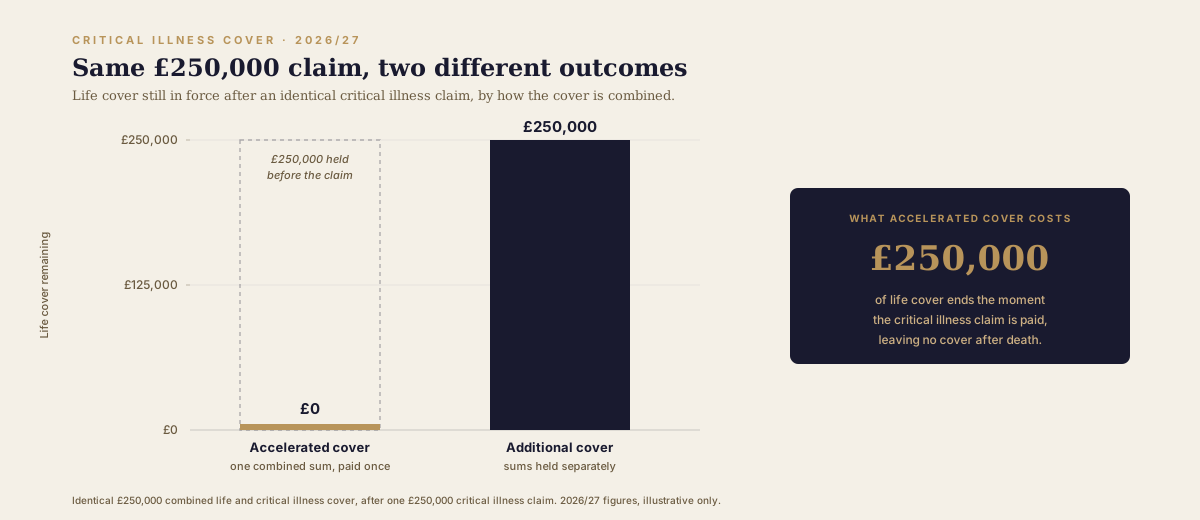
How you combine the cover with life insurance changes the protection materially. On an accelerated basis, a single combined sum pays out on the first event to happen, whether that is a critical illness or death, and the policy then stops. On an additional basis, the critical illness and life sums are separate, so a critical illness claim is paid while the life cover stays fully in force. Accelerated cover is cheaper; additional cover keeps your family protected after a claim.
Marcus and Elena, both 40, with £250,000 of cover
Marcus and Elena each take out £250,000 of combined life and critical illness cover to match their mortgage. They are the same age and in similar health, and their monthly premiums are close.
Marcus chooses accelerated cover, the standard combined option. Elena pays a little more for additional cover, where the life and critical illness sums are held separately.
Both are diagnosed with a heart attack at 47 and both claim £250,000. Marcus receives his lump sum, but his policy has now paid out and ends, leaving his family with no life cover at all. Elena receives the same £250,000 and still holds £250,000 of life insurance, so if she dies later in the term her family is paid again. The choice between accelerated and additional, not their health or their diagnosis, is what leaves one household protected and the other exposed.
Does a combined life and critical illness policy pay out twice?
Usually not. A standard combined policy is written on an accelerated basis, paying a single lump sum on the first event, a critical illness or death, and then ending. To be paid for both a critical illness and a later death, you need additional cover, where the two sums are separate benefits that each pay independently.
Premiums can be guaranteed, fixed for the whole term, or reviewable, starting lower but able to rise. Many policies also include children’s critical illness cover at no extra cost or for a small premium, paying a smaller sum if a child is diagnosed with a covered condition.
What does critical illness cover pay out on?
Critical illness cover pays out on a defined list of conditions, usually somewhere between 40 and 80, but the headline number matters far less than the wording behind it. Cancer, heart attack, and stroke account for the large majority of claims, so the quality of those core definitions does most of the work. Under the Association of British Insurers’ minimum standards for critical illness cover, those three conditions must be covered by any product calling itself critical illness cover, which is why the headline count of extra conditions tells you so little. Most declined claims come down to the diagnosis not meeting the policy definition, or to material facts not disclosed when the policy was taken out.
The detail that catches people out is severity. A full payout generally requires a condition of a specified seriousness: an invasive cancer, for example, rather than an early-stage or low-grade one. Many policies pay a smaller, capped partial payment for less severe conditions, such as certain early-stage cancers, and a few conditions are excluded altogether. The word “cancer” on the list does not guarantee a full claim; the medical definition attached to it does.
A long list of conditions reassures the buyer but rarely changes the outcome. Critical illness claims are won or lost on the precise wording behind cancer, heart attack, and stroke, not on the count of rare conditions a policy can advertise.
This is why comparing critical illness policies on condition count alone is misleading. A policy covering 50 conditions with strong, clear definitions can pay more reliably than one listing 90 with weaker wording. The same logic applies to partial payments and to how each insurer defines the conditions you are statistically most likely to claim for.
How much does critical illness cover cost, and is the payout taxed?
A personal critical illness policy pays its lump sum tax-free, because the premiums are paid from income you have already been taxed on, so HMRC does not tax the benefit again. Cost depends on your age, health, whether you smoke, the size of the lump sum, the length of the term, and whether the cover is combined with life insurance. Critical illness cover is noticeably more expensive than life insurance for the same sum assured, because you are far more likely to be diagnosed with a serious illness during your working life than to die young.
Is a critical illness payout taxed?
A personal critical illness policy pays its lump sum tax-free, because the premiums come from income you have already paid tax on. There is no income tax or capital gains tax on the payment. A lump sum left sitting in your estate can, however, affect inheritance tax later, which is one reason some policies are written in trust.
Age is the single biggest lever on price, because risk rises steeply over time, so the same cover bought at 30 costs a fraction of what it costs at 50. Buying young and in good health also locks in terms before any medical history accumulates to raise the premium or attach exclusions. As with all protection, the cheapest policy is rarely the one with the strongest definitions, and the gap between them is what decides whether a claim is paid.
Risk warnings
The Financial Conduct Authority does not regulate some aspects of Trust, Tax and Estate Planning.
HM Revenue and Customs practice and the law relating to taxation are complex and subject to individual circumstances and changes which cannot be foreseen.
Critical illness cover vs life insurance and income protection
Critical illness cover, life insurance, and income protection solve three different problems and are easily confused. Critical illness pays a lump sum on diagnosis of a named condition while you are alive. Life insurance pays a lump sum when you die. Income protection pays a regular replacement income for as long as illness or injury keeps you from working. The most common protection mistake is buying one and assuming it covers the risks of the others.
| Feature | Critical illness cover | Life insurance | Income protection |
|---|---|---|---|
| Pays out when | You are diagnosed with a listed condition | You die or are terminally ill | Illness or injury stops you working |
| Form of payout | One-off lump sum | One-off lump sum | Regular monthly income |
| Main purpose | A one-off financial shock on diagnosis | Protecting dependants after death | Replacing lost earnings while off work |
| Pays if you can still work? | Yes, on diagnosis | Not applicable | No, only while unable to work |
The three are complementary rather than competing. A lump sum can clear a mortgage or fund treatment in one stroke, while a replacement income keeps the rest of life running month to month. Buying one because you assume it does the work of another is how households end up paying for an expensive policy that pays nothing in the situation they actually face.
Should you write critical illness cover in trust?
Usually not, if it is a standalone critical illness policy, because the payout is designed to reach you while you are alive. A trust directs the proceeds to your chosen beneficiaries instead, which is exactly what you want for life cover but the opposite of what you want from a sum meant to clear your own mortgage or fund your own treatment. Placing a pure critical illness policy in trust can put the money beyond the reach of the person it was bought to protect.
The picture changes with a combined life and critical illness policy. Writing the policy in trust keeps the death benefit outside your estate and speeds it to your family, but a standard trust would also capture a critical illness claim made while you are still living. A split trust is designed to solve this, routing the critical illness benefit back to you and the death benefit to your beneficiaries. The trust should follow the type of cover, not the other way round.
Is critical illness cover worth it?
Critical illness cover is worth it for most people whose finances would not survive a serious diagnosis intact, and harder to justify for those who could absorb the hit. The deciding question is what a major illness would do to your commitments. If a cancer or heart attack diagnosis would leave a mortgage unpayable or a family without a financial cushion, a tax-free lump sum that clears the debt or buys recovery time is doing real work. Mortgage holders and households with dependants tend to gain most.
The trade-off is cost against the shape of the risk. Critical illness premiums are a permanent outgoing for a lump sum you may never claim, and a policy with weak definitions can disappoint at the worst moment. For many people, the more probable threat is not a single insurable diagnosis but a long spell unable to work, which a lump sum covers only until it runs out. If your priority is keeping the bills paid through a drawn-out illness, Statutory Sick Pay of £123.25 a week (2026/27) for up to 28 weeks is a thin safety net, and income protection may be the better-matched policy. Those with substantial savings, or who already hold income protection and life cover, may reasonably decide critical illness cover fills a gap they have largely closed. Deciding which policies you actually need, and in what order, is the heart of protection planning.
How does critical illness cover fit into a wider plan?
Critical illness cover sits within a layered approach to protection, not on its own. It pairs naturally with life insurance, often in a single combined policy, and with income protection, which covers the income risk that a one-off lump sum cannot stretch to. A coherent plan starts from the risks a household most needs to cover, mortgage, dependants, and lost income, then chooses the policy that matches each, rather than buying cover in isolation.
It also leans on the foundations underneath it. The cash buffer behind the 20% savings habit in the 50/30/20 approach is what carries a household through the survival period and the early weeks of a diagnosis before any claim is paid. In retirement the picture changes again: once the mortgage is gone and earnings have stopped, the case for critical illness cover usually falls away, while other risks come to the fore, such as insuring a State Pension for a surviving spouse. Protection is rarely a single purchase; it is a set of policies that should change as the plan does.
Risk warnings
The value of pensions and any income from them can fall as well as rise. You may not get back the full amount invested.
A pension is a long-term investment and the value is not guaranteed. Any advice or considerations are personal to each individual’s circumstances.
The value is in the wording, not the condition count
Critical illness cover insures against the financial shock of a serious diagnosis with a single tax-free lump sum, and it earns its place where a cancer, heart attack, or stroke would otherwise threaten a mortgage or a family’s stability. Its value lives in the policy wording, not the length of the condition list, and the choice between accelerated and additional cover quietly decides how protected a household is after a claim. Set against life insurance and income protection, it answers a different question, and the strongest plans use the three together rather than treating any one as a substitute for the others.
Frequently asked questions
What is critical illness cover?
Critical illness cover is an insurance policy that pays a tax-free lump sum if you are diagnosed with one of a defined list of serious conditions, such as cancer, a heart attack, or a stroke. It pays while you are still alive, on diagnosis, rather than on death, and the policy usually ends once the benefit is paid.
How does critical illness cover work?
You choose a lump sum, a term, and whether to combine the cover with life insurance. If you are diagnosed with a listed condition that meets the policy's medical definition and you survive a short qualifying period, usually 10 to 14 days, the insurer pays the lump sum. You can spend it on anything, from clearing a mortgage to replacing lost income.
Is critical illness cover worth it?
It is usually worth it if a serious diagnosis would leave you unable to pay the mortgage or keep your household running, and you have little else to fall back on. Mortgage holders and families with dependants gain most. It matters less if you have substantial savings or already hold income protection that covers the income risk.
What is the difference between critical illness cover and income protection?
Critical illness cover pays a single lump sum on diagnosis of a named condition, whether or not you can still work. Income protection pays a regular monthly income for as long as illness or injury stops you working, covering almost any condition. One settles a one-off shock; the other replaces ongoing earnings.
Does critical illness cover pay out for all types of cancer?
No. Critical illness cover pays in full only for cancers that meet the policy's definition, usually invasive cancers of a specified severity. Some early-stage or less severe cancers are covered for a smaller, capped partial payment, and a few are excluded entirely. The exact wording, not the word cancer, decides the claim.
How many conditions should critical illness cover include?
More conditions is not automatically better. Cancer, heart attack, and stroke drive the large majority of claims, so the quality and clarity of those core definitions matters more than a long list. A policy covering 50 well-defined conditions can be stronger than one listing 90 with weaker wording.