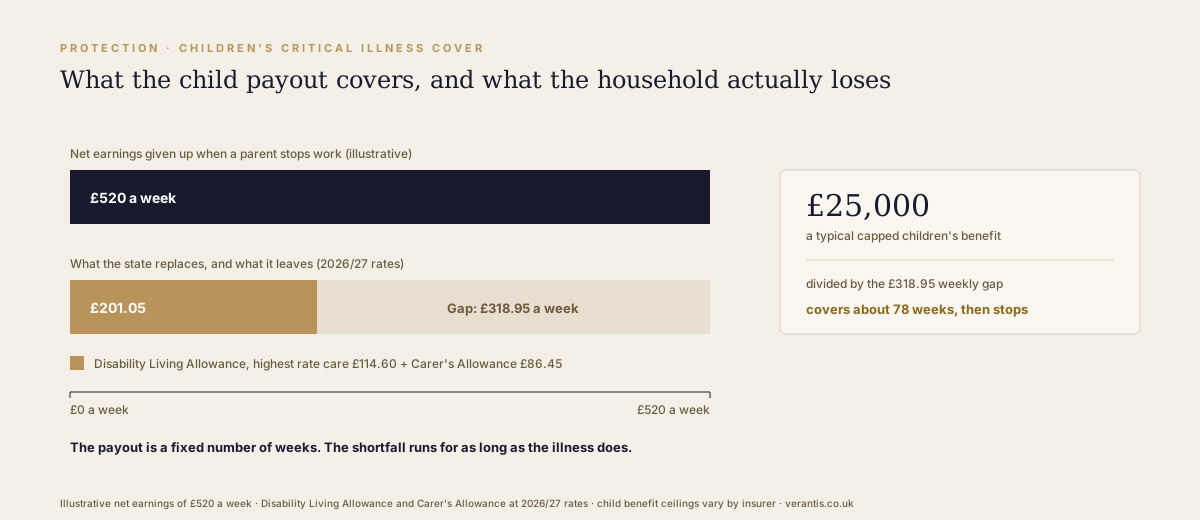
Children's critical illness cover is a benefit attached to an adult critical illness policy that pays a lump sum if the policyholder's child is diagnosed with one of the conditions listed in that policy. Check three things before you count on it: the most it will pay on a child claim, the ages the cover runs between, and the exclusion for anything present at birth. It matters because the financial damage of a child's serious illness is usually a parent's earnings stopping, and the state replaces little of that. Carer's Allowance is £86.45 a week for 2026/27 and disappears entirely once you earn more than £204 a week.
Nearly every critical illness policy sold to a UK adult now carries children’s critical illness cover, usually without anyone asking for it and often without changing the premium. It is the part of the contract least likely to be read and the least standardised part of a heavily standardised product: the industry fixes the wording insurers must use for cancer, heart attack and stroke on the adult’s cover, while the size of the child benefit, the ages it runs between and the conditions it will not pay for are left to each insurer to set. All figures in this article reflect the 2026/27 tax year.
What does children's critical illness cover pay out?
It pays a single lump sum to the adult policyholder when their child is diagnosed with a condition listed in the policy at the severity the policy defines. The amount is capped, commonly at a share of the adult's sum assured up to a fixed cash maximum, and the cover ends at an age the insurer sets rather than at any standard age.
Contents
- What is children’s critical illness cover?
- How does children’s critical illness cover work?
- What is standardised, and what does the insurer decide?
- Which exclusions decide a children’s critical illness claim?
- What does the state pay when a child is seriously ill?
- Where the money actually has to come from
- Should you choose a policy on its children’s cover?
- How does children’s cover fit into a wider plan?
What is children’s critical illness cover?
Children’s critical illness cover is a benefit sitting inside an adult’s policy, not a policy of its own. You cannot buy it on a child alone from a mainstream insurer, and it is not underwritten on the child’s health at outset in the way adult cover is. The parent is the policyholder, the parent is paid, and the child is simply the person whose diagnosis triggers the payment.
That structure explains most of what follows. Because the benefit is attached rather than sold, it is priced as a small addition to a much larger risk, which is why insurers can include it at little or no cost and why the amount is capped well below the adult’s own cover. The main guide to how critical illness cover works covers the adult side of the same contract, and everything there about definitions and severity applies to the child claim too.
Risk warning
The definitions vary between product providers and will be described in the key features and policy document, if you go ahead with the plan.
How does children’s critical illness cover work?
A claim runs exactly like an adult claim, with the policyholder submitting evidence of a diagnosis and the insurer testing it against the definition in the wording. Cover normally begins some weeks after birth rather than at birth, applies automatically to children born or adopted after the policy started, and ends at the age the policy states.
The payment is almost always an additional benefit, which means the adult’s sum assured is untouched and the policy carries on afterwards. A small number of older contracts do the opposite and accelerate the payment, reducing the adult’s cover by the amount paid on the child. The distinction matters more than it sounds: on an accelerated contract, a child’s illness quietly shrinks the cover protecting the family’s mortgage.
The maximum payout is where expectations and reality separate. Adult cover is sized to a mortgage or an income; the child benefit is sized to a gesture, typically a percentage of the adult sum assured subject to a fixed maximum in the tens of thousands. A £400,000 policy does not carry £400,000 of child cover, and no insurer offers a version that would replace a parent’s salary for long.
Risk warnings
Your home may be repossessed if you do not keep up repayments on your mortgage. Think carefully before securing debts against your home.
Not all mortgage contracts are regulated by the Financial Conduct Authority.
What is standardised, and what does the insurer decide?
Almost nothing about the child benefit is standardised, which is the opposite of the adult cover it is attached to. Insurers signing up to the Association of British Insurers’ Guide to Minimum Standards for Critical Illness Cover, revised on 16 September 2022, must meet set model wordings for the conditions they cover and must use the guide’s model wording where they apply an exclusion it covers. For children, the guide standardises the exclusion. It does not standardise the benefit.
Where the child benefit is fixed and where it floats
| Feature | Who decides it |
|---|---|
| Definitions of cancer, heart attack and stroke | Industry minimum standards |
| Wording of the pre-existing child exclusion | Industry minimum standards |
| Maximum payout on a child claim | The insurer |
| Age cover starts and the age it ends | The insurer |
| Whether the payment is additional or accelerated | The insurer |
| Whether cover is included or charged for | The insurer |
Four of those six rows are the insurer’s choice, and they are the four that decide how much money arrives and whether it arrives at all. Comparing two policies on their headline number of covered conditions tells you close to nothing about their children’s cover.
Is children's critical illness cover regulated by a common standard?
Only partly. Industry minimum standards fix the model wordings for conditions such as cancer, heart attack and stroke, and set the standard exclusion wording used for children. They do not set a minimum payout, a minimum age range, or any requirement to include children's cover at all, so those vary between insurers.
Which exclusions decide a children’s critical illness claim?
Three exclusions do most of the work, and the industry model wording sets out all three together: a claim is not covered where the child’s condition was present at birth, where the symptoms first arose before the child was covered, or where the child dies within 28 days of meeting the policy’s definition of the illness.
The first is the one families meet most often. A child born with a congenital heart condition, a chromosomal disorder, or any condition that existed on the day they were born sits outside the cover permanently, however serious the condition turns out to be and whenever it is eventually diagnosed. What the cover is aimed at is illness that arrives later, and whether a particular diagnosis pays comes down to the policy’s own list and the severity it sets for each entry, which is why two insurers can answer the same diagnosis differently.
The second exclusion catches timing rather than biology. Where symptoms began before the child came within the policy, the claim fails even though the diagnosis came afterwards, which is why taking out cover in the middle of an unexplained set of symptoms rarely achieves anything.
The third is the hardest to read and the most commonly misunderstood. A survival period means the benefit is not paid where a child dies within 28 days of meeting the definition, so the very worst outcome is the one this cover does not pay for. Parents who assume a critical illness policy pays out if a child dies are describing life insurance, which is a different product and is generally not written on a child’s life at all.
A child benefit insures the diagnosis, not the loss. The exclusions are where those two part company, and the survival period is where they part most sharply.
What does the state pay when a child is seriously ill?
Less than most families assume, and the main payments do not replace earnings at all. The child may qualify for Disability Living Allowance, which is tax-free, not means-tested, and paid to under-16s who need substantially more care than other children of the same age or who have difficulty walking. It requires the difficulty to have lasted three months and to be expected to last a further six, though that condition is waived for a child who is nearing the end of life.
The 2026/27 care component of Disability Living Allowance for children is £30.30, £76.70 or £114.60 a week, with a mobility component of £30.30 or £80 a week on top, awarded on how well the child gets about rather than on the care they need, and with a minimum age of its own: the higher rate from 3, the lower rate from 5. In Scotland the equivalent payment is Child Disability Payment. At 16 the child moves to Personal Independence Payment.
Carer’s Allowance is the payment aimed at the parent, and it comes with a cliff edge rather than a taper. It is worth £86.45 a week in 2026/27, requires at least 35 hours of care a week, and is refused outright in any week your earnings after tax, National Insurance and expenses exceed £204. The person cared for must already be receiving the middle or highest rate care component of Disability Living Allowance, so the parent’s claim depends on the child’s award. Carer’s Allowance is taxable, and it cannot be claimed while you are in full-time education or studying 21 hours a week or more.
That £204 earnings limit is worth pausing on, because it makes the middle option the least supported one. A parent who stops work entirely can claim Carer’s Allowance; a parent who keeps three days a week to hold a career together earns too much for it and receives nothing. The rule is a cliff, so the household that reduces hours carries the full drop in pay unsupported.
Where the money actually has to come from
Ordinarily it comes out of the parents’ own earnings, because the workplace provides time rather than money. Unpaid parental leave gives an eligible employee 18 weeks per child up to their 18th birthday, capped at 4 weeks a year for each child unless the employer agrees otherwise. Beyond that sit unpaid dependants’ leave for emergencies, whatever discretionary paid leave the employer offers, and annual leave.
What a £25,000 child payout funds when one parent goes part time
Ellen, 41, drops to three days a week after her son Rory, 7, is diagnosed with a condition her policy covers.
| Input | Value |
|---|---|
| Net pay given up | £1,240 a month |
| Disability Living Allowance, middle rate care (2026/27) | £76.70 a week, about £332 a month |
| Carer's Allowance | £0, because Ellen still earns above £204 a week |
| Children's critical illness payout | £25,000 |
- Monthly shortfall: £1,240 of lost pay less £332 of Disability Living Allowance = £908
- £25,000 ÷ £908 = 27.5 months of that shortfall
- After that the shortfall continues and the lump sum is gone
Result: The payout funds about 27.5 months of Ellen's reduced income, then stops. Nothing else in the policy responds to Rory's illness: the adult benefit pays only if Ellen herself is diagnosed.
Roughly 27.5 months is genuinely useful, and it is also finite in a way the underlying problem may not be. Serious childhood illness often reshapes a parent’s working life for years rather than months, through hospital appointments, immunosuppression, or a school that cannot be relied on for a full week. The lump sum buys the household time to reorganise. It does not buy an income.
Two households, one diagnosis, and the £204 line
Bryony and Meera each hold critical illness cover with a £25,000 maximum on the children’s benefit, and each has a child diagnosed with a covered condition in the same month. Both claims pay in full.
Bryony keeps three days a week, giving up £1,240 a month of net pay. Her son’s middle rate care award brings in about £332 a month. The roughly £429 a week she still earns sits well above the £204 limit, so Carer’s Allowance is refused and the household is about £908 a month down.
Meera stops work altogether, giving up £2,050 a month. Her daughter is awarded the highest rate care component, £114.60 a week, and because Meera now earns nothing she also qualifies for Carer’s Allowance at £86.45 a week. The two together come to about £871 a month, leaving her household roughly £1,179 a month down.
Meera gave up 65% more income than Bryony and ended up only 30% worse off, because the state support Bryony was refused is worth more than the earnings she kept. Neither outcome is a recommendation, and the arithmetic changes with every salary. The point is that the £204 line, not the £25,000 payout, is what shapes the household’s position over the following year.
Should you choose a policy on its children’s cover?
No. Choose the policy on the adult definitions, the sum assured and the premium you can sustain, then treat the children’s cover as a feature you inherit rather than one you select. The reason is proportion: the adult benefit is the one sized to a mortgage and an income, and a weaker cancer definition on the adult’s cover costs a household far more than a smaller maximum on the child benefit ever will.
There is a real trade-off to state honestly. Insurers with better children’s cover do exist, and where two policies are otherwise close on definitions and price, the stronger child benefit is a fair tie-breaker. What it should not do is pull you toward a policy whose adult definitions are weaker, because those definitions are what decide whether the claim the policy was bought for pays at all.
The mistake worth naming is the opposite one: buying critical illness cover primarily to protect against a child’s illness. The cover is not built for that. The most it pays on a child claim is a fraction of the adult sum assured, it excludes anything present at birth, and it does not pay where a child dies within 28 days of diagnosis.
It is worth being plain about what no policy does. There is no product on the UK market that replaces a parent’s earnings because their child is ill. Income protection pays when the person insured cannot work through their own illness or injury, and a parent who gives up hours to care for someone else is outside it. So the money for a child’s illness comes from the lump sum if there is one, from savings, from Carer’s Allowance where the earnings rule allows it, and from whatever the employer will agree to. That is the honest list, and it is short.
How does children’s cover fit into a wider plan?
It sits at the edge of the plan rather than the centre, which is the correct place for it. The centre is the parents’ own earnings, and income protection is the cover built for those: it pays monthly for as long as an illness or injury keeps the insured person from working, rather than once. It answers your own illness though, so a parent who stops work to look after a sick child has no claim on it. That is why the choice between critical illness cover and income protection is settled on the household’s own risks and never on the children’s benefit attached to one of them.
Behind the policies sits the buffer, and for a child’s illness it is doing more of the work than anything else on this page. Cash that can be reached this week covers the hospital parking, the second car, and the reduced hours in the fortnight before anyone has thought about a claim form. The savings habit that builds it is worth more to a family in that first month than the size of any child payout.
One practical check belongs here. If your life or critical illness policy is written in trust, ask whether the children’s benefit is carved out of the trust or falls inside it, because a payment made to trustees for a defined class of beneficiaries is not the same as cash reaching a parent’s account. Writing a policy in trust is usually the right decision for the main sum assured, and it is worth understanding what it does to the child benefit at the same time. Getting the layers to line up is the work of protection planning: sums assured sized to the household’s income, and the smaller benefits understood for what they are rather than what a brochure implies.
Risk warning
The Financial Conduct Authority does not regulate some aspects of Trust, Tax and Estate Planning.
The three numbers to find in your policy schedule
Children’s critical illness cover is a benefit almost every insured parent already owns and almost nobody has read. Take twenty minutes with the policy schedule and find three things: the most it will pay on a child claim, the ages the cover runs between, and the exclusion clause dealing with conditions present at birth. Those three tell you whether a claim would pay and how much, which is more than a comparison table will. Then judge the rest of the policy on the adult’s own cover, because that is the part sized against what the household would actually lose.
Frequently asked questions
Is children's critical illness cover free?
Usually it is included in the premium rather than charged for separately, which is why so few people know the detail of what they hold. A handful of insurers price it as an optional extra, and a few sell enhanced child cover for an additional premium. Included is not the same as generous: where an insurer offers an enhanced version, the cover you get without asking is the lower of the two.
Are children born after the policy started covered?
Yes on almost every policy, and there is no need to tell the insurer when a child arrives. The catch sits in the exclusion rather than the eligibility: a claim is not paid where the condition was present at birth, so a condition a child was born with sits outside the cover however serious it turns out to be, while one that arrives later is judged against the policy's own list and severity wording like any other claim.
Who receives the money from a children's critical illness claim?
The adult policyholder, not the child. That matters where the policy has been written in trust for the benefit of named adults, because the trustees rather than the parent may be the legal recipient. Most providers carve the children's benefit out of the trust deed for exactly this reason, but it is worth confirming with yours rather than assuming.
Does a child's claim end the adult's critical illness cover?
Normally no. Children's cover is almost always paid as an additional benefit, leaving the adult's sum assured untouched and the policy running. A small number of older contracts accelerate the payment instead, reducing the adult's cover by the amount paid out. The policy schedule will say which, and the older the contract the more it is worth checking.
Is children's critical illness cover worth it?
It is worth having and not worth choosing a policy for. As an included feature on cover you were buying anyway it costs nothing and pays a useful lump sum at a moment when money is the last thing anyone wants to think about. As a reason to prefer one insurer over another it is weak, because the adult definitions and sum assured decide far more of the policy's value.
What happens to the cover when the child grows up?
It stops at the age the policy names, commonly the late teens, with many insurers extending it while the child is in full-time education. Nothing converts and nothing carries over: an adult child who wants critical illness cover applies for their own policy and is underwritten on their own health, which is a harder conversation if they have been ill.
Are stepchildren and adopted children covered?
Generally yes where the child is financially dependent and living with you, and adopted children are usually covered from the date the adoption is legally complete rather than from placement. The definition of child sits in the policy wording and varies more than most people expect, so a blended family is a good reason to read that clause rather than assume it.