Life insurance is a protection policy that pays a tax-free cash lump sum to your chosen beneficiaries when you die, for as long as the policy stays in force and the premiums are paid. Total your debts, several years of lost income and future costs, then subtract savings and existing cover: the gap is what to insure. For most working parents that lands between £300,000 and £700,000, far more than the token sums bundled with a mortgage or offered by an employer. Buy for the need rather than a round-number multiple of salary, because too little leaves a shortfall and too much means paying every month for a sum your family has no use for.
How much life insurance you need is not a fixed figure or a simple multiple of your salary. The right amount replaces what your death would take away from the people who depend on you: the mortgage and other debts they could not clear, the years of income they would lose, and the future costs, from childcare to education, that would still have to be paid. A needs-based calculation works this out directly and then subtracts what you already have. For most working parents the answer lands somewhere between £300,000 and £700,000, well above the token cover often bundled with a mortgage or provided by an employer. All figures in this article reflect the 2026/27 tax year.
How do you work out how much life insurance you need?
Add up your outstanding debts, several years of the income your family would lose, and future costs such as childcare, then subtract your savings and any existing cover. The remaining figure is the sum assured to buy. For a working parent with a mortgage this is commonly £300,000 to £700,000.
Contents
- How much do you need?
- What should it cover?
- How to calculate it
- The 10 times salary rule
- Does death in service count?
- What it costs
- Should you buy more than you need?
How much life insurance do you need?
You need enough to leave your dependants no worse off financially than if you were still there to provide. In practice that means a sum that clears the debts they cannot service, replaces the income they relied on for as long as they relied on it, and covers the large costs still to come, minus whatever savings and cover already exist. The figure is personal, because two households with identical salaries can face very different gaps once their mortgage, ages of children, and existing provision are counted.
The reason a single rule of thumb fails is that life insurance is protecting a moving target. A 32-year-old with a new mortgage and a baby has decades of income and a large loan to protect, so the need is at its highest. The same person at 58, with the mortgage nearly gone and children independent, may need very little. The right amount is whatever closes the gap today, reviewed as that gap shrinks.
What should life insurance actually cover?
Life insurance should cover the specific financial consequences of your death, not a vague sense of security. There are three things to add and two to subtract. On the add side sit your debts, the income your family loses, and future one-off costs. On the subtract side sit the money you already hold and the cover you already have. Working through each in turn produces a figure grounded in your real position rather than a guess.
What a life insurance needs analysis adds up
| Component | Add or subtract | What it represents |
|---|---|---|
| Mortgage and other debts | Add | Balances your family could not clear from their own income |
| Income replacement | Add | Several years of the net income the household would lose |
| Future one-off costs | Add | Childcare, education, and similar costs still to come |
| Savings and investments | Subtract | Accessible capital your family already holds |
| Existing life cover | Subtract | Death in service and any personal policies in force |
The subtract side is where people most often over-insure. Your family would not be starting from nothing: existing savings, an emergency fund, a partner’s own earnings, and modest state help all reduce the sum you actually need to buy. State support in particular is easy to forget. A surviving spouse or civil partner with dependent children may receive Bereavement Support Payment, an initial lump sum followed by monthly payments for up to 18 months. It is modest and short-lived, so it does not remove the need for cover, but it belongs in the calculation.
How do you calculate how much life insurance you need?
Work through the five components in order: total your debts, add several years of lost income, add future costs, then subtract savings and existing cover. The result is the additional sum assured you need. The one judgement call is how many years of income to replace, which depends on how long your family would genuinely depend on your earnings, usually until the youngest child is financially independent.
A needs-based calculation for a parent with young children
Marcus, 38, married to Lena with two children aged 6 and 3, and a £284,000 mortgage.
| Input | Value |
|---|---|
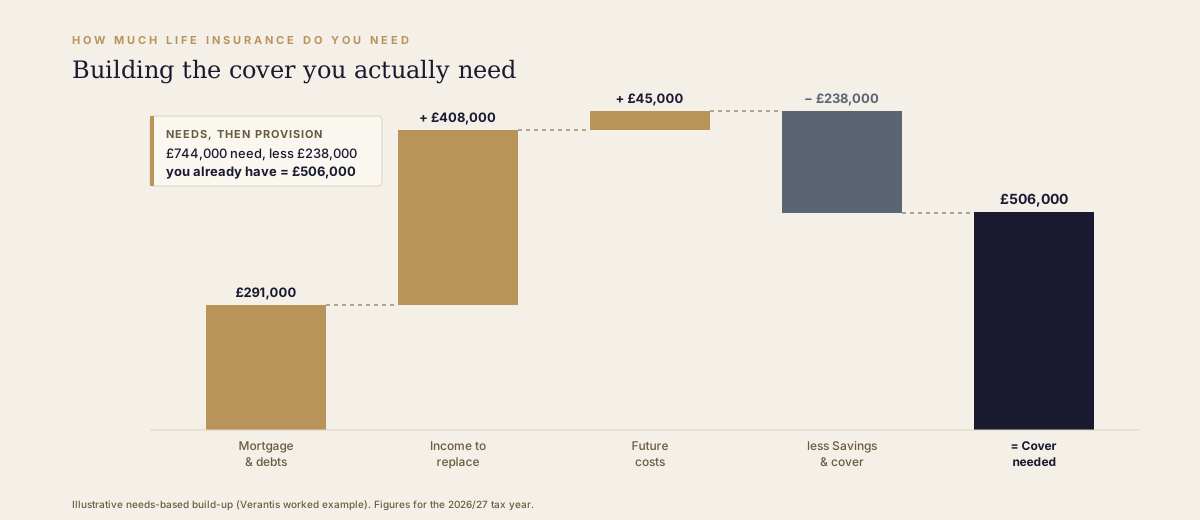
| Mortgage and other debts | £291,000 |
| Income to replace (net £34,000 x 12 years) | £408,000 |
| Future costs (childcare and education) | £45,000 |
| Savings and existing cover (incl. £209,600 death in service) | £238,000 |
- Add the liabilities and lost income: £291,000 + £408,000 + £45,000 = £744,000
- Subtract savings and existing cover: £744,000 - £238,000 = £506,000
Result: Marcus needs about £506,000 of additional life cover, not the £209,600 his employer scheme alone would pay.
The £408,000 income figure is a deliberate simplification: it treats twelve years of lost net income as a single lump sum, ignoring the interest it would earn once invested. That is fine at the planning stage, and slightly cautious, which is the right direction to err. The point of the exercise is not decimal precision but scale: it shows Marcus that his real need is more than double what his workplace cover provides.
Income protection does a different job alongside this. Life cover pays out if you die, whereas income protection insurance replaces your earnings if illness or injury stops you working, which is statistically the more likely event during your working life. A full protection plan usually needs both, sized separately.
Risk warning
The definitions vary between product providers and will be described in the key features and policy document, if you go ahead with the plan.
Is the 10 times salary rule enough?
The 10 times salary rule is a reasonable opening guess and a poor final answer. Multiplying gross salary by ten gives a quick sense of scale, and for a straightforward household it can land close to the needs-based figure. But it is blind to the things that actually drive the number: the size of the mortgage, how many years the children remain dependent, and what savings and employer cover are already in place. Use it to sense-check a needs-based calculation, not to replace one.
Consider two people each earning £50,000. The rule gives both a £500,000 target. One has a £330,000 mortgage, three young children, and no savings, so their real need is well above £500,000. The other has cleared their mortgage, has grown-up children and £180,000 in investments, so their real need is close to zero. Same salary, same rule of thumb, opposite conclusions. That gap is exactly what a needs-based calculation captures and a multiple cannot.
Does death in service count towards your cover?
Yes, count it, but never rely on it alone. Death in service is life cover provided by an employer, typically three or four times salary, paid if you die while employed. It is genuinely valuable and belongs on the subtract side of your calculation, as Marcus’s £209,600 did above. The problem is treating it as the whole answer. Four times a £52,000 salary is around £208,000, which rarely clears a family mortgage and replaces a decade of income at the same time.
Death in service cover is borrowed, not owned. It belongs to the job, not to you, and it ends on the day you change employer or retire, often the very time your family still depends on your income and your health may make fresh cover harder to arrange.
The practical approach is to size your personal cover to fill the gap that death in service leaves, and to hold that personal policy independently of your job. Our guide to death in service benefit sets out how the payment is taxed and what happens to it when you move roles. If your only cover is through work, a job change can leave you uninsured at exactly the wrong moment.
How long should the cover last?
Match the term of the policy to the length of the need, not to a round number. A repayment mortgage should be covered for its remaining years, because the balance falls each year and the cover can fall with it on a decreasing term basis. Family income protection should last until your youngest child is financially independent, which for most families points to a term ending in their late teens or early twenties. How many years you count is not a technicality: it is often the single assumption that moves the sum assured the most.
Hannah and Dev, both 37, one child aged 3
Hannah and Dev start by insuring the essentials: their £248,000 mortgage plus five years of Hannah’s income, which points to cover of about £300,000 each. On paper that looks prudent.
But if Hannah died, Dev would not simply carry on full-time. He would realistically drop to part-time for around six years to raise a three-year-old, losing roughly £21,000 a year of earnings and paying for wraparound childcare on the days he does work. Once those six years of reduced income and the childcare are counted, Hannah’s true need rises to about £520,000.
Same mortgage, same salaries, one assumption about who raises the child: it moved the figure by more than £200,000. The households that under-insure are usually the ones that never asked the question.
This is also where the type of policy matters as much as the amount. A fixed term keeps premiums low but pays nothing if you outlive it, which is the right trade-off for a temporary need. A need that never expires, such as an eventual inheritance tax bill, calls for whole of life cover instead, and choosing between the two is covered in our comparison of term and whole of life insurance. Buying a fixed term for a permanent need, or paying for permanent cover you only need for twenty years, are the two most common and most expensive mistakes.
How much does the right amount of cover cost?
Level term life insurance is cheaper than most people expect, which is why buying the right amount rarely means straining the budget. Price depends mainly on your age, health, whether you smoke, the sum assured, and the length of the term. A healthy non-smoker in their thirties can insure a large sum for the price of a couple of takeaways a month, and locking in cover young keeps that price low for the whole term.
How much does £500,000 of life insurance cost per month?
A healthy non-smoker aged around 35 can often buy £500,000 of level term cover over 25 years for roughly £20 to £30 a month in 2026/27, depending on health and the insurer. Premiums rise with age, poorer health, and smoking, and whole of life cover costs considerably more than term.
Because term cover is affordable, the goal is accuracy rather than economy: insure the calculated need, no more and no less. Over-insuring means paying every month for a sum with no job to do. Under-insuring is worse, because the shortfall only surfaces at the point of a claim, when it cannot be fixed. Whichever amount you settle on, write the policy in trust so the money reaches your family cleanly, which is the subject of the next section.
Should you buy more life insurance than you need?
Only where the extra sum has a job to do. Cover bought as a safety margin, on top of a figure you have already worked out, raises the premium without protecting anything you have identified. And any payout that lands in a taxable estate can lose 40% to inheritance tax above the £325,000 nil-rate band, which is frozen until April 2031. HMRC treats a policy you own and have not placed in trust as part of your estate, so a £500,000 payout could be reduced by up to £200,000 before your family sees it. The rules on inheritance tax set out how the charge applies.
Deliberately leaving money behind is the case that looks like an exception and is not one. If you want your children or grandchildren to inherit a set amount, or you expect an inheritance tax bill your estate will have to fund, that is a need in its own right, and the cover meeting it belongs inside the calculation rather than on top of it. The test is whether the extra sum has a purpose attached. £150,000 of whole of life cover sized against an expected inheritance tax charge is a decision; £150,000 added to a term policy because the round number felt safer is not. Cover held for that reason usually has to be permanent, because a fixed term can expire while the need is still there, and permanent cover costs considerably more for the same sum assured.
The fix costs nothing and changes the outcome entirely: write the policy in trust. A policy held in trust pays your chosen beneficiaries directly, outside your estate, so there is no inheritance tax on the proceeds and no wait for probate. GOV.UK explains how trusts interact with tax, and the practical steps are covered in our guide to writing life insurance in trust. So the honest answer to “should I buy more?” is to buy what you can point at a reason for, write it in trust, and revisit the figure every few years, because it moves in both directions: the protection need falls as the mortgage shrinks and the children grow up, while an estate or inheritance tax need tends to grow. If anything, the risk for most families is the opposite one: buying too little, or nothing at all, and discovering the gap too late. Sizing cover properly sits within wider protection planning rather than being a one-off purchase.
Risk warning
HM Revenue and Customs practice and the law relating to taxation are complex and subject to individual circumstances and changes which cannot be foreseen.
A number to calculate, not to guess
The amount of life insurance you need is a number you can calculate, not a figure to guess or borrow from a rule of thumb. Add the debts your family could not clear, the years of income they would lose, and the future costs still to come, then subtract what you already hold in savings and existing cover. What remains is the sum to insure. For most working parents it is larger than the cover bundled with a mortgage or provided at work, and smaller than a scare-driven over-estimate. Get the figure right, match the term to how long the need lasts, write the policy in trust, and revisit it as your life changes. The cover that actually protects your family is the cover that matches their real position, no more and no less.
Frequently asked questions
How much life insurance do you need?
Enough to clear your debts, replace several years of your income, and pay future costs like childcare, after subtracting savings and any cover you already hold. For a working parent with a mortgage that is often £300,000 to £700,000. A needs-based calculation gives a figure specific to your household rather than a generic multiple of salary.
Is 10 times your salary enough life insurance?
Sometimes, but it is a rule of thumb, not an answer. Ten times income is a useful sanity check, yet it ignores your actual mortgage, how many years your children remain dependent, and what you already have in savings and employer cover. Two people on the same salary can need very different sums once those are counted.
How much life insurance do you need with no mortgage or children?
Usually far less, and sometimes none. Without a mortgage or dependants, the main reasons to hold life cover are funeral costs, leaving a specific legacy, or covering an inheritance tax bill. Many single people with no debts and no one relying on their income do not need personal life insurance at all.
Do you still need life insurance if you have death in service at work?
Often yes, because death in service of three or four times salary rarely clears a mortgage and replaces years of income on its own. It also disappears the day you leave that employer, so it should be treated as a top-up to personal cover, not a replacement for it. Count it, then insure the remaining gap.
Should you buy more life insurance than you need?
Not as a safety margin. Cover added on top of a figure you have already worked out raises the premium without protecting anything you have identified, and if it lands in a taxable estate 40% of it can go in inheritance tax. It is a different question when the extra has a defined purpose, such as leaving a set legacy or meeting an expected inheritance tax bill, because that is a need in its own right rather than a cushion. If the worry is that the need might grow, check whether the policy carries a guaranteed insurability option, which lets you increase cover on a house move or a new child without fresh medical underwriting.
How long should your life insurance last?
Match the term to the length of the need. Cover a repayment mortgage for its remaining years, and family income cover until your youngest child is financially independent, often age 18 or the early twenties. A permanent need such as an inheritance tax bill calls for whole of life cover instead, because a fixed term could expire before it is needed.