Critical illness cover and income protection are two protection policies: one pays a lump sum on diagnosis of a listed condition, the other pays a monthly income while illness or injury stops you working. For most working people income protection is the higher priority, because loss of earnings is the likelier risk and the one your plan cannot absorb. Critical illness cover pays a one-off lump sum on diagnosis; income protection pays a monthly income until you recover or retire. Many households that can afford it hold both, covering the diagnosis and the loss of earnings separately.
The choice of critical illness cover vs income protection is not really a choice between two versions of the same thing. Critical illness cover pays a one-off tax-free lump sum when you are diagnosed with one of a defined list of serious conditions. Income protection replaces part of your salary, month after month, for as long as illness or injury keeps you from working. One responds to a diagnosis; the other responds to being unable to earn. Understanding that split is what tells you which you need, and whether you need both. The figures here reflect the 2026/27 tax year.
Does critical illness cover pay a lump sum or a monthly income?
Critical illness cover pays a single lump sum, not an income. It is released in full once you are diagnosed with a listed condition at the required severity, and the policy then ends. Income protection works the other way: it pays nothing as a lump sum and instead replaces part of your earnings each month until you recover, the term ends, or you retire.
Contents
- What is the difference between critical illness cover and income protection?
- Critical illness cover vs income protection: how do they compare?
- Which pays more, a lump sum or a monthly income?
- When does each policy actually pay out?
- How are critical illness and income protection payouts taxed?
- Do you need both critical illness cover and income protection?
- How do the two policies fit into a wider plan?
What is the difference between critical illness cover and income protection?
The core difference is that critical illness cover pays for a diagnosis and income protection pays for an inability to work. Critical illness cover is triggered by a named event: a heart attack, a stroke, or a cancer of specified severity, drawn from a list the insurer publishes and the Association of British Insurers helps standardise. When the diagnosis is confirmed, the lump sum is paid and the cover stops. Income protection is triggered by the effect, not the cause. If illness or injury stops you doing your job, it pays, regardless of whether the underlying condition appears on any list.
That leads to a gap most people miss. A great many things that stop someone working are not on a critical illness list at all. Back and musculoskeletal problems, stress, and mental health conditions are among the most common reasons for long-term absence, and a critical illness policy pays nothing for any of them. Income protection covers them without question, because it only asks whether you can work.
The two also differ in shape. Critical illness cover hands over one large sum you can use however you like, often to clear a mortgage or fund private treatment. Income protection drip-feeds a replacement salary that maps onto the bills that keep arriving every month. A lump sum is a good tool for a one-off cost; a monthly income is a good tool for an ongoing one.
Risk warnings
Protection
The definitions vary between product providers and will be described in the key features and policy document, if you go ahead with the plan.
Mortgages
Your home may be repossessed if you do not keep up repayments on your mortgage. Think carefully before securing debts against your home.
Not all mortgage contracts are regulated by the Financial Conduct Authority.
Critical illness cover vs income protection: how do they compare?
Set side by side, the two policies differ on almost every practical feature except the fact that both pay out when you are seriously unwell. The table below sets out how each one behaves at the point that matters.
| Feature | Critical illness cover | Income protection |
|---|---|---|
| What triggers a claim | Diagnosis of a listed condition | Illness or injury that stops you working |
| How it pays | One tax-free lump sum | A monthly income |
| How long it pays | Once, then the policy ends | Until you recover, the term ends, or you retire |
| Conditions covered | Only those named in the policy | Any cause of incapacity |
| Typical benefit | A chosen capital sum, often mortgage-sized | Up to around 60% of your gross earnings |
| Best suited to | A one-off cost on diagnosis | Replacing lost earnings over time |
The comparison table makes the complementary nature clear. Critical illness cover is narrow but generous at the moment it fires; income protection is broad but paid in instalments. Neither is a substitute for the other, which is why an honest comparison rarely ends with a clean single winner for everyone.
Where budget forces a single choice, the deciding question is which risk would do more damage to your plan. For most households that is the loss of a monthly income, not the absence of a lump sum.
Which pays more, a lump sum or a monthly income?
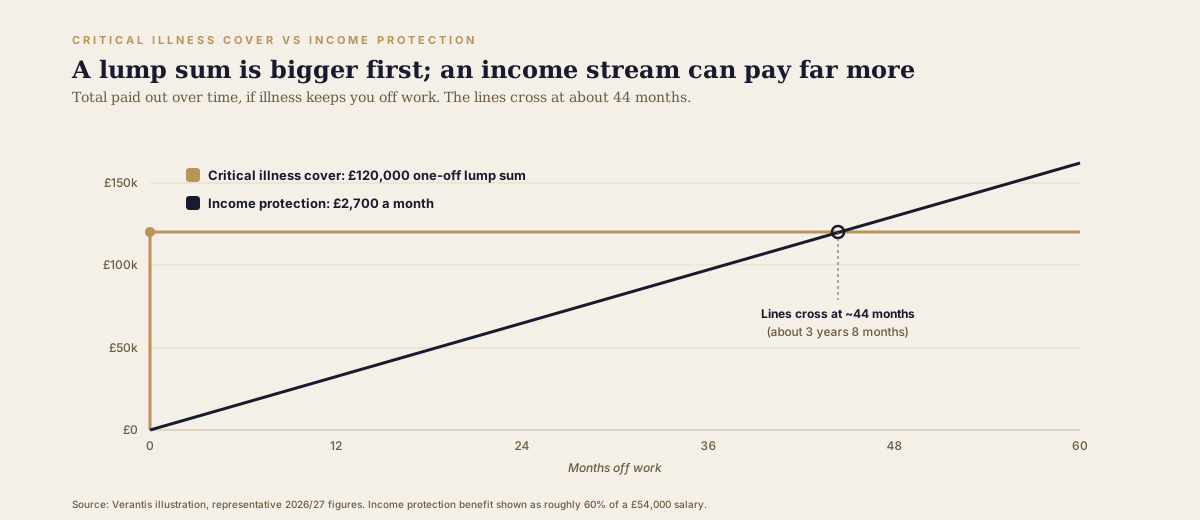
Whichever one pays for longer usually pays more, and that depends entirely on how long you are unable to work. A critical illness lump sum is larger on day one, because you receive the whole amount at once. An income protection benefit starts small and accumulates, so a short claim pays little and a long claim can dwarf any realistic lump sum.
The chart above shows the crossover using representative figures. A £120,000 critical illness lump sum is paid in full immediately and then stays flat. An income protection benefit of £2,700 a month climbs steadily and passes £120,000 after about 44 months, roughly three years and eight months. Recover inside that window and the lump sum paid more; stay off work beyond it and the income stream pulls ahead and keeps going, potentially for decades.
This is why comparing the two on their headline numbers is a mistake. The lump sum looks bigger because you can see all of it at once. The income protection benefit looks smaller because you only ever see one month of it at a time, yet its total value over a long claim is open-ended. The right comparison is not lump sum against monthly figure, but against the length and nature of the absence you are protecting.
When does each policy actually pay out?
Each policy pays in the exact situation the other may not, which is the clearest argument for treating them as partners rather than rivals. The strongest way to see it is to hold the person and their finances constant and change only the illness.
Naomi, 41, earns £54,000: two illnesses, two very different outcomes
Naomi is a self-employed graphic designer, 41, earning £54,000 a year. She holds critical illness cover with a £120,000 lump sum and income protection paying £2,700 a month, about 60% of her gross income, after a 13-week deferred period.
Scenario one: a heart attack. Naomi has a heart attack that meets the policy’s severity definition, then recovers well and returns to work after five months. Her critical illness cover pays the full £120,000 on diagnosis. Her income protection, with its 13-week wait, pays roughly two months of benefit, around £5,400, before she is back at work. Here the lump sum did nearly all the work.
Scenario two: a back condition. A degenerative spinal condition, not on the critical illness list, leaves her unable to work for four years. Her critical illness cover pays nothing, because the condition is not named in the policy. Her income protection pays £2,700 a month throughout: about £129,600 over the four years, and still paying. Here the monthly income did all the work.
Same person, same income, same two policies. Only the diagnosis changed, and it flipped which cover responded. That is the case for viewing them as complementary rather than interchangeable.
The pattern generalises. Critical illness cover is at its best for a sudden, severe, named diagnosis where you want capital fast. Income protection is at its best for anything that keeps you off work for a long time, whatever its label. Because you cannot know in advance which kind of event will befall you, choosing between them means weighing which risk you would least want to face uninsured.
How are critical illness and income protection payouts taxed?
Payouts from personal policies are normally free of income tax, but employer-funded income protection is not, which changes the sums quietly but significantly. When you pay the premiums yourself from money that has already been taxed, HMRC generally treats both a critical illness lump sum and an income protection benefit as tax-free, under the exemption set out in HMRC’s Insurance Policyholder Taxation Manual. There is no cap on the amount that can be received free of tax on a genuine personal policy.
Do you pay tax on a critical illness or income protection payout?
Payouts from a personal critical illness or income protection policy are normally free of income tax, because you pay the premiums from income that has already been taxed. The exception is employer-funded or group income protection, where the benefit is usually taxed as earnings through PAYE, just like salary. Employer-paid critical illness lump sums can also create a tax charge.
The picture changes with workplace cover. If your employer pays for group income protection and treats the premiums as a business expense, the benefit you receive is normally taxed as earnings through PAYE, in the same way as your salary. That means a group scheme replacing 60% of your gross salary can leave you with noticeably less in the hand than a personal policy paying the same headline percentage tax-free. It is one reason a personal policy can be worth holding even when workplace cover already exists.
Risk warning
HM Revenue and Customs practice and the law relating to taxation are complex and subject to individual circumstances and changes which cannot be foreseen.
Do you need both critical illness cover and income protection?
If you can afford both, holding both is the most complete arrangement, because they insure two genuinely different risks that a single policy cannot cover together. Income protection guards the income your whole plan rests on, whatever stops you earning. Critical illness cover puts capital in your hands at the moment of a serious diagnosis, for costs a monthly income is poorly shaped to meet, such as clearing a mortgage, adapting a home, or paying for treatment.
Income protection insures the risk you are most likely to face; critical illness cover insures the moment you would least want to face without capital. They are answers to different questions, which is why the strongest plans often hold both rather than choosing.
Where the budget only stretches to one, income protection is usually the stronger foundation. Being unable to work for a long stretch is more probable than a listed critical illness diagnosis, and the loss of earnings is the thing the rest of the plan, the mortgage, pension contributions, and the household budget, cannot absorb on its own. A lump sum is a comfort, but it runs out; a replacement income keeps the plan running. The exception is where a specific one-off liability dominates everything else, such as an interest-only mortgage due to be repaid, in which case the capital certainty of critical illness cover may matter more.
Buying critical illness cover for the reassurance of a big number while leaving loss of earnings uninsured is the priority most often the wrong way round. It protects the less likely event and leaves the more likely one exposed. If you hold a critical illness policy already, the useful next question is whether your income is protected too, not whether the lump sum should be larger.
Risk warnings
The value of pensions and any income from them can fall as well as rise. You may not get back the full amount invested.
A pension is a long-term investment and the value is not guaranteed. Any advice or considerations are personal to each individual’s circumstances.
How do the two policies fit into a wider plan?
Both policies exist to keep the rest of your financial plan intact when your ability to earn is interrupted, and they slot in above the thin support the state provides. Beyond Statutory Sick Pay, which runs for up to 28 weeks at £123.25 a week for 2026/27, the main state help for a longer absence is Employment and Support Allowance, which is assessed on whether you can do any work at all and pays far less than most working incomes. Neither comes close to a typical household budget, which is the gap these policies are built to fill.
The details inside each policy decide how well it holds. On income protection, the own occupation or any occupation definition matters more than the headline benefit, because it sets whether a claim is accepted at all, and the deferred period should be matched to your sick pay and savings. On critical illness cover, the length of the condition list and the severity wording decide how often it responds. Getting those right is the work of protection planning, and it is where cover stops being a guess and starts being a plan.
It also pays to look at what you already have. Workplace death in service benefit and group income protection are valuable but tied to the job and often taxable, so they rarely remove the need for personal cover entirely. Reviewing the two together, the diagnosis risk and the income risk, alongside your existing employer cover, is what turns a pile of separate policies into protection that actually matches your life. For the full detail on each, see the guides to critical illness cover and income protection insurance.
Which cover answers your question?
Critical illness cover and income protection are not competing versions of the same product; they answer different questions. Critical illness cover pays a lump sum for a listed diagnosis and is ideal for a one-off cost. Income protection replaces your earnings for as long as any illness or injury keeps you off work, and it protects the income everything else depends on. If you can only hold one, income protection is usually the stronger choice, because it insures the more likely risk and the one your plan cannot survive without. If you can hold both, you have covered the diagnosis and the loss of earnings separately, which is as complete as personal protection gets.
Frequently asked questions
What is the difference between critical illness cover and income protection?
Critical illness cover pays a single tax-free lump sum if you are diagnosed with one of a defined list of serious conditions. Income protection pays a regular monthly income if illness or injury stops you working, and keeps paying until you recover, the policy ends, or you retire. One responds to a diagnosis; the other responds to being unable to work, whatever the cause.
Is it better to have critical illness cover or income protection?
For most people income protection is the better single choice, because being unable to work through illness or injury is more likely than a listed critical illness diagnosis, and it replaces the income everything else depends on. Critical illness cover is valuable for clearing a debt or funding treatment on diagnosis, but it pays nothing for the many conditions that stop you working without appearing on its list.
Can you claim on both critical illness cover and income protection at the same time?
Yes. They are separate policies covering different risks, so a single illness can trigger both. A serious cancer diagnosis, for example, could pay a critical illness lump sum straight away and start an income protection claim once the deferred period passes. Holding both does not reduce either payout.
Does income protection cover the same illnesses as critical illness cover?
No, and this is the most common misunderstanding. Income protection is not tied to a list of conditions at all: it pays whenever illness or injury stops you working, including back problems, stress, and mental health conditions that critical illness cover excludes. Critical illness cover only pays for the specific conditions named in the policy, at the severity defined there.
Which is cheaper, critical illness cover or income protection?
Premiums depend on age, health, job, and the amount of cover, so neither is reliably cheaper. Critical illness cover is often quoted at a lower monthly cost for a headline sum, but that reflects a narrower trigger. Comparing them on price alone is misleading, because you are buying protection against two different risks, not the same cover at two prices.
Do you still need income protection if you have critical illness cover through work?
Usually yes, but check what your employer actually provides first. Critical illness cover through work is a lump sum for a listed diagnosis and does nothing for a long absence, so the income risk is only covered if there is a separate group income protection scheme alongside it. Even where there is one, the scheme belongs to your employer, who can change or withdraw it at renewal, and it ends when you leave. A personal policy is underwritten on the health you have when you take it out and does not depend on who employs you.