A relevant life policy is a single-life term assurance policy that a company takes out and pays for on an employee or director, paying a lump sum to their family if they die before a set age. It funds personal life cover far more cheaply than paying from taxed income, because the company pays the premiums as a deductible business expense. It suits company directors and employees of small firms that are too small for a group death-in-service scheme, and higher earners who want cover that sits outside their pension allowances. The cover must pay out before age 75, can only benefit individuals or charities, and is tied to your employer.
A relevant life policy is a life insurance policy that your company takes out on you and pays for, so the premiums come out of company profits rather than your own taxed income. It works much like death in service, but as a single policy on one person rather than a scheme covering a whole workforce, which makes it the natural way for a company director or a small employer to provide tax-efficient life cover. The premiums are usually an allowable business expense, they are not treated as a benefit in kind, and the lump sum is paid tax-free to your family through a discretionary trust. All figures and thresholds in this article reflect the 2026/27 tax year.
Is a relevant life policy a benefit in kind?
No. Premiums an employer pays into a relevant life policy are not treated as a benefit in kind, so the employee pays no income tax or National Insurance on them. The premiums are also normally an allowable business expense for the company, and the payout is free of income tax when written in trust.
Contents
- What is a relevant life policy?
- How does a relevant life policy work?
- How is a relevant life policy taxed?
- How does a relevant life policy compare to death in service?
- What conditions must a relevant life policy meet?
- Who is a relevant life policy for?
- Is a relevant life policy worth it?
- How does a relevant life policy fit into a wider plan?
What is a relevant life policy?
A relevant life policy is a single-life term assurance policy that a company takes out and pays for on one of its employees or directors, paying a lump sum to that person’s family if they die before a chosen age. It is, in effect, death-in-service cover for one person. Larger employers spread group life cover across a whole workforce, but a one-person company or a firm with only a handful of staff cannot do that, and a relevant life policy fills the gap with an individual contract.
The cover is owned and paid for by the company, not the individual. That single fact is what gives the arrangement its tax advantages, because the premiums leave the business as a cost rather than passing through your salary or dividends first. The policy is written under a discretionary trust from the start, so the payout reaches the family directly rather than the company.
Most relevant life policies also pay out early on diagnosis of a terminal illness, and the sum assured is agreed with the insurer based on total gross remuneration rather than an employer’s fixed scheme multiple. Because each policy is individually underwritten, the maximum available is higher than a group scheme’s two or three times salary in many cases, though insurers set their own limits based on remuneration rather than on personal liabilities or expenses.
How does a relevant life policy work?
A relevant life policy works by the company applying for the cover, paying the premiums, and placing the policy in trust for the employee’s family. The company is the policyholder and the person covered is the life assured, but the trust means neither the company nor the deceased’s estate ever owns the money that is paid out.
When a valid claim is made, the insurer pays the trustees, who then distribute the lump sum to the beneficiaries. As with a personal life insurance policy written in trust, this routing is what keeps the proceeds outside the estate for inheritance tax and lets the family receive the money without waiting for probate. You complete an expression of wish naming who you would like the trustees to pay, and they almost always follow it.
A relevant life policy turns life cover from a personal cost paid out of taxed income into a deductible business expense, which is why a company director’s family can be insured for a fraction of what the same protection would cost privately.
Because the policy is single-life and individually underwritten, it behaves like an ordinary term assurance for the person covered: a level or decreasing sum assured over a fixed term, with no investment element and no surrender value. The difference is purely in who owns it and how it is paid for.
How is a relevant life policy taxed?
A relevant life policy is taxed favourably at every stage, which is the whole reason it exists. The premiums are normally an allowable business expense, so they reduce the company’s corporation tax bill, charged at 19% or 25% for 2026/27 depending on profits. They are not treated as a benefit in kind under the Income Tax (Earnings and Pensions) Act 2003, so there is no income tax for the employee and no National Insurance for either side. With the employer National Insurance rate at 15% on earnings above £5,000 a year for 2026/27, avoiding that charge on the premium is a real saving in its own right.
The contrast with paying for cover yourself is stark, because money taken out of a company to fund a personal premium is taxed twice on the way: once as corporation tax on the profit, then again as income tax or dividend tax when you extract it.
Marcus, 46, funding £500,000 of cover
Marcus runs his own limited company, pays himself mainly in dividends, and is a higher-rate taxpayer. He wants £500,000 of life cover, with a premium of around £100 a month, or £1,200 a year.
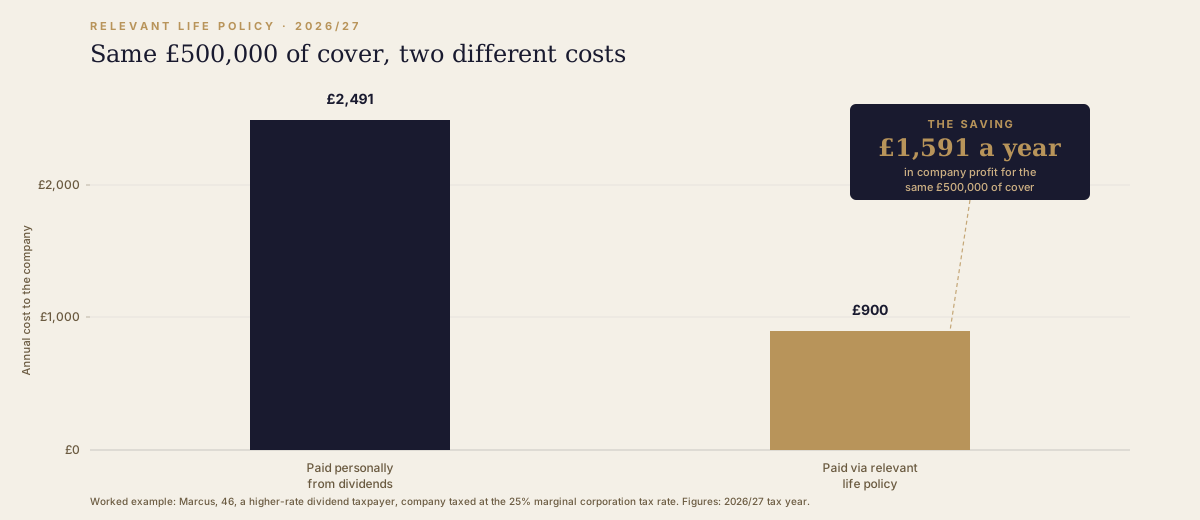
Paid personally from dividends, the maths works backwards. To keep £1,200 after the higher-rate dividend tax of 35.75% for 2026/27, he must draw about £1,868 in dividends. That dividend comes from profit already taxed at corporation tax, so at a 25% marginal rate the company has to earn roughly £2,491 to leave him the £1,200 he needs.
Paid through a relevant life policy, the company pays the £1,200 premium directly as an allowable expense, cutting its corporation tax by 25%, so the real cost is about £900. There is no benefit in kind, so no income tax and no National Insurance.
The same £500,000 of cover costs about £900 of company profit through the relevant life policy, against about £2,491 paid personally: a saving of roughly £1,591 a year. The figures assume a higher-rate dividend taxpayer and a 25% marginal corporation tax rate, and the deduction depends on the premium meeting the wholly and exclusively test.
There is one more tax advantage worth naming. A relevant life policy is written as an excepted group life policy, so unlike a registered death-in-service scheme its payout is not tested against the lump sum and death benefit allowance, which stands at £1,073,100 for 2026/27. For a high earner whose pension death benefits already approach that limit, keeping life cover outside the allowance can matter a great deal. The director’s route to extracting income tax-efficiently is the same question explored in dividend tax for company directors.
How does a relevant life policy compare to death in service?
A relevant life policy and death in service do the same job, paying a tax-free lump sum on death through a trust, but they suit very different employers. Death in service is a group scheme that covers a whole workforce under one arrangement, which is efficient for a larger company but unavailable to a one-person business. A relevant life policy is a single contract, so it works for a sole director or a firm with only a few employees.
The two also differ in how the cover interacts with pension limits and with leaving the job, as the table sets out.
| Feature | Relevant life policy | Death in service |
|---|---|---|
| Who it suits | Directors and small employers | Larger employers with group schemes |
| Number of lives covered | Single life, one policy each | Whole workforce under one scheme |
| Who sets the sum assured | Agreed with the insurer | Employer’s salary multiple |
| Counts against the lump sum and death benefit allowance | No | Yes, if a registered scheme |
| Medical underwriting | Individually underwritten | Usually none for standard cover |
| If you leave the employer | Can often be continued | Ends immediately |
Neither is better in the abstract. A large employer with a group scheme has no need of individual policies, while a contractor working through their own company has no group scheme to join and finds a relevant life policy is the only way to put the cover on the company’s books.
What conditions must a relevant life policy meet?
A relevant life policy must meet a set of conditions in tax law to keep its favourable treatment, and missing any of them can cause it to be taxed as ordinary remuneration. The core conditions, set out in the Income Tax (Earnings and Pensions) Act 2003, are these.
- The benefit must be a lump sum payable on death, and it must be paid where the person covered dies before a specified age that cannot exceed 75.
- The policy can have no surrender value and must offer no benefits other than the death sum, so it cannot include an investment or savings element.
- Only individuals and charities can benefit, which is why it must be written in trust and cannot be used to protect the company itself.
- Tax avoidance must not be a main purpose of the policy.
There is also a structural requirement: a relevant life policy needs an employer-employee relationship. A limited company can cover its directors and staff, but a sole trader or an ordinary partnership partner has no employer to take out the policy, so the route is not open to them. These are eligibility conditions rather than a sequence of steps, so an adviser checks them once at outset.
Risk warning
A pension is a long-term investment, the value of your investment and the income from it may go down as well as up. Your eventual income may depend upon the size of the fund at retirement, future interest rates and tax legislation.
Who is a relevant life policy for?
A relevant life policy is for company directors and employees of limited companies who want life cover paid for tax-efficiently by the business. It is most valuable to the owner-director of a small company that is too small to run a group death-in-service scheme, because it gives one person the same kind of company-funded, trust-based cover that a large employer provides as standard.
Can a company director take out a relevant life policy?
Yes. A director who is an employee of their own limited company can be covered by a relevant life policy the company takes out and pays for. Sole traders and ordinary partnership partners cannot, because a relevant life policy needs an employer-employee relationship. The cover must be for the individual’s family or chosen beneficiaries, not the business.
It also suits higher earners whose pension death benefits are nearing the lump sum and death benefit allowance, because the payout sits outside that limit. And it appeals to anyone who would otherwise buy life cover personally and is paying for it from dividends or salary, since moving the same premium onto the company is materially cheaper. Tax-efficient extraction of value from a company is the same theme that runs through employer pension contributions for company directors. It is not for protecting the business itself: cover that pays the company on the death of a shareholder is the job of shareholder protection, a different arrangement entirely.
Is a relevant life policy worth it?
For a director or employee of a limited company who wants life cover, a relevant life policy is usually worth it, because the company funds it with corporation tax relief and no benefit-in-kind charge, often cutting the real cost by around half compared with paying personally. The saving is largest for higher and additional-rate taxpayers, who face the steepest tax cost when extracting money from the business to fund a private premium.
The trade-offs are genuine rather than incidental. The cover is owned by the company, so it is tied to your employment and may need to be continued if you move on. It can only benefit individuals or charities, so it cannot double as key person or business cover. And the benefit must be paid before age 75, which means it is term assurance, not a whole-of-life policy designed to pay out whenever death occurs. For most company owners those limits are easy to live with, but anyone wanting permanent cover to meet an inheritance tax bill should look instead at whole of life insurance, which is built for that purpose.
How does a relevant life policy fit into a wider plan?
A relevant life policy is one layer of protection, not the whole of it. It answers the risk of dying while running or working for the company, but it says nothing about the more common risk of being unable to work through illness or injury. That gap belongs to income protection insurance, which replaces earnings rather than paying a lump sum on death, and which can also be arranged through a company.
It also sits alongside the way a director draws income and saves for retirement. The decision to fund cover through the company rather than personally is part of the same picture as how salary, dividends, and pension contributions are balanced, and it is the kind of question a protection planning review is built to weigh. Used well, a relevant life policy provides substantial family cover at a fraction of the personal cost, leaving more of the company’s profit to do other work.
Risk warning
The definitions vary between product providers and will be described in the key features and policy document, if you go ahead with the plan.
Efficient cover, with clear boundaries
A relevant life policy is one of the most efficient ways for a company director or small-firm employee to hold life cover: the premiums are a deductible business expense, they are not a benefit in kind, and the payout is tax-free and outside the estate when written in trust. Its limits are clear, in that the cover is tied to the employer, must benefit individuals rather than the business, and ends before age 75. For the right person, usually an owner-director paying for protection out of taxed income, moving that cover onto the company is a straightforward way to insure a family for materially less.
Frequently asked questions
What is a relevant life policy?
A relevant life policy is a single-life death-in-service policy that a company takes out and pays for on an employee or director. It pays a lump sum to their family if they die, or are diagnosed with a terminal illness, before a set age. The company owns and funds the policy, and it is normally written in trust for the family.
How does a relevant life policy work?
The company applies for an individually underwritten term policy on the life of an employee or director and pays the premiums from company funds. The policy is placed in a discretionary trust at outset, so on a valid claim the insurer pays the trustees, who pass the lump sum to the family free of income tax and outside the deceased's estate.
Are relevant life policy premiums tax deductible?
Usually yes. Premiums are normally an allowable business expense for the company, attracting corporation tax relief, provided they meet the wholly and exclusively test, which is decided by the local HMRC inspector. They are not a benefit in kind, so there is no income tax or National Insurance on them for employer or employee.
What is the difference between a relevant life policy and death in service?
A relevant life policy is a single policy on one person, while death in service is a group scheme covering a whole workforce. Relevant life suits directors and small employers who cannot run a group scheme. Unlike a registered death-in-service scheme, a relevant life policy does not count against the lump sum and death benefit allowance.
Is a relevant life policy worth it?
For a director or employee of a limited company who wants life cover, a relevant life policy is usually worth it, because the company funds it with corporation tax relief and no benefit-in-kind charge. The trade-offs are that the cover is tied to the employer, can only benefit individuals or charities, and must end before age 75.
What happens to a relevant life policy if you leave the company?
Because the company owns the policy, cover normally ends if you leave, unless the policy is continued. Many relevant life policies allow the cover to be transferred to a new employer or to you personally without fresh medical underwriting. Checking whether continuation is allowed before you move jobs avoids a gap in protection.
Risk warning
HM Revenue and Customs practice and the law relating to taxation are complex and subject to individual circumstances and changes which cannot be foreseen.