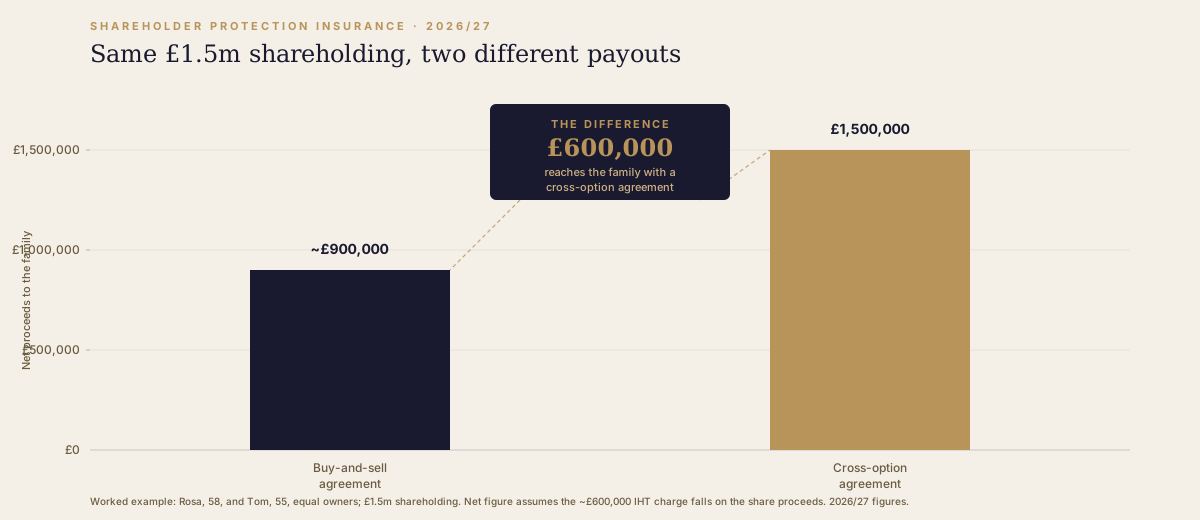
Shareholder protection is a business arrangement that pairs life or critical illness insurance on each shareholder with a legal option agreement covering the purchase of a shareholder's stake. When a shareholder dies, the policy pays the survivors enough to buy the deceased's shares, so the family gets cash and control stays put. Without it, an owner's stake can pass to relatives with no interest in the business, or leave the survivors scrambling to find the money. The structure matters more than the cover: a binding buy-and-sell agreement can strip the shares of business property relief, so the option-based cross-option route is standard.
Shareholder protection is the arrangement a private company uses to make sure that, when an owner dies or becomes critically ill, their shares can be bought by the people left running the business rather than passing to a family with no involvement in it. It pairs a life or critical illness policy on each shareholder with a written option agreement that sets out who can buy the shares and at what value. The insurance provides the cash; the agreement provides the mechanism. The figures in this article reflect the 2026/27 tax year. What follows is how shareholder protection works, how it is paid for and taxed, and the drafting decision that quietly decides whether the shares keep their inheritance tax relief.
Who buys the shares when a shareholder dies?
The surviving shareholders do. Each owner’s life is insured, and on a death the policy pays a lump sum, usually held in trust for the other shareholders, which they use to buy the deceased’s stake at an agreed value. A cross-option agreement gives the survivors the option to buy and the estate the option to sell.
Contents
- What is shareholder protection?
- How does shareholder protection work?
- How do you pay for shareholder protection?
- Why can the wrong agreement cost you business property relief?
- How is shareholder protection taxed?
- Shareholder protection vs key person insurance
- Is shareholder protection worth it?
- How does shareholder protection fit into a wider plan?
What is shareholder protection?
Shareholder protection is an arrangement that lets the surviving owners of a company buy a co-owner’s shares if that owner dies or becomes critically ill, using the proceeds of an insurance policy to fund the purchase. It has two halves that only work together: a policy on the life of each shareholder, and a legal agreement between the owners that governs how the shares change hands. Take away the agreement and the survivors have cash but no guaranteed route to the shares; take away the insurance and they have the route but no money.
The problem it solves is a specific one. When a shareholder in a private company dies, their shares form part of their estate and pass under their will, typically to a spouse or children. Those beneficiaries may have no wish to run the business, and the surviving owners may have no spare cash to buy them out. Shareholder protection, sometimes called share protection or co-shareholder protection, removes that uncertainty in advance by putting both the funding and the legal mechanism in place while everyone is still alive.
How does shareholder protection work?
Each shareholder takes out a policy on their own life, usually term assurance and often with critical illness cover added, for a sum that reflects the value of their shareholding. The policies are normally written in trust for the benefit of the other shareholders, so that on a death the money is paid promptly to the survivors and stays outside the deceased’s estate.
Sitting alongside the policies is the option agreement, and this is where shareholder protection earns its name. The standard form is a cross-option agreement, also called a double option. It gives the surviving shareholders an option to buy the deceased’s shares and gives the estate an option to sell them, both at a value set by the agreement. Either side can exercise its option, and once one does, the other is bound to complete. The result is that the survivors can always secure the shares and the family can always turn them into cash, but neither side is forced into the deal before a death actually happens. As the next sections explain, that distinction between an option and an obligation is not a technicality. It decides how the shares are taxed.
Risk warnings
Generally, these plans have no cash in value at any time and will cease at the end of the term. If premiums are not maintained, then cover will lapse.
The definitions vary between product providers and will be described in the key features and policy document, if you go ahead with the plan.
How do you pay for shareholder protection?
Each shareholder usually pays the premium on their own policy personally, and the premiums are then equalised between the owners. Equalisation matters because shareholders are rarely the same age or in the same health, so the raw cost of insuring each life differs. Adjusting the contributions so that no owner is paying more than their fair share keeps the arrangement commercial, which in turn helps stop HMRC treating it as a gift from one shareholder to another.
A company can pay the premiums instead, but that route carries a tax cost. Because the policy benefits the shareholders rather than the trade itself, company-paid premiums are normally treated as a benefit in kind, taxable on each shareholder through the payroll. For owner-directors weighing how to fund cover, it sits alongside the wider question of how to extract value efficiently, whether through salary, dividends, or employer pension contributions. For most shareholder protection arrangements, paying personally and equalising is the cleaner approach.
Risk warnings
Pensions
The value of pensions and any income from them can fall as well as rise. You may not get back the full amount invested.
Levels and bases of, and reliefs from, taxation are subject to change and their value will depend upon personal circumstances. Taxation and pension legislation may change in the future.
A pension is a long-term investment and the value is not guaranteed. Any advice or considerations are personal to each individual’s circumstances.
Tax, trusts and estate planning
HM Revenue and Customs practice and the law relating to taxation are complex and subject to individual circumstances and changes which cannot be foreseen.
Why can the wrong agreement cost you business property relief?
The form of the agreement, not the insurance, decides whether the shares keep their business property relief, and a binding buy-and-sell agreement can lose it. Shares in an unquoted trading company can usually attract business property relief at 100% for 2026/27, removing their value from the estate, provided they have been held for at least two years and the company genuinely trades. From 6 April 2026 that 100% relief is capped at the first £2.5 million of combined business and agricultural assets per person, with business relief of 50% above that. For most owner-managed companies the shares still fall comfortably within the 100% band.
The trap is in how the buyout is documented. If the agreement is a buy-and-sell arrangement, one that obliges the deceased’s estate to sell the shares and the surviving owners to buy them, HMRC treats it as a binding contract for sale at the date of death. Once that contract exists, the shares are no longer relievable property, so business property relief is denied and their full value is exposed to inheritance tax at 40% for 2026/27. A cross-option agreement avoids this because each party holds an option rather than an obligation, so there is no binding contract for sale until an option is actually exercised after death.
Why does a buy-and-sell agreement lose business property relief?
A binding buy-and-sell agreement obliges the estate to sell the shares and the survivors to buy them, which HMRC treats as a contract for sale. Once that binding contract exists at death, the shares no longer qualify for business property relief, so their full value can be taxed at 40% for 2026/27. A cross-option agreement avoids this because each side holds an option, not an obligation.
Two companies, one drafting decision
Rosa, 58, and Tom, 55, are equal owners of a trading engineering company. Rosa’s 50% stake is worth £1.5 million, the company has traded for twenty years, and both have shareholder protection policies in place.
In the first company, the owners signed a binding buy-and-sell agreement. When Rosa dies in 2026, the agreement obliges her estate to sell and Tom to buy, so HMRC treats it as a contract for sale. Business property relief is denied on her £1.5 million of shares, and after her available nil-rate bands the estate faces an inheritance tax charge running to roughly £600,000.
In the second company, everything is identical except that the owners used a cross-option agreement. Rosa’s estate keeps 100% business property relief on the same £1.5 million, well within the combined allowance of £2.5 million for 2026/27, so no inheritance tax falls on the shares. Tom still buys them with the insurance money, and the family still receives £1.5 million in cash. Same people, same policies, same outcome for the business, yet one estate pays a six-figure tax bill and the other pays nothing.
The insurance is identical in both companies. The only real difference is one word in the paperwork, an option rather than an obligation, and that single word decides whether the family hands roughly £600,000 to HMRC or nothing at all.
How is shareholder protection taxed?
A shareholder protection policy written in trust normally pays out free of income tax and inheritance tax, while the premiums are usually not deductible for the company. The payout itself is a life insurance benefit, so there is no income tax on it. Holding the policy in a suitable business trust keeps the proceeds outside the insured shareholder’s estate and directs them to the surviving owners, rather than leaving a large sum sitting in the deceased’s estate where it could attract inheritance tax of its own.
The premiums work differently. Because the cover exists to buy shares, which is a capital purpose, rather than to make good a loss of trading profit, HMRC does not normally allow a deduction for shareholder protection premiums. That is one reason owners tend to pay personally and equalise: the company gets no relief for paying, and paying through the business creates a benefit in kind instead. Equalisation also matters for inheritance tax during life, because broadly equal contributions make it far harder to argue that one shareholder has made a gift to another by funding their cover.
Shareholder protection vs key person insurance
Shareholder protection and key person insurance are both forms of business protection, but they insure entirely different risks and pay entirely different people. Shareholder protection insures the ownership of the company, funding the purchase of a deceased owner’s shares so the survivors keep control. Key person insurance insures the trading impact of losing a vital individual, paying the company a sum to cover lost profits, recruitment, or a loan that relied on that person. The two are often held together, but one is never a substitute for the other.
| Feature | Shareholder protection | Key person insurance |
|---|---|---|
| What it insures | The ownership of the shares | The profits tied to a key individual |
| Whose life is covered | Each shareholder | A key employee or director |
| Who receives the payout | The other shareholders, often via trust | The company |
| What the money is for | Buying the deceased’s shares | Replacing lost income or cover |
| Premiums deductible? | Not normally, a capital purpose | Sometimes, if strict trade conditions are met |
Where critical illness is added, both types can pay out on a serious diagnosis as well as on death, which is why critical illness cover features in many business protection arrangements. The right combination depends on what each company would actually lose: control of the business, the profits a key person generates, or both.
Is shareholder protection worth it?
Shareholder protection is worth it for most companies with two or more owners who could not comfortably buy out a deceased shareholder’s family from their own resources. The core benefit is control: it stops shares drifting to people outside the business and removes the risk of the survivors being unable to fund a buyout at the worst possible moment, while still paying the family a fair value in cash. The more valuable the shares and the less the co-owners are related, the stronger the case.
The trade-offs are real, though. Premiums are an ongoing cost that the company cannot usually deduct, and the arrangement only works if the share valuation and the agreement are kept current, since an out-of-date figure can leave the cover too low to buy the shares in full. A sole owner has no co-shareholder to buy them out, so shareholder protection does not apply to them at all; their concern is succession and inheritance tax, not a buyout. Deciding which policies a business and its owners actually need, and in what order, is the heart of protection planning.
How does shareholder protection fit into a wider plan?
Shareholder protection is one layer of a business owner’s plan, not the whole of it. It sits alongside key person cover for the trading risk, personal life and income protection for the family, and the everyday decisions about how owners are paid, from salary to dividends. Each addresses a different exposure, and a coherent plan starts from the risks the owners most need to cover rather than from the products.
It also connects to the owner’s estate planning. The same shares that shareholder protection buys out are the ones that may qualify for business property relief, and the two need to be designed together so the buyout does not accidentally destroy the relief. For owners who once assumed both their company and their pension would pass on largely tax-free, the picture has tightened from two directions: the 2026 cap on business relief, and the April 2027 change bringing most unused pension funds into the inheritance tax net. Shareholder protection works best when it is built into that wider plan, not bolted on in isolation.
The paperwork matters as much as the policy
Shareholder protection keeps a company in the right hands when an owner dies, funding the survivors to buy the shares while paying the family a fair cash value. Its value lies as much in the paperwork as in the policy: a cross-option agreement preserves business property relief where a binding buy-and-sell agreement can lose it, a difference worth hundreds of thousands of pounds on a valuable stake. Set up with policies in trust, premiums equalised, and the valuation kept current, it turns the death of an owner from a crisis into an orderly, pre-funded transfer.
Frequently asked questions
What is shareholder protection?
Shareholder protection lets a company's surviving owners buy a co-owner's shares if that owner dies or becomes critically ill, funded by insurance. It combines a policy on each shareholder with a written option agreement that fixes who can buy the shares and how they are valued. The aim is to keep control with the remaining owners while paying the family a fair cash value.
How does shareholder protection work?
Each shareholder's life is insured, and on a death the policy pays the surviving owners a lump sum to buy the deceased's shares. The policy is usually written in trust for the other shareholders, so the money reaches them quickly and outside the deceased's estate. The deceased's family receives cash instead of a stake in a business they may not want to run.
Are shareholder protection premiums tax deductible?
Usually not, because the cover exists to buy shares, a capital purpose, rather than to replace lost trading profits. HMRC does not normally allow the company to deduct the premiums. They are commonly paid by the shareholders personally and equalised, and company-paid premiums are typically a benefit in kind taxed on each shareholder.
Is shareholder protection worth it?
It is worth it for most companies with two or more owners who could not easily buy out a deceased shareholder's family from their own resources. It keeps control of the business with the surviving owners while paying the family a fair cash value. It is unnecessary for a sole owner, who has no co-shareholder to buy them out.
What is the difference between shareholder protection and key person insurance?
Shareholder protection funds the purchase of an owner's shares, while key person insurance replaces the profits lost when a vital employee dies or falls ill. With shareholder protection the payout goes to the other shareholders; with key person insurance it goes to the company. One protects ownership, the other protects trading income.
What happens to a business if a shareholder dies without protection?
Without protection, a deceased shareholder's stake passes under their will, often to a spouse or children with no role in the business. The survivors may face a co-owner who wants to sell or interfere, or a demand for a price they cannot fund. The family, meanwhile, can struggle to sell an unquoted minority stake for a fair value.