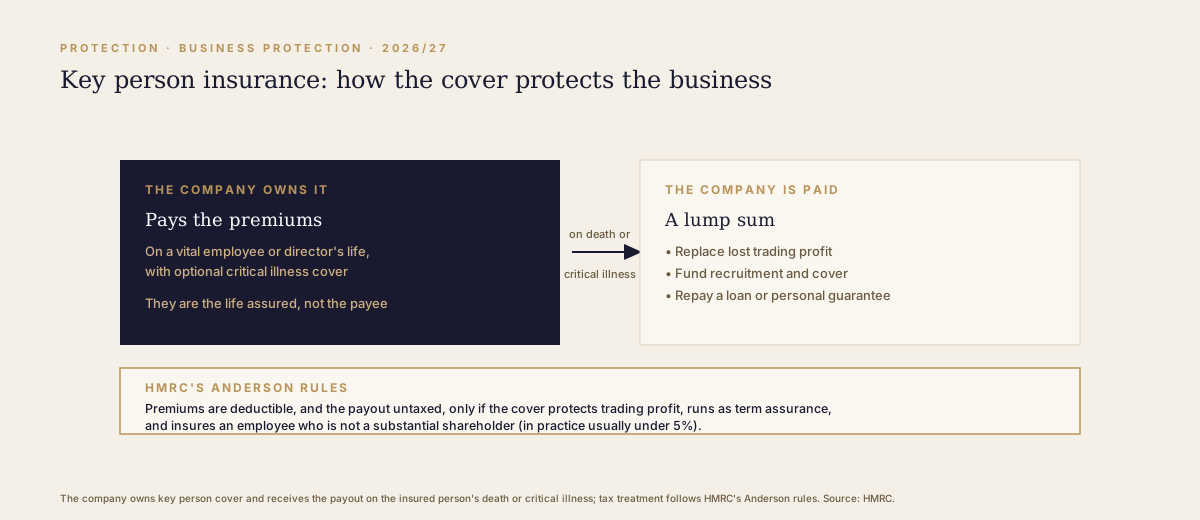
Key person insurance is a business protection policy a company owns on the life or health of a vital employee or director, paying the company a lump sum if that person dies or becomes critically ill. The company owns the policy and receives the payout, using it to replace lost profits, fund recruitment, or repay a loan if a vital employee dies or falls critically ill. It matters most where one person drives a large share of revenue, holds irreplaceable expertise, or personally guarantees borrowing. Whether the premiums are tax-deductible, and the payout taxable, turns on HMRC's Anderson rules: the cover must protect trading profit, run as term assurance, and insure an employee who is not a substantial shareholder.
Key person insurance is the cover a business takes out on the life, and often the health, of an individual whose loss would seriously damage its profits. The company owns the policy, pays the premiums, and receives the payout, which it can use to replace lost income, recruit a successor, or repay borrowing that depended on that person. It protects the trade itself, not the individual or their family. The figures in this article reflect the 2026/27 tax year. What follows is how key person insurance works, how the Anderson rules decide whether the premiums and the payout are taxed, how much cover a business needs, and how it differs from shareholder protection.
What does key person insurance pay out for?
It pays the company a lump sum if an insured key employee or director dies, and usually on a critical illness diagnosis where that cover is added. The money is the company’s to use for lost profits, recruiting a replacement, or repaying a loan. Cover is typically set at two to five times the person’s annual profit contribution.
Contents
- What is key person insurance?
- How does key person insurance work?
- How is key person insurance taxed?
- How much key person cover does a business need?
- Key person insurance vs shareholder protection
- Is key person insurance worth it?
- How does key person insurance fit into a wider plan?
What is key person insurance?
Key person insurance is a business protection policy that pays a company a lump sum if a named, vital individual dies or, where the cover is added, becomes critically ill. The company is the policy owner and the beneficiary; the insured person is simply the life assured and has no legal or beneficial claim on the money. It is sometimes called keyman, key man, or key employee cover, and the principle is the same in each case: the business is insuring its own exposure to losing that person.
A key person is anyone whose departure would materially reduce profits or threaten the firm’s survival. That might be a founder who holds the client relationships, a lead developer whose knowledge is not written down anywhere, a top salesperson who generates a large share of revenue, or a director whose personal guarantee underpins a bank loan. The test is not seniority but financial dependence: how much of the business would stall, and for how long, if that person were suddenly gone.
How does key person insurance work?
The company takes out a term policy on the key person’s life, usually with the option to add critical illness cover, and sets the sum assured to reflect the financial damage their loss would cause. The business pays the premiums and, because it owns the policy, receives the proceeds directly if a valid claim arises. Unlike a personal life policy, the money is not for dependants; it is working capital for the company to deploy.
What the payout funds depends on why the person mattered. It can cover the profit shortfall while the business stabilises, the cost of recruiting and training a replacement, or the repayment of a loan that a lender will call in once the guarantor has gone. Many policies are written on a level term basis over five or ten years and reviewed as the person’s role and the firm’s reliance on them change. Because the cover is owned by the company rather than the individual, it sits separately from any relevant life policy a business might also provide as a tax-efficient death-in-service benefit for the same person.
Risk warning
The definitions vary between product providers and will be described in the key features and policy document, if you go ahead with the plan.
How is key person insurance taxed?
Key person insurance has no single tax answer: whether the premiums are deductible and the payout taxable both turn on the purpose of the cover, under principles HMRC has applied since 1944. Those principles, known as the Anderson rules after the Chancellor who set them out, allow a company to deduct the premiums against corporation tax only where three conditions are met. The cover must exist to protect trading profit rather than a capital asset; it must be short-term assurance with no investment or surrender value; and the insured must be an employee whose only relevant relationship with the company is employment, not a substantial shareholder.
The shareholding point catches many owner-managed companies. HMRC sets no percentage here: whether a premium is wholly and exclusively for the trade is a question of fact, and the case it names is a policy on a director whose death would move the value of their shares, where protecting that value is a purpose sitting alongside protecting the trade. The 5% figure is the line advisers and insurers work to rather than one HMRC publishes, so treat a stake near it as a reason to write down why the cover exists, not as a test already passed. The same goes for cover whose real job is to repay a loan or to buy out a departing owner: both are capital purposes, and neither premium is deductible.
The decisive feature is the symmetry between the two sides. Where the premiums have been allowed as a deduction, HMRC taxes the eventual payout as a trading receipt, so corporation tax falls on the lump sum the company receives. Where the premiums were not deductible, the proceeds are generally outside trading income and not taxed, although HMRC stops short of guaranteeing this in every case. In other words, the tax relief you gain on the way in is usually repaid on the way out.
Are key person insurance premiums tax deductible?
Sometimes. Premiums are deductible against corporation tax only where the policy meets HMRC’s Anderson rules: it protects trading profit rather than capital, runs as term assurance, and insures an employee who is not a substantial shareholder, in practice usually under 5%. Where premiums are deductible, the payout is taxed as a trading receipt.
A research company insures Priya, 41, its lead chemist
Priya holds no shares but runs the firm’s two most profitable product lines. The company insures her life for £500,000 under a ten-year term policy, paying around £1,200 a year. Because the cover protects trading profit and Priya is a pure employee, the premiums meet the Anderson rules and are deducted against corporation tax.
Priya dies in 2026 and the insurer pays £500,000 to the company. Since the premiums were deductible, HMRC treats the payout as a trading receipt, so the firm’s main-rate corporation tax of 25% in 2026/27 applies. The company keeps roughly £375,000 after a £125,000 tax charge.
To leave £500,000 in the company after tax, the firm would have needed cover closer to £667,000. Had the identical policy instead been arranged purely to secure a £500,000 bank loan, the premiums would not have been deductible, but the £500,000 payout would generally have arrived tax-free.
Key person insurance is the rare business cover where saving tax on the premiums quietly costs you tax on the payout, so the deductible policy is usually the one you must over-insure to leave the right sum behind.
Risk warning
HM Revenue and Customs practice and the law relating to taxation are complex and subject to individual circumstances and changes which cannot be foreseen.
How much key person cover does a business need?
The right sum assured reflects what the business would actually lose, not the person’s salary. Salary measures what you pay someone, whereas key person cover should measure what they generate and what it would cost to carry on without them. A common starting point is two to five times the person’s annual contribution to gross profit, adjusted for how long recovery would realistically take and whether the payout will itself be taxed.
Three figures usually drive the calculation: the profit at risk while the role is unfilled, the cost of recruiting and training a credible replacement, and any borrowing the person guarantees that a lender could recall on their death. Where the payout will be taxed as a trading receipt, the cover should be grossed up so the after-tax amount still meets the need. A policy sized to the net figure, ignoring the corporation tax charge, can leave the business short at the very moment it can least afford it.
Key person insurance vs shareholder protection
Key person insurance and shareholder protection are both business protection, but they insure different risks and pay different people. Key person insurance protects trading profit: the company owns the policy and keeps the payout to cover the income, recruitment, or borrowing lost when a vital person goes. Shareholder protection protects ownership: it funds the surviving owners to buy a deceased shareholder’s stake, so the payout reaches the other shareholders, not the company. One keeps the business trading; the other keeps it in the right hands.
| Feature | Key person insurance | Shareholder protection |
|---|---|---|
| What it insures | Lost trading profit | Ownership of the shares |
| Who owns the policy | The company | Each shareholder, often in trust |
| Who receives the payout | The company | The surviving shareholders |
| What the money is for | Profit, recruitment, loan repayment | Buying the deceased’s shares |
| Premiums deductible? | Sometimes, under the Anderson rules | Not normally, a capital purpose |
The two are frequently held side by side, because the death of an owner-director can hit a company on both fronts at once: the trade loses a key person and the ownership needs resolving. Where the same individual is both a major shareholder and operationally critical, advice usually pairs shareholder protection on the shares with separate key person cover on the trading risk, rather than trying to stretch one policy across both jobs.
Risk warning
The Financial Conduct Authority does not regulate some aspects of Trust, Tax and Estate Planning.
Is key person insurance worth it?
Key person insurance is worth it for most businesses whose profits depend heavily on one or two individuals and that could not absorb their loss from reserves or cash flow. The benefit is time and money at the worst possible moment: a lump sum that lets the company keep paying staff, reassure lenders and clients, and recruit properly rather than in a panic. The greater the share of revenue or the borrowing that rests on one person, the stronger the case.
The trade-offs are genuine. Premiums are an ongoing cost, the corporation tax relief is not guaranteed, and where it does apply the payout is taxed in return, which means buying more cover than the headline need suggests. Critical illness cover and an investment element push a policy outside the deductible category altogether, because they are treated as capital rather than protection of trade. A business with no irreplaceable individual, or with deep enough reserves to ride out a loss, may not need the cover at all. Working out which risks a company and its owners should actually insure, and in what order, is the heart of protection planning.
How does key person insurance fit into a wider plan?
Key person insurance is one layer of a business owner’s protection, not the whole structure. It addresses the trading risk, while shareholder protection handles ownership and personal critical illness cover or income protection looks after the individual and their family. Each covers a different exposure, and a coherent plan starts from the losses the owners most need to guard against rather than from the products on offer.
It also interacts with how owner-directors are paid and how their estate is structured. The cost of cover sits alongside everyday decisions about salary, dividends, and pension funding, and the protection of trading shares connects to whether those shares still attract business property relief. For owners who once assumed both their company and their pension would pass on largely tax-free, that picture has tightened from two directions: the 2026 cap on business relief, and the April 2027 change bringing most unused pension funds into the inheritance tax net. Key person cover works best as part of that joined-up plan, not bolted on in isolation.
Risk warnings
The value of pensions and any income from them can fall as well as rise. You may not get back the full amount invested.
Levels and bases of, and reliefs from, taxation are subject to change and their value will depend upon personal circumstances. Taxation and pension legislation may change in the future.
A pension is a long-term investment and the value is not guaranteed. Any advice or considerations are personal to each individual’s circumstances.
Where the Anderson rules leave your premiums
Key person insurance turns the loss of a vital individual from an existential threat into a funded, manageable setback, paying the company the cash it needs to keep trading, recruit, or repay a lender. Its tax treatment is the part most often misunderstood: under the Anderson rules the premiums are deductible only where the cover protects trading profit and the insured is not a substantial shareholder, and wherever the premiums are deductible the payout is taxed in return. Size the cover to what the business would genuinely lose, gross it up for any tax on the payout, and keep it under review as the firm’s reliance on each person changes.
Frequently asked questions
What is key person insurance?
Key person insurance is a policy a company takes out on the life or health of a vital employee or director, where the company owns the policy, pays the premiums, and receives the payout. It is designed to protect the business against the financial loss of that person dying or becoming critically ill, not to benefit the individual or their family. It is sometimes called keyman or key employee cover.
How does key person insurance work?
The company identifies a person whose loss would seriously damage profits, takes out a term policy on their life with optional critical illness cover, and pays the premiums. The insured person is only the life assured and has no claim on the money. If they die or, where covered, are diagnosed with a serious illness during the term, the insurer pays the lump sum to the company.
Are key person insurance premiums tax deductible?
Sometimes. Premiums are deductible against corporation tax only where the policy meets HMRC's Anderson rules: it protects trading profit rather than capital, runs as short-term assurance, and insures an employee who is not a substantial shareholder, in practice usually under 5%. Cover that protects a loan or a shareholding is a capital purpose and is not deductible.
Is the key person insurance payout taxed?
It depends on how the premiums were treated. Where the premiums were allowed as a deduction, HMRC taxes the payout as a trading receipt, so corporation tax applies to it. Where the premiums were not deductible, because the cover served a capital purpose, the proceeds are generally not taxed, though HMRC gives no absolute guarantee. The two sides usually mirror each other.
Is key person insurance worth it?
It is worth it for most businesses that depend heavily on one or two individuals and could not absorb the loss of their profit contribution from cash flow. The payout buys time to recover, recruit, or repay a lender without forcing a fire sale or insolvency. It is unnecessary where no single person is critical to revenue or where the business holds ample reserves.
Can you take out key person insurance on a shareholder?
Yes, but the tax treatment usually changes. Where the insured person holds a substantial shareholding, the premiums are usually not deductible, because the cover protects the value of their shares as well as the trade. HMRC sets no percentage for this, though advisers commonly treat 5% as the point to start asking. Protecting an owner's stake or replacing a shareholder is normally handled through shareholder protection rather than key person cover.