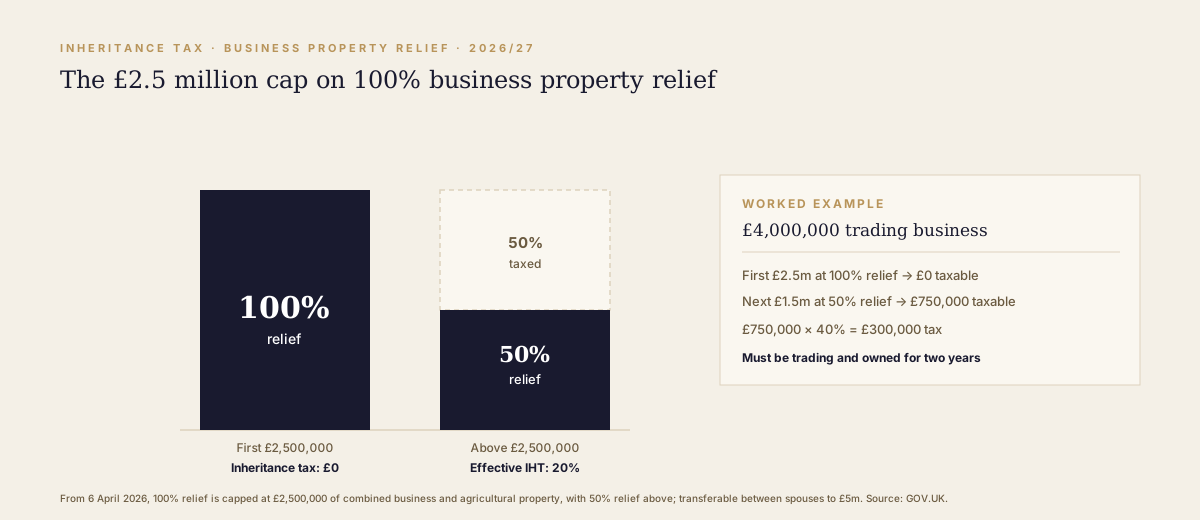
Business property relief is a UK inheritance tax relief that reduces the taxable value of qualifying business assets, such as a trading company or partnership interest, by 100% or 50%. Relief only applies to assets that are genuinely trading and have been owned for at least two years, so investment businesses and recent purchases are excluded. From 6 April 2026, full 100% relief is restricted to the first £2.5 million of combined business and agricultural assets, with 50% relief above that. The allowance is transferable between spouses, so couples can shelter up to £5 million at 100%.
Business property relief reduces the value of qualifying business assets for inheritance tax, by either 100% or 50%, so that a trading company, a share in a partnership, or the assets a business uses can often pass to the next generation with little or no inheritance tax due. From 6 April 2026 the relief works differently from how it has for decades: full 100% relief is capped at the first £2.5 million of combined business and agricultural assets, and anything above that is relieved at 50%. Business property relief remains one of the most valuable reliefs in the inheritance tax system, but the 2026 reform reshapes how business owners plan around it. All thresholds and rates in this article reflect the 2026/27 tax year.
How long must you own a business to qualify for business property relief?
You must generally have owned the qualifying business asset for at least two years before death for business property relief to apply. The two-year clock runs from the date of acquisition, so assets bought shortly before death, or restructured into a fresh holding, can fail the test even when the underlying business is long established.
Contents
- What is business property relief?
- How does business property relief work?
- What qualifies for business property relief?
- What is changing in 2026?
- Do all AIM shares qualify?
- The anti-forestalling rule
- Selling and replacing a business
- Effect on the residence nil-rate band
What is business property relief?
Business property relief is an inheritance tax relief that reduces the taxable value of qualifying business assets by 100% or 50%. It is the mechanism that allows a family trading business to pass on without being broken up to pay a 40% inheritance tax charge. The relief is sometimes called business relief or BPR, and it sits alongside agricultural property relief, which does the same job for farmland.
The relief works on the value of the asset, not on the tax. A trading business worth £1 million that attracts 100% relief has its entire £1 million value removed from the estate before inheritance tax is calculated, so no tax falls on it at all. The relief is given automatically when a valid claim is made on the inheritance tax return, and it applies both on death and to certain lifetime transfers.
What business property relief does not do is exempt the person. It exempts the qualifying asset. If a business owner sells the company for cash and dies holding the proceeds, the relief is lost, because cash is not a qualifying business asset. The relief follows the trade, which is the single most important thing to understand about it.
How does business property relief work?
Business property relief works by reducing the value of a qualifying asset before the inheritance tax calculation, rather than reducing the final tax bill. The rate of reduction is either 100% or 50%, depending on the type of asset, and the asset must usually have been owned for at least two years before the transfer.
The two rates matter because they decide how much of the value escapes tax. An asset attracting 100% relief contributes nothing to the taxable estate. An asset attracting 50% relief contributes half its value, which is then taxed at the standard inheritance tax rate of 40% for 2026/27, producing an effective rate of 20% on that asset.
The relief interacts with the rest of the estate too: it reduces the value of the business before the nil-rate bands are applied to whatever remains. Because the relief comes off first, a well-relieved business can leave the nil-rate bands free to shelter the family home and other assets, which is why business property relief is rarely planned in isolation. As a later section explains, however, the relief does not protect the residence nil-rate band from the £2 million taper.
What qualifies for business property relief?
The asset must be a genuine trading business that has been owned for at least two years, and it must not be a business that mainly holds investments. That last point is the dividing line that catches most people out.
Relief at 100% applies to a business or an interest in a business, such as a sole trade or a partnership share, and to shares in an unlisted company. Relief at 50% applies to shares giving control of a listed company, and to land, buildings, or machinery owned personally but used in a business the deceased controlled or was a partner in. A company qualifies only if it is wholly or mainly trading: businesses that deal wholly or mainly in securities, stocks and shares, land and buildings, or in making or holding investments are excluded entirely, as GOV.UK’s guidance on what qualifies for business relief sets out.
When a transferable allowance changes everything
David, 72, is the sole owner of an unlisted engineering company he has run for twenty years. On his death in June 2026 it is valued at £4 million and clearly qualifies as a trading business.
On David’s own allowance, the first £2.5 million attracts 100% relief and the remaining £1.5 million attracts 50% relief. That leaves £750,000 chargeable, and at the inheritance tax rate of 40% for 2026/27 the bill is £300,000.
Now change one fact. David’s wife, Eleanor, died in 2024 without using her own business relief allowance. From 6 April 2026 her unused £2.5 million allowance transfers to David, lifting the 100% band available on his death to £5 million. The whole £4 million company is now covered at 100%, and the inheritance tax bill is nil. A spousal allowance that did not exist in the original 2024 proposals turns a £300,000 charge into nothing.
The two-year ownership test is strict, and it runs from acquisition. Inheriting a business from a spouse is treated more generously, because the periods of ownership are combined, but acquiring a business and dying within two years generally means no relief at all.
What is changing for business property relief in 2026?
From 6 April 2026, business property relief is capped for the first time. Full 100% relief now applies only to the first £2.5 million of combined business and agricultural assets per person, with value above that relieved at 50%. Before this reform there was no upper limit on 100% relief, so an unlimited trading estate could pass entirely free of inheritance tax.
How much business property relief can you get from April 2026?
From 6 April 2026, 100% business property relief is limited to the first £2.5 million of combined business and agricultural assets per person. Value above £2.5 million receives 50% relief, an effective inheritance tax rate of 20%. The £2.5 million allowance can be transferred to a surviving spouse or civil partner, allowing couples up to £5 million at 100%.
Two further changes matter. AIM-quoted shares and other unlisted shares lose full relief and drop to 50% from 6 April 2026, which materially changes the appeal of AIM portfolios bought specifically for inheritance tax planning. Anyone holding AIM shares alongside other assets should also weigh the separate question of capital gains tax on shares when deciding whether to keep or sell them. Second, an anti-forestalling rule applies to gifts of relievable assets made on or after 30 October 2024: where the donor dies on or after 6 April 2026, those earlier gifts can reduce the £2.5 million allowance available on death.
The government confirmed in its December 2025 announcement raising the threshold to £2.5 million that the allowance would also be transferable between spouses, a significant softening of the original £1 million proposal from the 2024 Budget. HM Treasury and HMRC published the detailed mechanics alongside it.
Risk warnings
Investments
The value of investments and any income from them can fall as well as rise. You may not get back the full amount invested.
The taxation of the investment is dependent on the individual circumstance of each investor, and may be subject to change in the future.
Tax, trusts and estate planning
The Financial Conduct Authority does not regulate Cashflow Planning.
HM Revenue and Customs practice and the law relating to taxation are complex and subject to individual circumstances and changes which cannot be foreseen.
The Financial Conduct Authority (FCA) does not regulate Inheritance Tax Planning or Trust Advice.
Do all AIM shares qualify for business property relief?
No. Only AIM shares in companies that are wholly or mainly trading qualify for business property relief, and from 6 April 2026 even those qualify at 50% rather than 100%. AIM is treated as an unlisted market for inheritance tax, so AIM shares can attract relief in principle, but the company behind them still has to pass the trading test.
That test is the same one applied to any company. A business that is wholly or mainly making or holding investments, dealing in stocks and shares, or dealing in or letting land and buildings does not qualify at all. HMRC looks at the substance of the business, weighing where turnover and profit come from and how the company’s assets and management time are used. Many AIM-listed companies, including property, investment, and some financial businesses, fail this test, so holding an AIM portfolio is not a guarantee of relief.
Two further conditions apply. The shares must have been held for at least two years before death, and the company must still qualify at the date of death, not merely when the shares were bought. Investors who buy AIM shares mainly for the relief should remember that, like other tax-advantaged investment wrappers, the treatment depends entirely on what the underlying company does. From 6 April 2026 the relief on qualifying AIM shares is 50%, and AIM shares do not benefit from the £2.5 million allowance, so 50% is the most they can achieve.
How does the business relief allowance work?
The £2.5 million allowance is a single combined pot covering both business and agricultural property, applied per person and refreshing every seven years. It is not £2.5 million for each type of asset: a farmer with £2 million of farmland and £1 million of trading business has £3 million of relievable assets but only £2.5 million of 100% relief, with the final £500,000 relieved at 50%.
For couples, the transferability of the allowance is the planning headline. Because any unused £2.5 million passes to a surviving spouse, a married couple can structure their affairs so that up to £5 million of qualifying assets passes at 100% relief across both deaths. Where a first spouse died before 6 April 2026, the survivor is treated as inheriting a full £2.5 million allowance, even though the rules did not exist at the time of that first death.
The allowance sits on top of the ordinary nil-rate bands rather than replacing them. Relevant property trusts get their own £2.5 million allowance, refreshing every ten years rather than seven, which keeps trust planning relevant for larger business estates.
How does the anti-forestalling rule work?
The anti-forestalling rule stops people sidestepping the new £2.5 million cap by giving away business or agricultural assets shortly before it takes effect. It applies to lifetime gifts of relievable property made on or after 30 October 2024 where the person making the gift dies on or after 6 April 2026 and within seven years of the gift, as set out in the government’s reform documentation.
Surviving seven years from a gift still takes it outside the estate completely, and the rule does not change that. What it changes is the treatment of gifts that fail because the donor dies within seven years: those failed gifts are tested against the new capped relief rather than the old uncapped 100% relief, even though the gift itself was made before 6 April 2026.
In practice, a business owner who gifted a £4 million company in late 2024 to lock in unlimited 100% relief gains nothing from the timing if they die before surviving the full seven years. The gift is brought back into the estate, only £2.5 million of it attracts 100% relief, and the balance is relieved at 50%. Outliving the gift by seven years remains the clean way to put the asset beyond reach, which ties this planning directly back to the seven year rule.
What happens to business property relief if you sell the business?
If you sell a qualifying business for cash, the cash itself does not qualify for business property relief, but reinvesting in another qualifying business can preserve the relief through the replacement property rules. Cash is not relevant business property, so an estate holding the sale proceeds at death gets no relief on them, however long the original business was owned.
The replacement rules relax the usual two-year ownership test. Where qualifying business property replaces other qualifying business property, the condition is met if the original and the replacement were owned for periods together totalling at least two years out of the five years immediately before death or transfer. A long-held trading business sold and reinvested in another trading business can therefore still qualify, even if the new business has been owned for only a short time.
Two cautions matter. The relief is capped so that it is no greater than it would have been without the replacement, which blocks trading up into a much larger asset shortly before death. And the longer the proceeds sit as cash between sale and reinvestment, the harder the two-out-of-five-years test becomes to satisfy, because the cash period does not count as ownership of business property. Reinvesting promptly, and into a genuine trade rather than an investment vehicle, is what keeps the relief alive.
How do business property relief assets affect the residence nil-rate band?
Business property relief assets can quietly reduce or wipe out the residence nil-rate band, because the £2 million taper test ignores the relief. The residence nil-rate band, worth up to £175,000 per person in 2026/27, is reduced by £1 for every £2 by which the estate exceeds £2 million, and GOV.UK’s guidance on the residence nil-rate band confirms that this £2 million figure is measured before business and agricultural reliefs are deducted.
This catches business owners out. A trading company worth £1.5 million might attract 100% relief and pay no inheritance tax in its own right, yet its full £1.5 million value still counts toward the £2 million taper threshold. An estate with a £1.5 million home-and-savings base plus that company sits at £3 million for taper purposes and loses its entire residence nil-rate band, even though the business is fully relieved.
The taper threshold is frozen at £2 million until April 2031, and the residence nil-rate band tapers away completely once a single person’s estate reaches £2.35 million on this pre-relief basis. A business that looks tax-free in isolation can therefore cost the family £70,000 in extra inheritance tax for a single person, being the 40% charge on a lost £175,000 band, and up to £140,000 for a couple. This interaction is one of the strongest reasons to model business property relief across the whole estate rather than asset by asset.
What does business property relief mean for your wider plan?
Business property relief should be treated as one moving part of an estate plan, not a guarantee that a business passes tax-free. The relief is fragile in ways that catch families out: it depends on the business still qualifying at the moment of death, and that qualification can be lost overnight if the company is sold for cash, if it drifts from trading into holding investments, or if assets are moved into a structure that resets the two-year clock.
Business property relief follows the trade, not the trader, which is why selling the business for cash can quietly destroy a relief the family was counting on.
For company directors, the relief interacts with how profits are extracted during life. Cash accumulated inside a company can tip it from a trading business toward an investment business and weaken the relief, so the way you handle dividends as a company director carries an inheritance tax dimension, not just an income tax one.
Building retirement provision through employer pension contributions, rather than leaving surplus cash to accumulate in the company, can also help keep the trading test intact. None of this can be read off asset by asset.
The 2026 changes have to be read next to the pension changes coming in April 2027, which bring most unused pension funds into the inheritance tax net. A business owner who once expected both the company and the pension to pass largely free of inheritance tax now faces a cap on one and a new charge on the other.
Risk warnings
The value of pensions and any income from them can fall as well as rise. You may not get back the full amount invested.
Levels and bases of, and reliefs from, taxation are subject to change and their value will depend upon personal circumstances. Taxation and pension legislation may change in the future.
A pension is a long-term investment and the value is not guaranteed. Any advice or considerations are personal to each individual’s circumstances.
A pension is a long-term investment, the value of your investment and the income from it may go down as well as up. Your eventual income may depend upon the size of the fund at retirement, future interest rates and tax legislation.
Is business property relief worth relying on?
Business property relief is worth using but not worth relying on as the whole plan. For a genuine trading business held for the long term, it remains one of the most powerful reliefs available, capable of removing millions of pounds from a taxable estate. The trade-off is fragility and the new ceiling: the relief can vanish if the business stops qualifying, and from 6 April 2026 large estates can no longer assume the entire business passes at 100%.
The honest position is that the relief rewards businesses that keep trading and punishes those that drift. A family expecting to sell the company for cash should not assume the relief will be there when it matters, because the proceeds will not qualify. A family intending to pass on a working business has a valuable relief, provided they keep the qualifying conditions intact and plan for the value that now sits above the £2.5 million allowance. Used as one element of a plan that also uses the nil-rate bands, gifting, and spousal transfers, business property relief does real work. Treated as a reason not to plan at all, it is a risk.
Frequently asked questions
What is business property relief?
Business property relief is an inheritance tax relief that reduces the taxable value of qualifying business assets by 100% or 50%. It applies to assets such as a trading business, an interest in a partnership, or shares in an unlisted company, provided they have been owned for at least two years.
How does business property relief work?
Business property relief reduces the value of a qualifying asset before inheritance tax is calculated, rather than reducing the tax bill directly. A trading business attracting 100% relief has its full value removed from the estate; one attracting 50% relief has half its value removed. The relief applies automatically on a valid claim, not on request.
What is changing for business property relief in April 2026?
From 6 April 2026, full 100% relief is capped at the first £2.5 million of combined business and agricultural assets. Value above £2.5 million is relieved at 50%, giving an effective 20% inheritance tax rate. AIM-quoted and other unlisted shares are relieved at 50% rather than the full 100%.
Do AIM shares still qualify for business property relief?
Yes, but only at 50% from 6 April 2026, rather than the 100% relief they attracted before. Shares quoted on AIM count as unlisted for inheritance tax, so they still qualify in principle if the company is trading and held for two years, but the relief now removes half the value rather than all of it.
Can you transfer business property relief between spouses?
Yes. From 6 April 2026 the £2.5 million 100% relief allowance is transferable between spouses and civil partners. Any unused allowance on the first death passes to the survivor, so a couple can pass on up to £5 million of qualifying assets at 100% relief between them.
How long do you have to own a business to qualify for business property relief?
Generally at least two years before death. The asset must have been owned throughout the two years immediately before the transfer and must have been used mainly for business purposes during that period. Restructuring a long-held business into a new holding can reset this clock.
Is business property relief worth relying on for inheritance tax planning?
It is valuable but not guaranteed. Business property relief depends on the business still qualifying at the date of death, which a change in activity or a sale for cash can break. The 2026 cap also means large estates can no longer assume the whole business passes tax-free, so the relief works best as part of a wider plan rather than the entire plan.
Do business property relief assets reduce the residence nil-rate band?
Indirectly, yes: the £2 million threshold that tapers away the residence nil-rate band is measured before business and agricultural reliefs are deducted. A fully relieved business still counts toward that £2 million figure, so a business owner can lose some or all of the £175,000 residence nil-rate band even though the business itself pays no inheritance tax.