Group critical illness cover is an employer-arranged scheme that pays a tax-free lump sum to an employee diagnosed with one of a defined list of serious conditions, such as cancer, heart attack or stroke. The premium your employer pays is a small taxable benefit in kind, but the lump sum a claim pays is normally free of income tax. It gives you a safety net you might never qualify for individually, and the only thing it costs you is the income tax on that premium, usually a few pounds a month. The cover belongs to the job, though, and stops the day you leave, so it cannot be relied on for life.
Group critical illness cover is critical illness cover an employer arranges for its workforce: if an employee is diagnosed with one of a defined list of serious conditions, the scheme pays a tax-free lump sum, usually a fixed multiple of salary. The employer arranges the cover and pays the premiums, most employees are never assessed on their own health, and the money arrives as a single payment on diagnosis rather than as an income. It is one of the more valuable benefits an employer can offer, and one of the easiest to misread, because what gets taxed and what does not runs opposite to the way most people assume. All figures in this article reflect the 2026/27 tax year.
How does group critical illness cover work?
An employer takes out one policy covering its eligible employees and pays the premiums. Cover up to the scheme's free cover limit needs no individual health questions. If a covered employee is diagnosed with a listed condition and survives a set period, usually 14 days, the scheme pays a tax-free lump sum, commonly one or two times salary.
Contents
- What is group critical illness cover?
- How does group critical illness cover work?
- How is group critical illness cover taxed?
- Does group critical illness cover use ABI minimum standards?
- How does group critical illness cover compare with a personal policy?
- What happens to group critical illness cover when you leave your job?
- Is group critical illness cover worth it?
- How does group critical illness cover fit into a wider plan?
What is group critical illness cover?
Group critical illness cover is a scheme an employer takes out to cover its workforce, paying a tax-free lump sum to any covered employee who is diagnosed with one of a defined list of serious conditions. It is the employer-arranged, collective version of an individual critical illness policy: one policy held by the employer, with every eligible employee included under it, rather than a policy each person buys and owns.
Because the whole workforce is insured together, the cover is only partly underwritten. The insurer prices the scheme on pooled risk, spreading the expected cost of claims across the group rather than assessing each person, so most schemes provide automatic cover up to a free cover limit with no health questions asked. An employee who would be declined or heavily loaded on a personal application is still covered up to that limit. Above it, or for someone joining outside the normal enrolment window, individual medical underwriting usually still applies.
The payout is set by the scheme, not the individual. It is typically a fixed multiple of salary, often one or two times, rather than a figure each employee calculates from their mortgage and outgoings. That makes it simple to run, but it also means the cover is unlikely to match any one person’s actual need precisely.
Risk warnings
Protection
The definitions vary between product providers and will be described in the key features and policy document, if you go ahead with the plan.
Mortgages
Your home may be repossessed if you do not keep up repayments on your mortgage. Think carefully before securing debts against your home.
Not all mortgage contracts are regulated by the Financial Conduct Authority.
How does group critical illness cover work?
Group critical illness cover works by the employer paying regular premiums on a single policy, with the insurer paying a lump sum when a covered employee is diagnosed with a qualifying condition. Most schemes require the employee to survive a short period after diagnosis, commonly 14 days, before the claim is valid, which is why it is a diagnosis benefit rather than a death benefit.
The list of conditions is where these policies vary most. To be sold as critical illness cover at all, a policy has to cover cancer, heart attack and stroke, but a typical scheme extends well beyond that to 40 or more conditions, including multiple sclerosis, Parkinson’s disease, kidney failure and major organ transplant. Many group schemes also include children’s cover as standard, paying a smaller sum if an employee’s child is diagnosed with a listed condition, which parallels a standalone children’s critical illness policy. Some pay a reduced amount on less severe conditions rather than the full sum, a feature usually called severity-based or partial payment.
Two structures exist. Standalone group cover pays out on diagnosis and the policy continues, so it is a pure critical illness benefit. Accelerated cover is bundled with group life so that one lump sum is paid on either critical illness or death, whichever comes first, and the cover then ends. Standalone is more common in a workplace setting because it sits alongside a separate death in service benefit rather than competing with it.
How is group critical illness cover taxed?
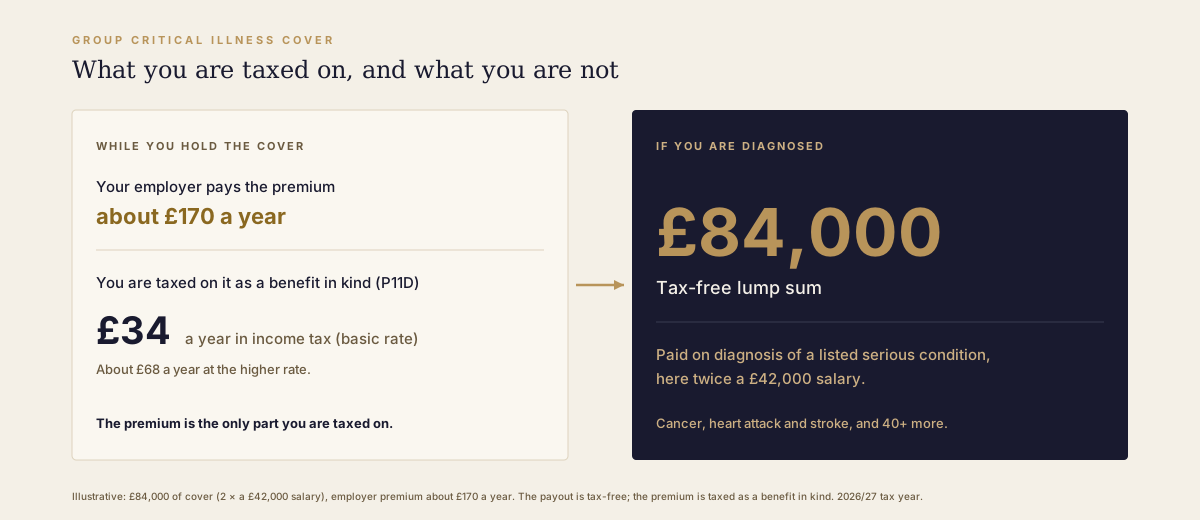
The tax falls on the premium, not the payout. Because the employer is paying for cover the employee personally benefits from, HMRC treats the premium as a benefit in kind: it is reported on the employee’s form P11D, the employer pays Class 1A National Insurance on its value, and the employee is taxed on that value at their marginal rate through an adjustment to their tax code.
Is group critical illness cover a taxable benefit?
The premium is. Because the employer pays for cover the employee personally benefits from, HMRC treats the premium as a benefit in kind, reported on form P11D, and the employee is taxed on its value at their marginal rate. The lump sum a claim pays is normally free of income tax, so the tax falls on the small premium rather than the large payout.
That premium is small, so the tax on it is small too. The employer can normally deduct the premiums as a business expense, and it pays Class 1A National Insurance at 15% for 2026/27 on the same value it reports for the employee. The reporting mechanism, and the P11D and Class 1A obligations that sit behind it, are set out in HMRC’s guidance for employers on expenses and benefits.
The payout is the part that matters, and it is normally tax-free. A critical illness lump sum is not an annual or recurring payment, so HMRC does not treat it as taxable income in the recipient’s hands. Exactly how a group payment reaches the employee can vary between schemes, so the precise position is worth confirming with the insurer, but the general rule is that the diagnosis payout arrives whole.
This is the mirror image of group income protection, where the employer’s premium is usually not taxed on the employee but the monthly benefit is taxed as earnings when it is paid. With critical illness the taxed part is the tiny premium and the untaxed part is the large lump sum. For an employee that is the more forgiving pattern: you pay a few pounds of tax a year while healthy, and the money you actually need on diagnosis is not eroded.
Naomi, 44, with £84,000 of cover through work
Naomi earns £42,000 and her employer’s scheme covers twice salary, so she has £84,000 of critical illness cover. The premium the employer pays for her is about £170 a year.
That £170 is reported as a benefit in kind, so it is added to Naomi’s taxable income. As a basic-rate taxpayer she pays about £34 of income tax on it for the year; a higher-rate colleague on the same cover would pay about £68. Either way, it costs a few pounds a month.
Two years later Naomi is diagnosed with breast cancer, a listed condition. The scheme pays her £84,000 as a single tax-free lump sum. She was taxed on the £170 premium and not on the £84,000 that followed, which is the whole shape of the benefit in one claim.
Risk warning
HM Revenue and Customs practice and the law relating to taxation are complex and subject to individual circumstances and changes which cannot be foreseen.
Does group critical illness cover use ABI minimum standards?
Yes. Any policy sold as critical illness cover, group or personal, has to meet the Association of British Insurers’ Guide to Minimum Standards for Critical Illness Cover. The guide, most recently revised for policies from 16 September 2022 and updated in April 2023, sets model wordings for common conditions and the exclusions insurers may apply, so that a “heart attack” on one insurer’s schedule means broadly the same thing on another’s.
What the standards fix is the floor, not the whole product. Three conditions have to be covered by everything calling itself critical illness cover: cancer, heart attack and stroke. Beyond that, insurers are free to add conditions, and most do, which is why one scheme covers 40 conditions and another covers 60. The standards make the definitions comparable; they do not make the schemes identical.
For a group scheme, the employer still chooses the shape within those rules: the payout multiple, the total number of conditions, whether children’s cover is included, and whether less severe conditions trigger a reduced payment. So two employers can both offer “group critical illness cover” that meets the same ABI standards and still provide materially different protection. Reading the scheme booklet, not just the label, is what tells an employee what they actually hold.
How does group critical illness cover compare with a personal policy?
The core difference is ownership: group cover is arranged and paid for by your employer and ends when the job does, while a personal policy is owned and funded by you and continues wherever you go. Neither is simply better, and for many people the sensible answer uses both.
Group critical illness cover versus a personal policy
| Feature | Group critical illness cover | Personal critical illness cover |
|---|---|---|
| Who arranges and pays | Employer | You |
| Is the premium taxed on you? | Yes, as a benefit in kind | No |
| Is the payout taxed? | No, normally tax-free | No, tax-free |
| Medical underwriting | None up to the free cover limit | Full individual underwriting |
| Amount of cover | Fixed multiple of salary set by the scheme | You choose the sum assured |
| If you change jobs | Cover ends | Cover continues |
| Premium if your health changes | Unaffected while employed | Locked in at the original terms |
The standout strength of group cover is access. Because cover up to the free cover limit relies on pooled risk rather than individual underwriting, an employee with a health history that would make personal cover expensive or impossible is protected anyway, usually at no premium cost to them. The standout weakness is that the cover is not theirs. It is sized by the scheme, capped at a multiple that may fall short of the mortgage, and it evaporates the moment the employment ends. A personal policy is the reverse: it costs you money and requires underwriting, but it is set to your own need and moves with you for as long as you keep paying.
Group critical illness cover taxes you on the premium and leaves the payout alone, which is the gentle way round. Its real weakness is not tax but ownership: the cover belongs to the job, not to you, and a job can change faster than your health can.
What happens to group critical illness cover when you leave your job?
It ends, almost always on your last day. Group critical illness cover is a feature of the employer’s policy, so when you leave, are made redundant, or retire, the cover stops with no transfer value and nothing to take with you. This is the same cliff edge that applies to death in service benefit and group income protection, and it is the single most overlooked feature of every employer-provided benefit.
A minority of schemes offer a continuation option, which lets a leaver take out an individual critical illness policy without providing fresh medical evidence. It is genuinely useful for someone whose health has changed since they were first covered, but it comes with conditions: it usually has to be exercised within a short window of leaving, often 30 to 90 days, the personal premiums are set at your age and the insurer’s current rates, and not every scheme includes it. Relying on it without checking whether your scheme actually offers it is a common and expensive assumption.
Halima and Ade, both 44, both leaving with £84,000 of cover
Halima and Ade are colleagues, each earning £42,000 with £84,000 of critical illness cover through the same scheme. Both accept a better-paid job at a new employer, three weeks apart.
Halima’s new employer runs a critical illness scheme that covers her from day one. Ade’s new employer offers the same benefit but only after a three-month eligibility period. Neither saw the gap: to both of them, the move looked like a straightforward pay rise.
Six weeks into the new job, Ade is diagnosed with a heart condition on the scheme’s list. His old cover ended on his last day, and the new cover had not started, so the scheme pays nothing. Halima, had it been her, would have been covered throughout. The difference was not the size of the cover but a three-month gap that a personal policy, owned by Ade rather than either employer, would have closed.
Is group critical illness cover worth it?
For an employee, group critical illness cover is worth having, because it provides a lump sum they might not qualify for or afford on their own, usually at no cost beyond a few pounds of tax a year. It is a benefit to accept and value, not one to decline. What it is not is a finished protection plan.
The honest trade-off is the same one that runs through every group scheme. The cover is generous while it lasts and worth nothing the day you leave, it is sized by the scheme rather than by your mortgage, and it hands you a single lump sum rather than a replacement income. Leaning on it alone leaves two gaps: the shortfall between a salary-multiple payout and what a serious illness actually costs a household, and the cliff edge when the job ends. Many people treat group cover as the base layer and hold a personal policy, or an income protection policy, to close those gaps.
A review of what your scheme already gives you, weighed against what your own situation needs, is the practical next step, and it is the sort of question a protection planning conversation is built to answer.
How does group critical illness cover fit into a wider plan?
Group critical illness cover handles one specific risk, a serious diagnosis while you are employed, and is one layer in a household’s protection rather than the whole of it. It pairs naturally with death in service, which covers dying while employed, and with group income protection, which replaces earnings during a long absence. Between them those three employer benefits cover diagnosis, death and long-term incapacity, but all three share the same weakness: they all belong to the job and all end together when you leave it.
That is why the useful question is not whether your employer’s cover is good, but what remains once you take the job out of the picture. Cover you own outright, a personal critical illness or income protection policy, is what carries through a job change, a career break, or a move into self-employment.
Company directors have an extra option here. A limited company can fund a relevant life policy for tax-efficient personal life cover, which sits outside the estate and continues on the individual’s terms rather than the scheme’s.
Worth having, and worth knowing its limits
Group critical illness cover is a benefit worth taking: a tax-free lump sum if a serious illness strikes while you are employed, paid for by your employer, usually with no health questions, and taxed only on the small premium rather than the large payout. Its limits are structural, not a flaw in the cover. The payout is a fixed multiple of salary rather than a figure built around your life, and the whole thing ends the day the job does, with no automatic right to continue it. The sensible response is to value it for the protection it gives you now, read the scheme booklet so you know what you actually hold, and decide whether a portable policy of your own belongs alongside it.
Frequently asked questions
What is group critical illness cover?
Group critical illness cover is an insurance scheme an employer buys for its workforce, paying a tax-free lump sum to an employee who is diagnosed with one of a defined list of serious conditions such as cancer, heart attack or stroke. The employer arranges and pays for the cover, and the payout is usually a fixed multiple of salary rather than an amount each employee chooses.
Is group critical illness cover a taxable benefit?
The premium is. Because the employer pays for cover the employee personally benefits from, HMRC treats the premium as a benefit in kind, reported on form P11D, with the employee taxed on its value at their marginal rate. The lump sum a claim pays is normally free of income tax, so the tax falls on the small premium rather than the large payout.
How does group critical illness cover work?
The employer takes out one policy covering its eligible employees and pays the premiums. Cover up to the scheme's free cover limit needs no individual health questions. If a covered employee is diagnosed with a listed condition and survives a set period, usually 14 days, the scheme pays a tax-free lump sum, commonly one or two times salary.
What conditions does group critical illness cover pay out for?
Every scheme must cover cancer, heart attack and stroke to be called critical illness cover under the ABI minimum standards, and most cover 40 or more conditions in total, such as multiple sclerosis, kidney failure and major organ transplant. The exact list, the payout amount and whether children are included are all set by the employer's scheme, not fixed by regulation.
What happens to group critical illness cover when you leave your job?
It ends. Group cover belongs to the employer's policy, so it stops on your last day with no transfer value and, in most schemes, no right to continue it. A few insurers offer a continuation option that lets you take out a personal policy without fresh medical evidence, but it must usually be exercised within a short window of leaving.
Do you need group critical illness cover if you have income protection?
They solve different problems, so many people benefit from both. Critical illness cover pays a one-off lump sum on diagnosis, useful for clearing a mortgage or funding treatment, while income protection replaces a portion of earnings while you cannot work. Neither lasts indefinitely: the lump sum is a fixed amount, and income protection stops when you can work again, when the policy term ends, or when you retire.
Is group critical illness cover worth it?
For an employee it is valuable to have, because it provides a lump sum they might not qualify for or afford individually, and the employer funds the premium, so the only cost to the employee is the income tax on it. It is not a complete plan, though: the payout is a fixed sum rather than tailored to your needs, and the cover disappears when the job does. It works best as a base layer alongside cover you own outright.