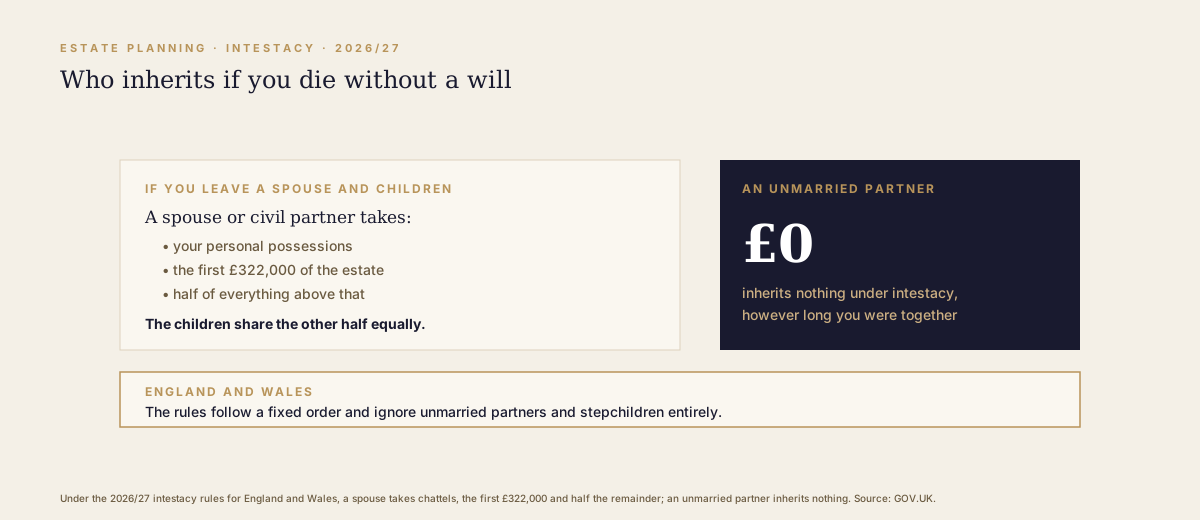
Intestacy is the legal position that arises when someone dies without a valid will, so their estate passes to relatives in a fixed statutory order rather than according to their own wishes. If you die without a will, statutory rules decide who inherits: a spouse or civil partner comes first, and an unmarried partner gets nothing. The rules ignore unmarried partners and stepchildren entirely, and can split an estate between a spouse and children in a way the deceased never intended. They apply only in England and Wales, with different rules in Scotland and Northern Ireland, and all figures here reflect the position for 2026/27.
Dying without a will means the law, not you, decides who inherits your money, property, and possessions. In England and Wales the rules of intestacy set a strict order of who benefits and by how much, starting with a married spouse or civil partner and working outwards to children, parents, and more distant relatives. An unmarried partner, however long you lived together, has no automatic right to anything. The statutory legacy figures here apply to deaths on or after 26 July 2023 and reflect the position for the 2026/27 tax year.
What happens if you die without a will in the UK?
If you die without a will in England and Wales, your estate is shared out under the rules of intestacy. A surviving spouse or civil partner inherits first, taking your possessions, the first £322,000, and half of anything above that. Children share the rest. Unmarried partners, stepchildren, and friends inherit nothing automatically.
Contents
- What happens if you die without a will?
- How do the intestacy rules divide your estate?
- What does a surviving spouse inherit under intestacy?
- Do unmarried partners inherit if you die without a will?
- How does dying without a will affect inheritance tax?
- What happens if you have no spouse or children?
- Should you make a will?
What happens if you die without a will?
If you die without a will, your estate is distributed under the rules of intestacy, a fixed legal order set out in statute that your relatives and administrators must follow. You lose all say over who benefits and in what proportion. The estate cannot be tailored to reflect a blended family, a long-term partner you never married, or a friend or charity you meant to provide for.
Someone still has to deal with the estate. Rather than an executor named in a will, a close relative applies to become the administrator, receiving a grant called letters of administration before they can collect in assets, settle debts, and distribute what remains. As GOV.UK’s guidance on inheritance where there is no will sets out, only married or civil partners and certain blood relatives can inherit under intestacy, and only they can usually apply to administer the estate.
The practical result is a loss of control at the worst possible time. A statutory formula built for the average family is applied to yours, and it has no way of knowing what you would have wanted.
How do the intestacy rules divide your estate?
The intestacy rules divide your estate according to which relatives survive you, in a strict hierarchy that stops at the first group with a living member. A married spouse or civil partner sits at the top, followed by children and their descendants, then parents, then siblings, and onwards through the family tree.
How the estate splits depends on the combination of relatives. If you leave a spouse or civil partner but no children, the spouse inherits everything. If you leave a spouse and children, the estate is divided between them under the statutory legacy formula explained below. If you leave children but no spouse, the children inherit the whole estate equally, with each share held on trust until they turn 18.
Two features catch families out. First, only a legal spouse or civil partner counts, not a partner you live with. Second, the rules look at relationships by marriage and blood only, so stepchildren you never adopted are not treated as your children for intestacy, even if you raised them. The order is rigid, and it does not bend to the realities of how the family actually lived.
What does a surviving spouse inherit under intestacy?
A surviving spouse or civil partner inherits your personal possessions, the first £322,000 of the estate, and half of anything above that, where you also leave children. This fixed sum is called the statutory legacy, and it has applied to deaths on or after 26 July 2023, as recorded in HMRC’s inheritance tax manual. It rose from £270,000 on that date, and from £250,000 before February 2020.
The other half of the value above £322,000 passes to your children in equal shares. On an estate at or below £322,000, the spouse takes everything and the children receive nothing under intestacy. Above it, the children’s share grows with the size of the estate, which can split a family home or business between a widow or widower and children who may have very different plans for it.
Margaret’s £600,000 estate, married and unmarried
Margaret, 66, dies suddenly without a will, leaving an estate of £600,000, her husband David, and two adult children.
Because they were married, David inherits Margaret’s possessions, the first £322,000, and half of the remaining £278,000, a further £139,000, giving him £461,000 in total. The two children share the other £139,000, taking £69,500 each.
Had Margaret and David never married, the outcome changes completely. David inherits nothing at all, even though they lived together for thirty years. The entire £600,000 passes to the two children, and David, who has no legal claim, could be left living in a home he does not own. The only difference between the two outcomes is a marriage certificate.
Risk warning
HM Revenue and Customs practice and the law relating to taxation are complex and subject to individual circumstances and changes which cannot be foreseen.
Do unmarried partners inherit if you die without a will?
No. An unmarried partner inherits nothing under the rules of intestacy, regardless of how long you lived together, whether you owned a home jointly, or whether you have children together. The idea of a common law marriage that grants automatic rights after a number of years is a myth with no legal basis in England and Wales.
A surviving partner’s only route is to bring a claim under the Inheritance (Provision for Family and Dependants) Act 1975, which lets certain people ask a court for reasonable financial provision from the estate. The claim is discretionary, must usually be brought within six months of the grant, and carries legal cost and uncertainty at a time of grief. It is a remedy for a problem a will would have prevented.
The intestacy rules treat a partner of thirty years as a stranger to the estate, while a marriage certificate signed the week before death changes everything. The law rewards the paperwork, not the relationship.
Couples who choose not to marry can still provide for each other, but they have to do it deliberately: through a will, jointly owned property, a nominated pension, or a life insurance policy written in trust that pays out directly to the survivor outside the estate.
Risk warnings
Pensions
The value of pensions and any income from them can fall as well as rise. You may not get back the full amount invested.
A pension is a long-term investment and the value is not guaranteed. Any advice or considerations are personal to each individual’s circumstances.
Protection
Benefits of insurance products will be put at risk or cease altogether if premium payments are not maintained.
How does dying without a will affect inheritance tax?
Dying without a will does not change the inheritance tax rates or thresholds, but it removes your ability to plan around them. Transfers between spouses and civil partners are exempt from inheritance tax, so when a legal spouse inherits under intestacy that part of the estate passes tax-free. An unmarried partner gets no spouse exemption, because they get nothing under intestacy in the first place.
Do you pay more inheritance tax if you die without a will?
Dying without a will does not change inheritance tax rates, but it can raise the bill by removing your ability to plan. Transfers to a spouse or civil partner are exempt from inheritance tax, but an unmarried partner inherits nothing and gets no exemption. Without a will you cannot direct a home to children to secure the residence nil-rate band.
The bigger cost is lost control. A will lets you direct who receives what, use the nil-rate band and residence nil-rate band efficiently, and create trusts for children or vulnerable beneficiaries. Intestacy applies a single formula regardless of the tax consequences, as the wider GOV.UK guidance on how inheritance tax works makes clear. The residence nil-rate band, for instance, depends on a home passing to direct descendants, and an intestate estate gives you no way to steer the home there on purpose.
A will also works alongside lifetime planning. Strategies such as the gift allowances covered in our guide to inheritance tax gift allowances reduce the estate before death, while the will controls what happens to whatever remains. Without one, the two halves of the plan never join up.
Where an intestacy has already happened, the outcome is not always final. The beneficiaries can redirect their statutory entitlements between themselves using a deed of variation within two years of the death, and inheritance tax then treats the redirection as though the deceased had made it. That is a repair rather than a plan, and it works only where everyone who gives something up agrees to sign.
What happens if you have no spouse or children?
If you die without a will and leave no spouse, civil partner, or children, your estate passes to the closest surviving relatives in a set order. Parents come first, then brothers and sisters and their children, then half-siblings, then grandparents, and then aunts and uncles. The first group with a living member takes the whole estate, dividing it equally between them.
Only relatives by blood or by a legal marriage or civil partnership can inherit. Friends, carers, unmarried partners, and stepchildren who were never adopted are excluded at every level, however close the bond.
If no qualifying relative survives at all, the estate passes to the Crown under a rule known as bona vacantia, and is dealt with by the Government Legal Department. This is uncommon, but it is a real outcome of leaving no will and no traceable family, and one that channels an entire lifetime’s savings to the state rather than to any person or cause you cared about.
Should you make a will?
Yes, making a will is worth it for almost everyone, because it is the only way to choose who inherits rather than leaving it to a statutory formula. A will lets you provide for an unmarried partner, name guardians for young children, leave gifts to friends or charity, and structure the estate around inheritance tax. None of that is possible once the rules of intestacy take over.
The trade-off is modest. A straightforward will costs relatively little and takes an afternoon, while the cost of dying without one falls on the family, in tax, in legal claims, and in disputes. The main risk of doing nothing is not that the estate goes unadministered, but that it goes to the wrong people. GOV.UK’s guidance on making a will explains the basic requirements, and a will should be reviewed after major life events such as marriage, divorce, or the birth of a child, since marriage usually revokes an existing will.
For anyone with an estate likely to face a tax charge, the will is one part of a broader inheritance tax planning strategy rather than the whole of it. The point is to make sure the estate passes the way you intend, and to keep that intention current as life changes around it.
Risk warning
The Financial Conduct Authority (FCA) does not regulate Inheritance Tax Planning or Trust Advice.
A formula that knows nothing about your family
Dying without a will hands your estate to a formula that knows nothing about your family. In England and Wales the rules of intestacy put a married spouse or civil partner first, with £322,000 plus half the balance and the children sharing the rest, and they shut out unmarried partners and stepchildren entirely. The fix is simple and within reach: a valid, up-to-date will that says who inherits, supports the people the law would ignore, and works alongside the rest of an estate plan. The rules of intestacy are the default the law applies when you have said nothing. A will is how you say something.
Frequently asked questions
What does it mean to die intestate?
Dying intestate means dying without a valid will, so your estate is shared out under the rules of intestacy instead of your own instructions. The law sets a fixed order of who inherits, starting with a married spouse or civil partner and moving outwards to children and other blood relatives. It applies to the whole estate that has not been left another way.
How is an estate divided if you die without a will and have children?
If you leave a spouse or civil partner and children, the spouse takes your personal possessions, the first £322,000, and half of the rest, while the children share the other half equally. The children's share is held on trust until they reach 18. If there is no surviving spouse, the children inherit the whole estate between them.
Does my partner inherit if we are not married?
No. An unmarried partner inherits nothing under the rules of intestacy, no matter how long you lived together or whether you have children together. There is no such thing as a common law marriage in England and Wales. A surviving partner's only route is a court claim under the Inheritance (Provision for Family and Dependants) Act 1975, which is slow, costly, and uncertain.
Should you make a will?
Yes, making a will is worth it for almost everyone, because it is the only way to choose who inherits rather than leaving it to a statutory formula. A will lets you provide for an unmarried partner, name guardians for young children, and structure your estate around inheritance tax. Without one, the intestacy rules apply in full, whatever your circumstances or wishes.
What happens if you die with no living relatives?
If you die without a will and have no surviving spouse, children, parents, siblings, grandparents, aunts, or uncles, your estate passes to the Crown under a rule called bona vacantia. The estate is then administered by the Government Legal Department. This outcome is rare but final, and it can be avoided entirely by leaving a valid will.
Do the intestacy rules apply across the whole UK?
No. The rules described here apply only in England and Wales. Scotland has its own system of prior rights and legal rights for a surviving spouse and children, and Northern Ireland applies a separate set of figures and shares. If you have assets or family in more than one part of the UK, the differences matter.