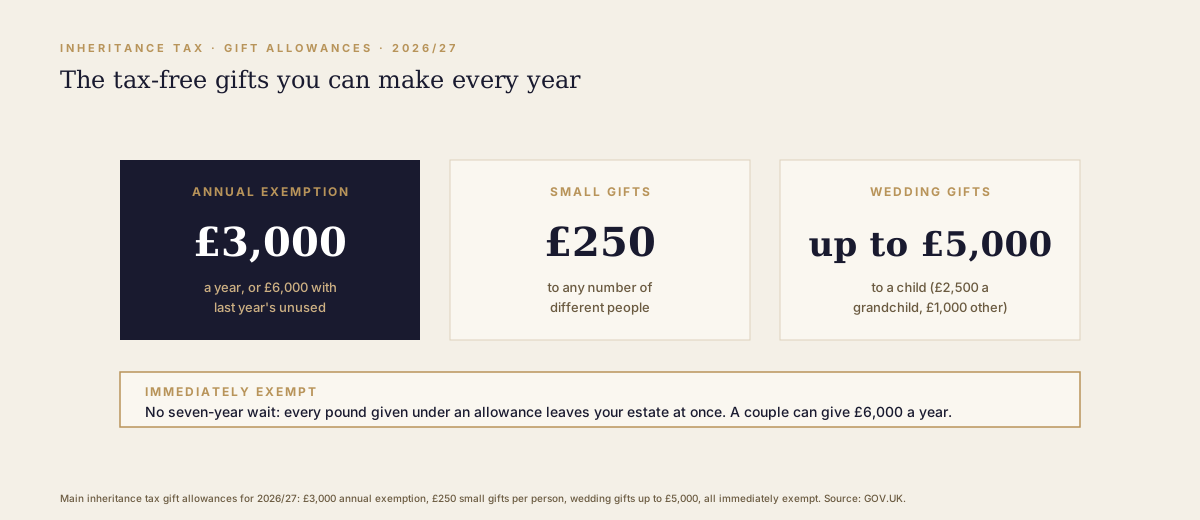
Inheritance tax gift allowances are statutory exemptions that let you give away set amounts each tax year, immediately free of inheritance tax and outside the seven-year rule that applies to larger gifts. You can give away £3,000 a year for 2026/27 free of inheritance tax under the annual exemption, plus £250 each to any number of other people and set wedding gifts, all immediately exempt. Every pound given under an exemption is a pound that can never be taxed at 40% on death, even if you die the next day. The amounts are modest and most have been frozen for decades, so their value comes from using them consistently rather than relying on one large gift.
The inheritance tax gift allowances are a set of exemptions that let you give money away each year with no inheritance tax to pay, and crucially with no seven-year wait. The largest is the annual exemption of £3,000 a year for 2026/27, but small gifts of £250 a person and wedding gifts of up to £5,000 to a child sit alongside it. Every pound given under an exemption leaves your estate the moment it is made, even if you die the next day. The figures throughout this article are correct for the 2026/27 tax year. Used consistently, these modest allowances move real money out of an estate that might otherwise be taxed at 40%.
How much can a couple give away tax-free each year?
A couple can give away £6,000 a year between them, using each partner’s £3,000 annual exemption. If neither used last year’s allowance, they can give £12,000 in a single tax year. Wedding gifts sit on top of that. The £250 small gifts exemption works differently: it goes to other people entirely, never to someone who has already received an exempt gift from you that year.
Contents
- What are the inheritance tax gift allowances?
- How does the annual exemption work?
- What are the small gifts and wedding gift exemptions?
- How do gift allowances work with the seven year rule?
- How do the gift allowances fit into an estate plan?
- Are inheritance tax gift allowances worth using?
- Do you have to report exempt gifts to HMRC?
What are the inheritance tax gift allowances?
The inheritance tax gift allowances are statutory exemptions that let you give away fixed amounts each tax year free of inheritance tax. They sit outside the seven-year rule, so the money is treated as leaving your estate immediately rather than after a survival period. There are four main exemptions: the annual exemption, the small gifts exemption, gifts in consideration of marriage, and gifts that count as normal expenditure out of income. Gifts between spouses or civil partners, and gifts to UK charities, are exempt without any limit.
| Exemption | Limit for 2026/27 | Who it can go to | Carries forward? |
|---|---|---|---|
| Annual exemption | £3,000 in total | Anyone, split between as many people as you like | Yes, one tax year only |
| Small gifts | £250 per person | Any number of people, but nobody who has had another exempt gift from you that year | No |
| Wedding gifts | £5,000, £2,500 or £1,000 | A child, a grandchild or great-grandchild, anyone else | No |
| Normal expenditure out of income | No fixed limit | Anyone, where the gifts are regular and paid from surplus income | Not applicable |
| Spouse, civil partner or UK charity | No limit | Your spouse or civil partner, or a UK charity | Not applicable |
The reason these allowances matter is the 40% rate. Inheritance tax is charged at 40% on the part of an estate above the nil-rate band, which stays frozen at £325,000 until April 2031. Anything you can remove from your estate without seven-year risk is money the charge can never reach.
Gifts that go beyond the allowances are not lost causes, but they are treated differently. Anything above your exemptions is added back into your estate if you die within seven years of making it. That is the dividing line this article keeps returning to: exempt gifts are final straight away, while larger gifts are only a hope until time passes.
How does the annual exemption work?
The annual exemption lets you give away up to £3,000 in total each tax year free of inheritance tax, across as many gifts or as many people as you like. The £3,000 is a single pot for the whole year, not £3,000 per recipient. For 2026/27 the figure remains £3,000, where it has sat since 1981.
If you do not use all of your annual exemption, you can carry the unused part forward, but only to the next tax year, and only after that year’s own £3,000 has been used first. HMRC’s guidance on gifts confirms this one-year carry-forward and the order in which the allowances are used.
This carry-forward rule is why a couple who have made no recent gifts can move a larger sum in one go. Each partner has their own £3,000, and each can carry forward an unused £3,000 from the year before, so between them they can give £12,000 in a single tax year before any seven-year clock starts.
Risk warning
HM Revenue and Customs practice and the law relating to taxation are complex and subject to individual circumstances and changes which cannot be foreseen.
What are the small gifts and wedding gift exemptions?
The small gifts exemption lets you give up to £250 to any number of different people each tax year, completely free of inheritance tax. There is no cap on how many £250 gifts you make, provided each goes to a different person and you have not used another exemption on that same person. You cannot, for example, give a grandchild £3,000 under the annual exemption and another £250 under the small gifts rule in the same year.
Wedding and civil partnership gifts are exempt up to limits that depend on your relationship to the couple. For 2026/27 you can give, free of inheritance tax:
- £5,000 to your child
- £2,500 to a grandchild or great-grandchild
- £1,000 to any other person
The wedding gift must be made before the ceremony, and the marriage or civil partnership must actually take place. A wedding gift sits on top of the annual exemption, so a parent can give a marrying child both in the same year.
How combining gift allowances moves £11,000 out of an estate in one tax year
Margaret, 72, helps her daughter Priya, who is getting married this year.
| Input | Value |
|---|---|
| This tax year’s annual exemption | £3,000 |
| Last year’s unused annual exemption carried forward | £3,000 |
| Wedding gift to a child | £5,000 |
- Use this tax year’s annual exemption: £3,000 to Priya.
- Add last year’s unused annual exemption, carried forward: another £3,000.
- Add the wedding gift, made before the marriage: £5,000.
- Total given to Priya in one tax year, all immediately exempt: £11,000.
Result: The full £11,000 leaves Margaret’s estate at once. At a 40% rate, that removes up to £4,400 of potential inheritance tax with no seven-year wait.
How do gift allowances work with the seven year rule?
Gift allowances and the seven year rule are two different routes for taking money out of your estate, and they work together rather than competing. A gift that fits inside an exemption is outside your estate at once. A gift above your exemptions becomes a potentially exempt transfer, which is only free of inheritance tax if you survive a further seven years.
That distinction changes how you should think about timing. The exemptions do the safe, certain work every year, while larger gifts carry survival risk that only clears with time. If you want to understand how that risk reduces, the seven year rule and taper relief are covered in detail separately, including why taper relief only helps on gifts above the nil-rate band.
An exempt gift is final from the day it is made; a potentially exempt transfer is only a hope until seven years have passed. That certainty is what makes the small allowances worth more than their size suggests.
There is a fifth route worth knowing about, because it has no monetary cap at all. Regular gifts paid from surplus income, rather than from capital, can be exempt under the normal expenditure out of income exemption, provided they are habitual and leave your standard of living intact.
How do the gift allowances fit into an estate plan?
In an estate plan, the gift allowances are the steady foundation that the larger, riskier strategies are built on. They are predictable, they need no survival period, and they reset every April, so they reward households that act early and repeat. The contrast between two approaches makes the point.
George and Sylvia, both 70, each use their £3,000 annual exemption every year to help their two children. Over a decade that is £60,000 moved out of their estate with complete certainty, saving up to £24,000 in inheritance tax at 40%. A neighbour the same age intends to “sort out gifting eventually” and makes a single £60,000 gift at 79, then dies at 84. Five years is not seven, so the gift is brought back into the calculation on death. Taper relief does not rescue it: at £60,000 the gift sits well inside the £325,000 nil-rate band, so there was never any tax on the gift itself to reduce. What the gift does instead is use £60,000 of that nil-rate band, leaving only £265,000 to shelter the rest of the estate, so £60,000 more of what he left is taxed at 40%. Same total given, potentially £24,000 of difference.
The allowances also interact with the rest of the plan. They sit alongside the nil-rate band and residence nil-rate band that shelter the estate on death, and they matter more now that unused pensions are being drawn into inheritance tax from April 2027, which pushes more estates over the threshold. For business owners, gifting cash through the allowances can sit alongside business property relief on trading assets. Where the figures are large enough to need tailored structuring, inheritance tax planning looks at how gifts, allowances, and the nil-rate bands combine for a specific estate.
One question comes before any of this, and it is not a tax question.
A gift is irreversible. Money given away under the annual exemption cannot be asked for again if your own costs rise later, and later-life care is the cost most likely to rise, so the figure worth working out first is what you need for the rest of your own life, and only then what is genuinely surplus. A local authority assessing care fees can also look at whether assets were given away to reduce what you would have to pay, and treat a gift made for that reason as though you still held it. Keeping the use of what you have given creates a separate problem: continuing to live in a house you have gifted, or drawing an income from an asset you no longer own, makes it a gift with reservation of benefit, which stays inside your estate however long you survive.
Risk warnings
Pensions
The value of pensions and any income from them can fall as well as rise. You may not get back the full amount invested.
Levels and bases of, and reliefs from, taxation are subject to change and their value will depend upon personal circumstances. Taxation and pension legislation may change in the future.
A pension is a long-term investment and the value is not guaranteed. Any advice or considerations are personal to each individual’s circumstances.
Tax, trusts and estate planning
The Financial Conduct Authority (FCA) does not regulate Inheritance Tax Planning or Trust Advice.
Are inheritance tax gift allowances worth using?
For anyone whose estate is likely to face inheritance tax, the gift allowances are worth using every year. The reason is the certainty: an exempt gift is outside your estate from the moment you make it, so it counts even if you die the same year, which is exactly when larger gifts are most exposed. The trade-off is scale, because the amounts are deliberately modest and have been frozen for years, so no single allowance transforms a large estate on its own.
The value comes from repetition and from using both partners’ allowances. A couple using their annual exemptions together can remove £6,000 a year without touching the carry-forward, and far more across a decade. What rarely makes sense is leaving the allowances unused while planning a single large gift later, because that swaps a certain saving today for one that depends on living another seven years.
Do you have to report exempt gifts to HMRC?
No. Gifts that fall fully within an allowance do not need to be reported to HMRC during your lifetime, and they are not added back into your estate when you die. HMRC treats exempt gifts as outside the estate from the outset, so there is nothing to declare for them.
Do you need to keep records of tax-free gifts?
Yes. Although exempt gifts are not reported during your lifetime, it is worth keeping a simple list of what you gave, to whom, the date, and which exemption applied. This helps your executors prove the gifts qualified, which matters most for regular gifts made out of income.
Records matter most for gifts claimed as normal expenditure out of income, where executors must show a pattern of giving and that the gifts came from surplus income. For the annual exemption, small gifts, and wedding gifts, a short note of the date and amount is usually enough.
The only allowances that renew every year
The inheritance tax gift allowances are best understood as the part of estate planning with no survival period attached: the gift is outside your estate the day you make it. They will not, by themselves, solve a large inheritance tax problem, but they are the only route that renews every April. For an estate near or above the £325,000 nil-rate band, the question is less whether the allowances are big enough and more whether they are being used at all, by both partners, every single year.
Frequently asked questions
What are the inheritance tax gift allowances?
The inheritance tax gift allowances are statutory exemptions that let you give away fixed amounts each tax year free of inheritance tax. The main ones are the annual exemption at £3,000 a year for 2026/27, the small gifts exemption at £250 a person, and wedding gifts of up to £5,000 to a child. Gifts within these limits leave your estate immediately, with no seven-year wait.
How much can I give away tax-free each year?
You can give away £3,000 a year for 2026/27 under the annual exemption, free of inheritance tax. That £3,000 is the total across everyone you give to, not £3,000 for each of them. Going over it does not cost you the exemption: the first £3,000 stays exempt and only the excess becomes a potentially exempt transfer that needs you to survive seven years. Wedding gifts and £250 small gifts sit outside that total.
Can I carry forward unused gift allowance?
Yes, but only the annual exemption of £3,000 a year for 2026/27, and only from the tax year immediately before. You must use the current year's £3,000 first, then any unused amount from the year before, giving a maximum of £6,000 in a single year. You cannot reach back two years or further, so an unused allowance older than one year is gone for good. The annual exemption for the tax year in which you die still applies, so a gift made in your final weeks can use it.
Do wedding gifts count towards the £3,000 annual exemption?
No, they are separate. A wedding gift of up to £5,000 to a child sits on top of the annual exemption, so you can give both in the same year. The gift must be made before the ceremony and the marriage or civil partnership has to actually take place. If the wedding is called off after the money has changed hands, the exemption is lost and the gift becomes a potentially exempt transfer instead, so the seven-year clock then applies to it.
Are inheritance tax gift allowances worth using?
Yes for anyone whose estate is likely to face inheritance tax, and no for anyone whose estate is not. If your estate sits comfortably below the nil-rate bands available to you, there is no inheritance tax for a gift to save, so the reason to give should be that you want to help rather than tax. Where tax is genuinely in prospect, the allowances take money out of your estate immediately rather than after seven years, so even a gift made in your final year still counts.
What happens if I give someone more than £250?
The small gifts exemption is all or nothing, so a gift of £280 to one person does not get £250 of relief on it. Once you go above £250 to the same person in a tax year, the small gifts exemption does not apply to that gift at all. Your £3,000 annual exemption can usually cover it instead, and anything beyond the exemptions you have left becomes a potentially exempt transfer.