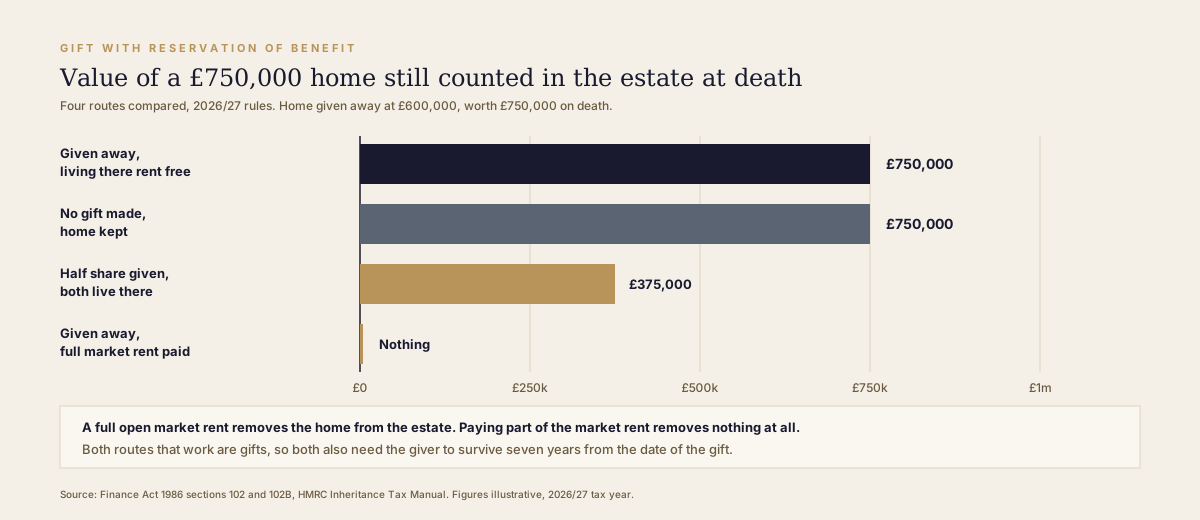
A gift with reservation of benefit is a lifetime gift of an asset from which the giver carries on receiving a benefit, so inheritance tax treats the asset as still belonging to them. Give your home away and carry on living in it rent free, and its full value at your death is still counted as yours. The seven year clock never starts, so a gift made twenty years ago sits in the estate exactly as it did on day one. Only two routes reliably break the reservation: paying a full market rent, or giving a share of a home you genuinely share.
The gift with reservation of benefit rules exist to stop one specific thing: giving an asset away on paper while carrying on as though you still own it. They are the reason the idea most people reach for first, signing the family home over to the children and staying put, almost never reduces the bill. All figures in this article reflect the 2026/27 tax year.
How do you avoid a gift with reservation of benefit?
Only two routes work. Either you pay a full open market rent to whoever now owns the property, or you give away a share of a home you genuinely share with them and meet your part of the running costs. Continuing to live there for nothing, whatever the paperwork says, leaves the entire property inside your estate.
Contents
- What is a gift with reservation of benefit?
- How does the reservation of benefit rule work?
- Can you give your house away and still live in it?
- How much rent do you have to pay to escape the rules?
- What is the pre-owned assets charge?
- Why is a reservation of benefit worse than doing nothing?
- Should you give your home to your children?
- How does this fit into a wider estate plan?
What is a gift with reservation of benefit?
A gift with reservation of benefit is a gift you have not really made. The legal title moves, the asset appears on somebody else’s balance sheet, and for every purpose except the one you were aiming at it belongs to them. For inheritance tax, it is still yours.
The rules sit in section 102 of the Finance Act 1986 and were written in response to a wave of arrangements in the 1980s that transferred ownership on paper while leaving daily life untouched. Parliament’s answer was blunt. If a gift is not enjoyed to the entire exclusion of the person who made it, the asset is treated as part of their estate immediately before death, and taxed accordingly.
The reach is wider than houses. Giving away a share portfolio while continuing to take the dividends is a reserved benefit. So is transferring a holiday cottage and carrying on using it each August, or moving a buy-to-let into a company you control. The family home is simply where the rules bite most often, because it is the asset most people own that is large enough to create an inheritance tax problem and impossible to stop using.
Risk warnings
Investments
The value of investments and any income from them can fall as well as rise. You may not get back the full amount invested.
The taxation of the investment is dependent on the individual circumstance of each investor, and may be subject to change in the future.
Mortgages
If property prices fall and your capital value falls below your outstanding interest-only mortgage, you’ll need to make up for any shortfall if the property sells for less.
How does the reservation of benefit rule work?
HMRC applies two separate tests, and failing either one is enough. The recipient must genuinely assume possession and enjoyment of the asset, and from then until death the asset must be enjoyed to the entire exclusion, or virtually the entire exclusion, of the person who gave it.
“Virtually to the entire exclusion” is the phrase that does the work, and it means a benefit so small it can be disregarded. HMRC’s own guidance puts numbers on it: staying in a gifted house for up to about two weeks a year is treated as negligible, while staying most weekends, or a month a year, is not. The test is applied continuously, not once at the point of the gift, so an arrangement that starts cleanly can fail years later when a parent moves back in.
The seven year rule rewards people who genuinely let go. A reserved benefit is not a slow gift that needs more time to work, it is a gift that has not started, and the clock only begins on the day the benefit actually ends.
That last point causes more disappointment than any other part of the regime. Where a benefit is reserved, the seven year rule for inheritance tax has nothing to bite on. If the benefit later stops, for instance because you move into care or start paying a market rent, the law then treats you as making a fresh gift on that date, and the seven year period runs from there.
Risk warning
HM Revenue and Customs practice and the law relating to taxation are complex and subject to individual circumstances and changes which cannot be foreseen.
Can you give your house away and still live in it?
You can, and the property genuinely becomes your children’s, but the inheritance tax position does not change. The house is added back to your estate at its open market value on the date you die, which is usually higher than its value when you gave it away.
Four routes are commonly proposed. Only two of them work.
How each route is treated for inheritance tax in 2026/27, assuming you survive seven years from any gift
| Route | In your estate at death? | Why |
|---|---|---|
| Give the house away, stay rent free | Full value | Reserved benefit under section 102 |
| Give the house away, pay full market rent | Nothing | Full consideration exclusion |
| Give a share, both live there, split the bills | Only the share you kept | Section 102B shared occupation |
| Keep the house | Full value | No gift made |
That assumption is doing real work in the two rows that succeed, because both of them are gifts and the ordinary seven year rule applies to them as it does to any other. Die within seven years and what you gave away is brought back into the calculation at its value on the day of the gift rather than at death, and it uses up your nil-rate band ahead of everything else in the estate. That is still a better position than a reserved benefit, where the clock has not started at all and the value comes back at the date of death. It is not the same thing as the house leaving your estate on the day you sign.
The third route is the one most people have never heard of. Where a house is put into the joint names of giver and recipient, both occupy it, and both meet their share of the outgoings, section 102B of the Finance Act 1986 says no reservation arises on the share given away. Living together is the whole basis of the exception, so it works for a child who moves in and fails for one who does not.
Ruth, 71, and her son Daniel
Ruth owns her home outright, worth £540,000, and Daniel has been renting nearby since his divorce. She transfers a half share to him as tenants in common and he moves in. They split the council tax, insurance and utility bills between them, and each pays their own way.
No reservation arises on Daniel’s half, because both of them occupy the property and Ruth receives nothing at his expense. The gifted half is a potentially exempt transfer of £270,000, and it falls outside her estate if she survives seven years. The half Ruth kept stays in her estate, as it should.
Two years later Daniel’s circumstances change and he moves out, keeping his half share. From that date Ruth occupies the whole of a property she half gave away, so his share becomes a reserved benefit and returns to her estate. Nothing about the paperwork changed. The living arrangement was carrying the entire arrangement.
How much rent do you have to pay to escape the rules?
The full open market rent, reviewed at regular intervals, and nothing less will do. There is no partial credit: paying half the market rate does not put half the property outside your estate, it leaves the whole of it inside.
For a house worth £600,000 in 2026/27, a market rent of roughly £1,850 a month is £22,200 a year. That money has to be genuinely paid, from income you can afford to lose, and it has to keep pace with the market rather than sitting at the figure agreed a decade ago. The rent is also taxable income for your children, less allowable expenses, at their own marginal rate. A higher rate taxpaying child receiving £22,200 keeps around £13,320 of it.
So the arrangement moves the house out of your estate, and moves roughly £22,200 a year out of your estate too, of which a substantial slice reaches HM Revenue and Customs rather than your family. The comparison worth running is not rent against nothing. It is rent against the inheritance tax the house would otherwise trigger, alongside how the same £22,200 a year would perform if it were simply gifted instead under the normal expenditure out of income exemption, which removes money from the estate immediately and with no seven year wait.
What is the pre-owned assets charge?
The pre-owned assets charge is an annual income tax charge on the benefit of using something you used to own, and it exists to catch arrangements clever enough to escape the reservation of benefit rules. The two regimes are alternatives rather than a double penalty: where the asset is already caught as a reserved benefit, the income tax charge does not also apply.
The charge is calculated on the notional rental value of the land, or on a set rate applied to chattels and intangibles. Where the total for the tax year does not exceed £5,000, no charge arises, and each of a couple has their own £5,000 limit. That threshold is all or nothing rather than an allowance: a benefit valued at £5,400 is charged on the whole £5,400, not on the £400 above the line.
What is the pre-owned assets charge?
The pre-owned assets charge is an annual income tax charge on the benefit of using an asset you previously owned. It applies to arrangements that escape the inheritance tax reservation of benefit rules, and only where the benefit for the tax year exceeds £5,000. It is reported and paid through Self Assessment every year the benefit continues.
Reaching a benefit of £5,000 takes very little property in 2026/27, so in practice the exemption protects modest arrangements and almost nothing involving a family home. Where the charge does apply, it is reported through Self Assessment and paid every year for as long as the benefit continues, which turns a one-off piece of planning into a recurring cost.
The arrangement that lands here most often is the one that looks like it works. Money is not traced into whatever it buys for the reservation of benefit rules, so giving an adult child cash and later moving into the house they buy with it is not a reserved benefit: the house was never yours to give away. That is the gap the pre-owned assets charge was written to close, through what the legislation calls the contribution condition. You provided part of the price of land you now occupy.
What the pre-owned assets charge costs where gifted cash bought the house
Gerald, 72, gave his daughter Helen £245,000 in 2024. She bought a house for £618,000 later that year, adding her own savings and a mortgage, and Gerald moved in rent free.
| Input | Value |
|---|---|
| Cash Gerald gave Helen | £245,000 |
| Price Helen paid for the house | £618,000 |
| Open market rent for the house, 2026/27 | £22,800 a year |
| Gerald's marginal income tax rate | 40% for 2026/27 |
- The cash is a potentially exempt transfer and the house is not traced back to it, so there is no reservation of benefit and nothing returns to Gerald's estate
- Gerald provided £245,000 of the £618,000 price, which is 39.6% of it
- The charge is that share of the property's rental value: £22,800 x 39.6% = £9,039
- That is above the £5,000 threshold, so the whole £9,039 is charged to income tax at 40%: £3,616
Result: £3,616 of income tax for 2026/27, payable again every year Gerald lives there, with the rental value revalued every five years.
Two dates decide whether any of that happens. The cash gift is outside the charge altogether where it was made at least seven years before the day the giver moves in, so what matters is the gap between the gift and the move rather than the gap between the gift and death. And Gerald can elect to have the house treated as a reserved benefit instead, on form IHT500 by the 31 January following the end of the first tax year the charge applies. The election stops the income tax by putting the share of the house his money bought back into his estate, which is the arrangement conceding the point: the tax it was built to save comes back, and he has given away £245,000 to get there.
Risk warnings
Your home may be repossessed if you do not keep up repayments on your mortgage. Think carefully before securing debts against your home.
Not all mortgage contracts are regulated by the Financial Conduct Authority.
Why is a reservation of benefit worse than doing nothing?
Because it leaves the inheritance tax exactly where it was while throwing away a capital gains tax relief you would otherwise have had. Assets that pass on death are rebased to their probate value, so an inheriting child sells with little or no gain. Assets given away in your lifetime carry your original cost forward to the recipient, and the reservation of benefit rules do not restore the uplift.
What a reserved benefit costs when the house is given away and then sold
Margaret, 76, gave her £600,000 house to her daughter Fiona in 2026 and stayed on rent free.
| Input | Value |
|---|---|
| House value at the date of gift | £600,000 |
| House value at Margaret's death | £750,000 |
| Fiona's capital gains tax rate | 24% for 2026/27 |
- The house returns to the estate at its date of death value: £750,000, not the £600,000 given away
- Inheritance tax at 40%, with the nil-rate bands used against the rest of the estate: £750,000 x 40% = £300,000
- Fiona's base cost stays at £600,000 with no uplift on death, so selling at £750,000 leaves a £150,000 gain, less the £3,000 annual exempt amount, taxed at 24%: £35,280
Result: £335,280 of tax in total, which is £35,280 more than if Margaret had simply kept the house and left it to Fiona in her will.
Had Margaret done nothing, the inheritance tax would have been the same £300,000 and Fiona would have inherited at £750,000, with no capital gains tax to pay on an immediate sale. The gift achieved a worse result than inaction, and it did so quietly, with no point along the way at which anyone was told the plan had failed.
There is more that a plan like this gives away. The house belongs to Fiona, so it is exposed to her divorce, her creditors and her own death. It sits in her estate, not Margaret’s. If Fiona ever lives elsewhere, the property is no longer her main home and a further slice of capital gains tax accrues on it. And a local authority assessing Margaret for care funding can treat a property given away while she still lived in it as deprivation of assets and assess her as though she still owned it.
The house coming back into the estate has one further effect worth naming. It counts toward the £2 million threshold at which the residence nil-rate band starts to taper away, and both that band and the £325,000 nil-rate band are frozen until 5 April 2031, so more estates cross the line each year.
Should you give your home to your children?
For the purpose of saving inheritance tax, this arrangement is usually a mistake, and it is one of the few in financial planning where the popular version of the idea is the version that does not work. The reserved benefit route leaves the tax bill untouched and adds a capital gains tax liability that would not otherwise have existed. The market rent route does work, but it costs real money every year and hands part of it to HMRC through your children’s tax return.
There are situations where transferring a home does make sense, and they have less to do with tax than with how the property is actually used:
- Section 102B, where a child is genuinely going to live in the property with you for the long term and share the running costs.
- An outright gift, where the property is not the home you live in, such as a second property or a former home you have already moved out of.
- A market rent arrangement, where the rental cost is comfortably affordable from income and the recipient’s tax position makes the arithmetic work.
The section 102B route rewards families whose living arrangements are actually shared, which is a small group, and it rewards them properly.
What tends to work better is the boring route. Using the annual and small gift exemptions, giving from surplus income where you have it, keeping the residence nil-rate band available, and reviewing whether the estate really has a problem before restructuring the roof over your head. Several of those are covered in the inheritance tax gift allowances guide.
Most people arrive at this idea because somebody at a dinner party mentioned it, and the instinct behind it is a reasonable one: the house is the biggest thing you own and the most obvious lever to pull. The reason it fails is that Parliament closed the route forty years ago, not because you missed something.
How does this fit into a wider estate plan?
The right sequence is to establish the size of the problem before choosing a tool. Plenty of estates that feel exposed turn out to sit comfortably inside the combined nil-rate bands once the numbers are actually run, and a couple leaving a home to their children can pass on up to £1 million before any inheritance tax arises. Restructuring ownership of a home to solve a liability that does not exist is a poor trade at any price.
Where there is a genuine liability, the question I would ask first is what the house is for. If you intend to live in it for the rest of your life, it is not really a gifting asset, and the planning belongs elsewhere: in pensions and their treatment after April 2027, in surplus income, in life cover written in trust to meet the bill, or in whether the estate can afford gifts of other assets at all. A lifetime cashflow projection answers the affordability question before any of the tax questions become worth asking.
If you are weighing this up, you do not need to have decided anything before you talk it through, and you do not need to arrive with valuations or documents. Understanding how inheritance tax is calculated on your own numbers usually changes the question, and it is a better starting point than a decision about the house. Where an estate does need a plan, inheritance tax planning works from that position rather than from the most eye-catching asset on the list.
Risk warnings
Pensions
The value of pensions and any income from them can fall as well as rise. You may not get back the full amount invested.
Levels and bases of, and reliefs from, taxation are subject to change and their value will depend upon personal circumstances. Taxation and pension legislation may change in the future.
A pension is a long-term investment and the value is not guaranteed. Any advice or considerations are personal to each individual’s circumstances.
Tax, trusts and estate planning
The Financial Conduct Authority (FCA) does not regulate Inheritance Tax Planning or Trust Advice.
Protection
Benefits of insurance products will be put at risk or cease altogether if premium payments are not maintained.
Frequently asked questions
What is a gift with reservation of benefit?
A gift with reservation of benefit is a lifetime gift where the giver keeps on benefiting from what they gave away, most often by giving a house to a child and continuing to live in it. Inheritance tax then treats the asset as still theirs. It is added back to the estate at its value on the date of death, however many years earlier the gift was made.
How does HMRC decide whether a gift has a reservation of benefit?
HMRC applies two tests set out in section 102 of the Finance Act 1986. The recipient must genuinely take possession and enjoyment of the asset, and the giver must be excluded, or virtually excluded, from any benefit from it. HMRC accepts small residual benefits: staying in a gifted house for up to about two weeks a year is treated as negligible, while most weekends is not.
Can I give my house to my children and keep living in it?
Yes, but the house stays in your estate for inheritance tax unless you pay your children a full market rent or the shared occupation rules apply. Legal ownership passes and the property is theirs, which brings its own consequences. What does not happen is any reduction in the inheritance tax your estate eventually pays.
Do I have to pay rent to my children if I gift them my house?
Only if you want the gift to work for inheritance tax. The rent must be full open market value and reviewed periodically, not a token figure, and paying part of the market rent gives no partial credit. Your children pay income tax on the rent they receive, at their own marginal rate, which is why the arithmetic often fails for a higher rate taxpayer.
Does the seven year rule apply to a gift with reservation of benefit?
No. The seven year rule applies to gifts you have genuinely let go of. Where a benefit is reserved, the asset is treated as part of your estate at death regardless of how long ago the gift was made, so surviving twenty years changes nothing. The seven year clock only starts on the date the reserved benefit actually ends.
Is giving your home away to save inheritance tax worth it?
Rarely, once the full cost is counted. A reserved benefit leaves the inheritance tax bill untouched while stripping out the capital gains tax uplift your children would have received on your death, so the arrangement can cost more than doing nothing. It also hands control of your home to someone else, and that exposure to their divorce, bankruptcy or death is usually the larger risk.