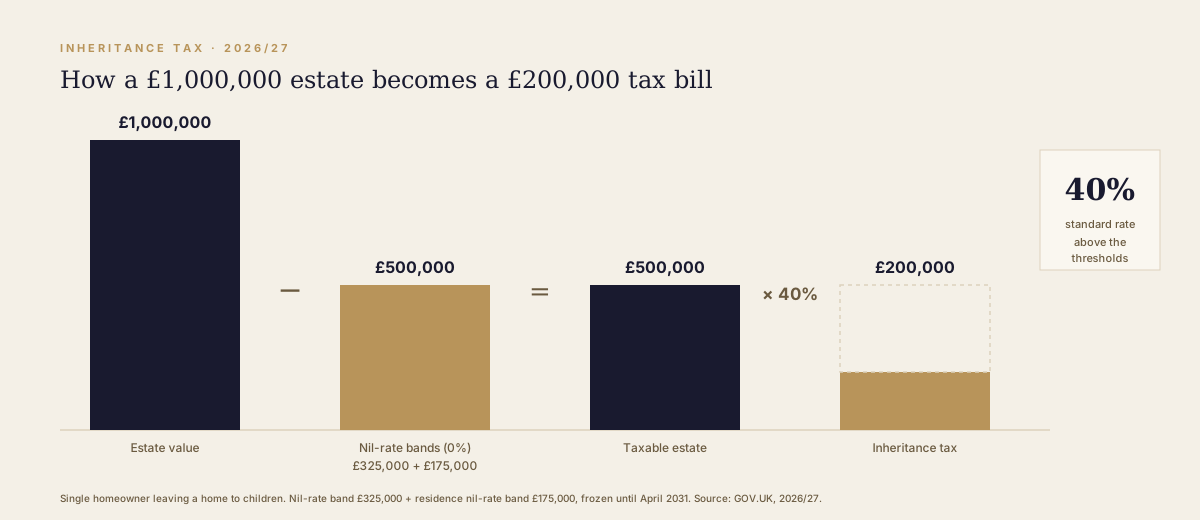
Inheritance tax is a 40% charge on the value of a deceased person's estate above their available tax-free thresholds, applied after debts, exemptions, and reliefs have first been deducted. Take the estate's total value, subtract debts, exempt gifts, and reliefs, then deduct the available nil-rate bands: whatever remains is taxed at 40% in 2026/27. The order is fixed and it matters, because exemptions and reliefs come off before the thresholds, and only the slice above the thresholds is ever taxed. Leave 10% or more of the net estate to charity and the rate on the taxable part falls to 36%.
Inheritance tax is worked out in a fixed order, and understanding that order is the difference between fearing a 40% bill on everything and seeing how little of an estate is often taxed at all. The calculation starts with the whole estate, strips out debts, then exemptions, then reliefs, then the tax-free thresholds, and applies the rate only to what is left. In 2026/27 that rate is 40%, and the first £325,000 of any estate sits inside the nil-rate band at 0%. Knowing how inheritance tax is calculated shows you where the tax actually falls, and therefore where planning can change the outcome. All figures in this article reflect the 2026/27 tax year.
How much inheritance tax is due on a £500,000 estate?
A single person's estate of £500,000 with only the £325,000 nil-rate band is taxed on £175,000 at 40%, giving £70,000 of inheritance tax in 2026/27. If the estate includes a home passing to children, the £175,000 residence nil-rate band can cover the excess and reduce the tax to nothing.
Contents
- How is inheritance tax calculated?
- What are the 2026/27 rates and thresholds?
- Why does the order of deductions matter?
- How do lifetime gifts change the calculation?
- How does leaving money to charity cut the rate?
- Can a charitable gift reclaim a tapered residence nil-rate band?
- How does the calculation fit into your wider plan?
- Should you try to reduce your inheritance tax bill?
How is inheritance tax calculated?
Inheritance tax is calculated by valuing the whole estate, taking off debts, exemptions, reliefs, and the nil-rate bands in turn, then charging 40% on the amount that remains. Nothing within the thresholds is taxed, and nothing left to a spouse or charity is taxed, so the figure that actually gets charged is usually far smaller than the headline estate value. The rate has been 40% for decades, and GOV.UK’s guidance on how inheritance tax works sets out the standard rate and the £325,000 threshold that frames every calculation.
The single most useful idea is that the estate is a stack, and the thresholds sit near the top of it. Everything below the line passes tax-free; only the part poking above it is charged. A concrete case makes the mechanism clear.
How inheritance tax is calculated on a £1.1 million estate
Ruth, 80, a widow, leaves her whole estate, including her home, to her son.
| Input | Value |
|---|---|
| Estate value | £1,100,000 |
| Debts and funeral costs | £15,000 |
| Own nil-rate bands (NRB + RNRB) | £500,000 |
| Bands transferred from late husband | £500,000 |
- Deduct debts: £1,100,000 minus £15,000 = £1,085,000 net estate
- Add up available thresholds: £325,000 + £325,000 + £175,000 + £175,000 = £1,000,000
- Taxable estate: £1,085,000 minus £1,000,000 = £85,000
- Inheritance tax at 40%: £85,000 x 40% = £34,000
Result: Ruth's estate pays £34,000 of inheritance tax, an effective rate of about 3% of the £1.1 million total.
Ruth’s estate is well over a million pounds, yet the tax is £34,000, because her late husband’s unused thresholds transfer to her and lift the tax-free total to £1 million. That transfer is one of the most valuable features of the system, and it is explained fully in the guide to the nil-rate band and residence nil-rate band.
What are the 2026/27 rates and thresholds?
For 2026/27, the standard inheritance tax rate is 40%, the nil-rate band is £325,000, and the residence nil-rate band is up to £175,000. A reduced rate of 36% applies where at least 10% of the net estate goes to charity. These are the four numbers that drive almost every calculation.
The thresholds are frozen. The nil-rate band has been £325,000 since April 2009, and both bands and the £2 million taper threshold remain fixed until 5 April 2031 following the 2025 Autumn Budget. Because the thresholds do not rise with inflation or house prices, more estates are drawn into the tax each year, an effect known as fiscal drag. An estate that was comfortably below the line a decade ago can sit above it today without a single asset changing hands.
The residence nil-rate band is the conditional one. It applies only where a main home passes to direct descendants, and it tapers away above larger estates: for every £2 an estate exceeds £2 million, £1 of the residence band is lost, as GOV.UK’s guidance on passing on a home explains. A single person’s £175,000 band disappears entirely once the estate reaches £2.35 million.
Why does the order of deductions matter?
The order matters because each deduction changes the base for the next, and the thresholds come last. Exemptions and reliefs are taken off before the nil-rate band, so a large charitable gift or a qualifying business does not just reduce the estate, it reduces the amount the thresholds then have to cover. Getting the order wrong makes the tax look larger than it is.
The calculation runs through six stages, always in this sequence:
- Value the estate. Add up property, savings, investments, and possessions at their open-market value on the date of death.
- Take off debts and liabilities. Deduct the mortgage, outstanding bills, and reasonable funeral costs to reach the net estate.
- Deduct exemptions. Anything left to a spouse, civil partner, or charity leaves the calculation entirely and is never taxed.
- Deduct reliefs. Business and agricultural property that qualifies can attract business property relief or agricultural property relief, reducing its taxable value.
- Deduct the nil-rate bands. Subtract the £325,000 nil-rate band, any residence nil-rate band, and any bands transferred from a late spouse.
- Apply the rate. Charge 40% on whatever is left, or 36% if the charity condition is met.
The spousal exemption at stage three is the reason most married couples pay nothing on the first death. Everything passing to the surviving spouse is exempt without limit, which is also why the first death usually leaves both nil-rate bands unused and available to carry forward.
How is an estate valued for inheritance tax?
An estate is valued at the open-market value of everything the person owned at the date of death: property, savings, investments, and possessions, less the mortgage, outstanding debts, and reasonable funeral costs. This net figure is the starting point before exemptions, reliefs, and the £325,000 nil-rate band are deducted to find the taxable amount.
Risk warnings
Your home may be repossessed if you do not keep up repayments on your mortgage. Think carefully before securing debts against your home.
Not all mortgage contracts are regulated by the Financial Conduct Authority.
How do lifetime gifts change the calculation?
Lifetime gifts change the calculation because gifts made within seven years of death are pulled back in and use up the nil-rate band before the rest of the estate can. A gift made more than seven years before death falls out of the reckoning completely. This is the mechanism behind the well-known “seven year rule”.
A potentially exempt transfer is an outright gift to another individual that becomes fully exempt if the person giving it survives for seven years. If they do not, the gift is added back to the estate and counted first against the £325,000 band. Only once gifts in the seven-year window exceed the band does tax fall on the gift itself, and even then it can be tapered down from 40% depending on timing, as GOV.UK’s guidance on gifts and inheritance tax describes.
Because gifts consume the band ahead of the estate, a large gift in the last few years of life can quietly remove the shelter the estate was relying on. The order of gifting, and the exemptions that let some gifts escape the seven-year clock, are covered in the seven year rule for lifetime gifting and the guide to inheritance tax gift allowances.
How does leaving money to charity cut the rate?
Leaving money to charity cuts the rate because a gift of 10% or more of the net estate reduces the rate on everything else from 40% to 36% in 2026/27. The charitable gift is exempt in its own right, and it also lowers the rate applied to the taxable remainder. The net estate for this test is the value left after debts, exemptions, reliefs, and the nil-rate band. The striking part is how little it costs the other beneficiaries.
Weighing a £20,000 charity gift against a £50,000 one
Denise, 66, has an estate of £825,000 and leaves it to her nieces, so no residence nil-rate band applies. After her £325,000 nil-rate band, the net estate for the charity test is £500,000, and 10% of that is £50,000.
Her original will leaves £20,000 to charity, below the 10% threshold. The taxable estate is £480,000, taxed at 40%, giving £192,000 of inheritance tax. After the gift and the tax, her nieces receive £613,000.
If she instead leaves £50,000 to charity, the 10% test is met and the rate drops to 36%. The taxable estate falls to £450,000, taxed at 36%, giving £162,000 of tax. The charity now receives £50,000, and her nieces still receive £613,000. Giving £30,000 more to charity costs her nieces nothing, because the tax bill falls by the same £30,000.
The charitable reduced rate is one of the few places in the tax system where giving more away leaves the family no worse off. Above the 10% line, the extra gift is funded almost entirely by tax that would otherwise have gone to HMRC.
That result is not a coincidence of Denise’s numbers; it holds around the 10% boundary generally, which is why estates that are already giving close to 10% to charity are usually advised to check whether nudging up to the full 10% is worthwhile.
Risk warning
HM Revenue and Customs practice and the law relating to taxation are complex and subject to individual circumstances and changes which cannot be foreseen.
Can a charitable gift reclaim a tapered residence nil-rate band?
No. A charitable gift in a will cannot restore a residence nil-rate band that the £2 million taper has taken away, because the taper is measured on the estate before exemptions and reliefs are deducted. This trips up estates that assume a legacy to charity, or a slice of business relief, will pull them back under the £2 million line and hand back the lost band.
The value that drives the taper, which HMRC calls “E”, is the estate after debts but before any spouse exemption, charity exemption, business relief, or agricultural relief, as HMRC’s manual on tapering the residence nil-rate band sets out. A £2.2 million estate is tested at £2.2 million whether or not £180,000 of it is heading to charity. The residence nil-rate band stays tapered; only the death estate itself falling below £2 million restores it.
Does a charity gift in a will restore a tapered residence nil-rate band?
No. The £2 million residence nil-rate band taper is measured on the estate after debts but before exemptions and reliefs, so a charitable legacy does not reduce the figure it is tested against. The gift is still exempt and can cut the rate to 36%, but the tapered band is restored only by reducing the death estate itself.
The gift is far from wasted. It is still exempt, and at £180,000 it is exactly 10% of the £1.8 million left once the nil-rate bands are deducted, the minimum needed to pass the 10% test, so the rate on the taxable estate drops from 40% to 36%. It changes the rate, not the residence nil-rate band, and the difference between the two effects is worth seeing side by side.
A £2.2 million estate left by a single person to their child, with and without a £180,000 charity legacy (2026/27)
| Outcome | No charity gift | £180,000 to charity |
|---|---|---|
| Residence nil-rate band available | £75,000 | £75,000 |
| Rate on the taxable estate | 40% | 36% |
| Inheritance tax due | £720,000 | £583,200 |
| Passes to the child | £1,480,000 | £1,436,800 |
| Passes to charity | £0 | £180,000 |
At £2.2 million, the single £175,000 residence nil-rate band is already tapered down to £75,000, and the charity legacy leaves that £75,000 untouched: the band does not move in either column. What the £180,000 gift does is drop the rate to 36%, cutting the tax by £136,800, so a £180,000 legacy costs the child about £43,000 after the tax it saves. Reclaiming the £100,000 of band the taper removed is a different job entirely, done by shrinking the death estate, for example through lifetime gifts made more than seven years before death, which leave the estate for good and lower the figure the £2 million taper is tested against.
The figures above use one person’s own bands. A widow or widower who has inherited a late spouse’s unused allowances starts from far more: two nil-rate bands of £325,000 and, in principle, two residence nil-rate bands of £175,000. The taper still applies to the combined total, so on the same £2.2 million estate the £350,000 of residence nil-rate band is cut by the same £100,000, leaving £250,000 and total thresholds of £900,000 rather than £400,000.
That larger shelter changes the charity sum needed. Because the 10% test is measured on the taxable estate after the nil-rate bands, a bigger allowance leaves a smaller taxable estate, so a smaller gift reaches the reduced rate. The single person needed £180,000, 10% of their £1.8 million taxable estate; someone with a spouse’s bands needs only £130,000, 10% of their £1.3 million.
The same £2.2 million estate where a spouse’s nil-rate bands have been inherited (2026/27)
| Outcome | No charity gift | £130,000 to charity |
|---|---|---|
| Residence nil-rate band available | £250,000 | £250,000 |
| Rate on the taxable estate | 40% | 36% |
| Inheritance tax due | £520,000 | £421,200 |
| Passes to the child | £1,680,000 | £1,648,800 |
| Passes to charity | £0 | £130,000 |
In both tables the residence band stays exactly where the taper left it, because a gift to charity has no effect on the taper at all. All the gift does is drop the rate to 36%, with the £98,800 of tax saved funding most of the £130,000 legacy. The only figure that changes between the two estates is the size of gift each one needs to reach that rate: the more nil-rate band available, the smaller the taxable estate, and so the smaller the charitable legacy needed to reach 10% of it.
How does the calculation fit into your wider plan?
The calculation is the scoreboard, not the game. Every worthwhile piece of inheritance tax planning works by changing one of the inputs: reducing the estate through gifting, moving assets into an exempt category such as a spouse or charity, or qualifying for a relief. Seeing the calculation laid out shows which lever is worth pulling and which would make no difference.
Pensions are about to become one of the largest inputs. From April 2027, most unused pension funds will be counted as part of the estate for inheritance tax, a change explained in the guide to pensions and inheritance tax from April 2027. An estate that looks comfortably within the thresholds today can be pushed well above them once a pension is added to the sum, which makes running the calculation on a forward-looking basis more important than it has been.
The mechanics of paying the bill matter too. The tax is normally due within six months of the end of the month of death, often before the estate’s assets can be released, and the executors handle the reporting and payment as part of the probate process. Where the liability is large and unavoidable, some families cover it with life cover held outside the estate rather than forcing a rushed sale of assets.
Risk warnings
Pensions
The value of pensions and any income from them can fall as well as rise. You may not get back the full amount invested.
Levels and bases of, and reliefs from, taxation are subject to change and their value will depend upon personal circumstances. Taxation and pension legislation may change in the future.
A pension is a long-term investment and the value is not guaranteed. Any advice or considerations are personal to each individual’s circumstances.
Tax, trusts and estate planning
The Financial Conduct Authority (FCA) does not regulate Inheritance Tax Planning or Trust Advice.
Protection
Benefits of insurance products will be put at risk or cease altogether if premium payments are not maintained.
Should you try to reduce your inheritance tax bill?
Reducing an inheritance tax bill is worth doing where an estate is clearly above the thresholds and the owner can afford to give away or reallocate assets without putting their own security at risk. The tax is entirely a function of the calculation above, so the question is always which input can be changed without causing more harm than the tax it saves.
The trade-off is real. Gifting reduces the estate but only after a seven-year wait, and money given away cannot be called back if circumstances change. Reliefs depend on assets keeping their qualifying status, and the residence nil-rate band can be lost through a single detail in a will. A plan that chases the lowest possible tax figure while leaving the owner short of income or flexibility has solved the wrong problem.
The better framing is to know the number, understand which parts of it are fixed and which are within your control, and act on the controllable parts in the right order. That is where advice earns its place: not in memorising the rates, but in modelling how a gift, a transfer, or a pension decision moves the whole calculation, and doing it while there is still time for the seven-year clock to run.
Frequently asked questions
How is inheritance tax calculated?
Inheritance tax is calculated by valuing the whole estate, deducting debts, then deducting exemptions and reliefs, then deducting the available nil-rate bands, and charging 40% on whatever is left. In 2026/27 the nil-rate band is £325,000, with up to £175,000 more where a home passes to direct descendants. Only the amount above the thresholds is taxed.
What is the inheritance tax rate in 2026/27?
The standard inheritance tax rate is 40% in 2026/27, charged only on the part of an estate above the available thresholds. A reduced rate of 36% applies where at least 10% of the net estate is left to charity. Some lifetime gifts made within seven years of death can be taxed at a tapered rate below 40%.
How much can you inherit before paying inheritance tax?
In 2026/27 the first £325,000 of any estate is taxed at 0%, the nil-rate band. A homeowner leaving their home to children or grandchildren can add up to £175,000 more, giving £500,000. A married couple or civil partners can combine both allowances to pass on up to £1 million between them.
Do you pay inheritance tax on the whole estate?
No. Inheritance tax is charged only on the value of an estate above the available thresholds, not on the whole estate. An estate of £400,000 with a £325,000 nil-rate band is taxed on £75,000, not £400,000. Everything within the thresholds, and everything left to a spouse or charity, is free of tax.
How does leaving money to charity reduce inheritance tax?
Gifts to charity are themselves exempt, and leaving 10% or more of the net estate to charity cuts the rate on the rest from 40% to 36% in 2026/27. The net estate is the value after debts, exemptions, reliefs, and the nil-rate band. The tax saved often means heirs receive almost the same amount while the charity gains.
How do gifts affect the inheritance tax calculation?
Gifts made within seven years of death are added back into the calculation and use up the nil-rate band first, before the rest of the estate. If total gifts in that window exceed £325,000, tax can fall on the gift itself, tapered down from 40% between three and seven years. Gifts made more than seven years before death fall out of the calculation entirely.
Who calculates and pays inheritance tax?
The executors or administrators of the estate calculate the tax, report it to HMRC, and pay it from the estate before the assets are distributed. It is usually due within six months of the end of the month of death. Any inheritance tax on lifetime gifts that become taxable is normally paid by the person who received the gift.
Should you try to reduce your inheritance tax bill?
Reducing an inheritance tax bill is worthwhile where an estate is comfortably above the thresholds and the owner can give away or reallocate assets without compromising their own security. The tools, gifting, spousal transfers, charitable giving, reliefs, and pensions, all work by moving value below the thresholds or into an exempt category. The risk is giving away too much too soon.