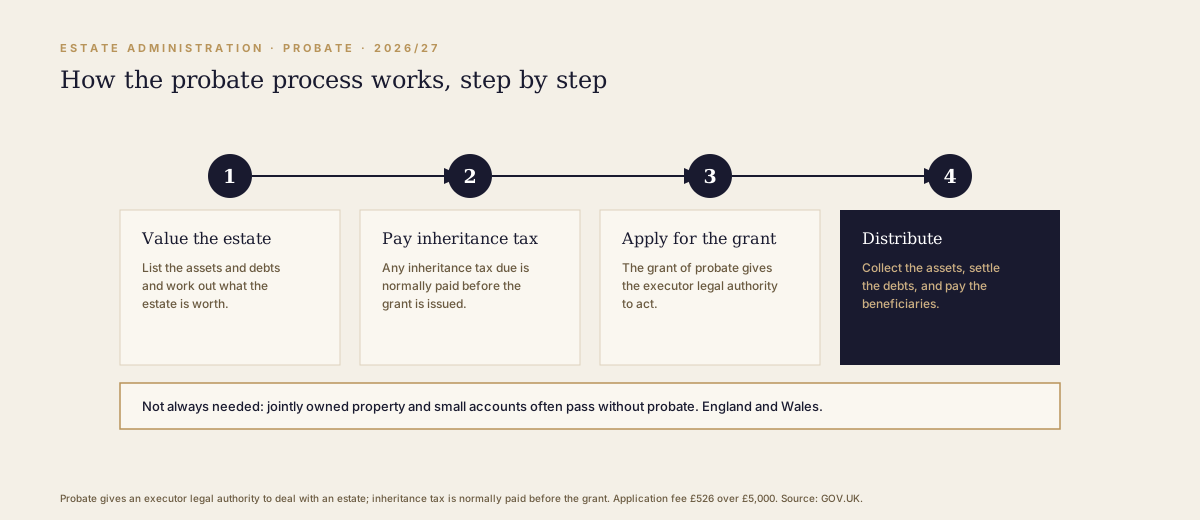
Probate is the legal authority to administer the estate of someone who has died, allowing the named executor to collect in the assets, settle debts and tax, and distribute what remains to the beneficiaries. You usually need probate to access most of someone's estate after they die, but not always: jointly owned property and small accounts often pass without it. The grant gives the executor or administrator legal authority to collect assets, settle debts, and distribute what remains. Any inheritance tax due must normally be paid before the grant is issued, and all figures here reflect the position in England and Wales for 2026/27.
Probate is the legal authority to deal with the money, property, and possessions of someone who has died. In England and Wales the executor named in the will applies for a grant of probate before banks, share registrars, and the Land Registry will release or transfer anything of value. If there is no will, a close relative applies instead for a similar grant called letters of administration. The grant proves to every institution that one named person is entitled to act, and without it most of the estate stays frozen. All figures and fees in this article reflect the position in England and Wales for the 2026/27 tax year.
How long does probate take in the UK?
The grant of probate commonly takes a number of weeks to come through after you apply, once any inheritance tax has been settled. Administering the whole estate usually runs to six to twelve months, and longer if a property has to be sold or the estate is complex. Inheritance tax is due within six months of death, which often sets the early pace.
Contents
- What is probate?
- How the probate process works
- When probate is not needed
- Grant of probate vs letters of administration
- How much probate costs
- Probate and inheritance tax
- Scotland and Northern Ireland
- Should you use a solicitor?
What is probate?
Probate is the legal right to administer the estate of someone who has died, confirming who has authority to collect in their assets and pass them on. The word is used loosely to mean the whole process of dealing with an estate, but strictly it refers to the grant itself, the court document that institutions rely on before they hand anything over.
The person who applies is usually the executor named in the will. Their job is to value the estate, pay any debts and tax, and distribute what is left according to the will. Until the grant arrives, that authority is only on paper: a bank will not close a substantial account, and a property cannot be sold or transferred, on the strength of a will alone. The grant is issued by HM Courts and Tribunals Service once the estate has been reported and any inheritance tax dealt with, as set out in GOV.UK’s guidance on applying for probate.
Probate exists to protect everyone involved. It gives institutions a single, court-backed point of authority, so they can release money knowing they are paying the right person, and it gives beneficiaries a record that the estate has been handled properly.
How does the probate process work?
The probate process works in four broad stages: value the estate, deal with inheritance tax, apply for the grant, then collect in and distribute the assets. The order matters, because inheritance tax usually has to be settled before the grant is issued.
The first task is to establish what the estate is worth. The executor lists everything the person owned, from property and investments to bank accounts and possessions, and subtracts debts such as a mortgage, loans, and outstanding bills. That net figure drives both the tax position and the application fee. The estate is then reported to HMRC, and any inheritance tax is paid or arranged, with tax due within six months of the end of the month of death, as explained in GOV.UK’s guidance on paying an inheritance tax bill.
Only then does the executor apply for the grant, online or by post, paying the fee and sending in the original will. When there is no will, the closest relative applies for letters of administration instead, a route covered in our guide to what happens when you die without a will. Once the grant arrives, the executor uses it to close accounts, sell or transfer property, pay any remaining debts, and distribute the estate, keeping clear accounts throughout.
Risk warnings
Tax, trusts and estate planning
HM Revenue and Customs practice and the law relating to taxation are complex and subject to individual circumstances and changes which cannot be foreseen.
Mortgages
Your home may be repossessed if you do not keep up repayments on your mortgage. Think carefully before securing debts against your home.
Not all mortgage contracts are regulated by the Financial Conduct Authority.
When is probate not needed?
Probate is not needed when the estate’s assets either pass automatically to someone else or are small enough that institutions release them without a grant. The two most common reasons are joint ownership and modest balances.
Anything owned as joint tenants, typically a home or a joint bank account, passes straight to the surviving owner by survivorship and never forms part of the estate that needs probate. Many banks and building societies will also release smaller sums without a grant, often up to a limit they set themselves somewhere between £5,000 and £50,000, so an estate made up only of cash below those thresholds may avoid probate entirely. A property owned in the deceased’s sole name, or as tenants in common, almost always needs probate before it can be sold.
Some valuable assets sit outside probate by design. Most pensions are held under trust and pay out at the discretion of the scheme administrator, so they pass to nominated beneficiaries without a grant, as explained in our guide to how pensions are taxed on death. A life insurance policy written in trust works the same way, paying the beneficiaries directly rather than the estate. Steering assets outside probate can speed up access for the family, though it does not by itself remove them from inheritance tax.
Risk warnings
Pensions
The value of pensions and any income from them can fall as well as rise. You may not get back the full amount invested.
Levels and bases of, and reliefs from, taxation are subject to change and their value will depend upon personal circumstances. Taxation and pension legislation may change in the future.
A pension is a long-term investment and the value is not guaranteed. Any advice or considerations are personal to each individual’s circumstances.
Protection
Benefits of insurance products will be put at risk or cease altogether if premium payments are not maintained.
What is the difference between a grant of probate and letters of administration?
A grant of probate is issued when there is a valid will, and letters of administration when there is not. Both give the same core authority to deal with the estate, but they go to different people and follow different rules.
A grant of probate is issued to the executor the deceased chose and named in their will. They act on the instructions in that will, distributing the estate exactly as it directs. Letters of administration are issued to an administrator, usually the closest surviving relative, when someone dies without a valid will or without naming an executor who is able to act. The administrator has no instructions to follow and must instead apply the statutory intestacy rules, which set a fixed order of who inherits and in what shares.
The practical difference is control. A will lets you appoint someone you trust and tell them what to do; intestacy hands both the appointment and the division to a legal formula. Where the two grants are identical is in the responsibility they carry: executor and administrator alike are personally accountable for valuing the estate correctly, paying the right tax, and distributing to the right people.
How much does probate cost?
In England and Wales the probate application fee is £526 for 2026/27, charged on an estate worth more than £5,000. An estate at or below that value pays £0. Extra copies of the grant, which let the executor deal with several institutions at once, cost £2 each ordered with the application and £16 each afterwards, as listed in GOV.UK’s probate fees guidance.
That fee moved recently. It was £300 until 13 July 2026, when the Ministry of Justice raised it and introduced the reduced charge for copies ordered alongside the application. Guidance written before that date still quotes £300, so check when anything you read about the cost was published.
How much does probate cost in 2026?
In England and Wales the probate application fee is £526 for 2026/27, and estates worth £5,000 or less pay nothing. It rose from £300 on 13 July 2026. Extra copies of the grant cost £2 each ordered with the application, or £16 each afterwards. Using a solicitor adds separate professional fees on top.
The court fee is only part of the cost. Using a solicitor or probate specialist adds professional fees, sometimes charged as a percentage of the estate, which on a large estate can run into thousands of pounds. Those fees are separate from the tax and the court charge, and they are the main reason executors of simple estates often apply themselves.
How does probate work with inheritance tax?
Inheritance tax and probate are linked because the tax must normally be paid before the grant is issued, which can create a timing problem. The executor needs the grant to release the money, but HMRC wants the tax before it allows the grant, and the two requirements can collide on an estate that is asset-rich but short of ready cash.
Whether tax is due at all depends on the estate’s value against the available allowances. The nil-rate band is £325,000 for 2026/27, with the residence nil-rate band adding a further £175,000 where a home passes to direct descendants, both frozen until April 2031, as covered in our guide to the nil-rate band and residence nil-rate band. A widow, widower, or surviving civil partner can also inherit whatever percentage of both bands their late spouse did not use, so someone whose partner left everything to them can carry up to £1 million of allowances between the two. Anything above the available allowances is taxed at 40%. Where tax is owed, executors can use the Direct Payment Scheme, under which banks pay HMRC directly from the deceased’s accounts, or pay the tax on property and some other assets in annual instalments.
Marcus settles his mother’s estate
Eleanor, a widow, dies leaving an estate of £1.3 million: a home worth £600,000 left to her son Marcus, and £700,000 in savings and investments. Marcus is the executor.
Eleanor’s late husband left everything to her and used none of his allowances, so both of his bands transfer to her estate. That gives her two nil-rate bands (£650,000) and two residence nil-rate bands (£350,000), £1 million of allowances in all. The £300,000 above that is taxed at 40%, an inheritance tax bill of £120,000. Marcus needs probate to reach the £700,000 of investments, but HMRC wants the £120,000 before issuing the grant. He uses the Direct Payment Scheme so the investment provider pays HMRC directly, then receives the grant, sells the house, and distributes the estate. The probate fee is £526.
Had a larger share of the estate passed outside probate, such as a jointly owned account that transfers straight to the survivor, or a life policy written in trust that pays its beneficiaries directly, Marcus would have needed the grant for less, and the collision between HMRC wanting the tax and the bank wanting the grant would have been smaller. The inheritance tax would still be due, but less of the estate would be locked behind the grant, the waiting, and the fee.
This interaction is where estate planning earns its keep. Reducing the taxable estate, structuring how assets are owned, and using exemptions all change both the tax bill and how smoothly probate runs, which is the territory of inheritance tax planning rather than the probate application itself.
Some of that work can still be done after the death. Beneficiaries have two years from the date of death to redirect what they inherit, and a deed of variation signed in that window is treated for inheritance tax as though the deceased had made the redirection themselves. Executors are usually the first to spot when a will has produced an outcome nobody intended, which is why the possibility is worth raising early in the administration rather than after the estate has been distributed.
Risk warning
The Financial Conduct Authority (FCA) does not regulate Inheritance Tax Planning or Trust Advice.
How is probate different in Scotland and Northern Ireland?
Probate as described here applies in England and Wales; Scotland and Northern Ireland run separate systems with their own terms and fees. The £526 application fee and the £5,000 threshold are features of the England and Wales process.
In Scotland the equivalent process is called confirmation, granted by the local sheriff court rather than a probate registry. The forms and thresholds differ, and Scots law also gives a surviving spouse, civil partner, and children fixed legal rights to a share of the estate that cannot be written out by a will. Northern Ireland keeps the term probate but applies its own court process and rules. Anyone dealing with assets or relatives in more than one part of the UK should treat each jurisdiction separately, because a grant from one does not automatically carry over to another.
Should you use a solicitor for probate?
Using a solicitor is worth it for complex estates but often unnecessary for simple ones. A straightforward estate, with a valid will, no inheritance tax to pay, a single property, and a family who agree, can usually be handled by the executor directly through the GOV.UK service for a £526 fee. Paying a percentage-based professional fee on top of that adds cost without adding much value.
The calculation changes when the estate is large or contested. A solicitor earns their fee where inheritance tax is payable, the will is disputed, there are trusts, business assets, or foreign property, or the family relationships are difficult. The reason is liability: the executor is personally responsible for getting the valuation, the tax, and the distribution right, and a mistake can fall on them financially. The trade-off is straightforward. Doing it yourself saves professional fees but puts the responsibility, the paperwork, and the risk on your shoulders, while a solicitor takes on the work and much of the risk in return for a fee that the estate, not you, ultimately pays.
When probate is needed, and when it is not
Probate is the legal authority that turns a will into action, letting an executor collect in an estate, settle its debts and tax, and pass it on. Most estates with property or sizeable accounts need it; jointly owned assets, small balances, and most pensions do not. The court fee is £526 for 2026/27, but the bigger hurdle is usually inheritance tax, which has to be paid before the grant arrives. Understanding that order, and structuring an estate with it in mind, is what makes the process quicker and cheaper for the people left to deal with it.
Frequently asked questions
What is probate?
Probate is the legal authority to deal with the estate of someone who has died. In England and Wales it is granted by HM Courts and Tribunals Service to the executor named in the will, or to an administrator if there is no will. It lets them collect in money and property, settle debts and tax, and pass the rest to the beneficiaries.
Do you need probate if there is a will?
Often yes. A will names who should deal with the estate, but it does not by itself give them authority over banks, registrars, or the Land Registry. The executor still applies for a grant of probate before most institutions will release assets. Whether probate is actually needed depends on what the estate holds, not on whether a will exists.
Can you access a bank account without probate?
Sometimes. Most banks release smaller balances without a grant, often up to somewhere between £5,000 and £50,000 depending on the bank's own limit. Above that threshold they will ask for probate before paying out. Joint accounts usually pass straight to the surviving holder and do not need probate at all.
Should you use a solicitor for probate?
Not always. A straightforward estate with a valid will, no inheritance tax, and a cooperative family can often be handled by the executor directly using the GOV.UK service. A solicitor earns their fee where the estate is large, the will is disputed, there are trusts or business assets, or inheritance tax is payable, because the executor is personally liable for mistakes.
What happens if you distribute an estate incorrectly?
The executor or administrator is personally liable. If you pay the wrong people, miss a creditor, or underpay inheritance tax, you can be required to make good the shortfall from your own money. Executors reduce this risk by advertising for creditors and by not distributing the estate until tax and debts are confirmed and paid.