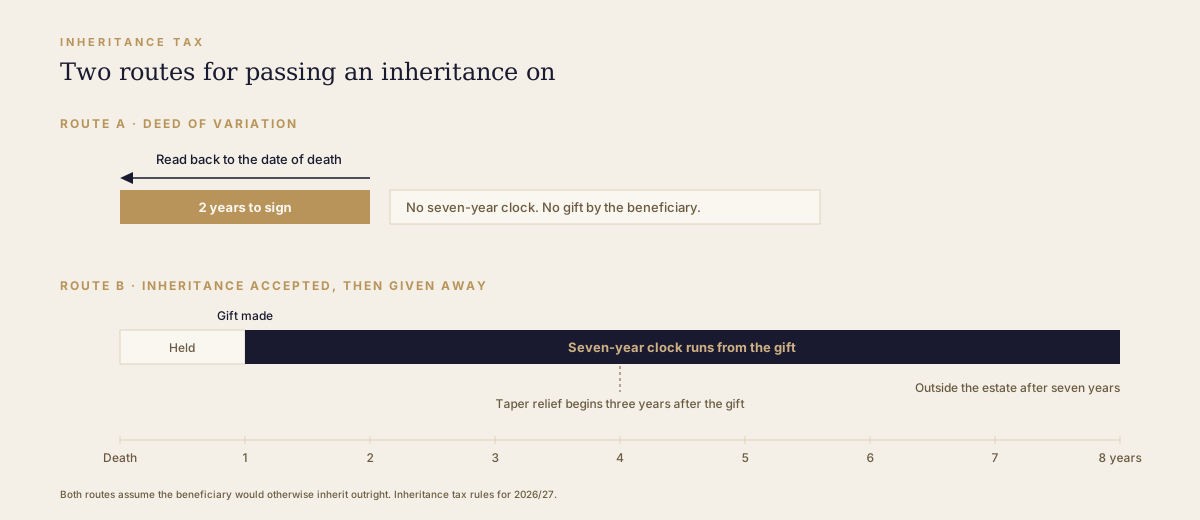
A deed of variation is a written instrument by which a beneficiary of an estate redirects all or part of their inheritance to a different person, trust, or charity. You have two years from the date of death to redirect an inheritance, and inheritance tax then treats it as the deceased’s own gift. It is the one piece of estate planning that survives the death it plans around, which is why executors reach for it when a will has aged badly. The rewrite reaches inheritance tax and capital gains tax and stops there, so it changes nothing for income tax, means-tested benefits, or care fee assessments.
A deed of variation lets the people who inherit an estate change where that inheritance goes, and have the change treated for tax as though the person who died had written it into their will. It runs for two years from the date of death, it covers estates that pass under the intestacy rules as well as those with a will, and it is one of the very few pieces of estate planning that can still be done after the person it concerns has died. All figures in this article reflect the 2026/27 tax year.
How does a deed of variation work?
A beneficiary signs a written instrument, within two years of the death, redirecting part or all of their inheritance to someone else. Where the document states that section 142 of the Inheritance Tax Act 1984 applies, inheritance tax treats the redirection as a gift made by the deceased rather than by the beneficiary.
Contents
- What is a deed of variation?
- How does a deed of variation work?
- What conditions must a deed of variation meet?
- What can a deed of variation achieve?
- Why does redirecting an inheritance not start a seven-year clock?
- What a deed of variation cannot do
- How do I make a deed of variation?
- Is a deed of variation worth it?
What is a deed of variation?
A deed of variation is a written instrument by which someone who inherits from an estate redirects all or part of what they receive to a different person, trust, or charity. HMRC uses the term instrument of variation, and its own guidance on changing a will after a death confirms that no particular form is required: a letter signed by the right people, containing the right wording, does the job as well as a formal deed prepared by a solicitor.
The name misleads in two ways. It does not have to be a deed, and it does not vary the will. The will stands exactly as written; what changes is where a beneficiary’s share ends up once the estate reaches them. That distinction matters when an estate passes under the intestacy rules instead, because there is no will to vary and the mechanism still works. Someone facing the fixed statutory shares that apply when there is no will can redirect their entitlement in the same way.
A variation is also not a disclaimer. Disclaiming means refusing an inheritance outright, after which it falls where the will or the intestacy rules say it should go next, and the person disclaiming has no say in that destination. A variation names the destination. That control is the whole point of it.
Risk warning
HM Revenue and Customs practice and the law relating to taxation are complex and subject to individual circumstances and changes which cannot be foreseen.
How does a deed of variation work?
It works by changing who the tax treats as the giver. Section 142 of the Inheritance Tax Act 1984 provides that where a beneficiary redirects property from a deceased person’s estate by an instrument in writing within two years of the death, inheritance tax applies as though the deceased had made that disposition themselves.
Practitioners call this reading back, and HMRC’s inheritance tax manual sets out the same effect in its guidance on what counts as a variation: the redirection of the property is treated as having been made by the deceased, so it is not a transfer of value by the beneficiary who gave it up. The consequence is the part people underestimate. The beneficiary never made a gift, so nothing enters or leaves their own estate, and nothing has to survive any period of time to be effective.
A separate provision does the equivalent job for capital gains tax, treating the new recipient as having acquired the asset at its value at the date of death rather than from the original beneficiary. That matters when the thing being redirected is a house or a share portfolio rather than cash, because it prevents a disposal at market value on the way through.
Risk warnings
The value of investments and any income from them can fall as well as rise. You may not get back the full amount invested.
The taxation of the investment is dependent on the individual circumstance of each investor, and may be subject to change in the future.
What conditions must a deed of variation meet?
Five conditions have to be satisfied, and missing any one of them costs the read-back rather than the redirection. The property still moves; it simply moves as an ordinary lifetime gift by the beneficiary, with all the consequences that follow.
- It must be in writing and signed within two years of the death. The clock runs from the date of death, not from the grant of probate, and there is no extension for an estate that takes a long time to administer.
- Everyone whose share is reduced must sign. A beneficiary who is unaffected does not need to be involved. Anyone under 18, unborn, or without capacity cannot consent at all, and their interest can only be varied with the court’s approval.
- It must contain a statement of intent. The instrument has to say that section 142 is intended to apply, with a parallel statement where the capital gains tax treatment is also wanted. Without it, the document is a gift with a tidy heading.
- No consideration may pass. A beneficiary cannot be paid, in money or anything else, for agreeing to redirect their share. Beneficiaries varying in each other’s favour within the same arrangement is permitted.
- The executors must sign, and HMRC must be told, where more tax is due. If the variation increases the inheritance tax on the estate, the personal representatives sign as well and a copy must reach HMRC within six months.
One further limit sits outside the statute. HMRC does not accept a second variation of property that has already been redirected once, so the first instrument is the only opportunity to get the destination right. Families sometimes treat the two-year window as a comfortable amount of time to think. It is comfortable for deciding, not for redeciding.
What can a deed of variation achieve?
Four uses account for most variations, and all four turn on the same read-back rule doing something that a gift by the beneficiary could not.
What families most often use a deed of variation for
| Use | What the variation changes |
|---|---|
| Passing an inheritance down a generation | Goes straight to children or grandchildren, bypassing the beneficiary’s estate |
| Restoring the residence nil-rate band | A home redirected to direct descendants qualifies for the band the will forfeited |
| Reaching the 36% charitable rate | A legacy topped up to 10% of the baseline amount cuts the rate on the rest |
| Correcting an intestate or outdated estate | Value moves to the people the deceased would now have chosen |
The residence nil-rate band case is the one that produces the largest numbers for the least effort, because the band is lost on a technicality rather than on value. It is only available where a home passes to direct descendants, so a will leaving the house to a sibling, a nephew, or a friend forfeits a band worth up to £175,000 for 2026/27 while the rest of the estate is unaffected. A variation redirecting the property to children is read back to the death, and the band is recovered. The conditions attached to the nil-rate band and the residence nil-rate band are worth checking against the will before anything else in an estate of this size.
How redirecting a home to children restores a lost residence nil-rate band
Ruth, 81, a widow whose will leaves her £480,000 home to her nephew and the rest to her two children.
| Input | Value |
|---|---|
| Total estate | £1,150,000 |
| Nil-rate bands available (hers and her late husband's) | £650,000 |
| Residence nil-rate bands available if the home is closely inherited | £350,000 |
- As written: a nephew is not a direct descendant, so no residence nil-rate band applies. Taxable estate £1,150,000 - £650,000 = £500,000, taxed at 40% = £200,000
- Varied so the home passes to her children: taxable estate £1,150,000 - £650,000 - £350,000 = £150,000, taxed at 40% = £60,000
Result: The variation cuts the inheritance tax bill from £200,000 to £60,000, a difference of £140,000 on an estate whose value has not changed at all.
The charitable route works on the rate rather than the threshold. Where at least 10% of the estate’s baseline amount passes to charity, the rate on the remainder falls from 40% to 36% for 2026/27, and a variation can top a modest existing legacy up to the qualifying level after the death. The arithmetic behind how inheritance tax is calculated shows how narrow the net cost to the family can be once the rate reduction is set against the larger gift.
A variation can also redirect an inheritance into a trust rather than to an individual, which is how families deal with a beneficiary who is young, vulnerable, or in the middle of a divorce. Read back to the death, the trust is treated as created by the deceased for inheritance tax, so it uses the deceased’s nil-rate band instead of the beneficiary’s. The ongoing charges that apply to a discretionary trust still apply, and the income tax position is different again, which is covered below.
Why does redirecting an inheritance not start a seven-year clock?
Because the beneficiary never makes a gift. The read-back means the property moves from the deceased to its final destination in a single step, so there is no transfer of value by the person who stepped aside and nothing that has to survive seven years to escape their estate.
Does a deed of variation count as a gift for the seven year rule?
No. Because inheritance tax reads the redirection back to the deceased, the beneficiary giving up the inheritance makes no transfer of their own, so no potentially exempt transfer arises and no seven-year survival period applies. Accepting the inheritance first and giving it away afterwards does start that clock.
The alternative route looks similar and behaves entirely differently. A beneficiary who takes the money and then gives it away has made a potentially exempt transfer: a lifetime gift that leaves their estate free of inheritance tax only if they survive seven years from the date of the gift. Die inside that period and the gift is brought back into the calculation, with taper relief reducing the charge only from the third year onwards. The mechanics of the seven year rule apply in full to that route and not at all to a variation.
Alan, 62, inheriting £300,000 from his mother
Alan inherits £300,000 under his mother’s will. He and his wife already have an estate of around £1.4 million, and earlier gifts have used his nil-rate band, so anything added to his estate is exposed to inheritance tax at 40% for 2026/27. He wants the money to reach his two adult children.
If he accepts the inheritance and gifts it to them, the £300,000 is a potentially exempt transfer. Were he to die four years later, taper relief at that point reduces the charge by 40%, leaving £72,000 of inheritance tax on a gift he made in full four years earlier.
If he signs a variation within two years redirecting his entitlement to his children, the £300,000 passes from his mother’s estate directly to them. It never enters his estate, no seven-year period runs, and the same four-year death produces no charge on the £300,000 at all.
The contrast is not a matter of degree. One route creates a seven-year exposure on the full amount and the other creates none, and the only difference between them is the order of two events and a paragraph of drafting.
What a deed of variation cannot do
The read-back is a rule about two taxes, and people routinely assume it reaches further than it does.
Income tax is the first and largest gap. HMRC’s guidance on deeds of variation in the trusts manual is explicit that there is no equivalent provision making a variation retrospective for income tax. Where a variation settles property on trust, the settlor is the beneficiary who gave up the inheritance, not the deceased. If that trust can benefit them, their spouse, or their own minor children, its income is taxed on them personally, which quietly undoes part of what the arrangement was for.
A variation rewrites the tax history of an estate and nothing else. The money genuinely moves, the family arrangement is real, and every rule outside inheritance tax and capital gains tax carries on treating the beneficiary as the person who gave it away.
Means-tested assessments work on that same principle. A local authority assessing a contribution to care costs, or the Department for Work and Pensions assessing entitlement to a means-tested benefit, can treat a beneficiary who redirects an inheritance as having deliberately deprived themselves of capital, and assess them as though they still held it.
Two further limits are worth knowing before an estate is planned around a variation. The first is pensions. Death benefits paid at the scheme trustees’ discretion are not disposed of by the will or by the intestacy rules, so no beneficiary has an entitlement under the estate to redirect: who receives the money is the trustees’ decision, guided by the member’s expression of wish.
The April 2027 inheritance tax change to pensions does not change that, though it is easy to read it as though it does. From 6 April 2027 most unused pension funds are counted in the taxable estate, which changes what the estate is taxed on rather than who holds the power to give the money away. An estate can therefore face a bill on pension money that no variation can move, and the document deciding its destination is still the expression of wish, updated in the member’s lifetime.
The second limit is that a variation cannot repair a problem created during the deceased’s lifetime. An asset caught by the rules on a gift with reservation of benefit is already in the estate on death, and redirecting it afterwards does not take it out.
Risk warnings
The value of pensions and any income from them can fall as well as rise. You may not get back the full amount invested.
Levels and bases of, and reliefs from, taxation are subject to change and their value will depend upon personal circumstances. Taxation and pension legislation may change in the future.
A pension is a long-term investment and the value is not guaranteed. Any advice or considerations are personal to each individual’s circumstances.
How do I make a deed of variation?
Start by establishing what the beneficiary is actually entitled to, because a variation can only redirect an entitlement that exists. That means the estate’s assets and debts need to be settled first, which in most cases means waiting for the picture that emerges during the probate process rather than acting on the will alone.
- Confirm the entitlement. Work out what each beneficiary receives under the will or the intestacy rules, and which specific assets or sums the variation will move.
- Agree the destination with everyone affected. Identify every beneficiary whose share reduces, because each of them signs. Where a minor or unborn beneficiary is involved, allow for a court application.
- Have it drafted with the statement of intent. The instrument identifies the property, names the new destination, and states that section 142 is intended to apply, with the capital gains tax statement added where an asset rather than cash is moving.
- Sign within two years of the death. The executors sign as well if the variation increases the inheritance tax due on the estate.
- Notify HMRC where more tax is payable. A copy must reach HMRC within six months of the variation. Where the tax is unchanged or reduced, no notification is needed.
The drafting is not a form-filling exercise, and this is one of the few places in estate work where the cost of a solicitor is trivially small against what is at stake. A missing statement of intent turns the whole arrangement into an ordinary gift with a seven-year clock attached, and nobody discovers the error until a death makes it expensive.
Is a deed of variation worth it?
It is worth it whenever the will or the intestacy rules produce a materially worse outcome than the beneficiaries would now choose, and the estate is large enough that the difference outweighs a few hundred pounds of legal cost. On the numbers above, restoring a residence nil-rate band changed a tax bill by £140,000 for a document signed in an afternoon. Very little else in estate planning has that ratio.
Redirected outright, though, a variation gives away certainty in exchange for a tax result. A beneficiary who sends an inheritance straight to their children has parted with money they may later need, and nothing in the read-back offers a route back if their circumstances change. That is a real cost for someone in their fifties or sixties whose own retirement is not yet fully funded.
There is a middle route, and it is the main reason this decision deserves advice rather than a template. A variation can redirect the inheritance into a discretionary trust that names the original beneficiary among the people the trustees may pay, alongside their children. Because the read-back makes the deceased the settlor for inheritance tax, the money stays outside the beneficiary’s estate even though the trustees can still pay them from it, which an outright gift by them could never achieve. Two rules normally stop someone giving property away and keeping the benefit of it, and neither of them reaches a variation. The gift with reservation rules need a gift, and the beneficiary has not made one. The pre-owned assets charge, which exists to catch what the reservation rules miss, is excluded by Schedule 15 to the Finance Act 2004 where the redirection is of an interest in a deceased person’s estate.
The costs sit elsewhere, and they are worth pricing before anyone signs. The trust falls into the relevant property regime, which brings a charge of up to 6% at each ten-year anniversary and a proportionate exit charge on the way out, also capped at 6% for 2026/27. Income tax runs the opposite way to inheritance tax here: the settlor is the beneficiary rather than the deceased, so income from a trust they can benefit from is taxed on them personally. And where care fees are a realistic prospect, the deprivation of capital rules above apply to this route as much as to an outright redirection.
All of which makes the estate’s tax bill the wrong place to start. The beneficiary has three destinations to choose between, keeping the inheritance, giving it away outright, or settling it where the trustees hold it, and only their own position decides which one holds up. Lifetime cashflow modelling is usually the quickest way to establish which the numbers allow.
The mistake to avoid is treating a variation as a substitute for having a current will. It only works because everyone who loses out agrees to it, and agreement is exactly what an unhappy family cannot supply. A will that says what you want it to say costs less, binds everyone, and does not depend on the goodwill of the people it disappoints. Where a variation earns its place is in the situations nobody could have drafted for: a beneficiary who no longer needs the money, an estate that turned out larger than expected, or a set of rules that changed after the will was signed. Reviewing an estate as part of a wider inheritance tax planning conversation is what surfaces those situations early enough for the two-year window to still be open.
Risk warning
The Financial Conduct Authority (FCA) does not regulate Inheritance Tax Planning or Trust Advice.
Frequently asked questions
What is a deed of variation?
A deed of variation is a written instrument that redirects all or part of an inheritance from the person entitled to it to someone else. HMRC calls it an instrument of variation. It can redirect a gift made by a will or an entitlement arising under the intestacy rules, and the new recipient does not have to be named in the will.
How long do you have to make a deed of variation?
Two years from the date of death. A variation signed after that deadline is still legally effective as a gift, but it loses the inheritance tax read-back, so the person giving up the inheritance is treated as making the gift themselves. Where the variation increases the inheritance tax due, HMRC must be told within six months of the variation.
Does everyone have to agree to a deed of variation?
Every beneficiary whose entitlement is reduced must sign. Beneficiaries who are unaffected do not need to, and there is no requirement for the executors to approve it unless extra inheritance tax becomes payable. A beneficiary who is under 18, unborn, or lacks capacity cannot consent, and their interest can only be varied with the approval of the court.
Can you use a deed of variation if there is no will?
Yes. The rules apply to an entitlement under the intestacy rules exactly as they apply to a gift under a will. This makes a variation particularly useful where intestacy has produced an outcome nobody wanted, such as an estate splitting between a surviving spouse and adult children in fixed statutory shares.
Does a deed of variation help with care fees or means-tested benefits?
No. The read-back is a rule for inheritance tax and capital gains tax only. A local authority assessing care fees, or the Department for Work and Pensions assessing a means-tested benefit, can treat a beneficiary who redirects an inheritance as having deliberately deprived themselves of capital and assess them as though they still held it.
Can the same inheritance be varied twice?
No. HMRC does not accept a second variation of property that has already been redirected once, so the first instrument is the only chance to get the destination right. This is the strongest argument for taking time over the drafting rather than signing quickly, even though the two-year window can feel generous.
Is a deed of variation worth it?
It is worth most where the inheritance would land on a beneficiary whose own estate already faces inheritance tax, because the same money is then taxed a second time on their death, at 40% for 2026/27, and a variation is the only way to stop it arriving. Redirecting it into a discretionary trust that includes the beneficiary among those the trustees may pay keeps it out of their estate without shutting the door on it, at the cost of the trust's own ten-year and exit charges. It buys nothing on a small estate comfortably inside the nil-rate band.