Agricultural property relief is a UK inheritance tax relief that reduces the agricultural value of qualifying farmland, farm buildings, and farmhouses by either 100% or 50%. Qualifying farmland can pass to the next generation with up to 100% of its agricultural value removed from inheritance tax. The relief matters most for working farms, where it can be the difference between keeping the land and selling it to settle a 40% charge. From 6 April 2026, full 100% relief is capped at the first £2.5 million of combined agricultural and business property, with 50% relief above that.
Agricultural property relief reduces the agricultural value of qualifying farmland, farm buildings, and farmhouses for inheritance tax, by either 100% or 50%, so that a working farm can often pass to the next generation without being sold to settle a 40% tax bill. From 6 April 2026 the relief is capped for the first time: full 100% relief now applies only to the first £2.5 million of combined agricultural and business property, with anything above that relieved at 50%. Agricultural property relief remains one of the most valuable reliefs in the inheritance tax system, but the 2026 reform changes how farming families plan around it. All thresholds and rates in this article reflect the 2026/27 tax year.
How long must you own farmland to qualify for agricultural property relief?
You must generally have owned and occupied the farmland for agricultural purposes for at least two years before death. Where the land is let to someone else who farms it, the ownership period rises to seven years. Buying farmland shortly before death usually means no agricultural property relief at all.
Contents
- What is agricultural property relief?
- How does agricultural property relief work?
- What qualifies for agricultural property relief?
- When do you get 100% or 50% relief?
- What is changing in 2026?
- How does the allowance work?
- How it fits the rest of your estate
- Is it worth relying on?
What is agricultural property relief?
Agricultural property relief is an inheritance tax relief that reduces the agricultural value of qualifying farmland by 100% or 50%. It is the mechanism that allows a family farm to pass down without being broken up to pay a 40% inheritance tax charge. The relief is often shortened to APR, and it sits alongside business property relief, which does the same job for trading businesses.
The relief works on the agricultural value of the land, not on its full market price. Agricultural value is the worth of the land on the assumption it can only ever be used for agriculture, ignoring any development or hope value attached to the same fields. A farm with planning potential can therefore be worth far more on the open market than its agricultural value, and agricultural property relief only ever covers the lower, farming-only figure.
What the relief does not do is exempt the owner. It exempts qualifying agricultural property. If a farmer sells the land for cash and dies holding the proceeds, the relief is lost, because cash is not agricultural property. The relief follows the farm, which is the single most important thing to understand about it.
How does agricultural property relief work?
Agricultural property relief works by reducing the agricultural value of qualifying land before the inheritance tax calculation, rather than reducing the final tax bill. The rate of reduction is either 100% or 50%, and the land must usually have been owned and farmed for long enough to meet the occupation tests.
The two rates decide how much value escapes tax. Land attracting 100% relief contributes nothing to the taxable estate. Land attracting 50% relief contributes half its agricultural value, which is then taxed at the inheritance tax rate of 40% for 2026/27, producing an effective rate of 20% on that land. The relief is not optional. Where the conditions are met the reduction applies as a matter of law rather than at HMRC’s discretion, but the estate still has to set it out on the inheritance tax return for HMRC to give it. It applies both on death and to certain lifetime gifts.
The relief comes off before the nil-rate bands are applied to whatever remains. Because agricultural property is relieved first, a well-relieved farm can leave the ordinary nil-rate bands free to shelter the farmhouse and other assets, which is why the relief is rarely planned in isolation.
Risk warning
HM Revenue and Customs practice and the law relating to taxation are complex and subject to individual circumstances and changes which cannot be foreseen.
What qualifies for agricultural property relief?
Qualifying agricultural property is land or pasture used to grow crops or rear animals, together with the farm buildings, farm cottages, and farmhouses that go with it. The land must be in the UK. Property in the Channel Islands, the Isle of Man, and the European Economic Area qualified until 5 April 2024, but relief was restricted to UK land for transfers on or after 6 April 2024, so an estate settled now gets nothing for farmland held abroad. The land must also have been occupied for agriculture throughout the required ownership period, as GOV.UK’s guidance on agricultural relief sets out.
The farmhouse is the most contested part. A farmhouse qualifies only if it is of a character appropriate to the land. A farmhouse is of a character appropriate when its size and value are proportionate to the surrounding farmland and farming activity. A modest house at the centre of a genuine working farm usually qualifies; a large country house with a few token acres attached usually does not. HMRC examines this test closely, weighing the house against the scale and type of the farming operation.
Two further points widen and narrow the relief. From 6 April 2025, land managed under an environmental agreement with bodies such as Natural England can also qualify, recognising farmers who take land out of production for habitat or carbon schemes. Against that, certain assets never attract agricultural property relief: farm machinery, livestock, milk quota, and the development value of land all sit outside it, though some may instead qualify for business property relief.
When do you get 100% or 50% agricultural property relief?
You get 100% relief where you farm the land yourself, where it is let on a short-term grazing licence or a Farm Business Tenancy, or where you could regain vacant possession within 24 months; most other let land attracts 50% relief. The distinction usually turns on how the land is occupied and, for let land, on when the tenancy was granted.
The dividing line is older tenancies. Land let on a tenancy granted before 1 September 1995 typically gives the landowner only 50% relief, because the tenant has long-term security and the owner cannot easily recover the land. Land farmed in hand, or let on a tenancy created since then, generally reaches 100%. The ownership test runs alongside this: two years if you occupy and farm the land yourself, or seven years if someone else farms it under a tenancy.
Two farms, one tenancy date
Robert, 76, farms his 200 acres himself. Margaret, 78, owns similar neighbouring land but let it to a tenant farmer on a tenancy granted in 1991. Each farm has an agricultural value of £900,000, and neither owns any other relievable property.
On Robert’s death the land is farmed in hand, so it qualifies for 100% relief and no inheritance tax falls on it. On Margaret’s death the pre-1995 tenancy limits her to 50% relief, so £450,000 of the agricultural value stays in her estate.
At 40% for 2026/27, that £450,000 carries £180,000 of inheritance tax. Two farms of identical value, both inside the allowance, yet the date the tenancy was signed decades earlier produces a £180,000 difference in the bill.
What is changing for agricultural property relief in 2026?
From 6 April 2026, agricultural property relief is capped for the first time. Full 100% relief now applies only to the first £2.5 million of combined agricultural and business property per person, with value above that relieved at 50%. Before this reform there was no upper limit on 100% relief, so an unlimited farming estate could pass entirely free of inheritance tax.
How much agricultural property relief can you get from April 2026?
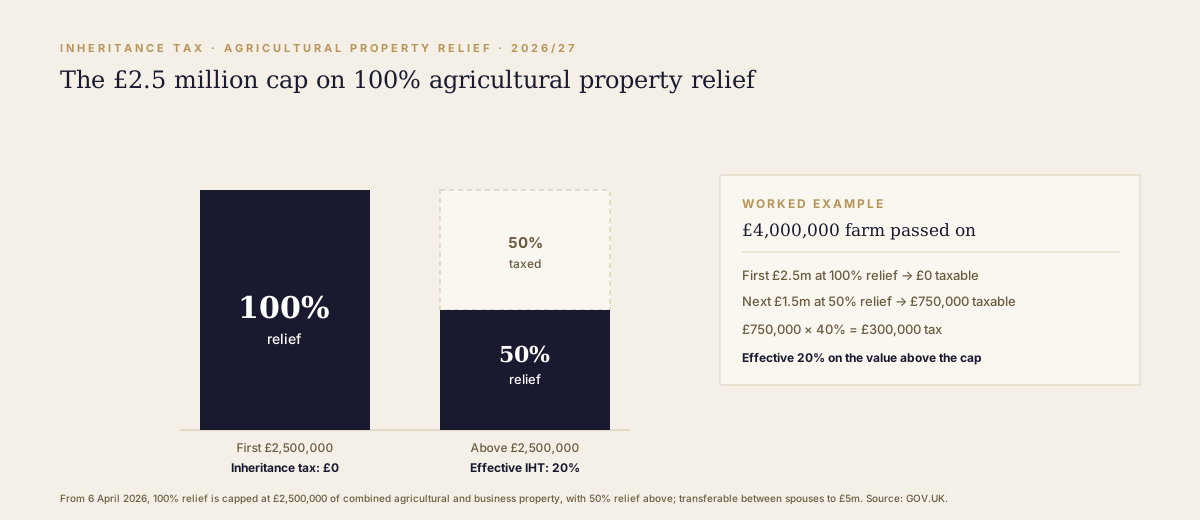
From 6 April 2026, 100% relief is limited to the first £2.5 million of combined agricultural and business property per person. Value above the allowance receives 50% relief, an effective inheritance tax rate of 20%. The allowance can pass to a surviving spouse, allowing couples up to £5 million at 100% relief.
The headline figure has moved once already. The 2024 Budget proposed a £1 million allowance, but the government confirmed in December 2025 that the threshold would rise to £2.5 million and would be transferable between spouses, a significant softening of the original plan. The allowance is a combined pot shared with business property relief, so a mixed farming and trading estate cannot claim it twice.
An anti-forestalling rule also applies to gifts of relievable property made on or after 30 October 2024. Where the donor dies on or after 6 April 2026 and within seven years of the gift, the failed gift is tested against the new capped relief rather than the old uncapped 100% relief, as the government’s reform documentation confirms. Surviving seven years from a gift still takes the land outside the estate, which ties planning directly back to the seven year gifting rule.
A second condition on gifts catches more families than the cap does. Where a gift of farmland fails because the donor dies within seven years, agricultural property relief reaches that failed gift only if the person who received it still owns the land at the date of death and it has been occupied for agriculture throughout the intervening period. A child who sells the fields, or lets them drop out of agricultural use, loses the relief on the gift altogether, and the full value comes back into the death calculation with nothing taken off it.
How does the agricultural property relief allowance work?
The £2.5 million allowance is a single combined pot covering both agricultural and business property, applied per person and refreshing every seven years for lifetime transfers. It is not £2.5 million for each type of asset: a farmer with £2 million of farmland and £1 million of trading business has £3 million of relievable assets but only £2.5 million of 100% relief, with the final £500,000 relieved at 50%.
Property that only ever attracted 50% relief sits outside the allowance completely. Land let on a pre-1995 tenancy keeps its 50% relief with no upper limit, and it uses none of the allowance. A farmer with £2.5 million farmed in hand and £900,000 let on an old tenancy therefore gets 100% relief on the first and 50% on the second, rather than the tenanted land pushing the in-hand land over the cap. The allowance rations 100% relief and nothing else.
For lifetime gifts the allowance behaves like the nil-rate band. Each transfer is measured against £2.5 million less whatever relief was already used on chargeable transfers in the previous seven years, so a gift of £2.5 million of farmland absorbs the whole allowance, and a further gift made more than seven years later starts again from a full allowance. Die inside that seven-year window and the two are cumulated, with the allowance set against the earliest transfer first.
How the £2.5 million cap applies to a £4 million farm from April 2026
Helen, 78, owns and farms land valued at £4 million on her death in 2026.
| Input | Value |
|---|---|
| Agricultural value of farm | £4,000,000 |
| 100% relief allowance | £2,500,000 |
| Inheritance tax rate | 40% for 2026/27 |
- First £2,500,000 receives 100% relief, leaving nothing taxable.
- Remaining £1,500,000 receives 50% relief, leaving £750,000 taxable.
- Inheritance tax at 40% on £750,000 is £300,000.
Result: Helen’s estate pays £300,000 of inheritance tax on a £4 million farm, an effective 20% on the value above the allowance.
For couples, transferability is the planning headline. Any unused allowance passes to a surviving spouse or civil partner, so a married couple can structure their affairs to pass up to £5 million of qualifying assets at 100% relief across both deaths. Where the first spouse died before 6 April 2026, the survivor is treated as inheriting a full £2.5 million allowance, even though the rules did not exist at the time of that first death.
One practical concession softens the change. Inheritance tax attributable to agricultural and business property can be paid in ten equal annual instalments, and from April 2026 those instalments are interest-free, which matters because farmland is rarely something a family can sell quickly to raise cash.
How does agricultural property relief fit with the rest of your estate?
Agricultural property relief should be treated as one moving part of an estate plan, not a guarantee that a farm passes tax-free. The relief is fragile in ways that catch families out: it depends on the land still qualifying at the moment of death, and that can be lost if the farm is sold, if farming stops, or if the value shifts from agricultural use toward development.
Agricultural property relief protects the land a family farms, not the wealth a family holds. The moment farmland is sold or set aside for development, the relief a family was counting on can quietly fall away.
Development value shows where the relief stops, and it does not wait for anyone to decide to sell. Inheritance tax values every asset at the price it would fetch if sold on the open market at the date of death, so land a developer would pay over the odds for is valued at that price whether or not the family has any intention of accepting it. Wanting to keep the farm does not keep the hope value off the return. The higher figure is the one declared, with agricultural property relief deducted from it; the agricultural value is not what goes in the box.
How development value is taxed when agricultural property relief only covers agricultural value
James, 74, owns 400 acres on the edge of a market town, let to a tenant farmer on a Farm Business Tenancy since 2011. A developer would pay £9,400,000 for the land; its agricultural value is £4,850,000.
| Input | Value |
|---|---|
| Open market value of the land | £9,400,000 |
| Agricultural value | £4,850,000 |
| Development and hope value | £4,550,000 |
| 100% relief allowance | £2,500,000 |
- The estate declares the full £9,400,000 open market value, not the agricultural value.
- Agricultural property relief applies to the £4,850,000 agricultural value alone.
- The first £2,500,000 of that gets 100% relief; the remaining £2,350,000 gets 50%, or £1,175,000.
- Total relief is £3,675,000, leaving £5,725,000 in the taxable estate.
- Inheritance tax at 40% on £5,725,000 is £2,290,000.
Result: James’s estate faces £2,290,000 before any nil-rate bands. Of the £5,725,000 left in the estate, £4,550,000 is development value that agricultural property relief never reaches, and £1,175,000 is the unrelieved half of the agricultural value sitting above the allowance.
How the land is occupied decides whether anything else reaches that gap. Where an owner farms in hand, the land is an asset of a trading business, so business property relief can cover the excess of market value over agricultural value that agricultural property relief cannot. Let the same land to a tenant farmer and the letting is an investment business, which business property relief does not touch. On James’s figures, farming in hand rather than letting would have taken the bill from £2,290,000 to £1,380,000, because the £4,550,000 of development value would have picked up 50% relief instead of none. Since April 2026 both reliefs draw on the same £2.5 million allowance, so that excess is relieved at 50% rather than escaping tax altogether.
The relief also interacts with the residence nil-rate band in a way that surprises landowners. That band, worth up to £175,000 per person, tapers away once an estate passes £2 million for 2026/27, and the threshold is measured before agricultural and business reliefs are deducted, as GOV.UK’s residence nil-rate band guidance confirms. A fully relieved £1.5 million farm still counts toward it, so a farming family can lose part or all of their residence nil-rate band even though the land itself pays no inheritance tax. That taper threshold is frozen until April 2031.
Where agricultural property relief covers only part of the value, gifting can do the rest. Regular gifts funded from farm profits can fall under the normal expenditure out of income exemption, moving value out of the estate without waiting seven years. The 2026 changes also have to be read next to the pension changes coming in April 2027, which bring most unused pension funds into the inheritance tax net, so a farmer who expected both the land and the pension to pass largely free now faces a cap on one and a new charge on the other. Modelling these together is exactly the work of inheritance tax planning rather than reading each asset in isolation.
Risk warnings
Pensions
The value of pensions and any income from them can fall as well as rise. You may not get back the full amount invested.
Levels and bases of, and reliefs from, taxation are subject to change and their value will depend upon personal circumstances. Taxation and pension legislation may change in the future.
A pension is a long-term investment and the value is not guaranteed. Any advice or considerations are personal to each individual’s circumstances.
A pension is a long-term investment, the value of your investment and the income from it may go down as well as up. Your eventual income may depend upon the size of the fund at retirement, future interest rates and tax legislation.
Tax, trusts and estate planning
The Financial Conduct Authority (FCA) does not regulate Inheritance Tax Planning or Trust Advice.
Is agricultural property relief worth relying on?
Agricultural property relief is worth using but not worth relying on as the whole plan. For a genuine working farm held for the long term, it remains one of the most powerful reliefs available, capable of removing millions of pounds of agricultural value from a taxable estate. The trade-off is fragility and the new ceiling: the relief can vanish if the land stops qualifying, and from 6 April 2026 larger farms can no longer assume the entire estate passes at 100%.
The honest position is that the relief rewards land that keeps being farmed and offers far less to land held for its development value. A family expecting to sell the farm for cash should not assume the relief will be there when it matters, because the proceeds will not qualify. A family intending to pass on a working farm has a valuable relief, provided they keep the qualifying conditions intact, use the spousal allowance, and plan for the value that now sits above the £2.5 million cap. Used as one element of a plan that also draws on the nil-rate bands, gifting, and interest-free instalments, agricultural property relief does real work. Treated as a reason not to plan at all, it is a risk.
Frequently asked questions
What is agricultural property relief?
Agricultural property relief is an inheritance tax relief that reduces the agricultural value of qualifying farmland, farm buildings, and farmhouses by 100% or 50%. It applies where the land has been owned and used for agriculture for long enough, and it sits alongside business property relief for trading assets.
How does agricultural property relief work?
Agricultural property relief reduces the agricultural value of qualifying land before inheritance tax is calculated, rather than cutting the tax bill directly. Land attracting 100% relief has its full agricultural value removed from the estate; land attracting 50% relief has half removed. The relief is claimed on the inheritance tax return.
Does agricultural property relief cover the farmhouse?
Yes, but only if the farmhouse is of a character appropriate to the land it serves. A house proportionate to a genuine working farm can qualify, while a large country house with token land attached usually cannot. Relief applies to the agricultural value of the farmhouse, which may be below its open-market value.
Can agricultural property relief be transferred between spouses?
Yes. From 6 April 2026, any unused part of the £2.5 million 100% relief allowance passes to a surviving spouse or civil partner. A couple can therefore shelter up to £5 million of qualifying agricultural and business property at 100% relief across both deaths.
How does agricultural property relief work alongside business property relief?
Agricultural property relief is applied first to the agricultural value of farmland, and business property relief can then cover qualifying non-agricultural value, such as a diversified trading activity. From 6 April 2026 both reliefs share a single £2.5 million 100% allowance, so they are no longer counted separately.
Does agricultural property relief cover a farm's development value?
No. Agricultural property relief covers only the agricultural value of land, meaning its worth for farming alone. Any development or hope value above that figure is not relieved by agricultural property relief, although business property relief may apply if the land is part of a qualifying trading business.
Is agricultural property relief worth relying on for inheritance tax planning?
It is valuable but should not be the entire plan. Agricultural property relief depends on the land still qualifying at death, which selling, ceasing to farm, or development can break. The 2026 cap also means larger farms can no longer assume the whole estate passes at 100%, so the relief works best within a wider plan.