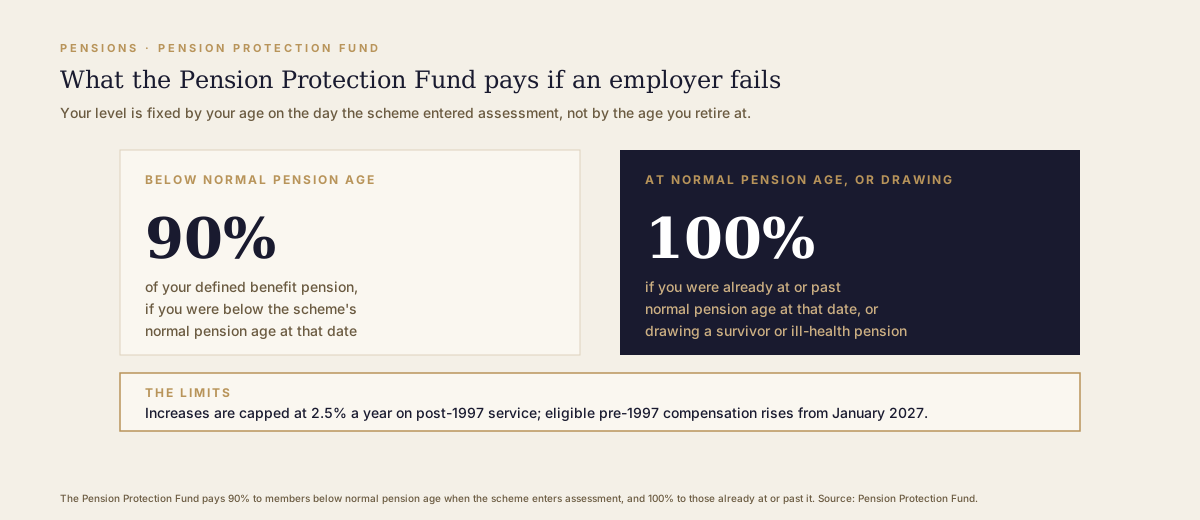
The Pension Protection Fund is a statutory UK lifeboat fund that pays compensation to members of defined benefit pension schemes whose sponsoring employer has become insolvent and cannot meet its pension promises. If your employer goes bust, the PPF pays 90% to members who were below their scheme’s normal pension age on the day it entered assessment, and 100% to those already at or past it. That date settles which level you get for life, whatever age you later retire at. Compensation is still short of the full promise: increases are capped at 2.5% a year, and pre-1997 compensation went unindexed entirely until eligible members start receiving increases from 1 January 2027.
The Pension Protection Fund is the reason a final salary pension is rarely lost when the company behind it goes under. It is a statutory fund that takes over defined benefit schemes whose employer has become insolvent and pays members compensation for the pension they were promised. Which level you get is settled by your age on the day your employer became insolvent and the scheme entered PPF assessment: members already at or past their scheme’s normal pension age on that date receive 100% of it, and everyone below it receives 90%. The rules described in this article reflect the PPF position in force during the 2026/27 tax year. Understanding what the fund does, and what it does not replace, matters most when you are weighing whether to leave a scheme at all.
When does the Pension Protection Fund step in?
The Pension Protection Fund steps in when the employer behind a defined benefit scheme becomes insolvent and the scheme cannot afford to buy out members’ benefits in full. An assessment period, usually lasting 18 months to two years, confirms eligibility before the PPF formally takes the scheme over and begins paying members.
Contents
- What is the Pension Protection Fund?
- How does the Pension Protection Fund work?
- How much compensation does the PPF pay?
- Ill-health pensions, survivors and children
- How do PPF payments increase each year?
- How is the Pension Protection Fund funded?
- What does the PPF mean for a defined benefit transfer?
- Should you worry about your defined benefit pension?
What is the Pension Protection Fund?
The Pension Protection Fund is a statutory compensation fund that protects members of defined benefit pension schemes when the sponsoring employer fails. It was created by the Pensions Act 2004 and began operating in April 2005, after a series of company collapses left workers with little or nothing from schemes they had paid into for decades. It covers final salary and career average schemes across the private sector in the UK.
The fund matters because of what a defined benefit promise actually is. Your employer, not you, carries the risk of paying a set income for life, and that promise is only as solid as the company standing behind it. The PPF converts that corporate promise into a statutory one. If the employer disappears, the obligation does not vanish with it.
It is worth being precise about one thing the PPF is not. It does not protect defined contribution pensions, where you own an invested pot rather than holding an employer promise. Those savings are covered, if at all, by the Financial Services Compensation Scheme. The PPF exists specifically for the kind of guaranteed income a final salary scheme provides.
Risk warning
The Financial Services Compensation Scheme (FSCS) protects eligible deposits up to £120,000 per person, per banking licence.
How does the Pension Protection Fund work?
The PPF pays compensation, not a continuation of your original pension. That distinction drives everything else. When an employer becomes insolvent, the scheme enters an assessment period before anything is settled. During this phase the trustees of the failed scheme keep running it and keep paying members, while the PPF checks whether the scheme can afford to secure benefits with an insurer instead. This assessment stage typically lasts between 18 months and two years.
The test at the heart of assessment is funding. If the scheme has enough money to buy benefits at or above PPF compensation levels with an insurance company, it does so and never enters the fund. Only schemes that fall short are taken over. In effect, the PPF is the floor, and a better-funded scheme can land above it.
Once a scheme transfers in, the PPF becomes the payer for the rest of each member’s life. You stop being a member of your old scheme and become a member of the PPF, receiving compensation directly. Survivor benefits continue to a spouse or partner under the fund’s rules, though usually at half the member’s level.
How much compensation does the PPF pay?
The PPF pays one of two levels depending on your age when your scheme entered assessment. Members who had reached their scheme’s normal pension age at that date receive 100% of the pension they were getting or were due. Members below normal pension age receive 90%, paid from the date they reach that age.
That date is the part most often misread. Your level is fixed when the scheme enters assessment and does not move afterwards, so a deferred member who was 54 at that point is still on 90% when they retire at 65. Waiting until you reach normal pension age changes when compensation starts, not whether it is paid at 90% or 100%.
For years the 90% level was subject to the PPF compensation cap, which mainly hit higher earners and those who retired early. That cap is gone. In July 2021 the Court of Appeal ruled it unlawful on the grounds of age discrimination, and the PPF stopped applying it and paid arrears to affected members. A senior professional with a large scheme pension is now far better protected than the headline 90% once implied.
The 10% reduction for younger members is deliberate. It shares some of the cost of failure and discourages the idea that PPF entry is as good as the original scheme. The gap, plus the limits on future increases, is exactly why the compensation level is a floor rather than a full replacement.
Two members of the same failed scheme
Margaret, 66, had already retired and was drawing a £20,000 a year pension when her former employer collapsed. Because she was past the scheme’s normal pension age at the assessment date, the PPF pays her 100% of that income, so her £20,000 continues.
David, 54, is a deferred member of the same scheme with a £20,000 pension due at 65. He was below normal pension age on the assessment date, so his level is fixed at 90%: £18,000 a year from 65. Reaching 65 does not move him onto Margaret’s 100%.
The £2,000 gap is only the start. David’s increases are capped at 2.5% a year and any pre-1997 service may not rise at all, so across a 25-year retirement the real shortfall against the original promise is far wider than the headline 10% suggests.
The 90% rule is often misread as a 10% haircut and little else. The larger erosion is usually inflation: capped increases and, for older service, no increases at all, which compound across a long retirement into a materially smaller real income.
Ill-health pensions, survivors and children
Two groups sit outside the 90% rule completely. If you retired early on ill-health grounds, or you were already drawing a pension because someone else had died, the PPF pays 100% of what you were receiving, whatever your age when the employer failed. The 90% level catches only a member who was below normal pension age and whose pension was neither of those things.
What your own survivor receives is settled in two parts, one by your old scheme and one by the PPF. Whether anyone is eligible at all comes from the scheme’s rules, and the PPF does not create a survivor’s benefit where the scheme never promised one. What an eligible survivor is then paid comes from the PPF, which applies a flat 50% of your compensation rather than reproducing your scheme’s own survivor rate. A scheme that would have paid a widow two thirds is levelled down to 50%.
That 50% is measured against your compensation rather than against your original pension, which matters most for a member who was below normal pension age when the scheme entered assessment. Their compensation is the 90% figure, so the survivor receives 50% of that. Dying before normal pension age does not undo that reduction: it only fixes the date the amount is measured at, which is what the member had built up when they died.
The first of those two parts also decides who counts as a survivor, and that is where an unmarried couple can lose out. A surviving civil partner is safe, because the scheme’s rules only need to have provided for a civil partner or a spouse. An unmarried partner is not. The PPF calls them a relevant partner, meaning someone you live with as though you were married or civil partners but are not, and they qualify only where your scheme made provision to pay a survivor’s pension to an unmarried partner, whether as a right or at the trustees’ discretion. A scheme written for a married spouse and nobody else leaves the person you actually live with entitled to nothing, and the PPF applies your scheme’s eligibility rather than a wider standard of its own. It will confirm what your old rules allowed if you ask.
That makes one piece of housekeeping worth doing now. Nominate your beneficiary through the PPF’s member website: a nomination you once gave your old scheme does not carry across, and if you separated from a spouse without ever divorcing and have not nominated the partner you live with now, the compensation goes to the spouse.
Children are covered as well. Their share is measured against the member’s own compensation rather than against what the survivor receives, which is what makes the combinations add up the way they do.
| Who is being paid | Children’s share | Total paid |
|---|---|---|
| A partner and one child | 25% | 75% |
| A partner and two or more children | 50%, split equally | 100% |
| One child, no partner paid | 50% | 50% |
| Two or more children, no partner paid | 100%, split equally | 100% |
A partner and two children therefore take 100% of the member’s compensation between them, while a partner and one child take 75%. Every figure here is a share of the member’s compensation too, so the same 90% base applies. Children’s payments run until 18, or until 23 where the child stays in qualifying full-time education or cannot work full-time because of a disability.
One more thing matters if a death has already happened. A survivor’s claim is backdated to the date they became eligible, but no further than 5 years before they make it, so compensation left unclaimed for longer than that is lost rather than paid as arrears.
How do PPF payments increase each year?
PPF compensation rises each year, but not by as much as most scheme pensions promised. Compensation built up from pension you earned on or after 6 April 1997 increases in line with the Consumer Prices Index, capped at 2.5% a year. If CPI is negative, payments are held flat rather than cut. Increases are applied each January.
Do Pension Protection Fund payments rise with inflation?
Partly. PPF compensation from service after 5 April 1997 rises with CPI inflation, capped at 2.5% a year. Pre-1997 compensation received no increases at all until the Pension Schemes Act 2026, which allows rises of up to 2.5% a year where the original scheme rules required them. The first of those are payable from 1 January 2027.
Pre-1997 service has been the weak point. Compensation relating to pensionable service before 6 April 1997 received no inflation increases at all, which steadily eroded its real value across a long retirement. The Pension Schemes Act 2026 changes that. It lets the PPF pay increases of up to 2.5% a year on pre-1997 compensation, but only where the original scheme rules required such increases in the first place.
Which start date applies depends on what your original scheme promised. If its rules required increases across your pre-1997 pension, your first increase is due on 1 January 2027. If the only pre-1997 increases it promised were on the guaranteed minimum pension you built up after 1988, the slice of a contracted-out pension that had to at least match the state pension you gave up, you wait a year longer, until 1 January 2028.
Neither date is backdated. The increases lift your compensation from the point they start, and do not make up the ground inflation has already taken out of it.
In a high-inflation stretch like 2022 and 2023, the 2.5% cap bites hard. A scheme pension rising with full CPI would have climbed far faster than PPF compensation, which is one reason the fund is a genuine safety net rather than a like-for-like substitute.
How is the Pension Protection Fund funded?
The PPF is funded by the schemes it protects, not by the public purse. It can charge every eligible defined benefit scheme an annual pension protection levy, weighted so that weaker-funded schemes with a higher chance of failing contribute more. That levy, the assets the PPF inherits from schemes that fail, and the investment returns on its reserves are what pay for compensation.
It has become resilient enough to stop charging. The PPF confirmed a zero levy for conventional defined benefit schemes in 2026/27, the second consecutive year at zero, on the back of reserves well above the compensation it expects to pay. Alternative covenant schemes still pay a proportionate one.
The Pension Schemes Act 2026 is what allows a zero levy at all. It lets the PPF drop the charge to nothing while keeping the power to reinstate it if the funding position turns, and it removed the separate administration levy that defined benefit schemes used to pay as well. The PPF also tracks the collective health of UK defined benefit schemes through the PPF 7800 index, a monthly measure of whether those schemes are in surplus or deficit as a group.
No fund offers an absolute guarantee, and the PPF depends on statute remaining in place. In practice, its scale, its statutory backing, and its ability to adjust the levy make a failure to pay members very unlikely. For most people the relevant question is not whether the PPF will pay, but how its compensation compares with the pension they already hold.
What does the PPF mean for a defined benefit transfer?
The PPF weakens one of the most common reasons people give for transferring out. The fear that “my company might go bust and I will lose everything” is largely answered by the fund, because most of the pension is protected even if the employer fails. The danger you would be insuring against by transferring is, to a large extent, already insured, which is why scheme security alone rarely settles a transfer decision.
That changes how a defined benefit transfer should be framed. A transfer swaps a protected lifetime income, underpinned by the PPF, for a cash equivalent transfer value that you then invest and manage yourself. You take on investment risk, longevity risk, and the responsibility for making the money last, in exchange for flexibility and control. The PPF backstop is one of the factors a regulated adviser must weigh when judging whether giving up those guarantees is genuinely in your interest.
The compensation level also informs the numbers. Because the PPF pays 90% rather than 100% to younger members and caps increases, staying is not perfectly risk-free either, and that nuance feeds into the return an invested pot would have to earn each year to match what the scheme pays. None of this points to a single answer. It simply means scheme security, on its own, is rarely the deciding factor it first appears to be.
Important information
We do not currently provide advice on transferring out of defined benefit (final salary) pension schemes. If you require this advice, we will provide details of a suitably qualified adviser at a firm with the necessary regulatory permissions who can assist you.
Should you worry about your defined benefit pension?
For most members, no, the security of a defined benefit pension is not something to lose sleep over. The combination of employer funding, oversight by The Pensions Regulator, and the PPF as a final backstop makes a final salary or career average pension one of the most secure retirement incomes available in the UK. The trade-off is that the protection is not unlimited: younger members face the 90% level and everyone faces capped increases, so PPF compensation is usually worth less in real terms than the original promise.
Worry is better directed at understanding your own position than at the fund’s solvency. Knowing your scheme’s normal pension age, how much of your service falls before and after April 1997, and whether your employer’s covenant looks strong tells you far more about your actual exposure than headlines about pension deficits. These details also shape how your benefits would be treated if you died and how any transfer would be valued.
The Pension Protection Fund means a defined benefit promise rarely disappears, even in a corporate failure. What it does not do is match that promise pound for pound. A member who was below normal pension age on the assessment date keeps the 90% level for the rest of their life, and the 2.5% cap holds down every increase after it. Those two limits, rather than any risk of the fund collapsing, are where the real planning questions sit.
Risk warning
A pension is a long-term investment, the value of your investment and the income from it may go down as well as up. Your eventual income may depend upon the size of the fund at retirement, future interest rates and tax legislation.
Frequently asked questions
What is the Pension Protection Fund?
The Pension Protection Fund is a statutory UK fund that pays compensation to members of defined benefit pension schemes when the sponsoring employer becomes insolvent and the scheme cannot meet its promises. It was set up in 2005 and is funded by the schemes it protects rather than by the taxpayer.
How does the Pension Protection Fund work?
The PPF pays compensation rather than continuing your original pension. When an employer fails, an assessment period of roughly 18 months to two years checks whether the scheme can afford to secure benefits elsewhere. If it cannot, the PPF takes it over and pays members directly for the rest of their lives.
Does the PPF pay 100% of my pension?
Only if you had reached your scheme’s normal pension age on the day it entered assessment, or were already drawing a survivor or ill-health pension. Anyone below it receives 90%, and reaching normal pension age later does not lift you to 100%: the level is fixed on the assessment date and paid from the date you retire.
Is the Pension Protection Fund safe, or could it run out of money?
The PPF is one of the UK's largest and best-funded pension institutions, holding a substantial reserve above the compensation it expects to pay. It is backed by statute and funded by a levy it can adjust, so the risk of it failing to pay is very low, though no fund carries an absolute guarantee.
Should I transfer out of my defined benefit pension because of the PPF?
No. The PPF answers most of the insolvency fear, so that fear on its own is a weak basis for giving up a guaranteed income. If you are weighing a transfer for other reasons, any transfer worth more than £30,000 legally requires advice from an FCA-authorised pension transfer specialist, and the regulator starts from the presumption that staying put is right.
Does the Pension Protection Fund cover defined contribution pensions?
No, the PPF only covers defined benefit pensions such as final salary and career average schemes. A defined contribution pension is your own invested pot, so there is no employer promise to protect. If a provider fails, the Financial Services Compensation Scheme is the relevant safety net instead.