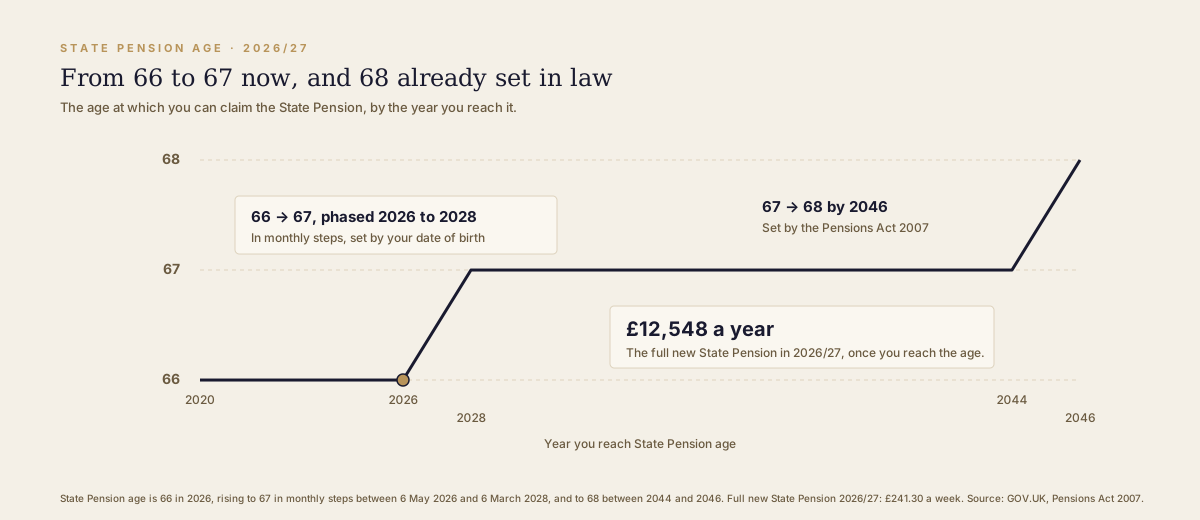
The State Pension age is the earliest age at which you can start receiving your State Pension, set by law according to your date of birth and reviewed periodically. You can claim your State Pension at 66 now, but that is rising to 67 by March 2028 and to 68 by 2046. It also fixes the point at which you stop paying National Insurance, and it depends on your exact date of birth. You are not paid it automatically, so you have to claim it, and it is separate from the age you can access a private pension.
The State Pension age is the line the government draws between working life and a state retirement income: reach it, and you can claim your State Pension; fall short of it by a day, and you cannot. For most people reaching it now it is 66, but that number is moving. It is partway through a rise to 67, and a further rise to 68 already sits on the statute book. All dates and figures in this article reflect the position for the 2026/27 tax year.
How is your State Pension age decided?
Your State Pension age is set by law according to your date of birth, not chosen. It is 66 for people reaching it now, rising to 67 in monthly steps between 6 May 2026 and 6 March 2028, and it is the same for men and women. Because the rise is phased, your exact date of birth decides the day you qualify.
Contents
- What is the State Pension age?
- When will you reach State Pension age?
- How is the State Pension age changing to 68?
- What happens when you reach State Pension age?
- How is it different from your pension access age?
- How does the State Pension age fit into your plan?
- Should you plan your retirement around the State Pension age?
What is the State Pension age?
The State Pension age is the earliest age at which you can start receiving your State Pension, and it is set by law according to your date of birth. It is not something you choose or can bring forward by paying in more; it is a fixed threshold that the same rules apply to everyone. For people reaching it in 2026 it is 66, and you can check your own date on GOV.UK using your date of birth.
Two features surprise people. The first is that it is the same for men and women. Men’s and women’s ages were equalised at 65 by November 2018 and have moved in step ever since, reaching 66 in October 2020. Every change from here applies equally to both. The second is that reaching the age does not, on its own, tell you how much you will get. That depends on your National Insurance record, not your birthday.
The State Pension age also does more than open the door to the pension. It is the point at which you stop paying National Insurance on your earnings, and it is the reference age for other entitlements, including Pension Credit and, in most of the country, a free bus pass. So it is worth knowing precisely, not roughly.
When will you reach State Pension age?
You reach State Pension age on a date fixed by your date of birth, and for anyone born after early April 1960 that date is later than their 66th birthday. The rise from 66 to 67 is being phased in gradually rather than switched on overnight, so people born a few months apart can reach the age months apart.
The table below sets out the current timetable. The middle band is the transition: within it, each month of birth adds roughly a month to the age at which you qualify.
| Date of birth | State Pension age | When you reach it |
|---|---|---|
| Before 6 April 1960 | 66 | On your 66th birthday |
| 6 April 1960 to 5 March 1961 | 66 and 1 to 11 months | Phased, May 2026 to February 2028 |
| On or after 6 March 1961 | 67 | On your 67th birthday, from 6 March 2028 |
| Reaching it in 2044 to 2046 | Rising to 68 | Under the Pensions Act 2007 |
Because the transition works in monthly steps, the exact day matters. Someone whose birthday sits just before a boundary can reach State Pension age nearly a year earlier than a friend born a little later, which is why guessing from your age alone is a mistake.
One year apart in birth, two years apart in claiming
Elaine was born on 10 March 1960, just before the transition begins. Her State Pension age is 66, so she reaches it on 10 March 2026 and can claim straight away.
Gary, her younger colleague, was born exactly a year later, on 10 March 1961. Because that falls after 6 March 1961, his State Pension age is a full 67. He does not reach it until 10 March 2028, two years after Elaine, despite being only one year younger.
The single year between their birthdays becomes a two-year gap in when the pension starts. At the full 2026/27 rate that extra year of waiting is roughly £12,548 of State Pension Gary receives later than a straight one-year age difference would suggest. Neither did anything differently; the calendar did it for them.
How is the State Pension age changing to 68?
The rise from 67 to 68 is already law. It was set by the Pensions Act 2007 and is timed for 2044 to 2046, so it currently affects people born after early April 1977. The 2023 government review left both the rise to 67 and the rise to 68 unchanged, rather than accelerating either, but it committed to looking at the 68 timetable again in the next Parliament.
That last point is the one to hold on to. The State Pension age is reviewed roughly every six years, and each review weighs life expectancy and the cost of the pension against how long people spend in retirement. Independent advice has already suggested bringing the rise to 68 forward to the late 2030s, and while no government has legislated for that, the direction of travel is clear.
Will the State Pension age rise to 68?
Yes. A rise from 67 to 68 is already set in law by the Pensions Act 2007, timed for 2044 to 2046. The 2023 review kept that date but agreed to review it again, and independent advice has suggested moving it earlier. Anyone currently under about 55 should treat 68, possibly sooner, as a realistic planning assumption rather than a fixed promise of 67.
For planning, that means younger workers should not bank on the age they see quoted today. If you are in your forties or younger, building a plan that assumes the State Pension arrives at 68, and that treats an even later date as possible, is the cautious and sensible approach. The pension is a foundation, but it is a foundation whose start date the government can, and periodically does, move.
What happens when you reach State Pension age?
Reaching State Pension age changes three things at once: you become able to claim the pension, you stop paying National Insurance, and any pension you do not claim starts to build up instead. None of them happens by itself, and the first is the one people most often get wrong.
The State Pension is not paid automatically. You have to claim it, and the Department for Work and Pensions writes to you about four months before you reach the age to invite you to do so. If you do nothing, you do not simply start receiving it late with the missed weeks paid up. Instead the pension defers, growing at a set rate for every week you delay, which is covered in full in the guide to State Pension deferral. Deferring can suit someone still working, but it is a decision, not a default to sleepwalk into.
The National Insurance change is more clear-cut. From State Pension age you stop paying National Insurance on your earnings, even if you carry on working. An employee earning past the age keeps their full pay without the deduction, and a self-employed person stops paying Class 4 contributions for the year after they reach the age. It is a small pay rise that arrives with the birthday.
What the age does not tell you is how much you will receive, which is set by your National Insurance record rather than the calendar. Some people reach State Pension age with gaps that leave them short of the full amount, and the years before you qualify are the window in which those gaps can sometimes be filled. Reading your State Pension forecast and checking whether topping up National Insurance is worthwhile is a far better use of attention than the age on its own.
How is it different from your pension access age?
The State Pension age governs only the State Pension; your private and workplace pensions run on a completely separate clock called the pension access age. That age is 55 now and rises to 57 from 6 April 2028, four weeks after the rise to 67 completes, and the two are frequently confused because both sound like “when I can get my pension”. Both sit on our timetable of dated UK pension and tax changes, which is the quickest way to see how close together they fall.
The distinction is not a technicality. For most people the pension access age comes first, often by a decade or more, and that gap is what actually funds an early or phased retirement. Someone who wants to stop full-time work at 60 cannot touch the State Pension for years, so the plan has to lean on private pensions, ISAs and other savings to bridge the distance. The mechanics of when you can draw a personal pension, and the coming change to 57 from 6 April 2028, are set out in the guide to the pension access age.
The State Pension age is not a birthday you can assume, and it is not the only pension age that matters. Two people born a year apart can reach it two years apart, while their private pensions may have been available to both a decade earlier.
Keeping the two ages separate in your head changes the shape of a retirement plan. The pension access age is when you can start; the State Pension age is when a guaranteed, inflation-linked income joins in behind whatever you have already arranged.
Risk warnings
ISAs
The favourable tax treatment of ISAs may be subject to changes in legislation in the future.
Pensions
Levels and bases of, and reliefs from, taxation are subject to change and their value will depend upon personal circumstances. Taxation and pension legislation may change in the future.
How does the State Pension age fit into your plan?
The State Pension age is best treated as one fixed date inside a wider plan, not as the retirement date itself. For most people it is neither the moment they want to stop work nor the only income they will live on, and building a whole retirement around it usually produces a worse answer than planning the income first and slotting the age in where it falls.
The most valuable thing the age gives a plan is certainty about when one reliable income begins. Everything before that date has to be funded from other sources, and everything after it can count on the State Pension as a base. That framing turns a vague worry about “having enough” into a series of answerable questions: what do you want to spend, when does each income source switch on, and how do you cover the years before the State Pension arrives? Those are exactly the questions a good pension to retire on is measured against, and the ones lifetime cashflow modelling is built to work through.
The age also interacts with tax. Because the State Pension is paid without tax deducted but still counts as taxable income, it can push other income into a higher band the moment it starts, so the year you reach State Pension age is often a year worth planning around rather than drifting into. This is where the age stops being a single number and becomes part of pension and retirement planning as a whole.
Should you plan your retirement around the State Pension age?
You should build your plan around when you want to stop work and what you want to spend, then fit the State Pension age into it, rather than the other way round. Making the age your retirement date is the common mistake, because for most people it is either later than they would like to finish or earlier than their savings alone could support, and in both cases the age is answering a question you did not ask.
That does not make it unimportant. The State Pension age is one of the few genuinely fixed points in a retirement plan, and knowing it precisely lets you work out how many years you need to fund yourself before it arrives and how much guaranteed income you will have once it does. The trap is treating it as the whole plan instead of one input to it. A sensible approach pins down your own State Pension age from your date of birth, assumes a later one if you are younger, checks your forecast so you know the amount as well as the date, and then designs the years around it. Do that, and the age becomes a useful anchor rather than a deadline you feel you are chasing.
Frequently asked questions
What is the State Pension age?
The State Pension age is the earliest age at which you can start receiving your State Pension, set by law according to your date of birth. It is 66 for people reaching it now, rising in monthly steps to 67 between May 2026 and March 2028, and it is legislated to reach 68 between 2044 and 2046. It is the same for men and women.
When can I claim my State Pension?
You can claim your State Pension from your State Pension age, which is 66 for most people reaching it in 2026 and rising to 67 by March 2028. The exact date depends on your date of birth, so the only reliable answer is the one the government's State Pension age checker gives you. You are not paid automatically: you have to make a claim, and the Department for Work and Pensions writes to you about four months before you qualify.
Is the State Pension age going up to 68?
Yes. A rise from 67 to 68 is already law under the Pensions Act 2007, timed for 2044 to 2046. The government's 2023 review left that timetable unchanged but committed to reviewing it again, and independent advice has suggested bringing it forward, so anyone currently under about 55 should treat 68 as a realistic planning assumption rather than a certainty.
Is the State Pension age the same as when I can take my private pension?
No. The State Pension age governs only the State Pension. Private and workplace pensions run on the separate pension access age, which is 55 now and rising to 57 from 6 April 2028. That gap matters: many people can draw a personal pension years before the State Pension starts, which is often how an earlier retirement is funded.
Does the State Pension age still differ for men and women?
No. Men's and women's State Pension ages were equalised at 65 by November 2018 and have moved together since, reaching 66 in October 2020. Every rise from here, to 67 and later to 68, applies equally to both. The differences that affected women born in the 1950s belong to the earlier equalisation and no longer create a gap between the sexes.
How many qualifying years do I need for the full State Pension?
You need 35 years of qualifying National Insurance for the full new State Pension of £241.30 a week in 2026/27, and at least 10 years to receive any new State Pension at all. Reaching State Pension age does not by itself entitle you to the full amount: your record decides how much you get, which is why checking your State Pension forecast matters more than the age alone.
Should I plan my retirement around the State Pension age?
Not entirely. The State Pension age tells you when a guaranteed, inflation-linked income begins, but for most people it is neither when they want to stop work nor the only income they will live on. It is better used as one fixed date inside a wider plan than as the retirement date itself, because private pensions, savings and the years before State Pension age usually do the heavier lifting.