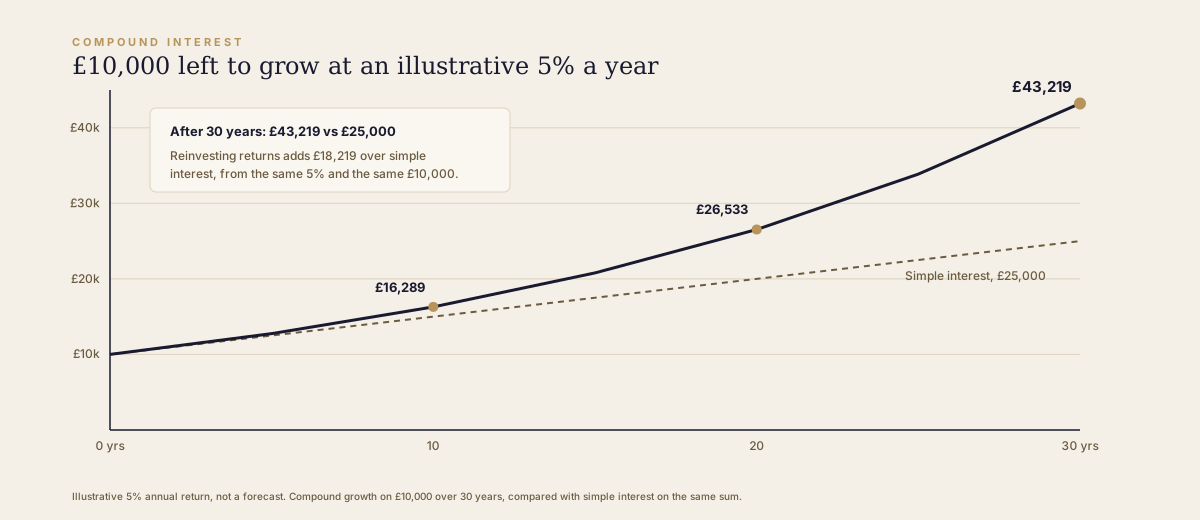
Compound interest is interest calculated on both the original sum and the interest already added to it, so each period's growth is worked out on a progressively larger balance. Left untouched at an illustrative 5% a year, £10,000 grows to about £43,219 over 30 years, against £25,000 without reinvestment. The effect builds slowly and then accelerates, which is why starting early and staying invested matter more than picking the perfect investment. Inflation compounds in exactly the same way against what your money can buy, so the return worth measuring is the one left after it.
Compound interest is the reason a modest sum left alone for decades can end up dwarfing the amount that was ever paid in. It works by paying a return not only on your original money but on all the returns already added to it, so the balance grows on a progressively larger base each year. Leave £10,000 to grow at an illustrative 5% a year and after 30 years it becomes about £43,219, against £25,000 if that same 5% were handed to you each year and never reinvested. The figures throughout this article are illustrations rather than forecasts, and the tax figures reflect the 2026/27 tax year.
The rate gets all the attention, but it is the least interesting part. Two things you actually control, how early you start and how long you leave the money alone, move the final figure far more than the difference between a decent investment and a slightly better one.
Why does compound interest speed up over time?
Because each year's return is added to the balance, the next year's return is worked out on a bigger sum. The percentage stays the same, but the pounds it produces grow every year, so the balance rises slowly at first and then increasingly steeply. Most of the growth in a long-run investment arrives in its final years, not its first.
Contents
- What is compound interest?
- How does compound interest work?
- How is compound interest different from simple interest?
- Why does starting early matter so much?
- How does inflation compound against you?
- How do you make compound interest work in practice?
- Is compound interest as powerful as people claim?
What is compound interest?
Compound interest is the return you earn on money that already includes previous returns. Instead of interest being paid out and the original sum left to earn the same flat amount forever, each payment is added back, and the next calculation is run on the new, larger total. Growth therefore feeds on itself.
The idea is easiest to see over a long stretch. A balance earning 5% adds 5% of a bigger number every year, so the pounds added in year 20 are far larger than the pounds added in year one, even though the rate has not moved. This is why people describe compounding as slow then sudden: for a long time not much seems to happen, and then the curve steepens sharply.
It applies well beyond a savings account. When an investment fund reinvests the dividends it receives, or a pension leaves its growth in place year after year, the same interest-on-interest effect is at work. It also runs in reverse on money you owe, which is why a credit card balance left unpaid can grow so quickly.
Risk warnings
Pensions
A pension is a long-term investment, the value of your investment and the income from it may go down as well as up. Your eventual income may depend upon the size of the fund at retirement, future interest rates and tax legislation.
Cash and deposits
While cash provides security of capital, it may not keep pace with inflation. Over time, the real value of your savings could fall.
How does compound interest work?
Compound interest works by adding each period’s return to the balance before the next period’s return is calculated, so the base keeps growing. Mathematically, a starting sum grows to the principal multiplied by one plus the rate, raised to the number of periods: £10,000 at 5% for 30 years is £10,000 times 1.05 to the power of 30, which is about £43,219.
The mechanism is clearer in pounds than in algebra. Watch the interest itself, rather than the balance, and you see it climb every single year.
How interest on interest builds each year on £10,000 at an illustrative 5%
£10,000 is left to grow at an illustrative 5% a year, with each year's return added back to the balance rather than paid out.
| Input | Value |
|---|---|
| Starting balance | £10,000 |
| Illustrative annual return | 5% |
- Year 1: 5% of £10,000 is £500, so the balance becomes £10,500.
- Year 2: 5% is now charged on £10,500, adding £525, so the balance becomes £11,025.
- Year 3: 5% of £11,025 adds about £551, taking the balance to roughly £11,576.
Result: Each year's interest is larger than the last (£500, then £525, then £551) because it is worked out on a bigger balance. That rising interest-on-interest is compounding.
Three years in, the extra £51 a year looks trivial. That is exactly why compounding is so easy to underrate early on and so hard to catch up with later. By year 30 the same 5% is being applied to a balance of more than £41,000, so a single year’s growth is worth over £2,000, more than a fifth of everything originally invested.
How is compound interest different from simple interest?
The difference is what the return is charged on. Simple interest is always worked out on the original sum alone, so the amount added never changes and the balance grows in a straight line. Compound interest is worked out on the balance including everything added so far, so the amount grows each period and the balance curves upwards.
Over a year or two the two are almost indistinguishable. Over decades they diverge dramatically, and the gap is the compounding itself.
| Feature | Simple interest | Compound interest |
|---|---|---|
| What earns the return | Only the original sum | The original sum plus all returns added so far |
| Growth over time | Straight line, the same amount each year | A curve that steepens the longer it runs |
| £10,000 at 5% after 30 years | £25,000 | £43,219 |
| Where you meet it | Some fixed-rate bonds paying income out | Reinvested savings and investments, most mortgages |
On the same £10,000 at the same 5% over the same 30 years, simple interest returns £25,000 and compound interest returns £43,219. The extra £18,219 was not earned by a better rate or a cleverer investment. It was earned purely by leaving the returns in place to earn returns of their own.
Risk warnings
Cash and deposits
Interest rates are not guaranteed to remain at current levels. Rates available when your fixed/notice account matures may be lower, and any reinvestment could earn less.
If your circumstances change, breaking a fixed-term arrangement early may reduce the interest you receive.
Mortgages
Your home may be repossessed if you do not keep up repayments on your mortgage. Think carefully before securing debts against your home.
Not all mortgage contracts are regulated by the Financial Conduct Authority.
Why does starting early matter so much?
Starting early matters because the years at the end of a long run do the heaviest lifting, and only an early start gives you enough of them. Delay, and you lose the most valuable years first: the ones where the balance is largest and each year’s growth is biggest. This is the single most expensive mistake in long-term investing, and it looks harmless while you are making it.
How much difference does starting early make?
A great deal. Paying £3,600 a year from age 30 to 68 at an illustrative 5% grows to roughly £388,000, while starting the same amount at 40 reaches only about £210,000. The 10-year delay costs around £177,000, far more than the £36,000 of extra contributions the earlier starter made.
Priya and Jason, same £3,600 a year, a decade apart
Priya and Jason each decide to invest £3,600 a year, or £300 a month, into a stocks and shares ISA until they reach 68. They assume an illustrative 5% a year. The only difference is when they begin.
Priya starts at 30 and pays in for 38 years, contributing £136,800 in total. Left to compound at 5%, her pot reaches roughly £388,000 by 68.
Jason means to start but does not get to it until he is 40. He pays in for 28 years, contributing £100,800, and his pot reaches about £210,000. He put in £36,000 less than Priya, yet he ends up roughly £177,000 behind. The missing decade was worth almost five times the contributions he skipped, because it was a decade of growth on his largest balances that never happened.
The lesson is not that Jason did badly. He built a substantial pot from a sensible habit. It is that the cost of waiting is enormous and invisible: nothing bad happens on the day you delay, and the price only becomes clear decades later when the two curves have pulled apart. If you have been meaning to start for a while, the most useful thing this article can tell you is that the best day to begin was earlier and the second best is now.
For the same reason, drip-feeding money in steadily each month works well for most people: it starts the clock immediately rather than waiting for a lump sum or the right moment, and the right moment is mostly a myth.
Risk warnings
Investments
Investing in shares should be regarded as a long-term investment and should fit in with your overall attitude to risk and financial circumstances.
ISAs
An investment in a Stocks & Shares ISA will not provide the same security of capital associated with a Cash ISA.
How does inflation compound against you?
Inflation compounds with exactly the same patience that growth does, only in the opposite direction. Prices rising by a steady percentage each year is compounding too, working on what your money can buy rather than on the number printed on the statement. That is how a balance can rise every single year and still leave you no better off.
The Bank of England targets 2% inflation on the Consumer Prices Index. At that rate, the £43,219 our £10,000 grew into over 30 years would buy about what £23,900 buys today. The nominal figure is roughly double the real one.
Nothing went wrong in that example, which is exactly what makes inflation so easy to miss.
The growth was genuine, and so was the erosion running underneath it. Both were compounding the whole time, and only one of them ever showed up on a statement.
Compound interest is indifferent machinery. It multiplies whatever you hand it, so a stalled contribution or a decade spent waiting for the right moment compounds against you with exactly the same patience that growth compounds for you.
So the return worth measuring is the real one, the growth left once inflation has been stripped out. That is also why a long-term pot sitting in cash is riskier than it feels: the balance never falls, so nothing ever signals a loss, while its spending power shrinks a little every year. The main types of investment behave very differently on this measure, since cash rarely keeps pace with inflation while shares have historically done more than keep pace. Over 30 years that gap is not a detail, it is most of the outcome.
How do you make compound interest work in practice?
You make compounding work by giving it the three things it needs: time, reinvested returns, and shelter from tax so nothing is clipped off the balance along the way. None of these requires predicting markets, which is fortunate, because reliably predicting them is not possible.
The first move is to shelter the growth from tax, because tax is a drag that compounds like any other. Returns inside a stocks and shares ISA or a pension grow free of income tax and capital gains tax, so nothing is taken out each year to slow the compounding. You can shelter up to £20,000 across your ISAs in 2026/27, as GOV.UK’s ISA guidance confirms, and a pension adds tax relief on the way in on top. Using that ISA allowance is one of the simplest ways to protect a long-run return.
The second move is to reinvest income rather than spend it. A fund’s dividends, a bond’s coupons or a savings account’s interest only compound if they are added back. Choosing accumulation over income units, or ticking the reinvest option, is the difference between the compound and simple lines in the table above.
The third move is to leave it alone. Compounding is interrupted every time money is withdrawn, and near retirement a badly timed withdrawal does lasting damage because the order of your returns starts to matter as much as their average. Spreading risk sensibly so you are less likely to be forced to sell after a fall is part of the same discipline, which is where diversification earns its place.
Where this gets difficult is not the arithmetic but the patience. The reward for compounding is mostly in years you cannot see yet, and staying invested through the boring middle is harder than it sounds. Deciding what the money is actually for, and building a plan you can hold onto through a bad year, is where I come in; our investment advice service starts from the plan rather than the product.
Risk warnings
Investments
The taxation of the investment is dependent on the individual circumstance of each investor, and may be subject to change in the future.
ISAs
The favourable tax treatment of ISAs may be subject to changes in legislation in the future.
Pensions
Levels and bases of, and reliefs from, taxation are subject to change and their value will depend upon personal circumstances. Taxation and pension legislation may change in the future.
Is compound interest as powerful as people claim?
Compound interest is genuinely as powerful as its reputation, but the power sits in the levers people tend to ignore rather than the one they obsess over. The returns are real, the arithmetic is not a trick, and over a working lifetime the difference between saving and not saving early is measured in hundreds of thousands of pounds. What gets oversold is the idea that the rate is the thing to optimise.
The rate you earn is the least controllable input and, over long periods, often not even the most important one. When you start, how much you pay in, whether you reinvest and how long you leave it alone are all things you decide, and together they usually move the outcome more than chasing an extra percentage point of return, which typically comes with extra risk attached. The common mistake is to spend all the effort on picking investments and none of it on starting sooner.
So it is worth relying on as an engine, but not as a promise. Compounding cannot guarantee a particular return, it needs years to do its work, and it punishes interruptions. Treat it as a reason to start early, keep contributing and stay invested, and it will do more for a plan than almost any individual investment decision.
Frequently asked questions
What is compound interest?
Compound interest is the return you earn on both your original money and the returns already added to it. Because each year's growth is worked out on a larger balance, the amount added rises over time even when the percentage rate stays the same.
How is compound interest calculated?
For a single lump sum, you raise one plus the rate to the number of years and multiply your starting sum by it. Most people need the harder version, because they pay in monthly rather than once: each contribution compounds for a different length of time, so every payment has to be grown separately and the results added together. That is the job a spreadsheet's FV function, or any compound interest calculator, does for you. It is also why two people who pay in the same total can finish with very different amounts, depending on when each payment went in.
How often is interest compounded?
It depends on the account or investment. Savings may compound daily, monthly or annually, and the more frequently it compounds the slightly higher the effective return. The AER, or annual equivalent rate, exists so you can compare savings accounts on the same annual basis whatever their compounding frequency.
Does compound interest apply to investments, not just savings?
Yes, though investments do not pay a fixed rate. Shares and funds compound when you reinvest dividends and leave growth in place, so future returns are earned on a bigger pot. The return varies year to year and can be negative, so investment compounding is real but far less smooth than savings interest.
Can compound interest work against you?
Yes. The same mechanism drives what you owe on credit cards, loans and mortgages, where interest is charged on a balance that can include unpaid interest. A credit card at 24% a year left unpaid compounds against you as relentlessly as savings compound in your favour.
Is compound interest worth relying on in a financial plan?
It is worth building a plan around, but not treating as a guarantee. Compounding rewards the two things you genuinely control: how early you start and how long you leave the money alone. It cannot promise a particular return, and it works only if you reinvest what it produces rather than spending it along the way.