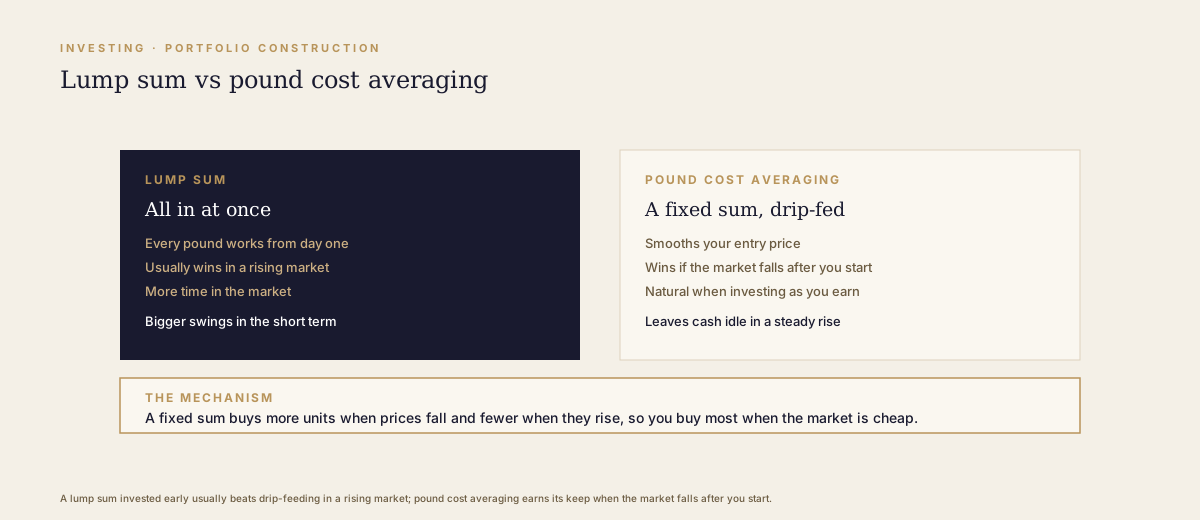
Pound cost averaging is an investment strategy of putting a fixed sum of money into the same investment at regular intervals, regardless of its price, rather than investing a single lump sum. Drip-feed a fixed sum at regular intervals and you smooth your entry price, but a lump sum invested early usually wins over the long run. It earns its keep when you are investing money as you earn it, or when a large sum would otherwise tempt you to wait for the perfect entry point. The cost is real: in a steadily rising market, staying in cash while you drip-feed leaves return on the table.
Pound cost averaging is the habit of investing a fixed amount on a regular schedule, say £500 every month, into the same investment whatever its price that month. When the price falls, your fixed sum buys more units; when it rises, it buys fewer. Over time this smooths the average price you pay and removes the need to guess the right moment to invest. It is the engine behind every workplace pension and most regular savings plans, even when savers never call it by name.
The allowances and figures in this article are correct for the 2026/27 tax year.
How does pound cost averaging work?
Pound cost averaging works by investing the same fixed amount on a regular schedule, so the money buys more units when prices are low and fewer when they are high. The cheap periods therefore supply more of the units you end up holding, and there is no need to judge the right moment to invest.
Contents
- What is pound cost averaging?
- How does pound cost averaging work?
- Is pound cost averaging better than a lump sum?
- Does pound cost averaging reduce risk?
- How does pound cost averaging fit your wider plan?
- Is pound cost averaging worth it?
What is pound cost averaging?
Pound cost averaging is investing a set amount at regular intervals, regardless of the price on the day. Instead of deciding when to buy, you decide how much and how often, then let the schedule run. The price you pay becomes an average of all the prices over the period rather than a single bet on one moment. Benjamin Graham, who shaped much of modern investing thought, described the approach as a way to keep ordinary investors from the costly temptation to predict the market.
The appeal is partly mathematical and partly behavioural. A fixed sum naturally buys more units when prices are low and fewer when they are high, so you accumulate them fastest when the market is cheap. Just as important, it takes the decision out of your hands. The Financial Conduct Authority warns that higher potential returns always come with a greater chance of loss, and that uncertainty is exactly what makes investors hesitate, sell in a panic, or wait endlessly for a better entry point.
Most people already do this without realising. A pension funded by monthly salary deductions, or a Stocks and Shares ISA topped up by standing order, is pound cost averaging by default. The strategy is less a clever tactic to adopt than the natural shape of investing out of income.
Risk warnings
Investments
Investing in shares should be regarded as a long-term investment and should fit in with your overall attitude to risk and financial circumstances.
ISAs
An investment in a Stocks & Shares ISA will not provide the same security of capital associated with a Cash ISA.
Pensions
A pension is a long-term investment, the value of your investment and the income from it may go down as well as up. Your eventual income may depend upon the size of the fund at retirement, future interest rates and tax legislation.
How does pound cost averaging work?
Pound cost averaging works because a fixed sum and a variable price pull in opposite directions. Spend £1,000 when a fund’s units cost £5 and you get 200 units. Spend the same £1,000 a month later when units have dropped to £2.50 and you get 400. The cheaper the units, the more your money buys, so falling prices quietly work in your favour while you keep investing.
The chart shows the core mechanic: the lower the unit price, the more units a fixed £1,000 buys. Because a fixed sum always buys more units when they are cheap, the cheaper prices carry more weight in your average, so your cost per unit ends up below the simple average of the prices you paid, whichever way the market moved. On its own, that is not much of a prize. It turns into real money only if the price later recovers above your average cost, which is what the chart sets up but does not show: its falling prices pile up cheap units, and Tom’s worked example below adds the recovery that pays them off. Had prices simply drifted upward instead, you would have done better to invest the whole sum at the start, when it was cheapest of all.
Tom, 38, drip-feeds £1,000 a month for six months
Tom invests £1,000 a month into a global tracker fund over six months, a £6,000 total. The unit price falls then recovers: £5.00, £4.00, £2.50, £2.50, £4.00, £5.00. His fixed sum buys 200, 250, 400, 400, 250 and 200 units, so he ends up with 1,700 units.
His average cost is £6,000 divided by 1,700 units, about £3.53 a unit, well below the £3.83 simple average of the six prices. With the price back at £5.00, his 1,700 units are worth £8,500, a £2,500 gain.
Had Tom invested the full £6,000 as a lump sum in month one at £5.00, he would have bought 1,200 units, worth exactly £6,000 at the end and no gain at all. In this dip-then-recover market, drip-feeding turned a flat result into a £2,500 profit.
Is pound cost averaging better than a lump sum?
On average, no: a lump sum invested early usually beats drip-feeding the same money in. The reason is simple. Markets rise more often than they fall, so cash you hold back to invest later spends most of its time earning less than it would in the market. Analysis of long-run UK and US data repeatedly finds that investing a lump sum immediately beats spreading it over roughly two years about two-thirds of the time. The longer your money sits on the sidelines, the larger the average drag.
The picture flips when the market falls early in the period. Take Tom’s £6,000 from the worked example, but change only one thing: the market climbs steadily from £5.00 to £6.00 over the six months instead of dipping. Now the lump sum buys 1,200 units worth £7,200, a £1,200 gain, while drip-feeding accumulates about 1,095 units worth around £6,571, a gain of roughly £570. The same investor and the same sum, separated only by the shape of the market, swing from drip-feeding winning by £2,500 to trailing by over £600.
That is the honest trade-off. Pound cost averaging gives up expected return in exchange for a narrower range of outcomes. You are paying, in average terms, for the comfort of not betting everything on a single day’s price. For many people that is a price worth paying, but it is a cost, not a free lunch.
Does pound cost averaging reduce risk?
Pound cost averaging reduces timing risk, not investment risk. It softens the danger of committing everything just before a fall, because only part of your money is exposed at any early point. What it cannot do is protect you from an investment that drops and never recovers. If a fund falls steadily across your whole investing window, averaging in simply means buying the whole way down, and you still end with a loss.
Does pound cost averaging lower your average cost per unit?
Compared with the simple average of the prices over the period, yes. The cheaper purchases buy more units, so those prices carry more weight in your average cost and pull it a little below the average of the prices themselves, in a rising market as well as a falling one. That is not the same as coming out ahead. In a market that only rises, investing the whole sum at the start still beats drip-feeding, because every later purchase costs more than the first. The averaging effect only turns into profit when prices fall and then recover, as in Tom’s example, where a £3.83 average price produced a £3.53 average cost and a £2,500 gain once the price returned to £5.
The genuine risk reduction is behavioural. The biggest threat to most investors’ returns is their own response to volatility: buying after a rally out of confidence, selling after a crash out of fear. A fixed schedule strips those decisions away. Pound cost averaging enforces that staying power automatically, which is why it pairs naturally with low-cost index funds held for the long term.
How does pound cost averaging fit your wider plan?
For most people, pound cost averaging is not a choice but the structure of how they invest: a slice of each month’s pay into a pension or ISA. The planning question is rarely whether to average in, but how much to commit and into what kind of investments. Getting the regular amount right, and the asset mix behind it, drives far more of the outcome than the averaging itself.
Tax wrappers make the habit more efficient. Feeding the £20,000 ISA allowance for 2026/27 through monthly contributions spreads your entry price and uses the allowance without a last-minute scramble. The cash ISA limit for under-65s falls to £12,000 a year from 6 April 2027, so investors leaning on stocks and shares may rely on regular investing even more.
Where pound cost averaging needs more thought is at the other end, when you come to draw the money out. Selling investments at a fixed rate in retirement is the mirror image of averaging in, and it exposes you to sequence of returns risk: a poor run of returns early in drawdown does lasting damage. The discipline that helps while building a pot can work against you while drawing it down, which is one reason a coherent investment plan treats the accumulation and decumulation phases differently. The same logic underpins regular portfolio rebalancing, another rules-based habit that keeps emotion out of the decision.
Risk warnings
Investments
The value of investments and any income from them can fall as well as rise. You may not get back the full amount invested.
The taxation of the investment is dependent on the individual circumstance of each investor, and may be subject to change in the future.
ISAs
The favourable tax treatment of ISAs may be subject to changes in legislation in the future.
Pensions
Levels and bases of, and reliefs from, taxation are subject to change and their value will depend upon personal circumstances. Taxation and pension legislation may change in the future.
Pension drawdown
Drawdown pension plans (unsecured income) are complex and are not suitable for everyone. Pension decisions can affect your income for the rest of your life (and that of any partner and other dependants). Where benefits are accessed on a flexible basis, these are not fixed or safeguarded for life. If security of income is important to you then you should consider purchasing an annuity or taking a scheme pension to provide a secured level of income.
Cash and deposits
While cash provides security of capital, it may not keep pace with inflation. Over time, the real value of your savings could fall.
Is pound cost averaging worth it?
For money you are investing as you earn it, pound cost averaging is unquestionably worth it, because there is no realistic alternative and the discipline of investing every month is one of the strongest habits a saver can build. The debate only really arises when you have a large sum already sitting in cash, perhaps from a bonus, an inheritance, or a maturing account.
In that case, the evidence leans toward investing sooner rather than spreading it over many months, because the expected cost of waiting outweighs the protection averaging offers. The exception is psychological, and it matters more than the maths admits. If drip-feeding a windfall is the only way you will bring yourself to invest at all, rather than leaving it in cash for years, then accepting a small expected cost to overcome that paralysis is a sensible trade. A short averaging window of three to six months often strikes a reasonable balance between reducing regret and minimising the drag of holding cash. The worst outcome is not choosing the slightly less optimal method; it is staying out of the market entirely while you wait for certainty that never comes.
Frequently asked questions
What is pound cost averaging?
Pound cost averaging is investing a fixed sum at regular intervals into the same investment, regardless of its price. The fixed amount buys more units when prices are low and fewer when they are high. It is also called drip-feeding, and it removes the need to time your entry into the market.
Does pound cost averaging guarantee you make money?
No. Pound cost averaging spreads the price you pay over time, but it does not protect against an investment that falls and stays down. If markets keep dropping over your whole investing period, you still lose money. It manages timing risk, not investment risk.
Is pound cost averaging better than investing a lump sum?
Usually not, on average. Studies of historical returns show a lump sum invested early beats drip-feeding roughly two-thirds of the time, because markets rise more often than they fall and cash held back earns less. Pound cost averaging wins when markets fall early in the period or when it stops you delaying out of fear.
Does pound cost averaging happen automatically in a workplace pension?
Yes. Every workplace pension run through automatic enrolment is pound cost averaging in action. A fixed slice of your salary buys investments every month at whatever the price is, so you are already averaging your entry price without choosing to.
How often should you invest to benefit from pound cost averaging?
Monthly is the most common interval and works well, matching how most people are paid. What matters is consistency, not frequency: investing weekly rather than monthly makes almost no difference to your average price, while it can add dealing costs in some accounts.
Is pound cost averaging worth it?
Yes, when you are investing money as you earn it, because that is the only realistic option and it builds a disciplined habit. For a large lump sum already in cash, the evidence favours investing sooner, so drip-feeding is worth it mainly as a way to manage the risk of bad timing and your own nerves.
Risk warning
Past performance is used as a guide only; it is no guarantee of future performance.