Portfolio rebalancing is the process of buying and selling investments to return a portfolio to its target asset allocation after market movements have pushed the holdings away from their intended weights. Rebalance when your asset mix drifts past a set tolerance band, often five percentage points, rather than on a rigid calendar. Rebalancing is a risk-control discipline, not a return-boosting trick: it stops a portfolio quietly becoming riskier than you intended as winners grow. Done in a taxable account it can trigger capital gains tax, so the same trade is far cheaper inside an ISA or pension.
Portfolio rebalancing is how you stop a portfolio from quietly drifting into a riskier shape than you chose. When shares rise faster than bonds, they grow to dominate the mix, and a 60/40 split can become 70/30 without you lifting a finger. Rebalancing sells some of what has grown and buys what has lagged, returning the portfolio to its target allocation. It is one of the few investment habits that imposes discipline automatically: sell high, buy low, on a rule rather than a hunch.
The thresholds and tax figures in this article are correct for the 2026/27 tax year.
How does portfolio rebalancing work?
Rebalancing works by selling assets that have grown beyond their target weight and buying those that have fallen below it, restoring the original allocation. Most investors rebalance once a year or when an asset class drifts more than five percentage points from target. Inside an ISA or pension it triggers no capital gains tax.
Contents
- What is portfolio rebalancing?
- How does portfolio rebalancing work?
- How often should you rebalance?
- Does rebalancing trigger capital gains tax?
- How does rebalancing fit your wider plan?
- Is portfolio rebalancing worth it?
What is portfolio rebalancing?
Portfolio rebalancing is the act of returning your investments to their target asset allocation once market movements have changed the weights. Your asset allocation, the split between shares, bonds, cash and other assets, is the single biggest driver of how a portfolio behaves, far more than the individual funds you pick. Spreading money across asset classes to manage risk is the foundation of sensible investing, and rebalancing is simply the maintenance that keeps that split intact.
The reason a portfolio drifts at all is that its parts grow at different rates. Over a few strong years for equities, shares can swell from a planned 60% of the pot to 68% or more, while bonds shrink as a share of the total even if their value barely moves. The result is no longer the blend of investment types you designed: it carries more equity risk, so it will fall harder in the next downturn than you signed up for.
This is why a mix of assets that behave differently from one another is worth maintaining rather than admiring once and forgetting. Rebalancing is how the intended balance survives contact with real markets. Without it, the asset that has done best simply takes over, and the portfolio slowly stops reflecting your appetite for risk.
How does portfolio rebalancing work?
Rebalancing works by comparing each holding’s current weight against its target, then trading to close the gap. If shares have grown above their target percentage, you sell the excess and use the proceeds to top up whatever has fallen below target, usually bonds or cash. The portfolio returns to its planned proportions, and your risk level resets to where it started.
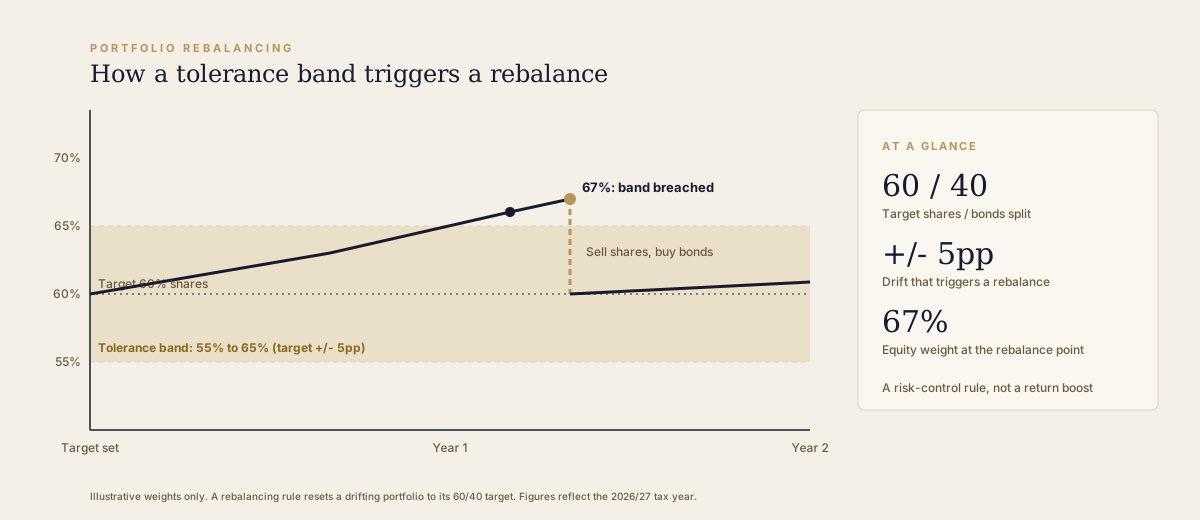
The diagram shows a 60/40 portfolio drifting to roughly 67/33 after a strong run for shares, which raises its equity risk without any decision on your part. Rebalancing sells the excess shares and buys bonds to return the split to 60/40, resetting the risk to its intended level. The mechanics are the same whether you trim a single fund or sell across several holdings.
There are two ways to do it. You can sell the overweight asset and buy the underweight one, which is the classic method. Or, if you are still paying into the portfolio, you can direct new contributions toward the underweight asset and avoid selling anything at all. The second route is gentler, because it sidesteps both trading costs and, in a taxable account, any tax on gains. For investors who favour low-cost index funds, steering monthly contributions is often enough to keep the allocation in line for years.
How often should you rebalance?
There is no single correct frequency, but two sensible approaches dominate: rebalance on a calendar, or rebalance on a tolerance band. Calendar rebalancing means checking on a fixed schedule, typically once a year, and resetting whatever has drifted. Tolerance band rebalancing means leaving the portfolio alone until an asset class moves more than a set distance from target, commonly five percentage points, and only then trading.
Rebalancing rarely makes you richer in a single year, but it is what keeps a long plan recognisable: the portfolio you retire with should still be the one you designed, not the one a bull market quietly built for you.
Tolerance bands tend to win for most investors because they react to what markets actually do rather than to the date. A portfolio that has barely moved is left untouched, avoiding needless cost, while a sharp run is corrected promptly even if it falls mid-year. The trade-off is that bands require occasional monitoring rather than a single annual diary note. Whichever you choose, the discipline matters more than the precise rule. Rebalancing constantly racks up costs; rebalancing never lets risk pile up unnoticed.
Does rebalancing trigger capital gains tax?
It depends entirely on the wrapper. Inside an ISA or a pension, rebalancing triggers no tax at all, because selling one holding and buying another within the wrapper is not a taxable event.
In a general investment account it is different. Selling a holding to rebalance is a disposal for capital gains tax, and a gain above the annual exempt amount of £3,000 a year for 2026/27 is taxable. Shares are taxed at 18% within the basic-rate band and 24% above it, the rates HMRC applies after the exempt amount.
Diane, 54, rebalancing a £200,000 portfolio
Diane started with £200,000 split 60% global shares (£120,000) and 40% bonds (£80,000). A strong run for equities pushes the shares to £160,000 while the bonds hold near £80,000, a £240,000 portfolio now sitting at roughly 67% shares.
To return to 60/40 she needs shares of £144,000, so she sells £16,000 of shares and moves the money into bonds. She holds these shares in a general investment account, so the sale is a disposal for capital gains tax.
Because the holding grew from £120,000 to £160,000, each £1 of shares she sells is 75p original capital and 25p gain. Selling £16,000 therefore realises a £4,000 gain. After the £3,000 exempt amount, £1,000 is taxable, and at the 24% rate that applies above the basic-rate band that is a £240 bill. The identical trade inside an ISA would have cost nothing, because switching holdings within the wrapper is not a disposal.
This is why the wrapper, not just the investment, shapes the real cost of staying disciplined. Where a taxable account is unavoidable, you can blunt the bill by realising gains gradually across tax years to use each year’s exempt amount, by directing new money to the underweight asset, or by moving holdings into an ISA over time.
Understanding how different wrappers are taxed is what lets you rebalance without quietly handing back part of the gain. The same discipline that controls your risk can be undone by tax friction if the holdings sit in the wrong account.
Risk warnings
Investments
The taxation of the investment is dependent on the individual circumstance of each investor, and may be subject to change in the future.
ISAs
The favourable tax treatment of ISAs may be subject to changes in legislation in the future.
Pensions
Levels and bases of, and reliefs from, taxation are subject to change and their value will depend upon personal circumstances. Taxation and pension legislation may change in the future.
A pension is a long-term investment, the value of your investment and the income from it may go down as well as up. Your eventual income may depend upon the size of the fund at retirement, future interest rates and tax legislation.
Tax, trusts and estate planning
HM Revenue and Customs practice and the law relating to taxation are complex and subject to individual circumstances and changes which cannot be foreseen.
How does rebalancing fit your wider plan?
Rebalancing is a risk-management tool first, and that is how it earns its place in a structured investment plan rather than as a way to chase performance. Its job is to make sure the portfolio you are relying on still matches the risk you can afford to take, both emotionally and in pounds. The closer you are to drawing on the money, the more that alignment matters, because a portfolio that has quietly drifted toward equities is far more exposed to a badly timed fall.
Does rebalancing increase your investment returns?
Rebalancing is mainly a way to control risk, not to raise returns. In some conditions, selling winners and buying laggards adds a small rebalancing bonus, but in a long bull market it can slightly reduce returns by trimming your best performers. Its real value is keeping risk where you intended.
In retirement the stakes rise. Selling assets to fund income in the early years of drawdown exposes you to sequence of returns risk, where a poor run of returns just as you start withdrawing does lasting damage to a pot you can no longer rebuild.
A disciplined rebalancing rule, paired with a sustainable withdrawal strategy, helps you sell from the asset that has held up rather than crystallising losses on the one that has fallen. Coordinating allocation, rebalancing and withdrawals is what keeps an income plan intact through a rough patch in markets.
Risk warnings
Investments
Past performance is used as a guide only; it is no guarantee of future performance.
Pension drawdown
Drawdown pension plans (unsecured income) are complex and are not suitable for everyone. Pension decisions can affect your income for the rest of your life (and that of any partner and other dependants). Where benefits are accessed on a flexible basis, these are not fixed or safeguarded for life. If security of income is important to you then you should consider purchasing an annuity or taking a scheme pension to provide a secured level of income.
Is portfolio rebalancing worth it?
For almost every long-term investor, yes, because the alternative is letting your risk level drift wherever markets push it. The honest case for rebalancing is modest and durable: it will not reliably make you richer, and in a long bull market trimming your winners can even cost you a little return. What it does is keep the portfolio recognisable, so the risk you carry into a downturn is the risk you chose, not the risk a few good years handed you.
The trade-offs are real but manageable. Rebalancing costs time, can incur trading fees, and in a taxable account can trigger capital gains tax. Those frictions are reasons to rebalance thoughtfully, using tolerance bands, new contributions, and tax-sheltered wrappers, rather than reasons to skip it. The investors who regret rebalancing are usually those who did it too often or in the wrong account, not those who kept their allocation honest. Done with a rule and the right wrapper, it remains one of the cheapest forms of risk control available.
Frequently asked questions
What is portfolio rebalancing?
Portfolio rebalancing is buying and selling investments to bring a portfolio back to its target asset allocation after market movements have changed the weights. For example, if shares grow from 60% to 68% of your portfolio, you sell some shares and buy bonds to return to 60/40. It keeps your risk level where you intended it.
How often should you rebalance your portfolio?
There is no fixed rule, but checking once a year or whenever an asset class drifts more than about five percentage points from target works well for most investors. Rebalancing too often adds trading costs and, in a taxable account, tax. Rebalancing too rarely lets risk build up unchecked.
Do you pay tax when you rebalance?
Inside an ISA or pension you pay no tax to rebalance, because selling and switching holdings within the wrapper is not a taxable event. In a general investment account, selling a holding to rebalance is a disposal for capital gains tax, which may be due on gains above the annual exempt amount, £3,000 a year for 2026/27.
Should you rebalance when markets are falling?
Yes, in principle, and it is when rebalancing matters most. A falling market pushes the asset that has dropped below its target weight, so rebalancing means buying more of it. That feels uncomfortable, but buying the laggard cheaply is exactly the discipline rebalancing is designed to enforce.
Is portfolio rebalancing worth it?
Yes, for almost every long-term investor, because it controls risk that would otherwise drift upward as winning assets grow. It rarely boosts returns and can slightly reduce them in a long bull market, so its value is keeping the portfolio aligned to your plan rather than maximising gains.