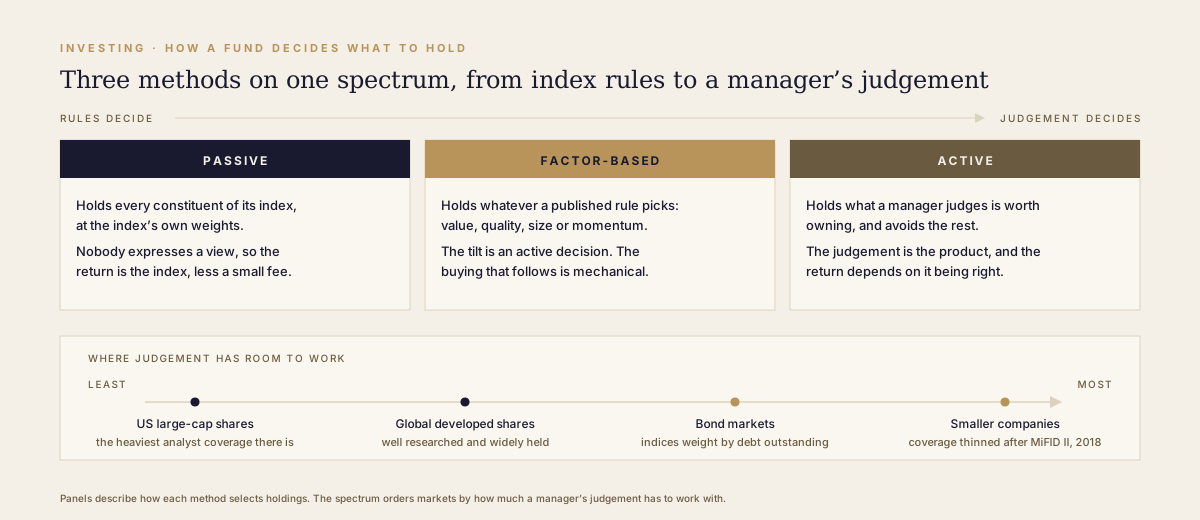
Active and passive investing are two fund management approaches: active funds employ managers who select holdings to beat a market index, while passive funds track an index rather than trying to beat it. The real distinction is method: a tracker inherits whatever its index rules produce, while an active manager's holdings reflect a person's view, and each of those suits some markets better than others. In large, heavily researched markets such as US large-cap shares, the mechanical approach has the stronger record. In less efficient corners, including smaller companies and much of the bond market, judgement has more to work with. Factor-based funds sit between the two, applying a published rule systematically rather than leaving the selection to a manager.
Active vs passive investing is a difference of method before it is a difference of price. A passive fund follows a published set of index rules and holds whatever those rules select. An active fund holds what a person believes is worth owning. Both can hold the same share on the same day for completely different reasons, and the useful question is not which approach is better in the abstract, but which method has more to work with in the particular market you are buying. Fund charges quoted in this article reflect typical UK pricing in the 2026/27 tax year.
What is the difference between active and passive investing?
Passive investing follows an index's published rules, holding its constituents at the index's own weights, so the fund's return is the market's return less a small fee. Active investing pays a manager to make that selection instead. The core difference is who decides: a rulebook or a person. Cost follows from that, because judgement has to be researched and paid for.
Contents
- What is the difference between active and passive investing?
- How does passive investing work?
- How does active investing work?
- Active vs passive investing: how do they compare?
- Which markets suit passive investing, and which suit active?
- What does the evidence say about active fund performance?
- Where does factor investing sit between the two?
- Can you combine active and passive investing?
What is the difference between active and passive investing?
The difference between active and passive investing is who decides what the fund owns. A passive fund delegates that decision to an index’s rulebook. An active fund delegates it to a manager. Almost everything else about the two, including the fee, follows from that single choice.
An index is a set of rules before it is a list of companies. The FTSE All-Share admits UK-listed companies above a size and liquidity threshold and weights each by its market value; a global equity index applies a comparable set of rules across dozens of markets at once. A tracker’s job is to reproduce that list faithfully and cheaply. If the rules admit a company that looks expensive on every sensible measure, it goes into the fund anyway, because there is nobody employed to have an opinion about it.
An active fund starts from a blank sheet and a benchmark to be measured against.
The manager researches companies, forms a view on which are mispriced, and builds a portfolio that deliberately looks unlike the index. That difference is measurable, which matters more than most fund literature lets on. Active share expresses the proportion of a fund’s holdings that departs from its benchmark: a fund holding the index’s biggest companies at close to index weights has low active share, while a concentrated portfolio of forty stocks picked on conviction has high active share. It is the cleanest way to ask what you are actually buying, because a fund can be labelled active without behaving that way.
Neither method is a claim about the quality of what you end up owning, since both can hold the same blue-chip company. The main types of investments in your portfolio, and how they are split between them, will move your outcome more than the active or passive label on the fund wrapped around them.
Risk warning
The value of investments and any income from them can fall as well as rise. You may not get back the full amount invested.
How does passive investing work?
Passive investing works by reproducing an index rather than judging it. The fund buys the index’s constituents and holds them in the index’s proportions, so its value moves almost exactly in line with that market. There is no research team and no stock-picking to pay for, which is why a broad global tracker typically carries an ongoing charge of around 0.1% to 0.2% a year.
The mechanics are more interesting than the summary suggests. A fund tracking 600 companies may hold every one of them (full replication) or a representative sample chosen to behave like the whole (sampling), which keeps trading costs down in markets where the smallest constituents are expensive to buy. Indices are reviewed on a published schedule, and a tracker has to trade on those dates whether or not the prices on offer that day are good ones. The small gap between a fund’s return and its index, known as tracking error, is where all of this quietly shows up.
What a tracker cannot do is object.
It inherits whatever the index rules produce, and that includes concentration. When a handful of very large companies come to dominate a market by value, a market-cap-weighted tracker holds them in exactly that proportion, and an investor who believed they had bought broad diversification across shares and bonds can end up with far more exposure to one sector than they intended. The same mechanism operates in reverse: a tracker follows its market down, because following is the entire design. Exchange-traded funds are the same idea in a different legal wrapper, priced and traded on an exchange through the day.
How does active investing work?
Active investing works by paying for decisions a rulebook never makes. A manager and a research team form views on individual companies, decide what to own and what to leave out, and change the portfolio as those views change. The fund can hold cash, refuse a sector outright, or concentrate into a small number of positions, none of which an index fund is permitted to do.
That research has to be funded, and it shows up in the ongoing charge: active equity funds commonly charge 0.75% or more a year, against a fraction of that for a tracker. The fee is the hurdle rather than the argument. A manager simply has to clear it, and the question worth asking is whether the market they work in gives them enough to clear it with.
The honest way to judge an active fund is by how different it actually is. A manager running a portfolio that closely resembles the index cannot produce a return that differs much from the index, whatever the fee schedule says. This is not a hypothetical failure: the FCA’s Asset Management Market Study estimated that around £109 billion sat in expensive funds which in practice tracked their benchmark closely. Ask what a fund holds that its index does not, and why.
Active vs passive investing: how do they compare?
Active vs passive investing is usually presented as a cost comparison. It is better understood as a comparison of method, with cost as one consequence of the method rather than the headline.
How active and passive funds compare across the features that matter most
| Feature | Active funds | Passive funds |
|---|---|---|
| What selects the holdings | A manager’s judgement, informed by research | The index’s published rules |
| What you are buying | A view on which companies are mispriced | The market’s return, whatever it turns out to be |
| Departure from the index | Deliberate, and measurable as active share | None by design, beyond small tracking error |
| Ability to respond to events | Can hold cash, avoid a sector, concentrate | None; the rules apply regardless |
| Principal risk | The manager’s view is wrong, or unfashionable for years | Whatever the index itself is exposed to |
| Typical ongoing charge | 0.75% or more a year | Around 0.1% to 0.2% a year |
No column wins outright, and the row that decides it is the first one. If the price of a given market already reflects everything knowable about it, paying for judgement there buys you very little. If there is information the price has not absorbed, judgement is the only way to act on it. The FCA’s golden rules of investing put comparing charges among the checks to make before buying any fund, and that check is straightforward precisely because the charge is knowable in advance while the return is not.
An index is not a neutral snapshot of a market. It is a set of rules somebody wrote, and a tracker is a promise to follow them without argument.
Which markets suit passive investing, and which suit active?
This is the question that actually settles the answer, and it does not have the same answer everywhere. An active manager competes against the collective judgement already priced into a market. Where that judgement is thorough, competing with it is close to futile. Where it is thin, patchy, or distorted by how the index is built, there is something to find.
US large-cap shares are the hardest case for active management, and the record there is consistently discouraging. Those companies are followed by large numbers of professional analysts, report frequently, and trade in enormous volume, so a genuinely original insight about one of them is both rare and short-lived. A manager working in that market is charging for research that has already been done many times over.
Smaller companies are the clearest counter-example. Analyst coverage thins sharply as company size falls, and a good deal of what remained disappeared after MiFID II unbundled research from dealing commissions in 2018. A market where fewer people are looking is a market where careful work has somewhere to go. Trading costs are higher there too, which cuts both ways: it raises the bar an active manager has to clear, and it penalises a tracker obliged to buy on index review dates whatever the spread on offer.
Bond markets deserve a paragraph of their own, because index construction there has a structural quirk that surprises people the first time they meet it. Equity indices weight by market value, which at least tilts toward what the market believes companies are worth. Most bond indices weight by the amount of debt outstanding, so the more heavily an issuer borrows, the larger its share of the index becomes. A passive bond fund therefore lends most to the borrowers who have borrowed most. That is a defensible rule and a perfectly transparent one, but it is still a rule, and wanting a manager with the discretion to override it is a reasonable position.
Emerging markets sit somewhere in between, and the case there is more contested than it is usually presented. Individual markets vary enormously in how freely information travels, index inclusion decisions made by the index providers themselves move very large sums, and currency and governance risks are awkward for a rulebook to price. There is real room for judgement. Whether the average fund charging for it has earned the charge is a separate question, and the record is mixed.
The mistake to avoid is applying one answer everywhere. Buying an expensive active fund for US large-cap exposure because active feels more sophisticated, then using a cheap tracker for a smaller-companies allocation because passive feels prudent, gets the argument backwards in both places at once.
Which markets suit active management?
Active management has most room where a market is less thoroughly researched or where the index rules are awkward. Smaller companies qualify because analyst coverage is thin, and bond markets qualify because most bond indices weight by debt outstanding, so a tracker lends most to the heaviest borrowers. It has least room in US large-cap shares, which are followed by very large numbers of analysts and traded in huge volume. Passive works best where the price already reflects what is knowable.
What does the evidence say about active fund performance?
Taken as a whole, the record is not kind to active management. The Financial Conduct Authority (FCA) examined it in its Asset Management Market Study, which found that actively managed funds on average did not beat their benchmarks once fees were taken into account, and that there was no clear relationship between what a fund charged and how well it performed before costs. A higher fee was not buying better raw performance.
Two things follow, and they point in different directions. The first is arithmetic. Active managers in any market are largely trading with each other, so the average actively managed pound earns roughly the market return before costs and necessarily falls short of it after. Not everyone can be above average. The second is that averages conceal dispersion: a meaningful minority of active funds do beat their index over long periods, and the difficulty is that identifying them in advance is a genuinely hard problem, with past performance a weak guide to what comes next.
The harder part is behavioural rather than analytical. Even an investor who picks a good manager has to hold the fund through the stretches when that manager’s approach is out of favour, which for a distinctive strategy can run for several years. Those are exactly the moments when switching feels most sensible. Selling a good fund after a bad run and buying last year’s winner is the most reliable way to turn a decent fund choice into a poor return.
Two global equity funds, both labelled active
Fund A holds 38 companies. Roughly three quarters of the portfolio differs from its benchmark, so its return is going to look distinctly unlike the index in both directions, and its performance in any given year says something real about the manager’s judgement.
Fund B holds 340 companies against a benchmark of about 600. Its largest positions are the index’s largest positions, at close to index weights. Perhaps a fifth of the portfolio departs from the benchmark, which caps how far its return can stray from the index either way.
Both charge an active fee. Only one of them is selling a judgement that could not have been bought more cheaply, and the difference is visible in the holdings long before it is visible in the performance. The figures here are illustrative, but the check is not: a fund’s factsheet gives you the number of holdings, and many managers now publish active share directly.
Risk warning
Past performance is used as a guide only; it is no guarantee of future performance.
Where does factor investing sit between the two?
Factor investing is the interesting middle ground, and it clarifies the active and passive distinction better than most head-to-head comparisons of the two. A factor fund selects holdings by a published, mechanical rule based on a single characteristic: the cheapest shares on some valuation measure (value), the companies with the strongest balance sheets and steadiest earnings (quality), the smallest companies (size), those whose prices have risen most over the past year (momentum), or the least volatile (low volatility).
The decision to own a value fund rather than the whole market is unambiguously an active one. You are deliberately holding something different from the market, on a view about what will be rewarded. The implementation, though, is entirely passive: nobody decides which specific companies clear the screen, the rule does, and the portfolio rebalances on a schedule. Charges sit between the two extremes, usually much closer to the tracker end. Factor funds are often sold as smart beta, which is a marketing term rather than a distinct product.
The intellectual case rests on decades of academic work finding that portfolios sorted on these characteristics have earned long-run returns different from the market as a whole. Two competing explanations survive. Either the factor carries a risk most investors would rather not hold, and is compensated for bearing it, or enough investors behave predictably badly that a mechanical rule can profit from it. Both imply the effect is real; neither implies it arrives on any particular schedule.
That last point is where factor investing disappoints people. Value shares lagged growth shares for most of the decade to 2020, long enough for a great many investors to abandon the approach shortly before it turned. A factor is a long-horizon proposition and it will spend years looking wrong. If you would not hold it through that, it is the wrong tool for you, and a plain global tracker is a better answer than a factor fund you will give up on.
There is also a definitional problem worth understanding before you buy. Factor definitions are not standardised across providers, so two funds both described as value can hold substantially different companies, one screening on price to book value and another on free cash flow yield. Read the rule rather than the label. The rule is published precisely so that you can.
Can you combine active and passive investing?
Yes, and most sensibly built portfolios do. The usual shape is a passive core covering the large, efficient markets where tracking has the stronger case, active funds used deliberately in the areas where the argument for judgement is strongest, and a factor tilt in between if you hold a view you are genuinely willing to sit with for a decade.
The discipline is being able to say why each active fund is there. A fund justified by nothing more than a good three-year run is not a decision, it is a purchase. A fund chosen because the market it invests in is genuinely under-researched, and because you have looked at what it holds and satisfied yourself that it differs from the index, is a decision you can defend to yourself in a bad year, which is when you will need to.
Two things sit alongside the fund choice and matter at least as much. Where you hold the funds is one: sheltering growth inside an ISA or a pension removes capital gains tax on shares and tax on dividends whether the fund inside is active, passive or factor-based, so choosing the investment wrapper is a separate exercise from choosing what goes in it. Which wrapper to fill first, explored in stocks and shares ISA versus pension, is a different question again.
If you want one starting position to work from: default to passive, and make active the thing that has to justify itself, market by market. Not because tracking is always right, but because it puts the burden of proof in the sensible place. A market where judgement can genuinely add something will survive the question; one where it cannot will not. Where that line falls across your own portfolio depends on what you already hold and what you need the money to do, which is the work of an investment strategy rather than a fund comparison.
Risk warnings
Investments
The taxation of the investment is dependent on the individual circumstance of each investor, and may be subject to change in the future.
ISAs
The favourable tax treatment of ISAs may be subject to changes in legislation in the future.
An investment in a Stocks & Shares ISA will not provide the same security of capital associated with a Cash ISA.
Pensions
The value of pensions and any income from them can fall as well as rise. You may not get back the full amount invested.
Levels and bases of, and reliefs from, taxation are subject to change and their value will depend upon personal circumstances. Taxation and pension legislation may change in the future.
A pension is a long-term investment and the value is not guaranteed. Any advice or considerations are personal to each individual’s circumstances.
A pension is a long-term investment, the value of your investment and the income from it may go down as well as up. Your eventual income may depend upon the size of the fund at retirement, future interest rates and tax legislation.
Frequently asked questions
What is passive investing?
Passive investing means holding what an index's rules select, in the proportions those rules dictate, rather than choosing holdings yourself or paying a manager to choose them. Nobody expresses a view, so the fund's return is the index's return less a small charge. The trade-off is that a tracker cannot object to anything: if the index rules admit a company, or a sector grows to dominate the index by value, the fund holds it in that proportion regardless.
How does active investing work?
An active fund employs a manager and a research team who decide what the fund owns, aiming to beat a benchmark index. The manager can hold cash, avoid a sector entirely, or concentrate the portfolio into a few dozen holdings, none of which a tracker can do. What you are buying is the judgement, so the test of an active fund is how far its holdings actually differ from the index rather than what the marketing says.
Do active funds beat the market?
On average, no. The FCA's Asset Management Market Study found that actively managed funds did not outperform their benchmarks after fees, and that a higher charge bought no better performance before costs. There is a simple arithmetic reason: active managers collectively trade with each other, so the average actively managed pound earns roughly the market return before costs and falls short after them. A minority do beat their index over long periods, but picking those funds in advance is a genuinely hard problem.
Which markets suit active management?
Those where the price has not already absorbed everything knowable. Smaller companies are the clearest case: analyst coverage thins sharply as company size falls, and much of it disappeared after MiFID II unbundled research from dealing commissions in 2018. Bond markets are another, because most bond indices weight by debt outstanding, so a tracker lends most to the heaviest borrowers. US large-cap shares are the hardest case for active management, being followed by very large numbers of analysts and traded in enormous volume.
What is factor investing?
Factor investing selects holdings by a published rule based on a characteristic, such as buying the cheapest shares on a valuation measure (value), the most financially stable companies (quality), or those whose prices have risen most recently (momentum). The decision to tilt away from the whole market is an active one, but the implementation is mechanical, with no manager choosing individual companies. Factor definitions are not standardised, so two funds both described as value can hold quite different companies.
Are index funds safer than active funds?
No. An index fund is not lower risk simply because it is passive; it rises and falls with the market it tracks, and a global equity tracker can fall sharply in a downturn. What it removes is manager risk, the chance that one person's calls go badly wrong. It replaces that with index risk: you are exposed to whatever the index rules produce, including concentration in a handful of very large companies when a market becomes top-heavy.
Should you choose active or passive investing?
Treat passive as the default and make active the choice you have to justify, market by market. In heavily researched markets the burden of proof is very hard to meet, so a tracker is usually the sensible core. In under-researched or structurally awkward markets, an active fund with genuinely differentiated holdings can earn its charge. Most well-built portfolios end up holding both, with each active position there for a reason its owner could state out loud.