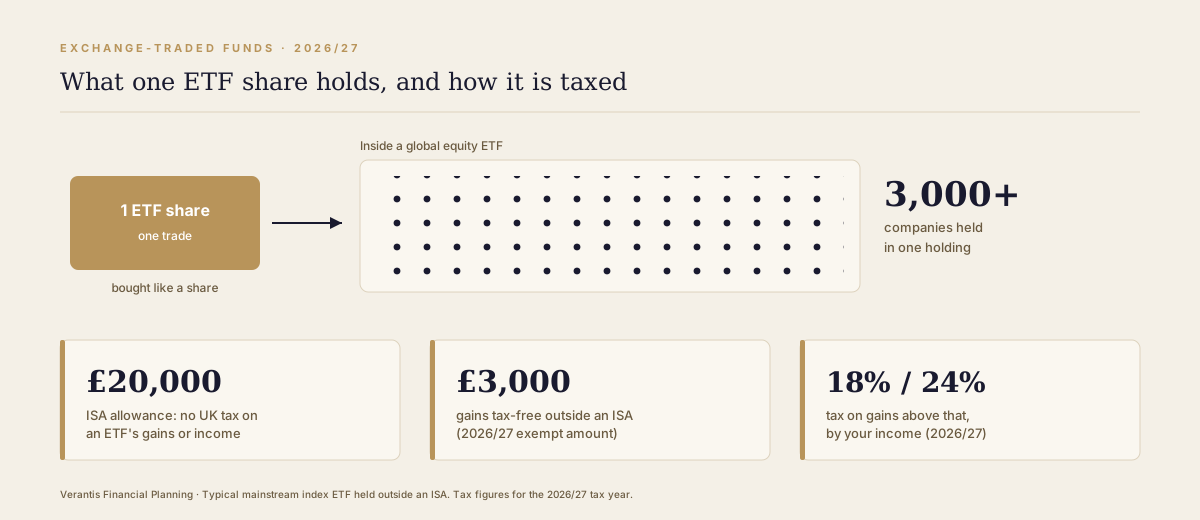
An exchange-traded fund (ETF) is a pooled investment that trades on a stock exchange like a share, holding a basket of assets, usually the constituents of an index it is built to track. An ETF gives most UK investors broad diversification across a whole market in a single holding. It trades live on an exchange through the day, unlike a traditional fund priced once daily, and held outside an ISA or pension its gains and income are taxable. Whether an ETF or a near-identical index fund suits you comes down to how you like to buy and how much a live, all-day price tempts you to trade.
An ETF, or exchange-traded fund, is a single investment you buy and sell on a stock exchange that holds a whole basket of shares or bonds inside it. Most track an index, so one purchase gives you a slice of hundreds or thousands of companies across a whole market. That combination, broad diversification bought in a single trade, is why exchange-traded funds now sit inside a large share of ordinary UK portfolios, ISAs and pensions included. The figures in this article are correct for the 2026/27 tax year.
The interesting questions are not really what an ETF is, but how it is taxed and whether it differs in any way that actually matters from the near-identical index fund sitting next to it on the same platform. That is where the real choice lies.
How is an ETF different from a tracker fund?
An ETF and a traditional tracker fund can hold the same shares and track the same index. The difference is how you trade them: an ETF has a live price and changes hands on an exchange throughout the day, while a tracker fund is bought and sold once a day at a single valuation point set by the fund manager.
Contents
- What is an ETF?
- How does an ETF work?
- How are ETFs taxed in the UK?
- ETF vs index fund: which should you choose?
- What are the drawbacks of ETFs?
- Where do ETFs fit in a wider plan?
- Are ETFs worth it?
What is an ETF?
An ETF is a fund you buy and sell on a stock exchange in exactly the way you would buy a single company’s shares, except that each ETF share represents a slice of everything the fund holds. Buy one share of a global equity ETF and you own a proportional stake in every company it tracks, which for a whole-world fund can be well over three thousand businesses across dozens of countries. On your platform it shows up as one holding and one line on your statement.
The vast majority of ETFs are passive, meaning they set out to copy an index rather than beat it. A FTSE 100 ETF holds the hundred largest companies on the London market in their index weights; an S&P 500 ETF holds the 500 US companies in that benchmark. This is the same job an index fund does, and the long-running active versus passive evidence applies to both: most funds that try to beat the market fail to do so over the long run.
What an ETF can hold has widened well beyond shares. There are ETFs for government and corporate bonds, for gold and other commodities, for property, and for narrow slices of a single theme or country. The wrapper is the same; what changes is the basket inside it, which is why choosing an ETF is really a decision about which type of investment exposure you actually want.
How does an ETF work?
An ETF works by continuously creating and cancelling its own shares behind the scenes so that its market price stays close to the value of the assets it holds. Large financial firms known as authorised participants can exchange baskets of the underlying shares for new ETF shares, and vice versa, and this mechanism keeps the traded price anchored to the fund’s true net asset value. As a private investor you never see any of this; you simply buy and sell ETF shares at a live price through your broker during exchange hours.
Most ETFs available to UK investors are UCITS funds, a European regulatory standard that sets diversification and disclosure rules, and they are typically domiciled in Ireland or Luxembourg for tax-treaty reasons rather than in the UK. That domicile has nothing to do with where the fund invests: an Irish-domiciled ETF can hold entirely US or global shares.
There are two ways an ETF can actually track its index. A physically replicating ETF buys and holds the underlying shares themselves. A synthetic ETF instead uses a swap contract with a bank to deliver the index return, which introduces a counterparty: if the bank fails to honour the swap, there is a recovery risk. For mainstream equity exposure, most investors are best served by a plain physical fund, and the reason to know the difference is to avoid buying complexity you were not looking for.
How are ETFs taxed in the UK?
Inside an ISA or a pension, an ETF is not taxed at all: no capital gains tax on growth and no tax on the income it pays out. The wrapper does the sheltering, and within your ISA allowance of £20,000 a year for 2026/27, an ETF is protected in exactly the same way as any other qualifying holding. For most investors this is where ETFs should live.
Held in a general investment account, outside any wrapper, an ETF is taxable. Gains you realise above the £3,000 annual exempt amount are subject to capital gains tax on shares at 18% or 24% for 2026/27 depending on your income, and any dividends or interest the fund distributes above the £500 dividend allowance are taxed at your dividend or income rates. GOV.UK’s Capital Gains Tax guidance confirms the rates and the exempt amount.
There is one trap specific to funds domiciled overseas, which is most ETFs. To have gains taxed as capital rather than as income, the fund must hold HMRC reporting fund status. Nearly every large, mainstream ETF does, and HMRC publishes the full list of reporting funds. Buy a non-reporting fund by mistake and a gain that should have been taxed at 24% can instead be taxed as income at up to 45% for 2026/27. Scotland sets its own income tax rates, and this charge falls inside them, so a Scottish taxpayer can pay up to 48%. The difference is easy to avoid and expensive to ignore.
How are ETF gains taxed in the UK outside an ISA?
In a general investment account, ETF gains above the £3,000 annual exempt amount are taxed at 18% or 24% for 2026/27, and distributions above the £500 dividend allowance are taxed at dividend or income rates. Inside an ISA or pension there is no UK tax on ETF gains or income at all, whatever the amount.
Risk warnings
Investments
The taxation of the investment is dependent on the individual circumstance of each investor, and may be subject to change in the future.
ISAs
The favourable tax treatment of ISAs may be subject to changes in legislation in the future.
Pensions
Levels and bases of, and reliefs from, taxation are subject to change and their value will depend upon personal circumstances. Taxation and pension legislation may change in the future.
A pension is a long-term investment, the value of your investment and the income from it may go down as well as up. Your eventual income may depend upon the size of the fund at retirement, future interest rates and tax legislation.
Tax, trusts and estate planning
HM Revenue and Customs practice and the law relating to taxation are complex and subject to individual circumstances and changes which cannot be foreseen.
ETF vs index fund: which should you choose?
For most buy-and-hold investors the honest answer is that it barely matters, because an ETF and an index fund can track the same index, hold the same shares, and behave almost identically once they are in your portfolio. What separates them is how you trade them: an ETF at a live price whenever the exchange is open, an index fund at a single price struck once a day. For a disciplined investor that difference is cosmetic. For one prone to tinkering, the once-a-day fund quietly does them a favour by giving them nothing to react to.
| Feature | ETF | Index fund (OEIC) |
|---|---|---|
| How it is priced | Live, throughout the trading day | Once a day, at a set valuation point |
| Where you buy it | An investment platform or broker | The same platforms and brokers |
| Range available | Vast, including niche and thematic funds | Broad mainstream markets |
| Suits the investor who | Wants to deal at a known live price | Prefers to buy and leave it alone |
| Tax treatment | Same in an ISA, pension or GIA | Same in an ISA, pension or GIA |
The lesson is not that one structure wins. It is that the right answer depends on how you behave as an investor, not on which product sounds more modern.
What are the drawbacks of ETFs?
The main drawback of an ETF is behavioural. A live, all-day price is an invitation to trade, and trading is where investors tend to hurt their own returns. A fund priced once a day gives you nothing to react to; an ETF flashing a new price every second makes it easier to sell in a panic or chase a rising line.
An ETF’s live price is a convenience for the disciplined and a temptation for everyone else. The market does not reward you for watching it more closely.
Then there is the breadth of choice, which cuts both ways. Alongside the plain, broad, whole-market ETFs sit thousands of narrow thematic and single-country funds, geared products, and complex exchange-traded notes that are not simple funds at all. The Financial Conduct Authority has repeatedly warned that some of these are unsuitable for ordinary investors. The label “ETF” tells you how something trades, not whether it is sensible to own.
Where do ETFs fit in a wider plan?
An ETF is a tool for gaining exposure to a market, not a plan in itself. The more important decisions sit above it: how much to hold in shares versus bonds and cash, and which wrapper you hold it in. A brilliant fund choice inside the wrong wrapper, or with the wrong overall mix of risk, can be undone by those bigger decisions; a plainer fund held the right way tends to serve you better.
For most people the sensible order is to fill tax-sheltered space first. Money going into a stocks and shares ISA or a pension escapes both capital gains tax and dividend tax, so the ETF versus index fund question only really matters once those allowances are full and you are investing in a general investment account. Getting the wrapper right matters more than getting the fund structure right, and it is the part people most often skip.
Where an ETF earns its place is as the engine inside a plan someone has actually thought through. That is the work I do with clients: deciding what the money is for, then choosing the most reliable way to hold it. If you want a second view on how your investments are structured, our investment advice service starts from the plan, not the product.
Risk warning
An investment in a Stocks & Shares ISA will not provide the same security of capital associated with a Cash ISA.
Are ETFs worth it?
For most long-term investors, a broad ETF that tracks a whole market is a genuinely good core holding, and yes, it is worth it. The value comes from what the best ETFs do reliably: they spread your money across hundreds or thousands of companies in a single holding, so no one company failing can sink you. That breadth is what does the work over the decades you hold it.
The honest caveat is that none of that value comes from the ETF label itself. A traditional index fund delivers the same diversification and tracks the same markets, so for many investors it is an equally good, and often simpler, tool. The ETF is worth it when its structure suits how you invest, not because it is an ETF.
At the narrow end of the range sit thousands of thematic and single-country funds. One of these concentrates your money into a handful of companies and a single story, so far more can go wrong than with a broad tracker, and by the time a theme is being packaged into a fund the easy gains have often already been made. That does not rule them out. For a small satellite slice of a portfolio, chosen after you have genuinely researched what you are buying and why, a thematic fund can earn its place. The mistake is letting one become the core of your investing, or buying it on the strength of the story alone.
So the sound approach for most people is a broad ETF or index fund doing the steady work at the centre, with anything narrower kept small and picked deliberately. Get that balance right, and whether the core is an ETF or an index fund matters far less than the discipline to leave it alone once it is set.
Frequently asked questions
What is an ETF?
An ETF, or exchange-traded fund, is a single investment that trades on a stock exchange like a share but holds a whole basket of assets inside it. Most track an index, so one purchase buys a slice of hundreds or thousands of companies across a whole market.
How does an ETF work?
An ETF issues and cancels its own shares behind the scenes so its market price stays close to the value of the assets it holds. You buy and sell those shares through a broker or platform at a live price during exchange hours, exactly as you would trade an individual company's shares.
Are ETFs better than index funds?
Neither is universally better; they are close cousins that can track the same market and hold the same shares. An ETF trades live throughout the day, which suits investors who want to buy and sell at a known price, while a traditional index fund prices just once a day, which removes any temptation to react to every market move.
Can you hold an ETF in an ISA or a SIPP?
Yes. Most mainstream ETFs are eligible for both a stocks and shares ISA and a SIPP, and holding them there removes all UK capital gains tax and income tax on the returns. Within your ISA allowance of £20,000 a year for 2026/27, an ETF is sheltered in exactly the same way as any other qualifying fund.
Do you pay tax on ETFs in the UK?
Not inside an ISA or pension. Outside those wrappers, in a general investment account, ETF gains above the £3,000 annual exempt amount are taxed at 18% or 24% for 2026/27, and income above the £500 dividend allowance is taxed at dividend rates. Most large ETFs have reporting fund status, so gains are taxed as capital, not income.
What is reporting fund status, and why does it matter?
Reporting fund status is an HMRC status that lets a UK investor pay capital gains tax on gains from an offshore fund rather than higher income tax rates. Most large ETFs available to UK investors are reporting funds. Buying a non-reporting fund can turn a capital gain into income taxed at up to 45% for 2026/27, or 48% for a Scottish taxpayer.
Are ETFs worth it?
For most long-term investors, a broad ETF that tracks a whole market is a sound core holding, because it spreads your money across hundreds or thousands of companies in a single trade. The value comes from that breadth, not the ETF label itself. Narrow thematic ETFs concentrate your risk into a handful of companies and a single story; they can suit a small, well-researched slice of a portfolio but rarely belong at its core.