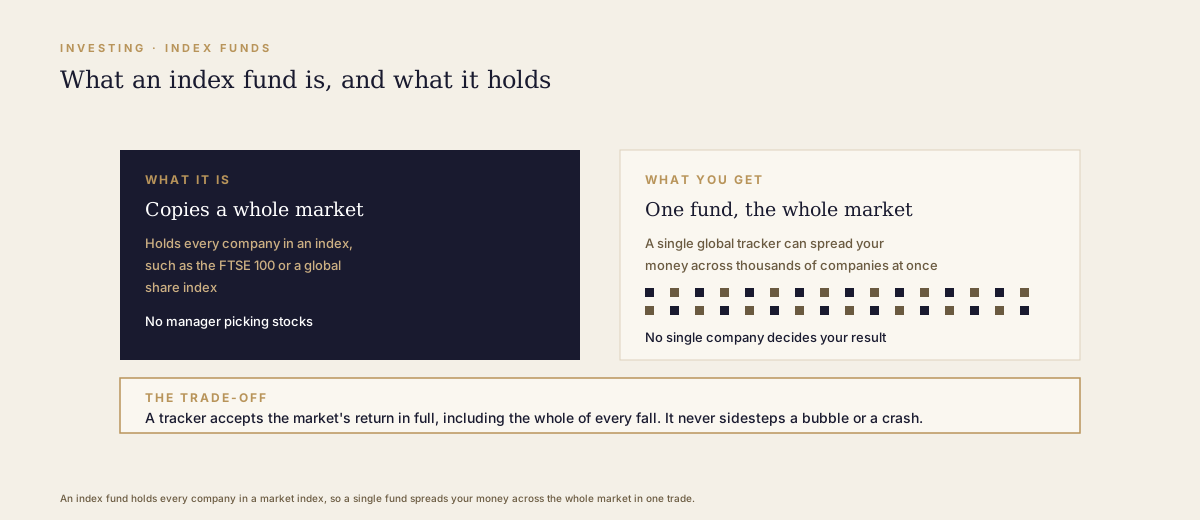
An index fund is a pooled investment that holds the constituents of a market index, such as the FTSE 100 or a global share index, in order to copy its return rather than beat it. Most copy a whole market by holding every company in an index, so a single fund spreads your money across hundreds or thousands of holdings at once. That broad diversification, run by fixed rules rather than a manager's judgement, is why they tend to do their job well. The trade-off is that a tracker accepts the market's return in full, including the whole of every fall.
An index fund is a ready-made basket of investments that copies a market, such as the 100 largest companies on the London Stock Exchange, instead of relying on a manager to pick winners. You buy a single fund and own a slice of every company in that index, in proportion to its size. That instant spread across a whole market, achieved in one trade and run by fixed rules rather than anyone’s judgement, is the quiet engine behind the long-run record of index funds. The catch is equally simple: an index fund rises and falls right along with the market it tracks.
The figures in this article are correct for the 2026/27 tax year.
What does an index fund actually hold?
An index fund holds the same companies as the index it follows, in the same proportions. A FTSE 100 tracker holds all 100 companies weighted by size, so a firm that is 4% of the index is roughly 4% of the fund. You own a small slice of every company at once, which spreads risk widely.
Contents
- What is an index fund?
- How does an index fund work?
- Do index funds beat actively managed funds?
- What are the drawbacks of index funds?
- How do index funds fit into your wider plan?
- Are index funds worth it?
What is an index fund?
An index fund is a fund that aims to match a market index rather than beat it. An index is simply a defined list of investments that represents a market or part of one: the FTSE 100 is the hundred largest companies listed in London, the S&P 500 is five hundred of the largest in the United States, and a global index can hold several thousand companies across dozens of countries. Buy a fund that tracks one of these and your money is spread across every holding at once.
That spread is the first thing an index fund gives you. A single global tracker can own shares in thousands of companies, so the failure of any one of them barely registers. Index funds sit among the mainstream, lower-complexity ways to invest, precisely because instant diversification removes the need to assess individual companies.
The second thing it gives you is predictability. An index fund follows a rulebook, not a hunch, so what it holds is knowable in advance and it never depends on a star manager staying sharp or staying put. Index funds turn investing from a contest you are likely to lose into a market return you are very likely to capture. Understanding how passive and active approaches differ is the natural next step once the basic idea is clear.
How does an index fund work?
An index fund works by replication: it buys the companies in its target index in the same weights the index uses. If a company makes up 4% of the FTSE 100, it makes up roughly 4% of a FTSE 100 tracker. As a company’s value rises or falls, its weight in the index shifts, and the fund follows along without anyone making a decision. This is why index funds are described as passively managed.
Some funds hold every single constituent (full replication), while others hold a representative sample that behaves like the index (sampling), which is common on indices with thousands of small holdings. The gap between a fund’s return and the index it follows is called tracking error, and a well-run tracker keeps it tiny, usually a fraction of a percent.
Index funds come in two common forms. A traditional index fund is priced once a day and bought through a platform or provider. An exchange-traded fund, or ETF, holds an index in the same way but trades on a stock exchange at a live price throughout the day, like a share. For a long-term investor the choice between the two matters far less than which index the fund tracks. That single decision settles what you actually own, alongside the other building blocks of a portfolio such as bonds and cash.
Risk warning
The value of investments and any income from them can fall as well as rise. You may not get back the full amount invested.
Do index funds beat actively managed funds?
Over the long run, index funds have beaten the majority of actively managed funds. The Financial Conduct Authority’s Asset Management Market Study concluded that, on average, actively managed funds did not outperform their benchmarks. The average active manager, in other words, does not deliver the market-beating return that the whole strategy is meant to produce.
This does not mean no active fund ever wins. In any period some managers beat their index, sometimes by a lot. The difficulty is identifying those managers in advance and knowing they will keep winning, because past success is a weak guide to future results. A handful outperform in any given decade, but few do so consistently, and choosing the right one before the fact is closer to a guess than a plan. An index fund sidesteps that contest by simply taking the market return.
An index fund will never beat the market, and that is precisely its strength: it declines to play a game most investors lose, and settles for the return the majority of active funds fail to match.
What are the drawbacks of index funds?
The main drawback of an index fund is that it offers no defence: it will follow its market all the way down in a crash, because tracking the index is the whole point. There is no manager to move into cash, rotate away from overpriced sectors, or hold back when a market looks stretched. If the FTSE 100 falls 30%, a FTSE 100 tracker falls close to 30% with it.
A second, subtler drawback is concentration inside the index itself. A fund weighted by company size automatically holds more of whatever has already risen most, so a tracker can become quietly dominated by a few giant companies or a single sector. You own the market, including its bubbles, and you buy more of an overvalued stock simply because it has grown large. The balance between shares and other assets does more to control your overall risk than the choice of tracker.
Index funds also lock you into the index’s definition of a market. A plain global tracker will not tilt toward your values, avoid a particular industry, or lean into a theme you believe in, without choosing a more specialist index, which usually means narrower diversification and a step away from the broad market. The FCA’s golden rules of investing stress being clear on your goals and taking a long-term view before you invest, and a broad tracker is a tool, not a complete plan in itself.
How do index funds fit into your wider plan?
Index funds are usually the engine of a plan rather than the plan itself. The bigger decisions sit around them: how much to invest, the split between shares and safer assets, and which tax wrapper holds the money. A well-chosen tracker inside the wrong structure, or with the wrong asset mix behind it, can still produce a disappointing result.
Wrappers decide how much of the return you keep. Holding index funds inside a Stocks and Shares ISA shelters the growth and income from tax, and you can shelter up to the £20,000 ISA allowance for 2026/27 each year. Held outside a wrapper, the same funds can generate a capital gains tax bill when you sell, since the annual exempt amount is only £3,000 in 2026/27. The fund you choose and the wrapper you hold it in are two separate decisions, and both matter.
Because an index fund drifts as markets move, the high-performing parts grow to dominate over time, which is why a rules-based rebalancing habit keeps your risk in line with your intentions. How those pieces fit together, the wrappers, the asset mix and the rebalancing, is exactly the territory a coherent investment plan is built to handle.
Risk warnings
Investments
The taxation of the investment is dependent on the individual circumstance of each investor, and may be subject to change in the future.
ISAs
The favourable tax treatment of ISAs may be subject to changes in legislation in the future.
An investment in a Stocks & Shares ISA will not provide the same security of capital associated with a Cash ISA.
Are index funds worth it?
For most long-term investors, index funds are worth it, because their central advantage is close to certain while their main disadvantage is shared by nearly every alternative. Broad diversification is yours from the day you buy, and it does the one thing every investor needs: it stops the fortunes of any single company from deciding your result. The chance of choosing an active fund that reliably beats the market, by contrast, is low and impossible to confirm in advance.
The honest trade-off is that an index fund buys you the market’s full downside along with its long-run growth, and it will never protect you from a bad year. If what you want is a manager actively steering risk, or exposure to something no mainstream index captures, a tracker alone will not provide it. For the core of a long-term portfolio, though, the combination of broad diversification and a return you can actually count on capturing is difficult to beat, which is why index funds have become the default building block for so many sensible plans rather than a clever exception to them.
Frequently asked questions
What is an index fund?
An index fund is a pooled investment that holds the companies in a market index, such as the FTSE 100, in the same proportions, so its return closely matches the market's. No manager picks the stocks; the fund simply follows the index by fixed rules, which is why it is called passive.
How does an index fund work?
An index fund works by tracking a market index using fixed rules instead of a manager's judgement. It buys the index's constituents in their index weights and adjusts automatically as those weights change, so its return stays close to the market's. This rules-based approach, with no manager deciding what to buy, is why it is called passive.
What is the difference between an index fund and an ETF?
Both track an index, but an exchange-traded fund (ETF) is bought and sold on a stock exchange at a live price through the day, while a traditional index fund is priced once a day. For a long-term investor the practical difference is small; the more important factor is which index the fund tracks, since that decides what you actually own.
Are index funds riskier than actively managed funds?
An index fund carries the full risk of the market it tracks, so it falls just as far as that market in a downturn. An active fund can in theory hold defensive positions, but most do not protect investors in practice. The main risk in both cases is the underlying market, not the fund type.
Do index funds pay dividends?
Yes. An income version pays out the dividends from the underlying companies, usually a few times a year. An accumulation version reinvests them inside the fund instead, increasing the value of your units. Both are taxed the same way outside an ISA or pension.
Can you lose money in an index fund?
Yes. An index fund follows its market down as well as up, so if the market falls, your investment falls with it. There is no manager and no built-in protection. The historical case for index funds rests on long holding periods, during which major markets have tended to recover and grow.
Are index funds worth it?
For most long-term investors, yes. A single fund gives you broad diversification, while the chance of picking an active fund that reliably beats the market over decades is small and hard to judge in advance. They are less suitable if you specifically want exposure that no index captures, or active management of risk.
Risk warnings
The value of pensions and any income from them can fall as well as rise. You may not get back the full amount invested.
Levels and bases of, and reliefs from, taxation are subject to change and their value will depend upon personal circumstances. Taxation and pension legislation may change in the future.
A pension is a long-term investment and the value is not guaranteed. Any advice or considerations are personal to each individual’s circumstances.
A pension is a long-term investment, the value of your investment and the income from it may go down as well as up. Your eventual income may depend upon the size of the fund at retirement, future interest rates and tax legislation.