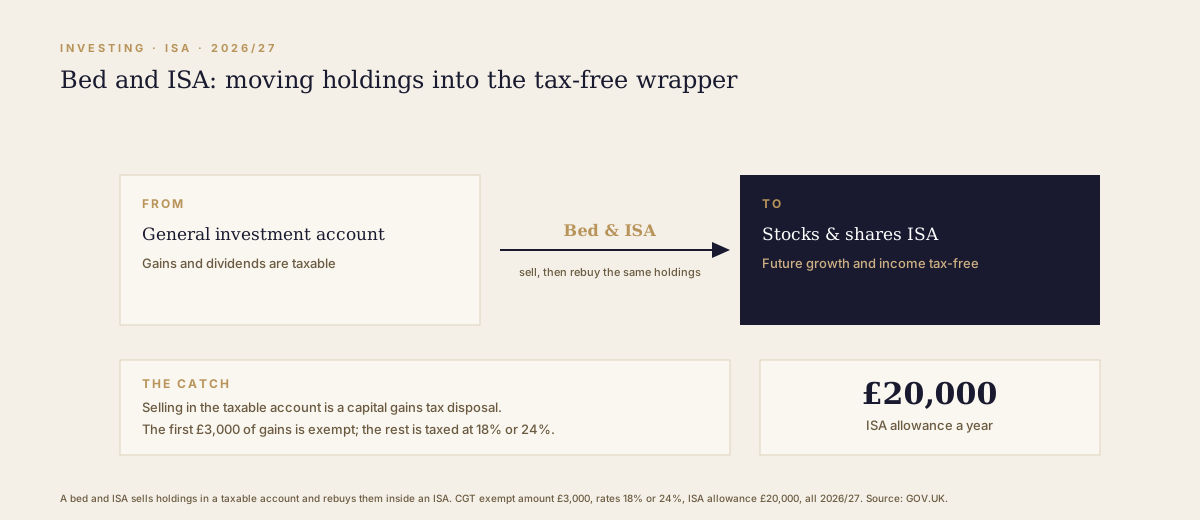
Bed and ISA is a transaction that sells investments held in a taxable account and immediately repurchases them inside a stocks and shares ISA, where their growth is no longer liable to capital gains tax and their income no longer liable to income tax. It matters most if you hold funds or shares outside a wrapper and expect to keep them for years, because the shelter then applies to every gain and every dividend along the way. The catch is that selling in the taxable account is a capital gains tax disposal, so a large embedded gain can trigger a bill in the year you move it. Spreading the move across tax years is the usual way to keep each year's gain within the annual exempt amount.
A bed and ISA moves investments you already hold in a taxable general investment account into a stocks and shares ISA, where future growth is free of capital gains tax and future income is free of income tax. It is a single, linked instruction: your provider sells the holdings, uses the cash to fund your ISA, then buys the same investments back inside the wrapper. The appeal is simple. Outside an ISA, gains above the annual exempt amount and dividends above the dividend allowance are taxable; inside one, they are not. The figures and thresholds throughout this article reflect the 2026/27 tax year.
How does a bed and ISA work?
A bed and ISA works in three steps: your provider sells investments held in a taxable account, uses the proceeds to subscribe to your stocks and shares ISA, then repurchases the same investments inside it. The sale is a capital gains tax disposal, and the repurchase shelters all future growth from capital gains tax and all future dividends from income tax.
Contents
- What is a bed and ISA?
- How does a bed and ISA work?
- Does a bed and ISA trigger capital gains tax?
- Does the 30-day rule stop a bed and ISA?
- Why does a bed and ISA matter for your plan?
- How much can you bed and ISA in a year?
- Is a bed and ISA worth it?
What is a bed and ISA?
A bed and ISA is a transaction that sells investments in a taxable account and immediately repurchases them inside a stocks and shares ISA. The holding does not change; its tax treatment does. The name borrows from the older bed and breakfasting trade, where investors sold and rebought shares to manage a tax year, but the ISA version has a different purpose: to put assets permanently beyond capital gains tax and income tax.
People end up with investments outside an ISA for ordinary reasons. They may have used their full ISA allowance in earlier years and invested the surplus in a general investment account, inherited a share portfolio, or received shares from an employer scheme that have since vested. Those holdings sit exposed to capital gains tax on every future gain and income tax on every dividend, which is the gap a bed and ISA closes. The wrapper, not the investment, is what changes. That distinction matters because the wrapper an investment sits in shapes how much of its return you keep, which is a different question from how well the fund performs.
The Individual Savings Account is the destination, and specifically the stocks and shares version, because it can hold the repurchased funds or shares. A cash ISA cannot, since it holds only deposits. So a bed and ISA is really a way of feeding an existing portfolio into the one wrapper that keeps capital gains tax off its growth and income tax off its dividends for as long as the holdings stay there.
Risk warnings
Investments
The value of investments and any income from them can fall as well as rise. You may not get back the full amount invested.
The taxation of the investment is dependent on the individual circumstance of each investor, and may be subject to change in the future.
ISAs
The favourable tax treatment of ISAs may be subject to changes in legislation in the future.
Cash and deposits
While cash provides security of capital, it may not keep pace with inflation. Over time, the real value of your savings could fall.
How does a bed and ISA work?
A bed and ISA works by selling the holdings in your taxable account, using the proceeds to subscribe to your stocks and shares ISA, then repurchasing the investments inside it. Most providers run the whole sequence as a single instruction, so you are out of the market only briefly, often for less than a day. The “bed” is the sale; the ISA subscription and repurchase complete the move.
The process is not entirely free. There is usually a small spread between the price you sell at and the price you rebuy at, a dealing charge may apply, and repurchasing UK shares attracts stamp duty of 0.5% (most funds are exempt). Against the capital gains tax and income tax saved over the years a holding stays sheltered, those costs are typically minor, but they are real and worth checking with your provider before you start.
Does a bed and ISA cost anything?
A bed and ISA can carry small costs: the spread between the sale and repurchase prices, any dealing charge your provider applies, and stamp duty of 0.5% on repurchased UK shares (funds are usually exempt). Many providers reduce or waive the dealing charge on the ISA repurchase, so the total is generally modest.
One detail catches people out: ISA subscriptions must be made in cash. You cannot usually transfer existing general account holdings straight into an ISA without selling them, which is exactly why a sale sits at the heart of the process. The narrow exception is shares leaving a SAYE option scheme or a Share Incentive Plan, which can be moved into an ISA within 90 days without a disposal on the open market.
Does a bed and ISA trigger capital gains tax?
Yes. Selling the holdings in your taxable account is a disposal for capital gains tax, even though you buy them straight back. The repurchase does not cancel the sale, so any profit built up since you bought the investments is crystallised at that point. For most investors this is a feature rather than a flaw, because the disposal is what lets you use an allowance that would otherwise be wasted.
For 2026/27 the first £3,000 of gains is covered by the annual exempt amount, and only gains above that figure are taxable. The rate then depends on your income: gains are taxed at 18% within your remaining basic-rate band and 24% above it for 2026/27. Because the £3,000 allowance is lost if you do not use it, a modest bed and ISA each year can shelter holdings at no capital gains tax cost at all.
Daniel and Sofia, both 57, each with £50,000 in the same fund
Daniel’s £50,000 holding carries a £2,500 unrealised gain. Sofia’s identical £50,000 holding carries a £9,000 gain, because she bought several years earlier. Both decide to bed and ISA £20,000 of the holding in 2026/27.
Selling £20,000 of a £50,000 holding crystallises two fifths of the embedded gain. For Daniel that is £1,000, comfortably inside the £3,000 annual exempt amount, so no capital gains tax is due. For Sofia it is £3,600, which is £600 above the allowance.
As a higher-rate taxpayer, Sofia pays 24% on that £600, a £144 capital gains tax bill, while Daniel pays nothing. The same £20,000 move costs one of them £144 purely because the holding carried a larger gain. Splitting Sofia’s move across two tax years would keep each year’s gain under the £3,000 allowance and remove the charge.
The lesson is that the capital gains tax on a bed and ISA is driven by the size of the embedded gain, not the value moved. How that gain is worked out, including share pooling where a holding was built up over time, is covered in capital gains tax on shares. The practical point is to check the gain before you sell, not after.
Does the 30-day rule stop a bed and ISA?
No. The 30-day share-matching rule that blocks ordinary bed and breakfasting does not undo a bed and ISA, because the investments are repurchased inside the ISA rather than in the taxable account. Bed and breakfasting is selling shares and buying them back shortly afterwards so the disposal falls in a chosen tax year. To stop that, the rules match a sale with any repurchase of the same shares within 30 days, treating the gain as if the sale never happened.
A bed and ISA sidesteps this because the repurchase happens inside the ISA wrapper, where the holding is outside capital gains tax entirely. The disposal in the general investment account still stands, so the gain is crystallised as intended and your annual exempt amount is used. You keep your market exposure throughout and still bank the gain in the current year, which is the whole point of the exercise.
The distinction HMRC draws is between leaving the market on paper and leaving it in substance. A bed and ISA does the latter: the holding exits the taxable account for good and re-emerges inside a wrapper where its gains no longer attract capital gains tax and its dividends no longer attract income tax.
Risk warnings
The Financial Conduct Authority does not regulate Cashflow Planning.
HM Revenue and Customs practice and the law relating to taxation are complex and subject to individual circumstances and changes which cannot be foreseen.
Why does a bed and ISA matter for your plan?
A bed and ISA matters because it changes how an entire portfolio is taxed for as long as you hold it, not just in the year you do it. Once investments sit inside the ISA, every future gain is free of capital gains tax and every dividend is free of dividend tax, where the allowance is just £500 and rates rose to 10.75%, 35.75% and 39.35% from April 2026. For an income-producing portfolio, sheltering the dividends can matter as much as sheltering the gains.
The same logic extends to interest and the wider question of where each pound is best held. Cash and bond income outside a wrapper uses up your personal savings allowance before income tax applies, and dividend-heavy portfolios run by company owners face their own pressures, which we cover in dividend tax for company directors. A bed and ISA is one tool within that broader sequencing decision, not a standalone trick.
One thing a bed and ISA does not do is change your inheritance tax position. Both the general investment account and the ISA sit inside your estate, where most holdings are exposed to inheritance tax at 40% above your available nil-rate bands, so moving between them shelters the growth and the income and leaves the estate position exactly where it was.
A bed and ISA does not change what you own. It changes where you own it, and that single shift decides whether your future dividends and gains are taxed at all.
Framed this way, the move is less about a one-off saving and more about steadily migrating an unwrapped portfolio into one sheltered from capital gains tax and income tax, year by year, until little remains exposed.
How much can you bed and ISA in a year?
You can bed and ISA up to your ISA allowance, which is £20,000 a year for 2026/27 across all the ISAs you pay into. The amount moved counts as a fresh subscription, so a £20,000 bed and ISA uses your entire allowance for the year, and any allowance not used cannot be carried into the next year.
A couple can move up to £40,000 between them by each using their own £20,000 limit, and because transfers between spouses are made on a no gain, no loss basis, holdings can be shifted to whichever partner has spare allowance or a lower tax rate first. Where a holding carries a large embedded gain, spreading the move across several tax years lets you use a fresh £3,000 annual exempt amount each year and keep the running tax cost at nil. How the £20,000 limit splits across cash and investments is set out in the ISA allowance explained. The cash ISA sub-limit for under-65s, £12,000 a year from 6 April 2027, does not restrict a bed and ISA, because the money lands in a stocks and shares ISA. If anything it points the other way: from that date an under-65 has £8,000 of allowance that can only be used on investments, and an unwrapped holding is already an investment looking for a wrapper.
How much can you move with a bed and ISA each year?
For 2026/27 you can move up to £20,000 with a bed and ISA, the annual ISA subscription limit across all your ISAs. A couple can move up to £20,000 each by using both allowances. Unused ISA allowance cannot be carried forward into the next tax year.
Deciding how much to move, and over how many tax years, is exactly the kind of question that investment advice is built around, because it balances the tax saved against the gain crystallised and the order in which other allowances are used.
Is a bed and ISA worth it?
A bed and ISA is usually worth it if you hold investments in a general investment account and have ISA allowance to spare, because it ends future capital gains tax and dividend tax on those holdings for the cost of a single transaction. The longer you expect to hold the investments and the more income they produce, the stronger the case, since the sheltering compounds with every year and every dividend.
The trade-offs are genuine but contained. The sale can crystallise a capital gains tax bill if the embedded gain exceeds your £3,000 annual exempt amount for 2026/27, and there are small dealing, spread, and stamp duty costs on the repurchase. There is also a brief spell out of the market while the trade settles. None of these usually outweigh the benefit, but a large embedded gain is a reason to spread the move across tax years rather than abandon it. The question is rarely whether to do a bed and ISA, but how much to move and when, so that the holdings end up sheltered without an avoidable capital gains tax charge along the way.
Frequently asked questions
What is a bed and ISA?
A bed and ISA is a transaction that sells investments held in a taxable account and immediately repurchases them inside a stocks and shares ISA. The point is to move existing holdings inside a wrapper where their growth sits outside capital gains tax and their dividends outside income tax.
Does a bed and ISA trigger capital gains tax?
Yes. Selling the holdings in your taxable account is a disposal for capital gains tax, even though you buy them straight back. For 2026/27 the first £3,000 of gains is covered by the annual exempt amount, so only gains above that are taxed, at 18% or 24%.
Does the 30-day rule apply to a bed and ISA?
No. The 30-day share-matching rule that blocks ordinary bed and breakfasting does not undo a bed and ISA, because the investments are repurchased inside the ISA rather than in the taxable account. The disposal in the general investment account still crystallises the gain, which is the intended outcome.
Is a bed and ISA worth it?
A bed and ISA is usually worth it if you hold investments in a taxable account and have ISA allowance to spare, because it ends future capital gains tax and income tax on those holdings. The main trade-off is any capital gains tax due on the sale, and small dealing or stamp duty costs on the repurchase.
Do you have to sell your investments to do a bed and ISA?
Yes, in almost all cases. ISA subscriptions must be made in cash, so the holdings are sold and rebought rather than transferred across directly. The exception is shares coming out of a SAYE or Share Incentive Plan, which can be moved into an ISA within 90 days without a sale.
Can you do a bed and ISA with a cash ISA?
Not in the usual sense. A bed and ISA repurchases investments, so it needs a stocks and shares ISA. You can sell investments and pay the cash into a cash ISA instead, but you would then be holding cash rather than the original investments.