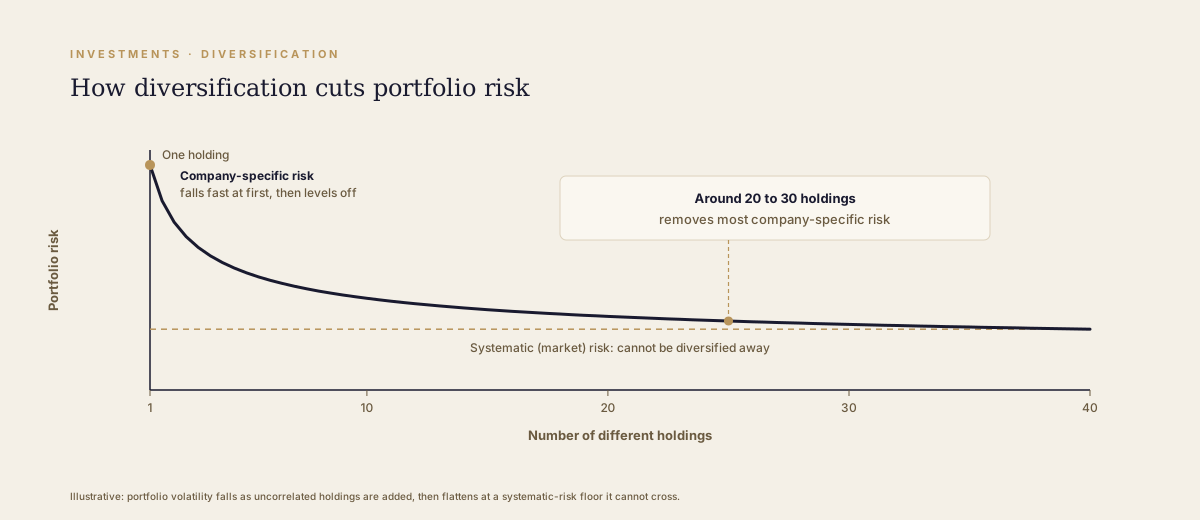
Diversification is an investment strategy that spreads money across different assets, sectors, and regions whose prices do not move in step, so that a fall in one holding is offset by others. Holding a mix of assets that behave differently is the one reliable way to cut risk without giving up expected return. It works because different holdings fall for different reasons, so they rarely all drop at once. What it cannot do is remove the market-wide risk that occasionally pulls almost everything down together, as UK investors saw in 2022.
Diversification is the simple idea that you should not stake your financial future on a single company, a single sector, or a single country. Spread your money across investments that respond to different economic forces and a bad year for one of them need not be a bad year for all of them. It is often called the only free lunch in investing, because it is the rare technique that lowers your risk without lowering the return you can reasonably expect. That claim is real, but it rests on conditions that are easy to miss, and a portfolio can look diversified while quietly resting on one bet. This article explains how diversification works, what you can spread across, and where its protection runs out.
All market figures in this article are stated as at August 2026.
What does diversification mean in investing?
Diversification means spreading your money across different assets, sectors, and regions so that no single holding can sink the whole portfolio. Because the holdings respond to different forces, they rarely all fall at once, which smooths returns over time. It reduces the risk tied to any one investment, though it cannot remove the market-wide risk that affects almost everything together.
Contents
- What is diversification?
- Why does diversification reduce risk without cutting your return?
- What can you spread your investments across?
- Are you as diversified as you think?
- How much diversification is enough?
- The risks diversification cannot remove
- Where diversification fits in your wider plan
- Should you diversify or back your best ideas?
What is diversification?
Diversification is spreading your investments so that your outcome does not hinge on any single one of them. In practice that means owning a range of assets, such as shares, bonds and cash, across different industries and different parts of the world, chosen so that they do not all rise and fall together. The main types of investments each behave differently: shares chase company growth, bonds respond to interest rates, cash sits still. Holding several of them means that when one is having a poor year, another may be having a good one, and the swings partly offset.
The Financial Conduct Authority describes it as spreading your investments so you are less dependent on any one holding performing well. That is the whole of the idea in a sentence. What makes it powerful, rather than merely sensible, is that it is close to free: done properly it reduces how much your portfolio lurches around without asking you to accept a lower long-term return in exchange.
Risk warning
Investing in shares should be regarded as a long-term investment and should fit in with your overall attitude to risk and financial circumstances.
Why does diversification reduce risk without cutting your return?
Diversification reduces risk without cutting your expected return because it works on the volatility of a portfolio, not on its average. If you hold two investments that each earn, say, 7% a year on average but rarely have a bad year at the same time, the combined portfolio still averages around 7%, yet its year-to-year path is far smoother than either holding alone. You have removed swings, not return.
The mechanism is correlation: the degree to which two holdings move together. When holdings have low or negative correlation, one tends to hold firm or rise while the other falls, so the peaks and troughs partly cancel. This is the insight behind the framework known as Modern Portfolio Theory, set out by Harry Markowitz in the 1950s, which showed mathematically that combining imperfectly correlated assets can lower a portfolio’s overall risk for the same expected return. You do not need the mathematics to use it, but it is worth knowing the free lunch has a formal proof behind it, not just a proverb.
Why does diversification not reduce your expected return?
Diversification blends the ups and downs of holdings that move differently, which smooths the portfolio's path without changing its long-run average. If two holdings each average 7% a year but seldom fall together, the mix still averages around 7% while swinging far less. You are removing volatility, not return, which is why it is often called the only free lunch in investing.
What can you spread your investments across?
You can spread investments across several different dimensions at once, and real diversification usually means combining them rather than relying on any one. Owning a hundred UK companies protects you from any one of them failing, but not from a bad decade for the UK economy as a whole. The point is to hold things exposed to genuinely different risks.
| What you spread across | What it protects against | In practice |
|---|---|---|
| Companies | One firm failing or disappointing | Hundreds of shares, not five |
| Sectors | A whole industry falling out of favour | Not only banks, or only technology |
| Asset classes | Shares, bonds and cash react to different forces | A mix of shares and bonds |
| Regions | One country’s economy stalling | Global exposure, not UK-only |
| Time | Committing everything at a single price | Investing steadily across market cycles |
The regional point catches out a lot of UK investors. It feels natural to hold what you know, so British savers often keep most of their money in British shares. That is home bias, and it quietly concentrates a portfolio in a market that is a small slice of the world. Widening the geography is one of the cheapest and largest diversification gains available, and a global index fund is one common way to get that reach.
Reach across companies is only one of the five rows in that table, though, and it is not the row that decides how bad your worst year feels. That is set by how much you hold in shares at all, against bonds and cash, and by how long you have before you need the money. A fund holding six thousand companies is still a fund holding only shares.
Are you as diversified as you think?
The most common mistake is confusing the number of funds you own with how diversified you are. Six funds that all hold the same large companies are not six bets. They are one bet wearing six labels. Diversification is measured by how differently your holdings behave, not by how many lines appear on your statement, and two portfolios with the same number of holdings can carry wildly different amounts of real risk.
This is where overlap does its damage. Many popular UK funds hold the same familiar large companies, so the ten biggest holdings can be a large share of each fund and largely the same names from one fund to the next. Stack several of them together and you have concentrated, not spread.
Diversification is not measured by how many funds you own but by how differently they behave. Six funds holding the same companies are one bet in six wrappers, not a spread of risk.
Yasmin and Malcolm: same money, very different risk
Yasmin, 52, holds £80,000 spread across six different UK equity income funds. She feels well diversified: six funds, six managers, six names on the statement. But each fund is built from the same pool of large UK dividend payers, so the same fifteen or so companies, mostly banks, oil majors, pharmaceutical and consumer giants, sit near the top of every one of them. Illustratively, well over half of her £80,000 tracks the fortunes of that same small group.
Malcolm, 54, holds the same £80,000 across three funds that each do a different job: a global equity fund spanning several thousand companies in dozens of countries, with the UK making up only around 3% of it, a bond fund, and a smaller holding in commercial property.
When UK large-caps had a weak stretch, all six of Yasmin’s funds fell together, because underneath they were the same bet. Malcolm’s equity fund barely noticed, because the UK was a small corner of it, and his bond fund was answering to interest rates rather than to UK dividends.
The lesson is not that three funds beat six. Yasmin’s problem is not the number; it is that her six overlap. Six funds chosen to do six different jobs would have spread her risk properly. What decides Malcolm’s outcome from here is not the fund count either, but the split between his shares, bonds and property, and whether that split matches when he needs the money.
How much diversification is enough?
Diversification has diminishing returns, and most of the benefit arrives surprisingly early. When you hold a single share, a large part of your risk is specific to that one company: a profit warning, a scandal, a lost contract. Add a second unrelated company and that company-specific risk starts to fall. By the time you hold around 20 to 30 genuinely different shares, spread across sectors, most of it is gone, and adding the thirty-first name barely moves the needle. A broad index fund clears that hurdle inside its own holdings, which is why the number of companies stops being the interesting question once you own one, and the mix around it starts.
Beyond that, more is not better. Piling up overlapping funds is sometimes called di-worse-ification: you add cost, admin and confusion without adding real spread, and you can dilute the portfolio into something you no longer understand or bother to review.
Holding several funds is not the mistake. Holding several that do the same job is. A portfolio built from index funds, one for global shares, one for bonds, perhaps one weighting an asset or a region deliberately, is a lot of funds doing genuinely different work, and that has nothing to do with the active versus passive investing choice, which is about how each fund is run rather than how many you hold. Enough is the level at which one setback cannot dominate your outcome, and that is reached with far fewer, better-chosen holdings than most people assume.
The risks diversification cannot remove
Diversification removes the risk tied to any one holding, but it cannot remove the risk that hits the whole market at once. That market-wide danger is called systematic risk, and it is the floor beneath every diversified portfolio. A global recession, a spike in inflation, a shock to interest rates: these pull almost everything down together, and no amount of spreading escapes them. The dot at the bottom of the diversification curve never reaches zero.
2022 was the clearest recent reminder. As inflation surged and interest rates rose sharply, shares and gilts fell in the same year, and the holding meant to be the safe one fell hardest: gilt funds lost around 20% while global shares fell about 8.5% in sterling terms. A diversified investor still lost money. That combination is unusual rather than unheard of. It happened in 1994 too, when the interest rate shock that began with US rate rises that February hit bond markets worldwide and UK share prices ended the year about 10% lower. The reason this happens sits in the relationship between shares and bonds: most of the time they move for different reasons, but in an inflation shock they move for the same one. Diversification cushioned the fall for most; it did not prevent it.
This is why diversification is a tool, not a guarantee, and why the timing of a shock matters as much as its size. A market-wide fall early in retirement, when you are drawing an income, does far more damage than the same fall while you are still saving. That is sequence of returns risk, and it is the reason a sensible plan pairs diversification with a cash buffer, so you are less likely to be forced to sell into a falling market.
Where diversification fits in your wider plan
Diversification is one layer of a plan, not the whole of it, and where you hold your investments matters alongside what you hold. The same fund behaves very differently inside an ISA, a pension or a taxable account, so spreading across types of investment wrapper is its own form of diversification, this time of tax treatment and access. Using your ISA allowance, £20,000 a year for 2026/27, alongside a pension gives you both tax-free growth and flexibility, rather than betting the whole plan on one set of rules staying still.
Diversification is not a one-off setting either. Left alone, a portfolio drifts as its winners grow into an outsized share and quietly rebuild the concentration you started by removing. Rebalancing periodically trims what has run ahead and tops up what has lagged, keeping the spread you designed. It is unglamorous and it works.
The principle is taken so seriously that it is written into law for pension schemes. The Occupational Pension Schemes (Investment) Regulations 2005 require that a scheme’s assets be “properly diversified in such a way as to avoid excessive reliance on any particular asset”. If you are in a workplace pension, the default fund you were placed in is a diversified, low-cost portfolio by design: The Pensions Regulator expects trustees to run a well-diversified default arrangement within a charge cap of 0.75% a year for 2026/27.
That governs the spread of the holdings. It does not settle the question underneath it, which is how much of your money sits in shares at all. Most workplace defaults are lifestyle funds, which move you out of shares and into bonds and cash automatically as you approach a target retirement date, usually the one the scheme assumed rather than one you chose. The holdings stay diversified the whole way through while the asset mix changes underneath you, sometimes years before you plan to stop working, and often toward an outcome the fund takes for granted, such as buying an annuity, that may not be the one you want. Being in a properly diversified default is not the same as being invested in line with your own plan. It is worth knowing what your default holds today and what date it is steering toward.
Deciding how much to hold in each asset, region and wrapper, and how that blend fits your own timeline and tolerance for a bad year, is the judgement that personal investment advice exists to support.
Risk warnings
Investments
The taxation of the investment is dependent on the individual circumstance of each investor, and may be subject to change in the future.
ISAs
The favourable tax treatment of ISAs may be subject to changes in legislation in the future.
Pensions
The value of pensions and any income from them can fall as well as rise. You may not get back the full amount invested.
Levels and bases of, and reliefs from, taxation are subject to change and their value will depend upon personal circumstances. Taxation and pension legislation may change in the future.
A pension is a long-term investment and the value is not guaranteed. Any advice or considerations are personal to each individual’s circumstances.
A pension is a long-term investment, the value of your investment and the income from it may go down as well as up. Your eventual income may depend upon the size of the fund at retirement, future interest rates and tax legislation.
Should you diversify or back your best ideas?
For almost everyone, the answer is diversify. Concentrating your money in a few high-conviction picks can produce a spectacular result, and every era has a handful of investors who got rich doing exactly that. What you do not see is the far larger number who backed their best ideas and were wrong, because a concentrated bet that fails can take a plan down with it. You rarely know in advance which group you are in.
The honest trade-off is this: diversification gives up the small chance of a life-changing win in return for a much better chance of a good, durable outcome. For money you are relying on, to retire, to stay retired, to pass on, that is the right trade almost every time. If you want to back a specific conviction, the disciplined version is to do it with a small, ring-fenced slice you can afford to lose, while the core of your wealth stays diversified. The mistake is not having a strong opinion. It is letting one opinion carry your whole future.
Frequently asked questions
What is diversification in simple terms?
Diversification is not putting all your eggs in one basket. It means holding a range of investments that respond to different forces, so a bad year for one need not be a bad year for all. The aim is a smoother ride, not a bigger return.
How does diversification actually reduce risk?
It reduces risk by combining holdings whose prices do not move in step. When one falls, another may be flat or rising, so the swings partly cancel out. The lower the correlation between holdings, the more the combined portfolio's ups and downs are smoothed.
Is it better to hold one global fund or several UK funds?
One broad global fund is usually more diversified than several UK funds, because the UK is only around 3% of the world market and UK funds tend to hold the same large companies. Owning six funds that overlap heavily is closer to one bet than to six.
Can you be too diversified?
Yes, in a mild sense. Past roughly 20 to 30 well-chosen holdings, adding more removes very little further risk, and stacking overlapping funds mainly adds cost and complexity. The bigger danger is diluting a portfolio into so many holdings that you cannot understand or manage it.
Does diversification protect you in a market crash?
Only partly. Diversification removes the risk tied to any single company or sector, but not the market-wide risk that hits almost everything at once. In 2022, shares and gilts fell together, so a diversified investor still lost money, just less than a concentrated one in most cases.
How many shares or funds do you need to be diversified?
For the share element, a broad global fund holds several thousand companies, so the company count is rarely what limits you. Holding individual shares, most of the company-specific risk is gone by around 20 to 30 names spread across sectors, provided they are genuinely different businesses. Neither figure answers how much you should hold in shares rather than bonds or cash, which matters far more to your worst year than the number of holdings does.
Should you diversify or back your best ideas?
For almost everyone, diversify. Concentrating on a few high-conviction picks can pay off spectacularly, but it can also destroy a plan, and you rarely know in advance which it will be. Diversification trades the small chance of a spectacular result for a far better chance of a good one.