A trustee of a life insurance trust is a person legally appointed to own the policy, claim the proceeds when the person assured dies, and hold or pay them to the beneficiaries. Appoint at least two trustees besides yourself, and make sure at least one is likely to outlive you. A trust with no surviving trustee cannot claim, so the money waits for probate, which is the delay the trust was set up to avoid. Whether you can change your mind about a trustee afterwards depends on the deed: some reserve you a power to appoint and remove, and where none does, the statutory grounds are narrow ones you cannot rely on.
The trustees of a life insurance trust are the people who legally own the policy and who alone can claim the money when you die. Everything the trust is supposed to achieve, a payout that reaches your family in weeks rather than months and sits outside the 40% inheritance tax charge, depends on there being a trustee alive, findable and able to sign when the claim arises. The tax rate and thresholds referred to here reflect the 2026/27 tax year. Most insurer trust forms give this decision one small box, next to the beneficiaries box, and neither box is as easy to revisit as its size suggests. On an absolute trust the beneficiaries are fixed the moment the deed is signed. The trustees can usually only be changed on the narrow statutory grounds, or under whatever power the deed happens to reserve. The difference is that the beneficiaries box decides who the money is for, and the trustees box decides whether it can be claimed at all.
Who can be a trustee of a life insurance trust?
Any adult of sound mind can be a trustee, including your spouse, an adult child, a sibling, a friend, or a paid professional. Beneficiaries may also act as trustees. The settlor should not be a beneficiary, because a settlor who can benefit brings the policy back into the estate for inheritance tax.
Contents
- What does a trustee of a life insurance trust do?
- Who should you choose as a trustee?
- How many trustees should a life insurance trust have?
- How do the trustees of a life insurance trust claim the payout?
- What happens if a trustee dies or loses capacity?
- Do the trustees have to register the trust with HMRC?
- Should you be a trustee of your own policy?
What does a trustee of a life insurance trust do?
A trustee holds legal ownership of the policy and is responsible for claiming the proceeds and getting them to the right people. That is the whole job, and for most of its life it involves doing nothing at all. The work arrives in a single concentrated burst at the worst possible moment for the people doing it.
There are four distinct responsibilities inside that job. The trustees hold the policy, which is what keeps it out of your estate once you have written the policy in trust. They make the claim, since the insurer will not pay anyone else. They decide, on a discretionary trust, which of the possible beneficiaries receives what. And they keep the trust’s paperwork in order, including the trust deed itself and any record of what they have paid out.
The standard they are held to is not a technicality. Section 1 of the Trustee Act 2000 sets a duty of care requiring trustees to act with the care and skill that is reasonable in the circumstances, judged against any special knowledge they hold and, for anyone acting in a professional capacity, against the standard expected of that profession. A solicitor acting as trustee is measured against solicitors. Your brother is measured against a reasonable person.
Who should you choose as a trustee?
Choose people who are likely to be alive, contactable and competent at the point of claim, and who between them understand what you wanted the money to do. Financial expertise is far less useful than availability, because in most cases the trustees are not investing anything. They are claiming a fixed sum and passing it on.
That reframes the choice. The question is not who is best with money, it is who will still be reachable, willing and legally able to sign a claim form on the worst week of your family’s life.
Who to consider as a trustee
| Option | What it brings | What to watch |
|---|---|---|
| Spouse or partner | Knows your intentions best | Often shares your risks and household |
| Adult child | Likely to outlive you comfortably | May also be a beneficiary |
| Sibling or close friend | Independent of your household | May not know your finances |
| Professional trustee | Continuity and formal record-keeping | Charges the trust for time spent |
The professional option is worth a moment’s thought rather than a reflex dismissal. A trust corporation or a solicitor acting professionally is entitled to charge the trust for their work, where a lay trustee acting for a family generally is not. On most claims that cost buys very little, because the money is not meant to sit anywhere. A surviving parent has a mortgage and a household to run, and the point of the cover is to hand it to them within weeks. A discretionary trust lets the trustees do exactly that, and then the trust is finished.
That is worth knowing before you fill in the beneficiaries box, because an absolute trust naming the children does not allow it. That money belongs to the children from the outset, so the trustees can only spend it on the children, not on the surviving parent’s own income or a mortgage in their sole name, and whatever is left is theirs outright at eighteen, or at sixteen in Scotland, whether or not the trustees think they are ready for it. If you want the survivor to have the choice, the discretionary form is the one to ask for.
The genuine case for a professional arises where there is no surviving parent to pay: both of you in the same accident, or a sole parent from the start. £300,000 to £700,000 of cover then really does have to be invested, accounted for and drawn on for as long as it takes the youngest child to grow up, which is not a period anyone can put a number to when the form is signed. You are buying that rather than a single claim form, and it is worth the charge for the family it happens to.
One person to keep off the list of beneficiaries is yourself. You can be a trustee of your own policy, and usually are, but a settlor who can also benefit from the trust has not really given anything away, and the policy is pulled back into the estate for inheritance tax.
Risk warnings
Your home may be repossessed if you do not keep up repayments on your mortgage. Think carefully before securing debts against your home.
Not all mortgage contracts are regulated by the Financial Conduct Authority.
How many trustees should a life insurance trust have?
Two beyond yourself is the sensible floor, and at least one of them should be someone whose life is not bound up with your own household. A trust of an insurance policy can legally run with a single trustee, which is why the forms allow it, but a single trustee is a single point of failure in an arrangement whose entire purpose is speed.
The failure is quiet and only appears at the moment it matters. If every trustee has died, the trust still exists and the policy still pays, but there is nobody with legal standing to claim it. The right to appoint a new trustee then passes to the personal representatives of the last surviving trustee, and reaching them means waiting for the grant of probate on that person’s estate. The trust was set up precisely to avoid that wait, and a thin trustee list hands it straight back.
Esther, 41, and Tomasz, 43: the same policy, one extra signature
Esther takes out £400,000 of level term cover and writes it in trust for her two children. On the insurer’s form she names herself and her husband Rob as trustees, which feels complete: two names, both parents, both invested in the outcome.
Tomasz sets up an almost identical policy in the same month. He names himself, his wife Halina, and his brother Marek, who lives two hundred miles away and has nothing to do with the couple’s day-to-day life.
Esther and Rob are killed in the same road accident. The trust survives them, the £400,000 is payable, and no living person can claim it, so the family waits on probate in Esther’s estate before a new trustee can even be appointed. On the same facts, Marek is a surviving trustee of Tomasz’s trust and can open the claim the following week. The difference between the two outcomes is one name on a form.
Adding trustees has a cost. Every surviving trustee has to sign the claim, so five people spread across three countries means five sets of signatures and identity checks, chased by post, before the insurer will release anything. That is friction rather than failure, and the two mistakes are not symmetrical: too many trustees makes a claim slow, too few can stop it outright until probate. Three is usually the right number.
Risk warning
Generally, these plans have no cash in value at any time and will cease at the end of the term. If premiums are not maintained, then cover will lapse.
How do the trustees of a life insurance trust claim the payout?
The surviving trustees contact the insurer directly, send a certified copy of the death certificate together with the trust deed, complete and all sign the claim forms, receive the money into a trustee account, and then pay the beneficiaries. The estate’s executors have no part in it, because the policy was never the deceased’s to leave.
How long does a life insurance trust take to pay out?
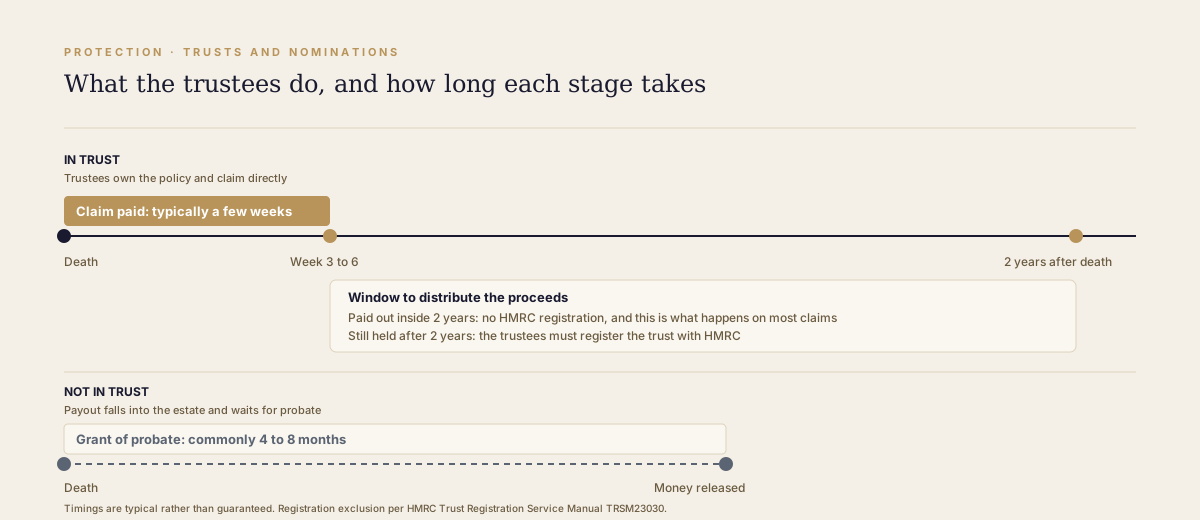
Trustees are typically paid within a few weeks of submitting a completed claim, because the money bypasses the estate entirely. Proceeds that are not in trust must instead wait for the grant of probate, which commonly takes four to eight months and sometimes longer, before anything can be released.
Two practical things decide whether that takes days or months, and neither is legal. The first is whether anyone can find the trust deed, which is the document proving who the current trustees are. Insurers do not always hold a copy, and a trust deed nobody can locate produces exactly the delay the trust was meant to prevent. The second is whether every trustee can be reached and is able to sign.
The trustees are the only people who can turn a life insurance policy into money in your family’s hands. Who you name, and whether they can be found, decides how quickly that actually happens.
Where the trust is discretionary, the trustees also have a decision to make rather than an instruction to follow. Your letter of wishes is what guides it. That letter carries no legal force, which is the point: it can be rewritten at any time without a deed, so it is the one part of the arrangement that stays flexible as your family changes. Keep it with the deed and update it when circumstances move.
What happens if a trustee dies or loses capacity?
The remaining trustees can appoint a replacement in writing, without going to court. Section 36 of the Trustee Act 1925 gives that power where a trustee has died, is incapable of acting, refuses to act, wants to be discharged, or has been outside the United Kingdom for more than twelve months. Section 36 also gives priority to anyone the deed nominates for the job, so the deed is always the first place to look.
Incapacity is the case people prepare for least and hit most often. A trustee who develops dementia cannot be removed by the family’s goodwill, and a lasting power of attorney does not solve it either: an attorney is appointed over that person’s own affairs, not over property they happen to hold as a trustee for somebody else.
Note what the statutory list does not cover: a trustee you have simply fallen out with. Before assuming you are stuck, read your own deed. Many insurer trust forms reserve an express power to the settlor to appoint and remove trustees during their lifetime, and a power of that kind does not depend on the section 36 grounds at all. Where the deed gives you one, you can replace someone simply because you have changed your mind, and the appointment is a good deal less permanent than this section makes it sound.
The forms are not consistent about it, though, and some reserve nothing. Where there is no such power and the trustee will not retire voluntarily, what is left is agreement between everyone concerned or an application to court. Check which kind of deed you have signed while you still have the option of signing a different one.
Do the trustees have to register the trust with HMRC?
In most cases no, and then suddenly yes. HMRC’s guidance on policy trusts excludes a trust from the Trust Registration Service while it holds nothing but a policy paying out on death, terminal or critical illness, permanent or temporary disablement, or the cost of healthcare. That covers the overwhelming majority of protection policies written in trust, and it is why nobody hears about registration when they sign the form.
The exclusion then runs for two years from the date of death. If the trustees have distributed the proceeds inside that window, the trust never has to register at all. If they are still holding the money after it, the trust becomes registrable and the obligation lands on the trustees personally.
That two-year clock matters most for the families most likely to breach it: those holding money for children, or where a discretionary trust is deliberately keeping funds back. Registration itself is a modest administrative job, done online, and GOV.UK’s guidance for trustees requires registration within 90 days of a trust becoming registrable, with a fixed penalty of £5,000 for failing to register. The problem is not the difficulty, it is that trustees who were told at outset that registration did not apply to them have no reason to go looking two years later.
Risk warnings
Tax, trusts and estate planning
HM Revenue and Customs practice and the law relating to taxation are complex and subject to individual circumstances and changes which cannot be foreseen.
Protection
The definitions vary between product providers and will be described in the key features and policy document, if you go ahead with the plan.
Should you be a trustee of your own policy?
Yes, in almost every case. Being a trustee of your own policy keeps you in control of the arrangement while you are alive, lets you join in appointing replacement trustees as circumstances change, and costs nothing. Insurer trust forms generally assume it, and there is no inheritance tax problem with a settlor acting as a trustee. The problem is only ever a settlor who is also a beneficiary.
The trade-off is that it makes your own trustee list look fuller than it is. You are the one person guaranteed not to be a trustee at the moment the claim arises, so a trust with you and one other person on it is functionally a single-trustee trust. Read your own form with your name crossed out, and count what is left.
There is a second decision hiding behind this one, and it is the one people skip. Being a trustee is a real job with a legal standard attached, and nobody should learn they hold it by receiving a claim form. Tell the people you have named, tell them where the deed is kept, and tell them roughly what you want the money to do. The same conversation is worth having about your pension, where a nomination form tells the scheme trustees who you want to benefit and the same silence causes the same confusion. If you are reviewing cover as part of a wider protection plan, the trustee list is the cheapest part of it to get right and the most expensive to get wrong.
Risk warnings
The value of pensions and any income from them can fall as well as rise. You may not get back the full amount invested.
Levels and bases of, and reliefs from, taxation are subject to change and their value will depend upon personal circumstances. Taxation and pension legislation may change in the future.
A pension is a long-term investment and the value is not guaranteed. Any advice or considerations are personal to each individual’s circumstances.
Trustees matter more than beneficiaries
Beneficiaries are the part of a trust form people think about, and trustees are the part that determines whether the beneficiaries ever see the money. How reversible the appointment is depends on a power your deed either reserved to you or did not, and where it did not, the statutory grounds will not help you with a trustee you have merely changed your mind about. The cost of a thin trustee list, meanwhile, only shows up when nobody is left to make the claim. Three names, one of them outside your household, all of them told where the deed is: that is the whole discipline.
Frequently asked questions
What does a trustee of a life insurance trust do?
A trustee legally owns the policy, claims the payout when the person assured dies, and passes the money to the beneficiaries under the terms of the trust. Trustees also keep the trust's paperwork, decide the timing of payments where the trust is discretionary, and register with HMRC if the money is still held two years after the death.
Can a life insurance trust have only one trustee?
Legally yes, but it is a poor idea. A trust of a policy can run with a single trustee, and the settlor often is that trustee at the outset. If that one person dies, nobody is left who can claim, and the proceeds cannot be released until the deceased trustee's personal representatives have gone through probate.
Can a beneficiary also be a trustee of a life insurance trust?
Yes, and it is common for a spouse to be both. The person to keep out of the beneficiary list is the settlor, because a settlor who can benefit from the trust brings the policy back into the estate for inheritance tax. On a discretionary trust there is one limit worth knowing: a trustee cannot decide alone how much of the fund to pay themselves, because that is deciding their own case. Insurer deeds usually deal with it by leaving that particular decision to the other trustees, which only works if there is another trustee to make it.
Should you appoint a professional trustee?
Only where the payout will be held for years rather than paid out quickly. A professional trustee charges the trust and adds formality, which is worth paying for when young children are involved or the family is likely to disagree. For a straightforward policy paying an adult beneficiary, family trustees do the job at no cost.
What happens if a trustee loses mental capacity?
The remaining trustees can appoint a replacement in writing under section 36 of the Trustee Act 1925, which treats incapacity as a ground for replacement. A lasting power of attorney does not help here, because an attorney appointed for personal affairs has no authority over trust property held in someone else's name.
Do trustees of a life insurance trust have to register it with HMRC?
Usually not, provided the policy only pays out on death, terminal or critical illness, disablement, or healthcare costs. That exclusion continues for two years after the death of the person assured. If the trustees are still holding the money after those two years, the trust must be registered on the Trust Registration Service.
Can you remove a trustee once the deed is signed?
Read the deed before you assume you cannot. Many insurer trust forms reserve a power to the settlor to appoint and remove trustees during their lifetime, and where yours does, you can change your mind as freely as the deed allows. Where it does not, you fall back on section 36 of the Trustee Act 1925, which covers a trustee who has died, become incapable, refused to act, asked to retire, or been abroad for more than twelve months, and nothing else. Falling out with someone is not on that list.