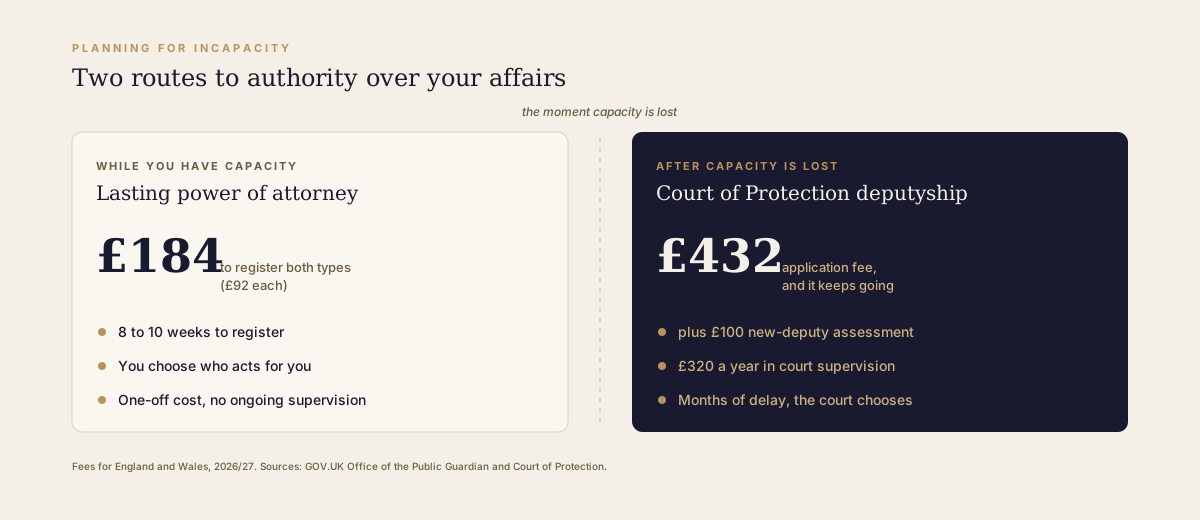
A lasting power of attorney is a legal document under which you appoint one or more people, called attorneys, to make decisions about your property and finances, or your health and welfare, on your behalf. Set up a lasting power of attorney while you still have mental capacity, because once it is lost only a court can appoint someone. It lets someone you trust manage your finances or make health decisions if illness or injury leaves you unable to. Registering each type costs £92 and takes 8 to 10 weeks, and all figures here reflect the position in England and Wales for 2026/27.
A lasting power of attorney is a legal document that lets you choose, in advance, who will make decisions for you if a stroke, dementia, a serious accident, or any other illness leaves you unable to make them yourself. You appoint one or more people you trust, called your attorneys, and set out what they can and cannot do. There are two separate types, one covering your money and property and one covering your health and care, and each has to be registered with the Office of the Public Guardian before anyone can use it. All fees and figures in this article reflect the position in England and Wales for the 2026/27 tax year.
How much does a lasting power of attorney cost in 2026?
Registering a lasting power of attorney with the Office of the Public Guardian costs £92 for each type, so £184 to put both a property and financial affairs LPA and a health and welfare LPA in place. Registration takes 8 to 10 weeks if the form is correct. A reduced £46 fee applies where the donor's income is under £12,000.
Contents
- What is a lasting power of attorney?
- The two types of LPA
- How an LPA works
- What it costs
- What happens without one
- LPAs and inheritance tax
- Should you set one up?
What is a lasting power of attorney?
A lasting power of attorney is the legal instrument that keeps your affairs moving if you can no longer manage them. It hands specific decision-making authority to people you have chosen, so that your bills still get paid and your care is still directed by someone who knows you, rather than by a stranger appointed after the event.
It exists because of a gap that catches most families by surprise. Being someone’s husband, wife, or next of kin gives you no automatic right to act for them. A bank will freeze a sole account the moment it learns the holder has lost capacity, and it will not take instructions from a relative without legal authority, however close. The lasting power of attorney is that authority, granted in advance by the person themselves while they still can.
An LPA is not a will, and the two cover different periods of your life. A will directs who inherits after you die, while an LPA governs the stretch before that, when you are still alive but unable to act for yourself. They do not overlap, and having one does nothing to supply the other, which is why dying without a will leaves that side of your affairs to the intestacy rules however carefully your LPA was drawn up.
Lasting powers of attorney were created by the Mental Capacity Act 2005 and came into force on 1 October 2007, replacing the older enduring power of attorney. An enduring power of attorney signed before that date is still valid and still covers property and finances, but you can no longer make a new one. Anyone planning today uses an LPA.
What are the two types of lasting power of attorney?
There are two types of lasting power of attorney, and they are entirely separate documents doing entirely different jobs. One deals with your money and property, the other with your care and your medical treatment. Making one does nothing to put the other in place.
A property and financial affairs LPA covers decisions such as running your bank accounts, paying bills, collecting your pension and benefits, dealing with your investments, and selling your home. Crucially, it can be used as soon as it is registered, with your permission, while you still have full capacity, which is useful if you are abroad, in hospital, or simply want help with the admin.
A health and welfare LPA covers decisions about your daily care, your medical treatment, where you live, and, if you specifically grant it, whether life-sustaining treatment is given or withheld. This type is different in one important respect: it can only ever be used once you have lost the capacity to make the decision yourself. Up to that point, the choices remain entirely yours.
| Feature | Property and financial affairs | Health and welfare |
|---|---|---|
| Covers | Bank accounts, bills, pensions, investments, selling property | Care, medical treatment, where you live, life-sustaining treatment |
| When it can be used | As soon as registered, with your permission | Only once you have lost capacity |
| Registration fee | £92 | £92 |
| Most useful for | Keeping finances running through illness or absence | Ensuring your care wishes are followed if you cannot speak for yourself |
Most people who plan properly put both in place, because losing capacity rarely affects only your finances or only your care. The GOV.UK guidance on lasting powers of attorney sets out the full scope of each.
Risk warnings
The value of pensions and any income from them can fall as well as rise. You may not get back the full amount invested.
A pension is a long-term investment and the value is not guaranteed. Any advice or considerations are personal to each individual’s circumstances.
A pension is a long-term investment, the value of your investment and the income from it may go down as well as up. Your eventual income may depend upon the size of the fund at retirement, future interest rates and tax legislation.
How does a lasting power of attorney work?
A lasting power of attorney works in three stages: you make it, you register it, and then it can be used. Skipping or fumbling any stage can leave the document worthless at the moment it is needed, which is why the detail matters.
Making the LPA means naming your attorneys and deciding how they must act. You can appoint one attorney or several, and if you appoint more than one you choose whether they act “jointly”, meaning every decision needs all of them, or “jointly and severally”, meaning any one of them can act alone. Jointly and severally is usually the more practical choice, because it keeps things running if one attorney is unavailable or dies. You can also name replacement attorneys to step in, and you can write in preferences and binding instructions.
Every LPA needs a certificate provider, an independent person who confirms you understand what you are signing and are not being pressured into it. This can be someone who has known you for at least two years, or a professional such as a doctor or solicitor. The donor, the attorneys, the certificate provider, and the witnesses must all sign in a set order, and getting that order wrong is one of the most common reasons an LPA is rejected.
The finished document is then sent to the Office of the Public Guardian to be registered. Until registration is complete, the LPA cannot be used at all, even in an emergency. That lag is the single strongest argument for setting one up long before you think you will need it.
How much does a lasting power of attorney cost?
Registering a lasting power of attorney costs £92 for each type, according to the GOV.UK guidance on registering an LPA, so £184 for both. There is a reduced fee of £46 where the donor’s income before tax is at or below £12,000 a year, and no fee at all where the donor receives certain means-tested benefits.
That fee is only the government charge. You can complete an LPA yourself on the GOV.UK service for nothing beyond it, and for a simple situation that is often perfectly sensible. Using a solicitor adds professional fees, typically a few hundred pounds per document, which buys careful drafting and matters most where the family or the finances are complicated. The other cost is time: registration takes 8 to 10 weeks when the form is right, and considerably longer when it is not, so this is not something to leave until capacity is already slipping.
What happens if you lose capacity without an LPA?
If you lose mental capacity without a lasting power of attorney, no one can simply step in. Your family has to apply to the Court of Protection for a relative to be appointed as your deputy, and that process is slower, more expensive, and more intrusive than an LPA in every respect.
The figures make the gap plain. Applying to become a deputy costs a £432 application fee, plus a £100 assessment fee for a new deputy, with a further £266 if the court decides the case needs a hearing, as set out in the GOV.UK guidance on deputy fees. A deputy is then supervised by the court for as long as they act, at £320 a year for general supervision, and usually has to take out a security bond as well. Where an LPA is a one-off cost settled in advance, a deputyship is an ongoing charge and an ongoing accountability.
What happens if you lose mental capacity without a lasting power of attorney?
Nobody can automatically act for you, not even a spouse. Your family must apply to the Court of Protection for one of them to be appointed as your deputy, which costs a £432 application fee plus a £100 new-deputy assessment and £320 a year in ongoing supervision, and takes several months. The court, not you, decides who acts and what they can do.
The deeper cost is control. With an LPA, you choose who acts for you and set the rules. With a deputyship, the court chooses, applying its own view of who is suitable and what they may do, and it can take several months before anyone has authority at all. For a health and welfare deputyship, the court is often reluctant to appoint anyone, which can leave the most personal decisions in the hands of medical staff and social services rather than family. Setting up an LPA is, in practice, the difference between planning your own affairs and having them administered for you.
An LPA is the difference between choosing who runs your affairs if you cannot, and leaving that choice to a court that has never met you.
Two brothers, one signed form apart
Geoffrey and his younger brother Alan are both in their late sixties. Geoffrey spends an afternoon on the GOV.UK service and registers both a property and financial affairs LPA and a health and welfare LPA, appointing his daughter Naomi. The total cost is £184 and the registrations come through in about nine weeks. Alan means to do the same but never gets round to it.
Three years later both brothers are affected by strokes that leave them unable to manage their affairs. Naomi uses Geoffrey’s registered LPA to take over his banking and work with his doctors within days, at no further cost. Alan’s wife has no such authority. She must apply to the Court of Protection to be his deputy: a £432 application fee, a £100 assessment, a wait of several months while his bills mount and his account stays frozen, and then £320 every year in supervision for as long as she acts.
The two families started in the same position. The only difference was an afternoon and £184 spent while there was still capacity to spend it. That is the whole case for acting early, made in numbers.
How does an LPA affect inheritance tax planning?
An LPA affects inheritance tax planning in a way few people expect: it largely puts a stop to it. An attorney’s power to give money away is tightly limited, so the gifting strategies that reduce an estate cannot simply be continued on the donor’s behalf once capacity is lost.
Under section 12 of the Mental Capacity Act 2005, an attorney may make only limited gifts: reasonable presents on customary occasions such as birthdays and weddings, and modest donations to charities the donor already supported, always in proportion to the size of the estate. Continuing a deliberate inheritance tax plan falls well outside that. An attorney who wants to keep using the annual gift allowances at scale, or to make the larger lifetime gifts that rely on the seven year rule, must apply to the Court of Protection for specific approval, which is neither quick nor guaranteed.
This is the quiet link between capacity planning and estate planning. A carefully constructed programme of gifting can freeze the day capacity is lost, and an attorney acting in good faith can find their hands tied. It is one reason to bring the LPA into the wider conversation about inheritance tax planning rather than treating it as a standalone form, and a reason not to leave gifting intentions until the last possible year.
Risk warnings
HM Revenue and Customs practice and the law relating to taxation are complex and subject to individual circumstances and changes which cannot be foreseen.
The Financial Conduct Authority (FCA) does not regulate Inheritance Tax Planning or Trust Advice.
Should you set up a lasting power of attorney?
Yes, almost everyone should, and the common mistake is treating it as something only the elderly need. Capacity can be lost at any age through accident or sudden illness, and the whole value of an LPA depends on it being in place before that happens. A registered LPA sitting unused is not wasted money; it is the point.
If there is one thing not to do, it is to assume your spouse or your next of kin can step in without it. They cannot, and discovering that during a crisis, with a frozen account and a hospital asking for decisions, is how families learn the hard way. The document that prevents all of it costs £184 for both types and an afternoon of your time.
An LPA also has a natural end point worth planning around: it stops the moment you die, when authority passes to the executor named in your will and the estate is dealt with through probate. The LPA covers the gap between capacity and death, no more, so it belongs in the same conversation as your will rather than in place of it.
There is a genuine judgement to make about scope and attorneys rather than about whether to bother. Choosing people who will genuinely act in your interests, deciding whether they act jointly or separately, and thinking through the health and welfare choices you would want are the parts that reward care, and the parts where advice earns its place. The decision to have an LPA at all, for any adult with assets or people who depend on them, is close to automatic.
Frequently asked questions
What is a lasting power of attorney?
A lasting power of attorney is a legal document under which you appoint one or more people, your attorneys, to make decisions on your behalf if you cannot make them yourself. There are two types: one for property and financial affairs, and one for health and welfare. Both must be registered with the Office of the Public Guardian before they can be used.
How does a lasting power of attorney work?
You appoint one or more attorneys and decide whether they must act jointly, together on every decision, or jointly and severally, so any one of them can act alone. An independent certificate provider confirms you understand the document, then it is registered with the Office of the Public Guardian. Only once registered can it be used at all.
Can you set up a lasting power of attorney for someone who has already lost mental capacity?
No. The person making the power, the donor, must have the mental capacity to understand it at the time they make it. Once capacity is lost, it is too late, and the only route is for a relative to apply to the Court of Protection to become a deputy. That is why an LPA has to be a plan made in advance, not a reaction to a crisis.
Can an attorney change your will or make large gifts?
No. An attorney cannot make or change your will, and under the Mental Capacity Act 2005 they can only make limited gifts, such as reasonable presents on birthdays or at weddings and modest donations to charities you already supported. Anything larger, including gifts made to reduce inheritance tax, needs the Court of Protection's approval first.
Do lasting powers of attorney expire?
An LPA does not expire on a set date, but it ends automatically when the donor dies, at which point the executor named in the will takes over. While you still have capacity you can also cancel or replace it. A health and welfare LPA can only ever be used once you have lost the capacity to make the decision in question.
Does a lasting power of attorney work in Scotland and Northern Ireland?
No. Lasting powers of attorney are creatures of the law of England and Wales only. Scotland has its own continuing and welfare powers of attorney, registered with the Office of the Public Guardian (Scotland), and Northern Ireland runs a separate system. A power made in one part of the UK does not automatically carry over to another.
Is it worth using a solicitor to make a lasting power of attorney?
Not always. A straightforward LPA, with attorneys who agree and no complicated family or business affairs, can be completed on the GOV.UK service for the £92 registration fee alone. A solicitor earns their fee where there is a business to run, a blended family, likely disputes between attorneys, or any doubt about the donor's capacity, because a badly drafted LPA can be rejected or fought over later.