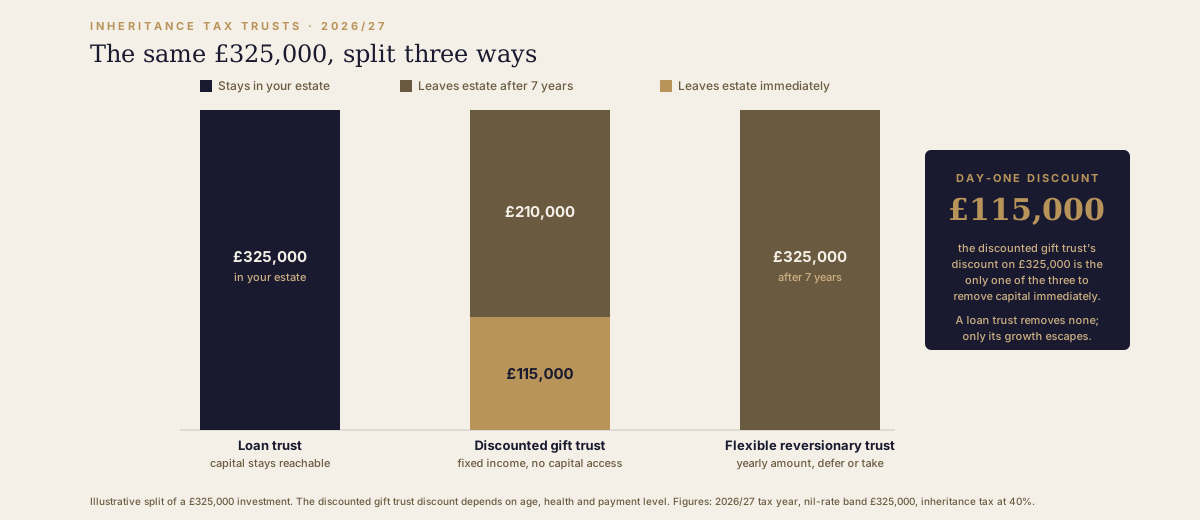
Loan trusts, discounted gift trusts and flexible reversionary trusts are three bond-based structures that reduce inheritance tax while letting the settlor keep a different form of access to the money placed in trust. Which trust to choose depends on the access you need: full capital on demand, a fixed lifetime income, or a deferrable yearly amount. The choice matters because the more access you keep, the less inheritance tax the structure ultimately saves. Growth on the investment escapes your estate immediately in all three; what differs is the capital. A loan trust makes no gift, so only that growth ever escapes and the loaned capital stays in full, while a discounted gift trust and a flexible reversionary trust give the capital away and it leaves once you survive seven years.
A loan trust and a discounted gift trust are often set against each other because both cut inheritance tax without giving your money away outright, yet they hand back completely different kinds of access. Add a flexible reversionary trust as a third option and the decision comes down to a single question: what sort of access do you actually need? A loan trust keeps your original capital reachable on demand. A discounted gift trust pays you a fixed income for life. A flexible reversionary trust offers a yearly amount you can take or leave. All figures reflect the 2026/27 tax year.
Which of these trusts removes capital from your estate immediately?
Only a discounted gift trust removes any capital immediately, through its discount: the value of the payments you keep is outside your estate from day one. All three move future investment growth outside your estate straight away, but a loan trust's capital stays in your estate as an outstanding loan, and a flexible reversionary trust's gifted capital leaves only once you survive seven years.
Contents
- The core difference
- How does a loan trust work?
- How does a discounted gift trust work?
- How does a flexible reversionary trust work?
- How do they compare?
- How are these trusts taxed?
- Which one should you choose?
- What is changing?
What is the difference between a loan trust, discounted gift trust, and flexible reversionary trust?
The difference is what you give up and what you keep. A loan trust gives up nothing permanently: you lend the money and can ask for it back. A discounted gift trust gives up the capital entirely but keeps a fixed income. A flexible reversionary trust gives up the capital too, but keeps an annual option to reclaim slices of it.
That single distinction drives everything else, including how much inheritance tax each one saves and how quickly. The more access you retain, the less the structure shelters, because inheritance tax follows control. A loan trust hands you the most access and therefore saves the least. A discounted gift trust and a flexible reversionary trust give away more and can shelter the full sum, but each pays for that with a different restriction on how you get money out.
All three are built on an investment bond and, in most versions, a discretionary trust, so they share the same underlying tax machinery. What separates them is the access mechanism bolted on top, and that is the part worth understanding before you compare the tax.
How does a loan trust work?
A loan trust works by lending money to a trust rather than gifting it. You establish the trust, lend it a lump sum on an interest-free basis, and the trustees invest that money, usually in an investment bond. Because a loan is not a gift, nothing leaves your estate at the outset, and there is no seven year clock to start.
The saving comes from growth. Every pound the investment earns above the original loan belongs to the trust and its beneficiaries, outside your estate from the moment it is generated. Your estate is capped at the value of the outstanding loan, while the growth accumulates for the next generation free of inheritance tax. HMRC’s guidance on the gift and loan trust confirms the arrangement is effective precisely because your estate is not reduced by making the loan.
That is also its limitation. The loan itself is always repayable, and whatever remains outstanding when you die is fully in your estate at 40% for 2026/27. Calling the loan back does not swell your estate, because the outstanding loan already sat in it at full value; a repayment simply turns the loan you were owed into cash you hold. What actually shrinks your estate is spending that cash, which many people do to fund their retirement, drawing the loan down over the years. A loan trust is the gentlest of the three: it shelters growth, keeps your capital on a short lead, and asks for no irreversible decision.
Risk warning
HM Revenue and Customs practice and the law relating to taxation are complex and subject to individual circumstances and changes which cannot be foreseen.
How does a discounted gift trust work?
A discounted gift trust works by gifting an investment bond into trust while keeping the right to a fixed stream of payments for the rest of your life. You choose the payment level at outset, often up to 5% of the original investment each year to use the bond’s tax-deferred withdrawal allowance, and that figure is locked for good.
How much can you take from a discounted gift trust each year?
The payments are fixed when the trust is set up and commonly run up to 5% of the original investment a year, taken for life. You cannot increase them later or touch the capital itself, only the agreed payment stream. Depending on the trust's terms you may be able to give up future payments if you no longer need them, but that surrender is treated as a new gift and can start a fresh seven year clock.
The clever part is the discount. Because you have carved out a valuable right to receive those payments, HMRC accepts that the gift you have actually made is worth less than the money you put in. The value of the retained payments is calculated from your age, your health, and the size of the payments, and that amount, set out in HMRC’s manual on discounted gift schemes, is treated as outside your estate from day one. Only the balance, the gift element, has to run the seven year course. The growth the bond earns from then on also builds up outside your estate.
The trade-off is rigidity. The payments are fixed, so if your circumstances change you cannot draw more than the amount you set at outset. If you no longer need the income, some trusts let you give up future payments, but that counts as a new gift and starts a fresh seven year clock on the value you hand back; the simpler alternative is to let the unwanted payments accumulate in your own hands, where they rejoin your estate. You have no access to the capital at all, only to the payment stream you fixed at the start. A discounted gift trust suits someone who wants a dependable income and is content to give the capital away for good.
How does a flexible reversionary trust work?
A flexible reversionary trust works by gifting an investment bond into a discretionary trust while keeping a series of reversionary interests, set future dates on which agreed amounts can return to you. Before each date, you decide whether to take that year’s slice or instruct the trustees to defer it, in which case the money stays in trust for your beneficiaries.
Of the two trusts that give the capital away for good, this is the more flexible, because the decision is made afresh every year rather than fixed at outset. It does not match a loan trust, where the whole of your capital stays reachable on demand; a flexible reversionary trust only returns the pre-set amounts on their set dates. Set against a discounted gift trust’s fixed income, though, it lets you respond to changing needs year by year.
If you never need the money, you defer every reversion and the whole gift leaves your estate once you survive seven years. If your circumstances tighten, you take a reversion, and that slice returns to your estate at full value. As with any gift into trust, growth on the bond sits outside your estate from the moment you fund it; only a reversion you actually take comes back. The mechanism is explained in full in the guide to what a flexible reversionary trust is.
The price of that flexibility is an annual deadline. Trustees must actively defer each reversion before its date, and a missed window means the fund vests by default and lands back in your estate. Where a discounted gift trust asks you to commit once, a flexible reversionary trust asks you to decide every year, which is more control but also more to manage.
Loan trust vs discounted gift trust vs flexible reversionary trust: how do they compare?
The three trusts pull in different directions on the same two levers: how much access you keep, and how much inheritance tax you save. No option wins on both. The table sets them side by side on the features that decide the choice.
How a loan trust, discounted gift trust and flexible reversionary trust compare across the features that matter most
| Feature | Loan trust | Discounted gift trust | Flexible reversionary trust |
|---|---|---|---|
| What you give away | Nothing (a loan) | Capital, keeping fixed payments | Capital, keeping yearly reversions |
| What escapes inheritance tax | Growth only; the capital never leaves | Growth now, the discount now, and the rest of the capital after 7 years | Growth now, and the whole capital after 7 years |
| When the benefit lands | Immediately, for the growth | Partly now, the gift at year 7 | Partly now, the gift at year 7 |
| Access you keep | All your capital, on demand | A fixed income for life | A yearly amount, take or defer |
| Can you change the access? | Yes, fully flexible | No, only by giving payments up (a new gift) | Yes, decide each year |
| Main drawback | Shelters only the growth | No access to the capital itself | Tied to an annual decision |
| Best suited to | Wanting the capital reachable | Wanting income and a faster saving | Giving away with a safety valve |
Read across the “access” row and the pattern is clear. The loan trust keeps the most and saves the least. The discounted gift trust gives up the most direct access, no capital at all, and is rewarded with the largest, fastest saving. The flexible reversionary trust sits between them, trading a fixed commitment for an annual choice.
Access and inheritance tax saving sit on a seesaw. Every route back to your money that a trust preserves is value the taxman keeps counting as yours, which is why the loan trust, the most accessible of the three, is also the weakest shield.
How are these trusts taxed?
All three usually start life as a chargeable lifetime transfer, a gift into most trusts that is assessed for inheritance tax straight away rather than only on death within seven years. For a discounted gift trust set up as an absolute rather than discretionary trust, the gift element is instead a potentially exempt transfer, which falls out of your estate cleanly after seven years with no entry charge. GOV.UK’s guidance on trusts and Inheritance Tax sets out how these transfers are treated.
Because a chargeable lifetime transfer above the available nil-rate band is taxed at 20% for 2026/27 on the way in, these trusts are almost always funded within the £325,000 nil-rate band, so no entry charge arises. A discounted gift trust makes that easier: the discount reduces the chargeable gift, so a larger investment can still slip under the threshold. The available band is also cut by any chargeable gifts in the previous seven years, which is why the order of your gifts matters under the seven year rule.
Once running, a discretionary version falls under the relevant property regime, facing a periodic charge of up to 6% every ten years and an exit charge of up to 6% when capital leaves, both applied only to value above the nil-rate band. Kept within £325,000, both are usually nil. On death, anything still in your estate, the outstanding loan of a loan trust, or a reversion you have taken, is taxed at 40% as GOV.UK explains for inheritance tax generally. None of the three is a gift with reservation, because in each case the settlor keeps only a defined, carved-out right rather than a benefit from the gifted capital itself. All three also carry the income tax rules of the underlying investment bond and ongoing trustee administration, which is part of their real cost against simpler routes such as regular gifts from surplus income.
Risk warning
The taxation of the investment is dependent on the individual circumstance of each investor, and may be subject to change in the future.
Should you choose a loan trust, discounted gift trust, or flexible reversionary trust?
Choose the trust that matches the access you genuinely need, not the one that saves the most tax on paper. If there is a real chance you will want your capital back, a loan trust is the only one that keeps it reachable. If you want a reliable income and can part with the capital for good, a discounted gift trust rewards that commitment with the largest immediate saving. If you want to give the money away but keep a yearly line of retreat, a flexible reversionary trust fits, and the wider inheritance tax planning picture usually decides which.
Bernard and Ravi, both with £325,000 to plan with
Bernard, 74 and in good health, has a comfortable pension but wants a dependable income top-up and to cut his estate now. He puts £325,000 into a discounted gift trust taking £13,000 a year, 4% of the investment. Underwriting produces a discount of around £115,000, outside his estate immediately, and the remaining £210,000 gift sits within his nil-rate band and leaves his estate once he survives seven years. He can never change the £13,000.
Ravi, 63, may need the capital for his business or later care, so cannot commit to giving it away. He sets up a loan trust, lending the same £325,000 to the trustees to invest. The loan stays in his estate and he can recall it in full at any time. Only the growth escapes: if the fund reaches £430,000 over a decade, roughly £105,000 sits outside his estate while the £325,000 loan remains within it.
Same starting sum, opposite trades. Bernard buys income and a fast, sizeable saving but locks the capital away. Ravi keeps every pound reachable and shelters only the growth. A lifetime cashflow projection is what tells you, before you commit, which of them your own circumstances most resemble, because the wrong choice is expensive to unwind.
Risk warnings
Pensions
The value of pensions and any income from them can fall as well as rise. You may not get back the full amount invested.
Levels and bases of, and reliefs from, taxation are subject to change and their value will depend upon personal circumstances. Taxation and pension legislation may change in the future.
A pension is a long-term investment and the value is not guaranteed. Any advice or considerations are personal to each individual’s circumstances.
A pension is a long-term investment, the value of your investment and the income from it may go down as well as up. Your eventual income may depend upon the size of the fund at retirement, future interest rates and tax legislation.
Tax, trusts and estate planning
The Financial Conduct Authority (FCA) does not regulate Inheritance Tax Planning or Trust Advice.
What is changing for trusts and inheritance tax?
The nil-rate band that caps all three trusts is frozen at £325,000 until April 2031, so as estates grow, more value is pushed above the threshold and the case for acting strengthens each year. Doing nothing quietly costs more over time.
The larger shift is the move to bring most unused pension funds within inheritance tax from April 2027. Pensions have long been the simplest way to pass wealth on free of inheritance tax, and as that route narrows, more families will look again at bond-based trusts for capital they would once have left in a pension. A loan trust, discounted gift trust or flexible reversionary trust may each earn a place in that rethink, but the choice between them should still turn on access, not on which pension door has closed.
How much access do you actually need?
The comparison is really a single question wearing three answers. Decide how much of your money you need to keep within reach, and the structure chooses itself: a loan trust for full access, a discounted gift trust for a fixed income, a flexible reversionary trust for an annual option. Each buys its inheritance tax saving with a matching sacrifice of control, and the mistake to avoid is picking the biggest saving while quietly needing the access it takes away.
Frequently asked questions
What is a discounted gift trust?
A discounted gift trust is an arrangement where you gift an investment bond into trust but keep the right to fixed regular payments for life. The value of those retained payments, the discount, sits outside your estate immediately, while the rest of the gift leaves your estate if you survive seven years. You cannot access the underlying capital, only the fixed payments.
How does a loan trust reduce inheritance tax?
A loan trust reduces inheritance tax in two ways. First, it moves all future investment growth outside your estate from day one: you lend money to the trust rather than gifting it, so the loan itself stays in your estate at full value, but any growth the trustees generate belongs to the beneficiaries. Second, as you call the loan back in instalments and spend it on living costs, the outstanding loan shrinks, so less of it remains in your estate to be taxed on death. The saving comes only from growth, so it starts at nothing and builds up gradually, and the outstanding loan stays in your estate.
Should you choose a loan trust or a discounted gift trust?
Choose a loan trust if you may need your original capital back, because it stays reachable on demand. Choose a discounted gift trust if you want a fixed income for life and are willing to give the capital away for good in exchange for a larger, faster inheritance tax saving. The deciding factor is whether you need the capital or only an income from it.
Can you set up a discounted gift trust in poor health?
You can, but poor health shrinks or removes the discount. The discount is priced on how long you are expected to receive the retained payments, so a shorter life expectancy means a smaller immediate saving and, in serious cases, a discount of nil. The gift element still leaves your estate after seven years, but the upfront benefit that defines the structure may largely disappear.
Does a loan trust need to survive seven years?
No. The loan is not a gift, so there is no seven year clock on it and the growth escapes your estate straight away. The catch is that the outstanding loan always stays in your estate. If you later waive the loan, forgiving what the trust owes you, that waiver is a gift and does start a seven year clock on the amount waived.
Which trust is best if you might need your capital back?
A loan trust is the only one of the three that keeps your original capital reachable in full and on demand. A discounted gift trust locks the capital away and pays only a fixed income, and a flexible reversionary trust returns capital only in pre-set yearly slices. If retaining access to the whole sum matters, the loan trust is the natural choice.