A flexible reversionary trust is an arrangement where a settlor gifts an investment bond into a discretionary trust while retaining reversionary interests that can return set amounts to them on chosen future dates. Kept within the £325,000 nil-rate band, it moves capital outside your estate after seven years while leaving a yearly option to take agreed amounts back. The trustees can defer each reversion, so any amount you do not need stays in trust for your beneficiaries rather than rejoining your estate. Every reversion you actually take returns to your estate at full value, and the plan only works if you survive seven years and never reserve a benefit.
A flexible reversionary trust is one of the few estate planning tools that tries to do two things at once: move capital out of your estate for inheritance tax, while leaving you a route back to it if your circumstances change. It works by combining a discretionary trust with a series of reversionary interests, set future dates on which agreed amounts can return to you. If you do not need a given year’s payment, the trustees can defer it, and that money stays in trust for your beneficiaries. All figures in this article reflect the 2026/27 tax year.
How does a flexible reversionary trust reduce inheritance tax?
The settlor gifts an investment bond into a discretionary trust as a chargeable lifetime transfer. Once the settlor survives seven years, that value falls outside the estate. The retained reversionary interests let agreed amounts return on set dates, but any sum the trustees defer stays in trust for the beneficiaries.
Contents
- What is a flexible reversionary trust?
- How does a flexible reversionary trust work?
- How is a flexible reversionary trust taxed?
- Can a reversion be taxed twice within seven years?
- Why is it not a gift with reservation?
- Why choose a discretionary trust instead?
- How does a flexible reversionary trust fit a wider estate plan?
- Is a flexible reversionary trust worth it?
- What is changing for trusts and inheritance tax?
What is a flexible reversionary trust?
A flexible reversionary trust is a discretionary trust that holds an investment bond, paired with a series of reversionary interests the settlor keeps for themselves. The settlor gives the bulk of the value away to the trust for their chosen beneficiaries, but reserves the right to have defined amounts revert to them on fixed future dates, usually one each year. It is sometimes called a flexible carve-out trust, because the reversions are carved out and kept rather than given away.
The structure exists to solve a single, common problem. Outright gifting can reduce inheritance tax, but it is irreversible, and many people are reluctant to give away capital they might one day need. A flexible reversionary trust answers that hesitation by building in an annual safety valve: a sum you can choose to take back, or instruct the trustees to leave invested for the next generation.
Because no beneficiary has a fixed entitlement, the trust portion sits within the same framework as any discretionary trust for inheritance tax. What sets it apart is the retained reversions, which are the only part of the arrangement the settlor still has any claim over.
How does a flexible reversionary trust work?
A flexible reversionary trust works by splitting an investment bond into many small policy segments and grouping them into funds that mature on different dates. The settlor invests a lump sum, places the bond in trust, and the trust deed sets out a schedule: on each anniversary, a defined fund is due to revert to the settlor unless action is taken first.
Before each reversion date arrives, the settlor decides whether they need that year’s amount. If they do, the fund vests and becomes theirs absolutely. If they do not, they ask the trustees to defer the reversion to a later year, and that fund stays inside the trust for the beneficiaries. The decision repeats every year, which is where the flexibility comes from.
The reversion is the mechanism, and it has a precise meaning: a reversionary interest is a right to receive trust property at a future point once an earlier interest ends. While a fund is still waiting to revert, its open market value is treated as negligible, because the trustees hold overriding powers that could appoint it away to beneficiaries instead. That negligible value is the reason the retained reversions add very little to the estate while they sit in the trust, a point that matters for the tax treatment below.
How is a flexible reversionary trust taxed?
The gift into a flexible reversionary trust is a chargeable lifetime transfer, the same starting point as any gift into a discretionary trust. A chargeable lifetime transfer is a gift into most trusts that is assessed for inheritance tax straight away, rather than only if you die within seven years. GOV.UK’s guidance on trusts and Inheritance Tax confirms that anything above the available nil-rate band entering the trust is taxed immediately at 20% if the trustees pay.
For this reason, these trusts are almost always funded with no more than the settlor’s available nil-rate band, which is £325,000 for 2026/27, so that no entry charge arises. Fund it with more and the excess is taxed at 20% on the way in. The available band is also reduced by any chargeable transfers made in the previous seven years, which is why the order of your gifts matters under the seven year rule.
Once inside, the trust falls under the relevant property regime, so it faces a periodic charge of up to 6% every ten years and an exit charge of up to 6% when assets leave, both applied only to value above the nil-rate band. Kept within £325,000, both charges are usually nil. The headline benefit comes from survival: provided the settlor lives seven years and is not taking the reversions, the gifted capital falls outside the death estate, where it would otherwise be taxed at 40% as set out in GOV.UK’s overview of how Inheritance Tax works. Because the underlying asset is an investment bond, the arrangement also carries chargeable event income tax rules and ongoing trustee administration, which is part of its real cost.
Risk warnings
Investments
The taxation of the investment is dependent on the individual circumstance of each investor, and may be subject to change in the future.
Tax, trusts and estate planning
HM Revenue and Customs practice and the law relating to taxation are complex and subject to individual circumstances and changes which cannot be foreseen.
Can a reversion be taxed twice within seven years?
Not on the same pound, but the effect can feel like it if you die within seven years of settling the trust. The issue is not double taxation in the strict sense. It is that the gift ties up your nil-rate band while a reversion you have already taken sits back in your estate with no band left to shelter it.
Take the sequence people worry about most. You settle your whole nil-rate band, £325,000 for 2026/27, so there is no entry charge. Two years later you draw a £30,000 reversion to cover a one-off cost, and it stays in your estate. You then die in year three, inside the seven-year window.
On death, the £325,000 chargeable lifetime transfer is reassessed first, ahead of your estate. It sits within the £325,000 band, so it produces no tax of its own, but it uses up the whole nil-rate band. Your death estate, which now holds the £30,000 that reverted, has nothing left to set against it, so that £30,000 is taxed at 40%, £12,000. The £30,000 has not been taxed twice, yet it has still been taxed at the full rate, because your band was already committed to the original gift.
Taper relief does not rescue this, despite a common assumption that it must. Taper only reduces tax actually due on a failed transfer, and here the transfer produced none, so there is nothing for taper to reduce.
What resolves it is survival. Live seven years from the gift and the £325,000 transfer drops out of your cumulation, your nil-rate band is restored in full, and the same £30,000 reversion is once again covered by the band rather than taxed at 40%. The exposure belongs to dying early, not to the structure itself, and it is the clearest reason to defer any reversion you do not genuinely need while you are still inside the seven-year period.
Why is it not a gift with reservation?
A flexible reversionary trust is not a gift with reservation because the settlor is excluded from the discretionary trust and only ever keeps the separate reversionary interests, which were carved out at the start rather than given away and clawed back. A gift with reservation is a gift where the donor keeps a benefit from the very asset they gave away, the classic example being someone who gives their house to their children but goes on living in it rent free, as explained in HMRC’s manual on gifts with reservation.
Is a flexible reversionary trust a gift with reservation of benefit?
No. The settlor is excluded from the discretionary trust holding the beneficiaries’ share and only retains separate reversionary interests carved out at the outset. Because no benefit is reserved from the gifted portion, the reservation of benefit rules do not apply, so the gifted value can leave the estate after seven years.
The carve-out principle sidesteps that. The settlor never had, and never gives away, the reversions: they are retained from the outset, so there is nothing reserved out of the gifted portion. The beneficiaries’ share and the settlor’s reversions are distinct interests from day one.
There is a subtlety worth understanding. A reversionary interest is normally excluded property and outside inheritance tax altogether, but HMRC’s manual on reversionary interests confirms that this does not apply where the settlor is beneficially entitled to it. The settlor’s retained reversions are therefore inside their estate in principle, but valued at next to nothing while they remain unvested. The value only crystallises if and when a reversion is actually taken.
Why choose a discretionary trust over a flexible reversionary trust?
You would choose a standard discretionary trust over a flexible reversionary trust when you are confident you will not need the capital back, because the access that defines an FRT is paid for in flexibility, simplicity, and cost. The reversionary option only earns its keep if there is a genuine chance you will use it. On paper an FRT can look like a discretionary trust with a free upgrade; in practice the upgrade has a price, and three trade-offs explain it.
- It ties you to an investment bond. The reversion mechanism relies on the segmented policies of a bond, so an FRT has to be built on one and cannot, for example, hold collective funds, property, or assets qualifying for business property relief. A standard discretionary trust can hold a bond too, which is what many advisers use in practice, but it keeps the freedom to hold other assets where they suit the family better. An FRT settles that choice of investment wrapper at the outset rather than leaving it open.
- It keeps a thread of value attached to you. Once you survive seven years, a discretionary trust is a clean break, with nothing left tethered to your estate. An FRT’s retained reversions remain part of your estate in principle, and every reversion that vests pulls capital back at full value. The feature you are paying for is the same one that can quietly undo the saving.
- It carries an annual decision with a failure mode. Trustees must actively choose to defer each reversion before its date arrives. Miss that window and the fund vests by default, landing back in your estate and potentially triggering a chargeable event on the bond. A discretionary trust holding collectives has no such recurring deadline.
The honest position is that an FRT is not strictly better than a discretionary trust; it is a different tool. It buys optional access in exchange for investment freedom, lower running costs, and a fully completed gift. If you will never touch the access, a plain discretionary trust reaches the same inheritance tax outcome with fewer moving parts.
How does a flexible reversionary trust fit a wider estate plan?
A flexible reversionary trust suits someone caught between two instincts: wanting to act on inheritance tax now, but unwilling to part with capital they might need later. It is rarely the first tool to reach for. Using the annual exemption, making outright gifts, or making regular gifts from surplus income are simpler and cheaper where they fit the situation.
Where it earns its place is the access in reserve. The worked example below shows how much that depends on whether the reversions are actually drawn.
Margaret and Douglas, both 68, each settling £325,000
Margaret and her brother Douglas each invest £325,000 into a flexible reversionary trust, structured as ten yearly reversions of £32,500. Both gifts sit within the nil-rate band, so neither pays an entry charge.
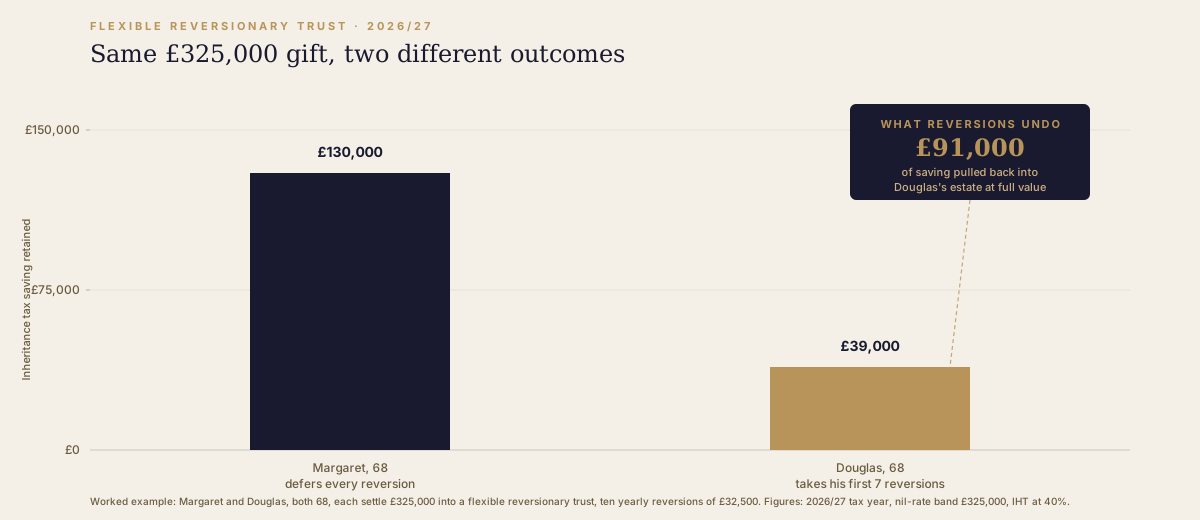
Margaret has enough pension income and defers every reversion. After she survives seven years, the original £325,000 plus any growth sits outside her estate, a potential inheritance tax saving of £130,000 at 40%.
Douglas takes the first seven reversions, £227,500 in total, to top up his spending, and banks what he does not use. That £227,500 rejoins his estate, so around £91,000 of the potential saving is undone, from an identical starting plan.
That contrast is the whole point of the structure. A lifetime cashflow projection is what tells you, before you commit, whether you are likely to be Margaret or Douglas, and a coordinated inheritance tax planning strategy times the trust so the nil-rate band is not already used up by earlier gifts.
Risk warnings
Pensions
The value of pensions and any income from them can fall as well as rise. You may not get back the full amount invested.
Levels and bases of, and reliefs from, taxation are subject to change and their value will depend upon personal circumstances. Taxation and pension legislation may change in the future.
A pension is a long-term investment and the value is not guaranteed. Any advice or considerations are personal to each individual’s circumstances.
A pension is a long-term investment, the value of your investment and the income from it may go down as well as up. Your eventual income may depend upon the size of the fund at retirement, future interest rates and tax legislation.
Tax, trusts and estate planning
The Financial Conduct Authority (FCA) does not regulate Inheritance Tax Planning or Trust Advice.
Is a flexible reversionary trust worth it?
A flexible reversionary trust is worth it when you want to start the seven year clock but genuinely cannot rule out needing the money back. For a retiree with a comfortable income who simply wants insurance against future care costs or a change in circumstances, that yearly option to reclaim capital is something an outright gift cannot offer.
The flexibility in a flexible reversionary trust is a safety net, not an income plan. Every reversion you draw is capital pulled back into your estate, so the more you lean on the access, the less inheritance tax the structure ever saves.
The trade-offs are real. You are tied to an investment bond and its chargeable event rules, you carry ongoing trustee duties and adviser costs, and the access is annual and pre-set rather than on demand. Most importantly, the benefit only materialises if you survive seven years and leave the reversions largely untouched. The honest test is whether you expect to leave the money where it is. If you do, the trust can work well. If you think you will need to draw on it regularly, a flexible reversionary trust is an expensive way to achieve very little.
What is changing for trusts and inheritance tax?
The nil-rate band that caps these trusts is frozen at £325,000 until April 2031, so as estates grow, more value is pushed above the threshold and the case for lifetime planning strengthens each year. The freeze quietly raises the real cost of doing nothing.
The larger shift is the move to bring most unused pension funds within the scope of inheritance tax from April 2027. Pensions have long been the simplest way to pass wealth on free of inheritance tax, and as that advantage ends, more families will look again at trusts and lifetime gifting for capital that was previously left untouched. A flexible reversionary trust is one option in that conversation, but it should be chosen on its merits, not adopted because a pension strategy has closed.
A gift with a yearly escape hatch
A flexible reversionary trust is best understood as a gift with a yearly escape hatch, not a way to have your capital and shelter it too. Survive seven years and leave the reversions alone, and it removes capital from your estate as cleanly as an outright gift while keeping a measure of control. Draw on the reversions and the benefit erodes, pound for pound. It rewards people who can commit to giving the money away but want reassurance they will not regret it, and it punishes those who treat the access as an income stream.
Frequently asked questions
What is a flexible reversionary trust?
A flexible reversionary trust is an arrangement where a settlor gifts an investment bond into a discretionary trust but keeps a series of reversionary interests, set dates on which agreed amounts can return to them. The trustees can defer any reversion the settlor does not need, so it stays in trust for the beneficiaries. It is used to start the seven year inheritance tax clock while keeping access in reserve.
How does a flexible reversionary trust work?
The settlor invests in an investment bond split into many policy segments and places it in a discretionary trust. The trust deed sets out reversionary interests: future dates on which a defined slice of the bond reverts to the settlor. Before each date the trustees either let the amount revert or, at the settlor's request, defer it to a later date so it remains in trust.
Is a flexible reversionary trust worth it?
A flexible reversionary trust is worth it when you want to start the seven year inheritance tax clock but cannot afford to give up access entirely. The trade-off is cost and complexity: an investment bond, ongoing trustee administration, and the fact that every reversion you draw rejoins your estate. For those happy to make an outright gift, simpler routes usually save more.
What happens to a flexible reversionary trust when you die?
If you survive seven years from creating the trust and have not been taking the reversions, the gifted value sits outside your death estate and passes to your beneficiaries through the trust. Any reversions you took and did not spend remain in your estate. If you die within seven years, the original chargeable lifetime transfer is reassessed against your nil-rate band.
Can you take money out of a flexible reversionary trust?
Yes, but only through the reversionary interests on their set dates, not on demand. On each reversion date the relevant slice of the bond becomes yours absolutely and re-enters your estate. If you do not need it, the trustees defer it before that date so it stays in trust. You cannot simply withdraw capital whenever you wish, which is the price of the inheritance tax treatment.
How is a flexible reversionary trust different from a discretionary trust?
A flexible reversionary trust is built on a discretionary trust but adds carved-out reversionary interests that an ordinary discretionary trust does not have. With a standard discretionary trust the settlor gives the assets away completely and keeps no route back. The reversionary interests are what give the settlor a yearly option to reclaim agreed amounts, which is the defining feature of the structure.